
Career pathing in healthcare means mapping where a role can lead, what skills each step needs, and how to get there. Paths run up a ladder, across to a new role, or out of the organization altogether. A good plan starts with a structured self-assessment, then compares the result against real roles in the market. ConnectedMedics is a healthcare-only network with verified profiles and a global jobs board. It lists over 22,000 active healthcare vacancies, so a plan can be checked against actual openings.
This guide covers doctors, nurses, pharmacists, healthcare assistants, home care assistants, administrators and researchers.
TL;DR
- Healthcare paths come in five forms: vertical ladders, dual ladders, horizontal lattices, moves outside the organization, and encore careers.
- Frontline workers can advance within an occupation, move between occupations, or move beyond their original scope of practice.
- Doctors have medicine-specific assessment tools. Nurses and pharmacists have structured models for the same job.
- A plan needs a goal, a skills gap list, a mentor and a deadline.
- Checking the plan against live, specialty-filtered vacancies keeps it realistic.
Table of Contents
- What career pathing means in healthcare
- Three routes for frontline workers
- Step one: assess interests, skills and values
- Step two: rank what matters
- Step three: turn a goal into a plan
- Goals by career stage
- Step four: test the plan against real roles
- Step five: use peers
- Our view on career pathing
- Build a path on ConnectedMedics
- FAQ
- Sources
What career pathing means in healthcare
A career path is the sequence of roles a person can hold over time. Pathing is the work of choosing and preparing for that sequence on purpose.
A November 2025 workforce development session from CHC Workforce describes five kinds of path:
- Vertical career ladder: promotion within one line of work.
- Dual career ladder: a clinical track and a management track that run side by side.
- Horizontal career lattice: sideways moves that build new skills.
- Progression outside the organization: a step up that requires a new employer.
- Encore career: a later-life move into new work.
The same session recommends that organizations state the skills and competencies each path requires, and name the training available. Employees should ask for that information. If it is not published, request it from a manager or HR.
Location also shapes paths. The session cites WIPFLI data that nearly 60% of medical residents practice within 100 miles of their residency program. More than half stay in the same state. A path plan should therefore state geographic limits early.
Three routes for frontline workers
The Jobs to Careers practice brief from JFF looked at 17 US sites that built pathways for frontline health care workers. It found three types of route:
| Route | What it means | Example from the brief |
|---|---|---|
| Within an occupation | Moving up rungs of the same job | Levels of medical assistant or certified nursing assistant |
| Between occupations | Moving to a related job | Transport or dietary worker becoming a unit clerk or medical receptionist |
| Beyond the original scope | Moving into a different professional field | Lab or imaging tech becoming a health informaticist; medical assistant moving toward a registered nurse or physician assistant track |
For healthcare assistants and home care assistants, the first question is which route is wanted. A rung up in the same role needs experience and certification. A move between occupations needs a new set of skills. A move beyond scope usually needs formal education.
Related professions can look alike and still need different training. Learning the difference between a dietitian and a nutritionist is an example of the kind of check to make before committing to a track.
Step one: assess interests, skills and values
A plan built on guesses fails. Assessment comes first. Each profession has a structured way to do it.
Doctors: a medical career assessment
The AAMC's Careers in Medicine program offers four medicine-specific tools. They are the Medical Specialty Preference Inventory (interests), the Physician Values in Practice Scale (values), the Physician Skills Inventory (skills) and the Specialty Indecision Scale. The AAMC states these tools help identify specialties that may fit. The program also holds data on 160+ specialty profiles and 27 specialty spotlights.
The program follows four phases:
- Self-assess interests, values and skills.
- Explore specialty options using data on residency requirements, competitiveness, workforce and compensation.
- Make a realistic decision that meets educational and career goals.
- Prepare for residency.
The model rests on person-environment fit theory. Its premise is that people who fit their field and work setting tend to be more satisfied and perform better.
These tools suit physicians in training best. A practicing physician who wants a change can use the same logic. Rate interests, values and skills again. Skills and values shift after years in practice.
Self-assessment has a limit that the AMA notes. Its Council on Medical Education report says self-assessment lets physicians take responsibility for their own learning. The report also says some physicians have trouble judging their own performance alone. The fix is outside input: a mentor, a supervisor, a peer in the specialty.
The AMA policy cited in that report assesses physicians on six ACGME competency domains: patient care, medical knowledge, interpersonal and communication skills, professionalism, practice-based learning and improvement, and systems-based practice. Scoring yourself on each domain gives a simple skills baseline.
Nurses: reflect, ask, evaluate
CU Anschutz nursing guidance for choosing a graduate specialty suggests several steps:
- Reflect on which interests and clinical rotations were enjoyable.
- Connect with a nurse in the field, or find a mentorship opportunity.
- Ask a former faculty member or supervisor about strengths.
- Take an online self-evaluation that identifies professional strengths.
Suggested mentor questions cover work/life balance, advancement opportunities and the hardest parts of the specialty.
The International Council of Nurses workbook frames career planning like a patient care plan. Nurses assess, plan, develop and evaluate. Its model includes scanning the environment, self-assessment with a reality check, and writing a career vision.
Pharmacists: a five-step decision model
The American Pharmacists Association workshop workbook sets out five steps:
- Appraise the challenge.
- Assess goals, values, strengths, skills, interests and preferences.
- Survey alternatives.
- Match the self-assessment to the options and consider the consequences.
- Commit, with a contingency plan.
The contingency plan is the step most people skip. Write down what happens if the first choice does not work out.
Administrators, researchers and assistants
No single national tool exists for these groups. The models above transfer. Interests, skills, values and constraints (location, hours, pay, family) are the inputs for everyone. Healthcare assistants and home care assistants can add one practical question: which of the three JFF routes fits the next five years?
Step two: rank what matters
The American College of Physicians says the most common mistake among residents and fellows is starting a job search without a clear plan. It also notes that between 40% and 60% of newly graduated physicians change jobs within five years.
ACP asks residents to answer and rank 13 questions. They cover:
- Practice setting: inpatient, outpatient, mixed or nontraditional.
- Practice model: hospital employee, single- or multispecialty group, HMO, solo, urgent care, student health or public health department.
- Compensation type and level.
- Managed care preference.
- Urban, suburban or rural setting.
- Patient mix.
- Weekly hours and monthly call days.
- Spouse's job opportunities.
ACP's view is that meeting most needs does not guarantee satisfaction, but ranking the factors is a rational way to plan. The list works for other professions with small changes. A nurse swaps practice model for employer type. A pharmacist swaps patient mix for setting: retail, hospital, ambulatory or industry.
A worked example: a hospitalist ranks "no call days" first, "academic teaching" second and "rural setting" last. That ranking points toward outpatient or academic roles, and away from community hospital shifts. The ranking narrows the search before any listing is opened.
Step three: turn a goal into a plan
The American Academy of Family Physicians gives practical advice that applies well beyond family medicine:
- Write a personal mission statement, a CV goal statement and a basic cover letter.
- Decide how to round out clinical skills and build extra competencies.
- Use the 20-60-20 rule to compare positions: about 20% of time for aspirations, 60% for core clinical work, 20% for shared chores.
- Find a mentor in an area where growth is wanted.
Early-career physicians can build a secondary niche. AAFP names geriatrics, palliative care, women's health, sports medicine, sleep medicine, quality improvement, population or community health, information technology and medical education. AAFP also advises framing skill-building so employers see it as a good investment.
A simple gap plan has four columns:
| Goal | Required skill or credential | Where to get it | Target date |
|---|---|---|---|
| Quality improvement lead | QI project experience | Hospital committee, CPD course | 12 months |
| Nurse practitioner | Graduate degree | Accredited program | 24 to 36 months |
| Unit clerk to medical assistant | Certification | Employer training or school | 6 to 12 months |
The entries are examples. Check requirements with the licensing body or program for the exact credential. CPD options are covered in the guide to medical CPD courses for healthcare professionals.
Goals by career stage
- Early career: build core skills, then add one niche.
- Mid career: test leadership, teaching, research or a different setting. See the comparison of academic medicine and private practice.
- Specialty change: compare the new specialty's training needs with current experience. The switching specialties guide covers it for physicians.
- Nonclinical move: keep the license active while testing a new role. See nonclinical physician careers.
- Late career: decide what comes next.
For senior physicians, an August 2025 AMA article says options include retiring, slowing down, teaching or changing careers. Dr. Atkisson outlines three steps:
- Let go of the active role while building interests outside work.
- Expect emotional reactions and talk them through with a peer, coach or adviser.
- Picture a new identity, such as educator, consultant, adviser, mentor or coach.
A longer timeline is laid out in the guide to a 12 to 18 month physician career transition.
Step four: test the plan against real roles
Assessment tools say what might fit. Job listings show what exists. Compare them.
Useful checks:
- Search by specialty, not by general title. Titles differ between employers.
- Read ten listings for the target role. Record the required credentials, years of experience and setting.
- Note which requirements appear in most listings. Those become the gap list.
- Update the CV to match the target role. See the physician CV tips.
- Work through the healthcare job search checklist.
General job sites mix healthcare roles with everything else. That is one reason doctors report trouble finding relevant jobs, covered in the guide on why doctors struggle to find relevant jobs. A healthcare-only board with specialty filters removes much of that noise. How listings are matched to specialty is explained in specialty matching in medical hiring.
Work-life balance deserves a line in every plan. A role that fits the title but not the hours does not last. See work-life balance for doctors.
Step five: use peers
Every source above recommends a mentor or a peer in the field. CU Anschutz suggests asking a nurse in the specialty. AAFP advises finding a mentor. AMA suggests talking through transitions with a peer or coach. Peer input corrects the blind spots that self-assessment leaves.
ConnectedMedics is built for this step. Members have credential-checked profiles, and the network is organized by specialty across 190+ countries. It also has peer-to-peer clinical discussion forums and a knowledge hub of curated medical news and research summaries.
Our view on career pathing
Most career plans fail at one point: the plan and the market never meet. A person writes a goal, then searches a general site full of unrelated roles.
We built ConnectedMedics around a different idea. A healthcare-only, verified network lets a doctor, nurse or pharmacist see relevant roles and relevant peers in one place. Specialty filters narrow the board. Credential-checked profiles keep the network to real clinicians.
Our AI-powered career matching and workforce assessments are designed to turn an assessment into a short list of roles. The knowledge hub adds clinical insight and research summaries that help members keep skills current.
A path is not a single decision. It is a series of small ones, each made with better information. A network that puts specialty peers, vacancies and learning together is where those decisions get easier.
David
Build a path on ConnectedMedics
ConnectedMedics gives healthcare professionals verified profiles, a global jobs board with over 22,000 active vacancies, specialty filters, peer forums and AI-powered career matching. A profile makes experience visible to employers. The board shows which roles exist for a chosen specialty.
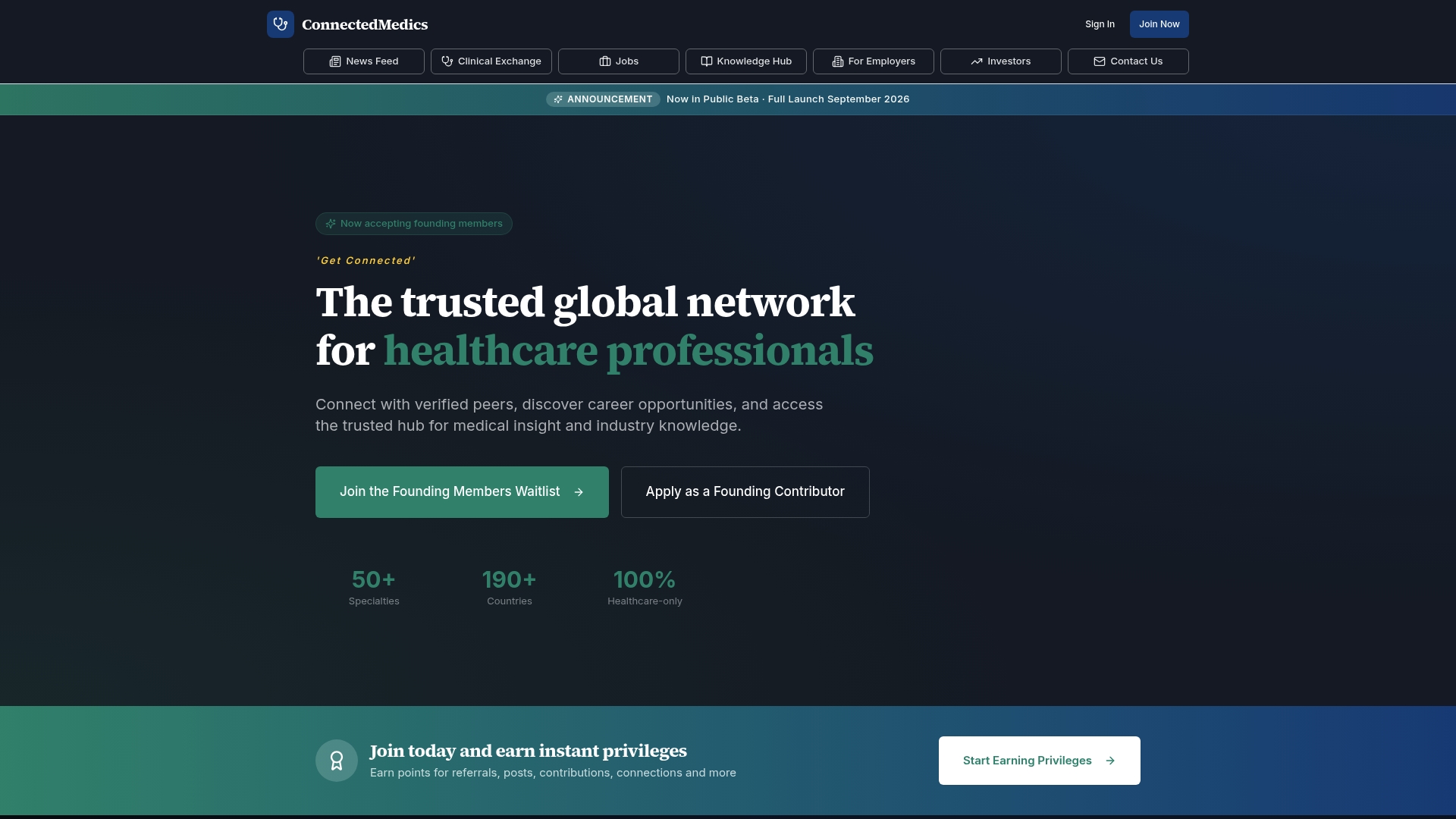
Start on the ConnectedMedics home page. The knowledge hub holds clinical guides and medical news. Administrators and recruiters can review the employer plans: Free, Growth at £99 per month, and Enterprise. A Premium Employer plan is also listed.
FAQ
What is considered a career path in healthcare?
It is the sequence of roles a person holds over time, such as a medical assistant rising through levels or a nurse moving into a graduate specialty. Paths can go up, sideways, across employers or into encore work. The CHC Workforce session lists five forms.
Where can a doctor take a medical career assessment?
The AAMC's Careers in Medicine program offers four medicine-specific self-assessments covering interests, values, skills and specialty indecision. Its four-phase process begins with self-assessment and moves to exploration, decision and preparation. Practicing physicians can repeat the same steps when considering a change.
How do I set a healthcare career goal?
Pick a role, then list the skills and credentials it needs and the date you want to reach it. AAFP suggests a mission statement, a CV goal statement and a mentor. Rank your priorities, such as setting, hours and pay, before looking at job listings.
How long should a career plan cover?
Twelve to 36 months works for most moves, depending on whether a degree is needed. ACP reports that 40% to 60% of new physicians change jobs within five years. Review the plan once a year.
Sources
- Building a Path: Investing in Career Development, CHC Workforce
- Jobs to Careers Practice Brief, JFF
- Careers in Medicine awareness, utilization and value, AAMC
- Four-phase career planning process, AAMC
- Council on Medical Education report, AMA
- How to Choose a Graduate Nursing Specialty, CU Anschutz
- Career planning and development workbook, ICN
- Pathway Workshop Workbook, APhA
- Planning a Career Strategy, ACP
- Developing Your Professional Career Plan, AAFP
- What's next? How senior physicians can plan a career transition, AMA
- Dietitian and nutritionist: the difference