
A physician curriculum vitae is defined as a comprehensive document, typically 10–20 pages, that records every credential, publication, and clinical role a doctor has held. It differs fundamentally from a physician resume, which runs 1–2 pages and focuses on outcomes for clinical job applications. Knowing which document to submit, and when, is one of the most consequential physician CV tips you can apply in 2026. Major health systems now screen applications through applicant tracking systems (ATS) like Workday and iCIMS before a human ever reads a single line. Getting the format, content, and length right from the start determines whether your application advances or disappears.
1. Physician CV tips: format your document for ATS and recruiters
The single most important formatting rule is to use a single-column, text-only layout. ATS systems at major health systems cannot parse tables, graphics, or multi-column designs, and they discard documents that contain them. That means a beautifully designed CV with a sidebar column may never reach a recruiter's desk.

Follow a predictable section order: contact information, medical education, training, licensure, board certification, and clinical experience. Recruiters and credentialing committees expect this structure. Deviating from it creates friction and slows review.
Name EHR platforms by their specific module. Write "Epic InPatient" or "Cerner Millennium," not just "EHR experience." Specific platform names match the exact keywords ATS filters look for when ranking candidates. Generic terms score lower or score nothing at all.
- Use reverse chronological order for all experience sections.
- Keep your full CV at 10–20 pages; your clinical resume at 1–2 pages.
- Use standard fonts: Times New Roman, Arial, or Calibri at 11–12 point.
- Avoid headers and footers, which ATS often strips out entirely.
- Remove photos, logos, and decorative lines.
Pro Tip: Save your CV as a .docx file unless the posting specifies PDF. Many ATS platforms parse Word documents more reliably than PDFs.
2. How to quantify clinical experience on your CV
Quantification is the single most effective way to separate your CV from the competition. Metrics like patient volume, wRVU generation, length-of-stay reductions, and infection rate improvements give recruiters concrete evidence of your clinical impact. Vague duty descriptions tell a recruiter nothing they cannot assume about any physician.
Replace generic language with specific numbers wherever possible. "Managed daily census of 15+ high-acuity patients" communicates far more than "responsible for inpatient care." Patient satisfaction scores and safety metrics work the same way. They show outcomes, not just activity.
- State your average daily patient census by acuity level.
- List wRVU totals or percentile rankings if available.
- Include length-of-stay reductions as a percentage or number of days.
- Cite infection rate improvements tied to protocols you led or implemented.
- Add patient satisfaction scores with the benchmark for context.
- Quantify any leadership roles: "Led a 12-physician hospitalist group" beats "leadership experience."
Quantification of clinical outcomes serves as a differentiator, enabling physicians to showcase unique impact beyond listed duties. Recruiters reviewing dozens of CVs will stop at a number and read the surrounding context.
Pro Tip: Use unit-level data rather than patient-specific data. Aggregate metrics demonstrate impact while keeping your document fully HIPAA-compliant.
3. Essential content sections every physician CV must include
Credential completeness is the price of admission in healthcare hiring. A missing board certification number or an unlisted DEA registration stalls credentialing immediately. Every section below must appear in your CV, fully populated with dates, institutions, and identification numbers.
- Contact information: Full legal name, phone, professional email, and LinkedIn or Connectedmedics profile URL.
- Medical education: MD or DO degree, institution, and graduation year.
- Residency and fellowship: Program name, institution, specialty, and completion dates.
- Licensure: State medical license numbers with expiration dates for every state where you hold a license.
- Board certification: Full certification name, acronym, certifying body, and expiration date. ATS systems do not map acronyms alone, so always write "Advanced Cardiac Life Support (ACLS)" rather than just "ACLS."
- Hospital privileges: List each facility and the privileges granted.
- CME credits: Format CME as annual totals over the past three years rather than listing individual activities. AMA PRA Category 1 credit carries the highest value and should be labeled clearly.
- Professional memberships and awards: Include the organization name and your membership start year.
- Publications and presentations: Required for academic CVs; optional for private practice applications.
Healthcare hiring is credential-dense. Completeness and specificity in every section directly determine whether your application passes the initial screen.
4. Common physician CV mistakes to avoid in 2026
Submitting the wrong document type is the most costly error a physician can make. Credentialing committees expect a full CV while hospital recruiters want a short, ATS-friendly resume. Sending a 15-page CV to a clinical job posting signals that you do not understand the hiring process.
Generic adjectives are the second most common problem. Phrases like "dedicated" or "passionate about medicine" appear on 90% of physician resumes and add no value to ATS scoring or recruiter judgment. Replace every adjective with a metric or a named credential.
"The physician who writes 'compassionate, team-oriented clinician' loses to the physician who writes 'Reduced 30-day readmission rate by 18% through a structured discharge protocol.' One is an opinion. The other is evidence."
Additional mistakes to eliminate before submitting any application:
- Omitting license numbers, board certification expiration dates, or DEA registration.
- Failing to mirror keywords from the job posting in your document.
- Including patient names, case details, or any individually identifiable health information, which creates HIPAA risk.
- Using tables, text boxes, or graphics that cause ATS parsing failures.
- Listing certifications by acronym only, which ATS systems cannot reliably match.
Review your document against the job posting line by line. Every required credential and skill listed in the posting should appear in your CV or resume using the same terminology.
5. When to use your full CV versus a targeted resume
Physicians need two documents, and they serve entirely different purposes. The full curriculum vitae goes to credentialing committees, academic medical centers, fellowship programs, and any role requiring a complete professional record. The targeted resume goes to clinical job postings at hospitals, group practices, and health systems where an ATS screens applications first.
| Situation | Use Full CV | Use Targeted Resume |
|---|---|---|
| Hospital credentialing | Yes | No |
| Academic faculty application | Yes | No |
| Clinical job posting (ATS) | No | Yes |
| Locum tenens agency | Yes | No |
| Private practice application | No | Yes |
| Fellowship program | Yes | No |
Early-career physicians typically have CVs of 4–6 pages, while experienced attendings may reach 10–20 pages or more. Neither document should be padded. Every entry must earn its place.
Maintain both documents in parallel. When you add a new publication, privilege, or certification, update the CV immediately. When you apply for a clinical role, pull the relevant sections into your resume and tailor the language to match the posting. Keep publication lists and certificate copies as separate addenda so neither document becomes unwieldy. A solid healthcare job search checklist can help you track which version to submit for each application type.
Pro Tip: Create a master CV that contains every credential, role, and publication. Build your targeted resume by copying and trimming from the master. Never edit the master itself for a specific application.
6. Age-neutral language and how it protects your application
Experienced physicians face a specific ATS risk that most medical resume advice overlooks. Systems trained on keyword density can inadvertently deprioritize candidates whose graduation dates reveal long tenure. The fix is straightforward: emphasize current competencies, not historical timelines.
Age-neutral resume strategies focus on current certifications, quality metrics, and technology proficiency rather than dates that signal tenure. List your most recent board recertification prominently. Lead with current EHR proficiency and recent quality improvement outcomes. Move graduation dates to the education section and do not repeat them elsewhere.
Unit-level data works particularly well here. Patient satisfaction percentile rankings, infection rate benchmarks, and wRVU productivity figures all demonstrate current clinical value without referencing how long you have practiced. This approach also keeps the document HIPAA-compliant because it uses aggregate data, not patient-specific records.
7. How to tailor your CV for specific physician job applications
A generic CV sent to every posting is a losing strategy. Tailoring means reading the job description carefully and mirroring its exact language in your document. If the posting says "outpatient internal medicine," your resume should use that phrase, not "ambulatory care" or "clinic-based practice."
Start with the required qualifications section of the posting. Every credential, certification, and skill listed there must appear in your document using the same terminology. Using a predictable, disciplined CV structure reduces administrative delays during credentialing review. Tailoring the language within that structure improves ATS ranking before a human ever reads the document.
For clinical applications, lead your resume with a two-to-three sentence professional summary that names your specialty, years of experience, and one quantified outcome. Follow with your most relevant clinical experience, then credentials. Recruiters spend seconds on an initial scan. The first third of your resume determines whether they read the rest. Reviewing medical job application tips alongside your CV draft helps you catch gaps before submission.
Key takeaways
A physician's best career document is a targeted, credential-complete CV that pairs specific clinical metrics with ATS-compliant formatting to pass automated screens and impress human reviewers.
| Point | Details |
|---|---|
| Maintain two documents | Keep a full CV for credentialing and a 1–2 page resume for clinical job applications. |
| Format for ATS first | Use single-column, text-only layouts and name EHR platforms by specific module. |
| Quantify every claim | Replace duty descriptions with patient volumes, wRVU figures, and quality metrics. |
| Complete all credentials | List license numbers, board certification expiration dates, and DEA registration without exception. |
| Tailor language to each posting | Mirror the exact terminology from the job description to improve ATS keyword matching. |
What I have learned about physician CVs after years of watching applications fail
The most common reason a strong physician's application stalls is not missing credentials. It is a formatting error that an ATS silently rejects before any human sees the document. A table-heavy CV, a multi-column layout, or a PDF that the system cannot parse will eliminate a fully qualified candidate without a single notification. That reality should change how every physician approaches document preparation.
The second lesson is harder to accept: most physicians underestimate how much their CV sounds like everyone else's. "Board-certified internist with a passion for patient-centered care" describes approximately half the applicants in any pool. The physicians who advance are the ones who write "Reduced 30-day readmission rate by 18% through a structured discharge protocol" or "Managed a daily census of 20 high-acuity patients with a 4.7/5.0 patient satisfaction score." Numbers create separation. Adjectives do not.
Maintaining two documents feels like extra work until you realize that sending the wrong one to the wrong audience costs you the opportunity entirely. A credentialing committee receiving a two-page resume will question your experience. A hospital recruiter receiving a 15-page CV will not read past page two. The discipline of keeping both documents current and knowing exactly when to use each one is what separates physicians who move through hiring processes quickly from those who stall.
The detail most physicians overlook is keyword mirroring. Read the job posting. Find the exact phrases used for required skills and certifications. Use those exact phrases in your document. ATS systems do not reward synonyms. They reward matches.
— David
Connectedmedics: a resource for physicians managing their job search
Physicians who want to go beyond document preparation need a network built specifically for healthcare careers.
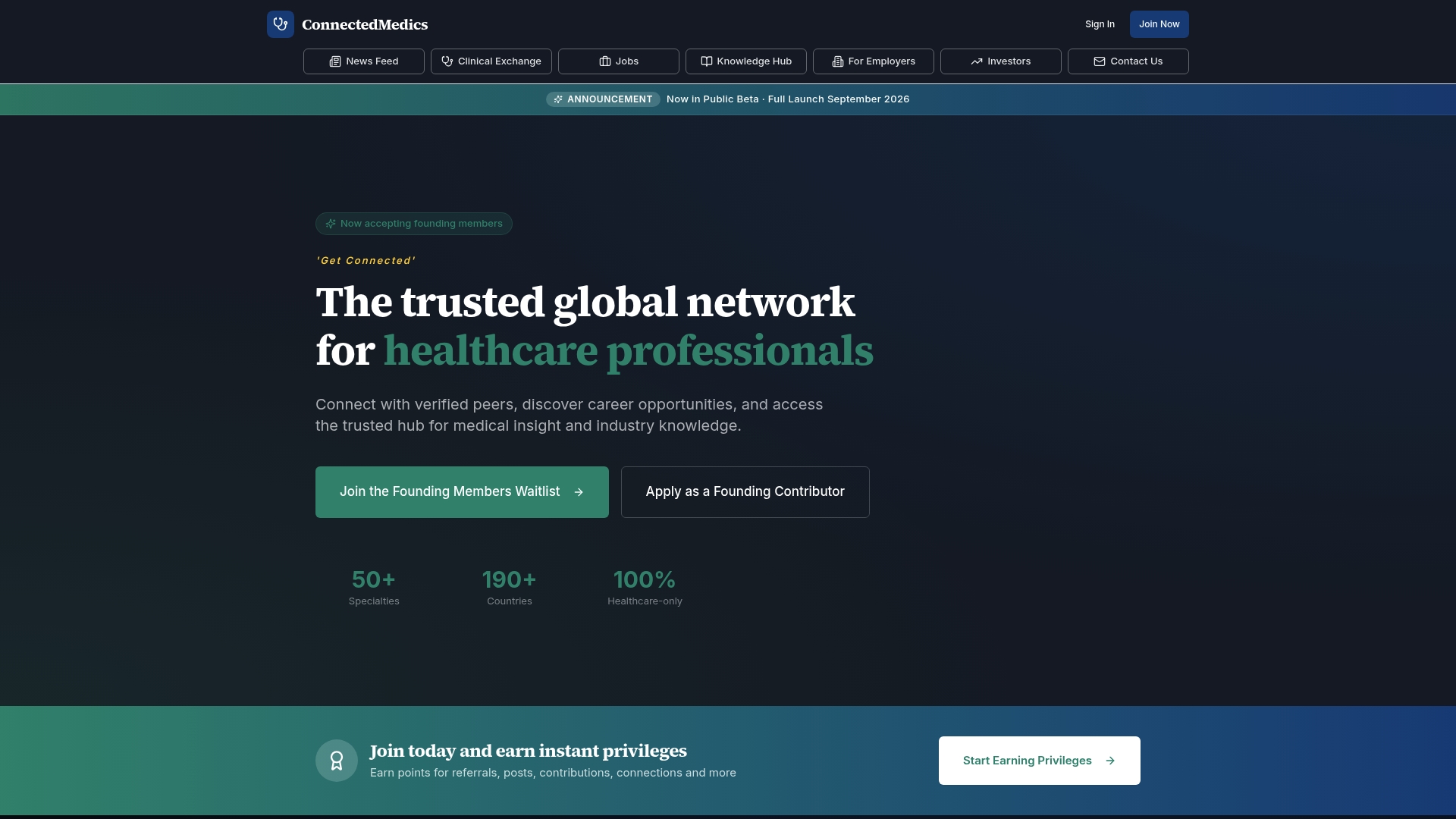
Connectedmedics is a verified professional network for healthcare professionals, with over 4,600 active healthcare vacancies listed on its global jobs board. The platform provides verified physician profiles that complement a strong CV by adding a credentialed digital presence that recruiters can confirm. Its knowledge hub covers clinical trends, career resources, and hiring guidance contributed by verified medical experts. Physicians can use Connectedmedics to find specialty-specific roles, build a verified profile, and access resources that support every stage of a physician job search.
FAQ
What is the difference between a physician CV and a resume?
A physician CV is a comprehensive 10–20 page document used for credentialing and academic applications. A physician resume is a 1–2 page, outcomes-focused document used for clinical job applications screened by ATS.
How long should a physician CV be?
Early-career physicians typically have CVs of 4–6 pages. Experienced attendings may have CVs of 10–20 pages or more. Clinical resumes should never exceed 2 pages.
What credentials must a physician CV always include?
A physician CV must include medical education with dates, residency and fellowship details, state license numbers with expiration dates, board certification with the certifying body, DEA registration, and hospital privileges.
How do I make my physician CV ATS-friendly?
Use a single-column, text-only format. Name EHR platforms by specific module, such as Epic InPatient or Cerner Millennium. List all certifications with both the full name and acronym to ensure ATS keyword matching.
Should I include CME credits on my physician CV?
List CME credits as annual totals over the past three years rather than individual activities. AMA PRA Category 1 credit is the highest-value category and should be labeled clearly in your CV.