
Healthcare jobs and careers are defined as the full spectrum of employment opportunities, advancement pathways, and professional roles within the medical industry, from entry-level clinical positions to senior research and administrative posts. The field is growing faster than most sectors, and competition for the best roles is intensifying. Professionals who understand current job market trends, apply strategically, and invest in continuous education consistently outperform those who rely on passive job searching. Connectedmedics currently lists over 4,600 active healthcare vacancies, making it one of the most concentrated sources of medical career opportunities available today.
What are current trends in healthcare jobs and career advancement?
The healthcare job market in 2026 is shaped by three forces: employer investment in education, evolving work mode policies, and a growing premium on diverse professional experience. Understanding these forces before you apply gives you a measurable advantage.
Employer-funded education is now standard at top organizations
Upfront tuition coverage is now offered by leading employers like Labcorp, allowing employees to earn healthcare certificates and undergraduate degrees online from accredited institutions without paying out of pocket first. This is a shift from the older reimbursement model, where professionals paid tuition and waited for repayment. The practical effect is that career development no longer requires personal financial risk. Professionals who target employers offering this benefit gain both a credential and a salary simultaneously.

Research roles carry specific performance benchmarks
Postdoctoral and research scientist positions at institutions like RIKEN set clear career advancement criteria tied to publications in top-tier conferences. Career growth in research is not measured by tenure alone. It is measured by output: papers published, conferences attended, and peer recognition earned. Professionals entering research tracks need to treat publication as a core job function, not an optional extra.
Diverse experience outperforms narrow specialization
Employers value candidates with diverse work experiences and active mentoring participation more than those with static, single-specialty skill sets. This insight from Marriott's career guidance applies directly to healthcare: a nurse who has rotated through emergency, oncology, and outpatient settings is a stronger candidate than one with ten years in a single ward. Breadth signals adaptability, which healthcare organizations increasingly prioritize.
Pro Tip: When updating your resume, list every department rotation, volunteer role, and mentoring activity you have held. Hiring managers in 2026 read breadth of experience as a proxy for resilience.
How to effectively search and apply for healthcare job vacancies
Finding the right role is a process, not a single event. The professionals who land the best positions follow a repeatable system for monitoring, applying, and following up.
-
Monitor application windows daily. Government and public sector healthcare roles typically open for only 14 days, with automated portal closures at the deadline. Missing a window by one day means waiting for the next cycle. Set calendar alerts the moment you identify a target role.
-
Join talent communities before you need a job. Platforms like MITRE and Labcorp operate dedicated talent networks that give members early access to openings before they are publicly posted. Joining these communities when you are not actively searching means you are already inside the pipeline when a role opens.
-
Add a tailored note to every application. Candidates who include a brief, specific note explaining their interest are nearly twice as likely to receive employer contact. The note does not need to be long. Two to three sentences connecting your background to the specific role is enough to separate your application from the bulk.
-
Use specialized job boards over general platforms. A medical job board filters out irrelevant postings and surfaces roles that match clinical credentials. General recruitment platforms like ZipRecruiter are useful for broad market awareness, but healthcare-specific boards deliver higher signal-to-noise ratios for medical professionals.
-
Set up job alerts for your specialty. A medical job alert delivers new postings directly to your inbox the moment they go live. This removes the need for daily manual searching and reduces the risk of missing short application windows.
Pro Tip: Treat your talent community memberships like professional subscriptions. Log in monthly, update your profile, and engage with posted content. Active profiles receive more recruiter outreach than dormant ones.
What certifications and education programs accelerate healthcare career growth?
Credentials remain the clearest signal of competence in healthcare hiring. The right combination of certifications and degree programs directly expands the range of roles you qualify for.
Core educational pathways
- Healthcare certificates: Short, focused programs covering clinical skills, coding, or administration. These are the fastest route to qualifying for entry-level and mid-level roles.
- Undergraduate degrees in life sciences: Biology, biochemistry, and public health degrees open doors to research, pharmaceutical, and hospital administration tracks.
- Employer-sponsored degree programs: Labcorp and similar organizations offer upfront tuition for employees pursuing degrees online, removing the financial barrier to advancement.
- Postdoctoral training: For research-focused professionals, postdoctoral positions at institutions like RIKEN provide structured mentoring and publication opportunities that build long-term career capital.
- Continuous professional development: Short courses, workshops, and specialty certifications keep credentials current and demonstrate ongoing commitment to the field.
Education pathway comparison
| Pathway | Time to complete | Best suited for | Employer funding available |
|---|---|---|---|
| Healthcare certificate | 6–12 months | Entry-level and career changers | Yes, at select employers |
| Undergraduate life sciences degree | 3–4 years | Research and clinical tracks | Yes, via tuition programs |
| Postdoctoral research position | 2–3 years | Academic and R&D roles | Salary-based, not tuition |
| Specialty certification (e.g., coding, imaging) | 3–6 months | Mid-career advancement | Varies by employer |
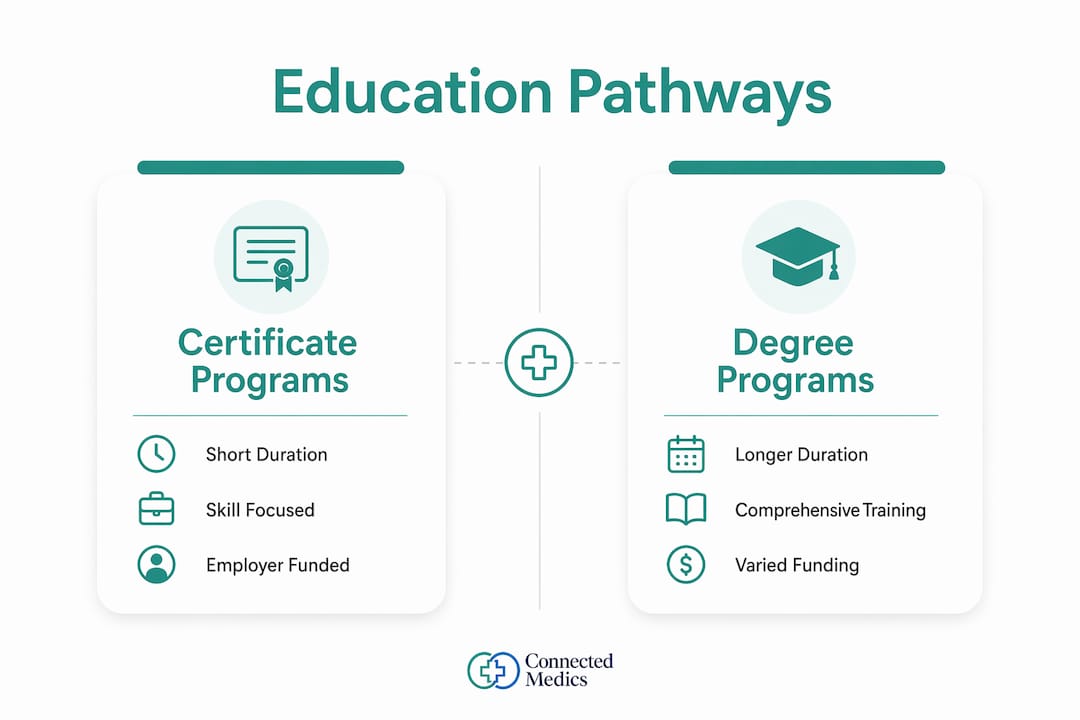
Professionals pursuing training opportunities should prioritize programs with recognized accreditation and clear links to job titles they are targeting. A credential that does not appear in job postings for your target role adds resume length but not hiring leverage.
How do work modes and location policies affect healthcare job eligibility?
Work mode requirements are now a primary filter in healthcare job searches. Getting this wrong wastes application effort and delays your search by weeks.
| Work mode | Definition | Common in healthcare |
|---|---|---|
| On-site | Full-time presence at employer location | Clinical, surgical, and lab roles |
| Hybrid | Split between on-site and remote | Administrative and coordination roles |
| Remote | Fully location-independent | Telehealth, coding, and data roles |
Employers like Southern California Edison publish explicit work mode and residency requirements alongside each posting. Many healthcare employers require candidates to be legal residents of a specific state or region before they can be hired, regardless of the role's remote status. This requirement is legal and common. Applying without meeting the residency condition results in automatic disqualification.
The practical step is to read the full job description before spending time on an application. Check three things: the work mode, the residency requirement, and whether relocation support is offered. Professionals who understand work mode policies before applying avoid wasted effort and target only roles they are genuinely eligible for.
Pro Tip: If a role lists "hybrid" without specifying the on-site frequency, contact the recruiter before applying. Some hybrid roles require four days on-site per week. Others require one. The difference matters for your decision.
Key takeaways
Healthcare professionals who apply proactively, join talent communities early, and pursue employer-funded education consistently secure better roles faster than those who rely on reactive job searching alone.
| Point | Details |
|---|---|
| Monitor application windows | Public sector roles close in as few as 14 days; set daily alerts for target positions. |
| Join talent communities early | Networks like MITRE provide early access to openings before public posting. |
| Add a tailored note to applications | A brief, specific note nearly doubles the likelihood of employer contact. |
| Target employer-funded education | Programs like Labcorp's tuition coverage build credentials without personal financial risk. |
| Verify work mode and residency | Check location requirements before applying to avoid automatic disqualification. |
What I have learned about healthcare career growth after years in this field
The single biggest mistake I see healthcare professionals make is treating job searching as a reactive activity. They update their resume only when they are unhappy, apply only when a role appears, and join talent networks only after they have already been passed over. By then, the best positions are already filled.
The professionals who advance fastest do the opposite. They join talent communities months before they need a job. They keep their credentials current even when their current role feels stable. They apply to roles with a tailored note every single time, not just when they feel particularly motivated. These habits are not complicated. They are just consistent.
The education piece surprises most people I speak with. Upfront tuition programs at employers like Labcorp have fundamentally changed the calculus of career investment. You no longer need to choose between paying for a degree and paying your rent. The employer pays first. That changes who can access advanced credentials, and it changes how quickly a motivated professional can move up.
My honest advice: treat your career like a portfolio, not a ladder. Add diverse experiences deliberately. Rotate through specialties when you can. Mentor others, because the act of teaching forces you to articulate what you know. And check your target employers' work mode policies before you fall in love with a role you cannot actually take.
— David
Connectedmedics: a dedicated network for healthcare career growth
Connectedmedics is built specifically for healthcare professionals who want more than a generic job board.
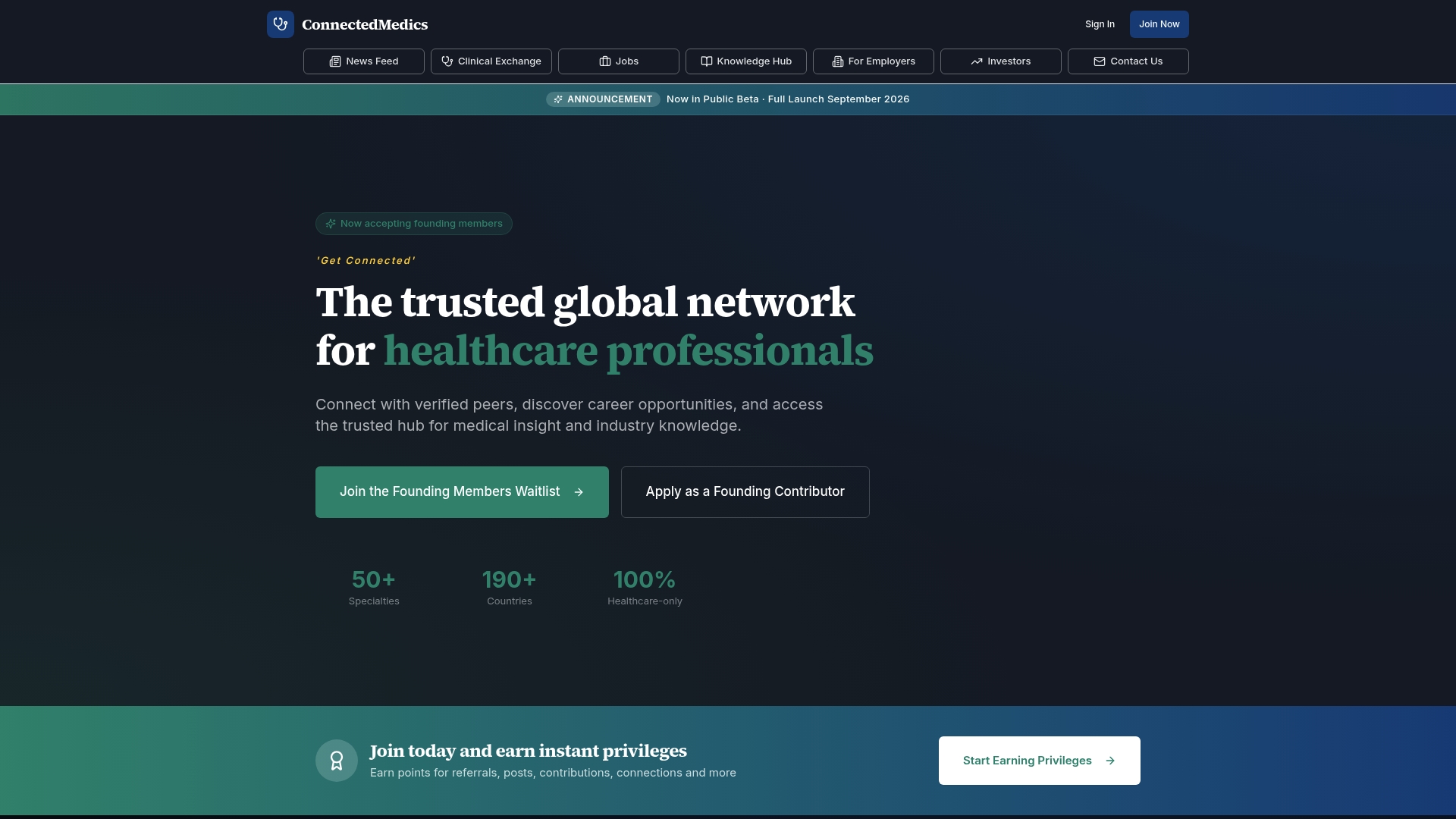
The platform hosts over 4,600 active healthcare vacancies, all verified and categorized by specialty, work mode, and location. Profiles on Connectedmedics are verified, which means recruiters searching the network are looking at real credentials, not unverified claims. Beyond job listings, the platform provides a knowledge hub with clinical insights and research summaries contributed by verified medical experts. For professionals serious about career advancement in healthcare, Connectedmedics offers the combination of job access, peer networking, and industry knowledge that generic platforms cannot replicate. Join the network and connect with the roles and professionals that match your specialty.
FAQ
What is the typical application window for public healthcare jobs?
Public sector healthcare roles typically remain open for 14 days, with automated portal closures at the deadline. Missing the window requires waiting for the next posting cycle.
How do talent communities improve healthcare job search outcomes?
Talent communities provide early access to job openings before they are publicly posted, giving members a head start over candidates who apply through standard job boards.
Does adding a note to a job application actually help?
Yes. Candidates who include a brief, tailored note explaining their specific interest are nearly twice as likely to receive employer contact, according to ZipRecruiter hiring data.
What work modes are common in healthcare roles?
Healthcare roles span on-site, hybrid, and remote work modes. Clinical and lab positions are almost always on-site, while telehealth, coding, and administrative coordination roles are more likely to offer hybrid or remote options.
How can healthcare professionals fund further education without paying upfront?
Employers like Labcorp offer upfront tuition coverage programs that pay for certificates and degrees before the employee completes the program, removing the need for personal financial outlay.