
A medical job board is a specialized platform focused exclusively on healthcare roles, providing targeted job listings, filters for clinical credentials, and hiring tools designed for healthcare professionals. General recruitment platforms like Indeed and LinkedIn cover every industry, which means healthcare roles compete for visibility alongside retail, finance, and tech positions. The difference is not cosmetic. For physicians, nurses, and allied health professionals, choosing the wrong platform type directly affects how fast you find a role, how well it fits your clinical background, and what salary you can expect.
How do medical job boards compare to general recruitment platforms?
The performance gap between specialized and general platforms is measurable. Specialized healthcare job boards yield a qualified candidate rate of 60 to 80 percent, compared to just 20 to 30 percent on general sites. That gap reflects the fundamental difference in audience: a medical job board attracts candidates who already hold nursing licenses, board certifications, or clinical degrees, while a general site attracts anyone who searched "healthcare jobs."
Time-to-hire follows the same pattern. Specialized boards reduce average time-to-hire to 25 to 30 days, while general platforms average 41 days. For a hospital filling a critical care vacancy or a physician finishing a residency with a hard start date, that 10 to 16 day difference is significant. Faster hiring cycles also reduce the risk of a candidate accepting a competing offer during a prolonged process.

Salary expectations differ too. Employers posting on specialized medical job sites offer 15 to 25 percent higher salaries than those posting on general platforms. This reflects the caliber of candidates those employers expect to attract and the competitive nature of healthcare talent acquisition in 2026.
| Metric | Medical job boards | General platforms |
|---|---|---|
| Qualified candidate rate | 60 to 80% | 20 to 30% |
| Average time-to-hire | 25 to 30 days | 41 days |
| Salary premium | 15 to 25% higher | Baseline |
| Credential filtering | License, certification, EMR | Limited or none |
Pro Tip: Set up job alerts on a specialized board like ConnectedMedics before you actively start applying. You will build a clear picture of market demand and salary ranges in your specialty before you commit to any application.
What are the cost differences between platform types?
Pricing models vary significantly between platform types, and understanding them helps you evaluate where to invest your time as a job seeker and where employers are investing their budgets. General job boards charge $100 to $500 per job post, while specialized healthcare boards typically charge $300 to $1,200 or require annual subscription fees. Higher posting costs on niche platforms signal that employers are serious about filling the role with a qualified candidate rather than generating volume.
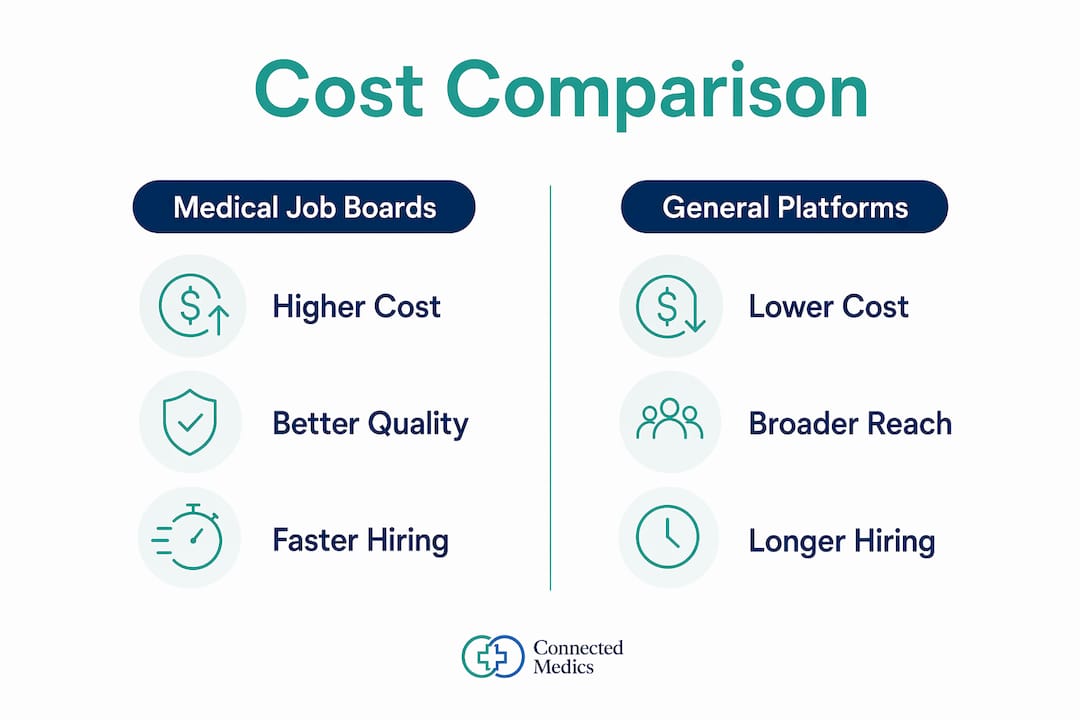
For job seekers, this pricing dynamic has a practical implication. Employers who pay a premium to post on a medical job board are not fishing with a wide net. They have defined the role carefully, specified the required credentials, and targeted a specific clinical audience. That specificity benefits you directly: the listings you find on specialized platforms are more likely to match your actual qualifications and career goals.
The trade-off between reach and relevance is real. General platforms offer broader exposure, which can be useful for exploring roles in adjacent specialties or geographic markets you had not considered. Specialized boards offer depth, precision, and a higher probability that the employer on the other end is genuinely qualified to evaluate your clinical background.
- General platforms: lower cost per post, high application volume, weaker credential filtering
- Specialized boards: higher cost per post, lower application volume, stronger clinical alignment
- Subscription models on niche boards often include employer branding tools and candidate database access
- For job seekers, free access to specialized boards is common, making the cost asymmetry entirely the employer's concern
How do networking and referrals fit into healthcare job searching?
Job boards generate applications, but they do not generate most hires. Job boards and social media account for 49 percent of job applications but only 24.6 percent of actual hires. Direct networking and referrals convert at a far higher rate. This is not a reason to abandon job boards. It is a reason to use them as one component of a broader strategy rather than the entire strategy.
Referral-augmented applications produce conversion rates of 15 to 30 percent, compared to single-digit rates for cold applications through general platforms. In practice, this means that finding a role through a specialized board and then connecting with someone at that organization before applying meaningfully increases your odds. Platforms that combine job listings with professional networking, like ConnectedMedics, are built precisely for this workflow.
Passive candidate engagement is also a defining feature of healthcare recruitment. Experienced bedside RNs receive recruiter outreach every 7 to 10 days, even when they are not actively searching. This frequency reflects how competitive the healthcare talent market is in 2026. Being visible on a specialized platform, even passively, puts you in front of recruiters who are actively building pipelines rather than waiting for applications.
Pro Tip: When you receive recruiter outreach, respond even if you are not actively looking. A brief, professional reply keeps the relationship open and gives you market intelligence on compensation and demand in your specialty.
What strategies maximize success across both platform types?
The most effective approach to healthcare job searching in 2026 combines platform focus with proactive engagement. Healthcare recruitment experts recommend using no more than 2 to 3 primary platforms, including 1 to 2 niche boards for best conversion. Spreading applications across 10 platforms produces more noise than results. Focused use of a small number of well-chosen platforms produces better outcomes.
A practical framework for platform selection looks like this:
- Choose 1 to 2 specialized medical job boards that cover your specialty and geography. ConnectedMedics, for example, lists over 4,600 active healthcare vacancies with filters for specialty, location, and role type.
- Add 1 general platform, such as Indeed or LinkedIn, primarily for market research and visibility rather than mass applications.
- Set up targeted job alerts on each platform using specific filters: specialty, location, role type, and employment model.
- Prioritize listings that specify clinical unit, patient population, and EMR systems. Listings with this detail signal better clinical and cultural alignment and are worth more of your time.
- For roles you are seriously considering, check whether the organization offers contract-to-hire or locum-to-perm arrangements. Contract-to-hire roles allow you to assess the clinical environment and leadership before committing long-term.
General platforms remain useful for one specific purpose: exploring roles in specialties or markets you have not previously considered. A physician exploring a shift from hospital medicine to urgent care, for example, might use a general platform to map the breadth of available roles before narrowing down on a specialized board. The healthcare job search checklist approach works well here: use general platforms to define scope, then use specialized boards to execute.
Understanding how to apply for vacancies efficiently matters as much as where you apply. A targeted application with a tailored cover letter submitted through a specialized board outperforms five generic applications submitted through a general platform. Volume is not a strategy in healthcare hiring. Precision is.
Key takeaways
Specialized medical job boards outperform general recruitment platforms on every metric that matters for healthcare professionals: candidate quality, time-to-hire, salary levels, and credential alignment.
| Point | Details |
|---|---|
| Candidate quality gap | Specialized boards yield 60 to 80% qualified candidates vs. 20 to 30% on general platforms. |
| Faster hiring timelines | Medical job boards average 25 to 30 days to hire vs. 41 days on general sites. |
| Salary advantage | Employers on specialized boards offer 15 to 25% higher salaries than on general platforms. |
| Referrals outperform boards | Referral-augmented applications convert at 15 to 30%, far above cold job board applications. |
| Platform focus wins | Limiting searches to 2 to 3 platforms, including 1 to 2 niche boards, produces the best conversion rates. |
Why the "post and wait" approach no longer works in healthcare hiring
The conventional wisdom that posting a resume on a job board and waiting for responses is a complete job search strategy is outdated. Top-tier healthcare recruitment in 2026 focuses on quality of hire and retention, not just speed-to-fill. Employers are building talent pipelines months before roles open, which means the candidates who get the best offers are often the ones who were already visible and engaged before the job was posted.
What I have observed consistently is that the healthcare professionals who land the most competitive roles treat job boards as a starting point, not a destination. They use specialized platforms to identify organizations worth pursuing, then build relationships with people inside those organizations before applying. The application itself becomes a formality rather than a cold introduction.
General platforms have a role in this process, but it is a supporting one. LinkedIn remains useful for professional visibility and for researching hiring managers and department heads before outreach. Indeed is useful for understanding market-wide demand and compensation benchmarks. Neither replaces the targeted, credential-aware environment that a specialized medical job board provides.
The best healthcare job seekers build pipelines and trusted relationships long before positions open. That shift in mindset, from reactive applicant to proactive professional, is the single biggest differentiator between candidates who wait months for offers and those who field multiple options simultaneously.
— David
Find your next role on ConnectedMedics
ConnectedMedics is built specifically for healthcare professionals who want more than a list of job postings. The platform combines over 4,600 active healthcare vacancies with verified employer profiles, specialty-specific filters, and a professional network of credentialed medical experts.
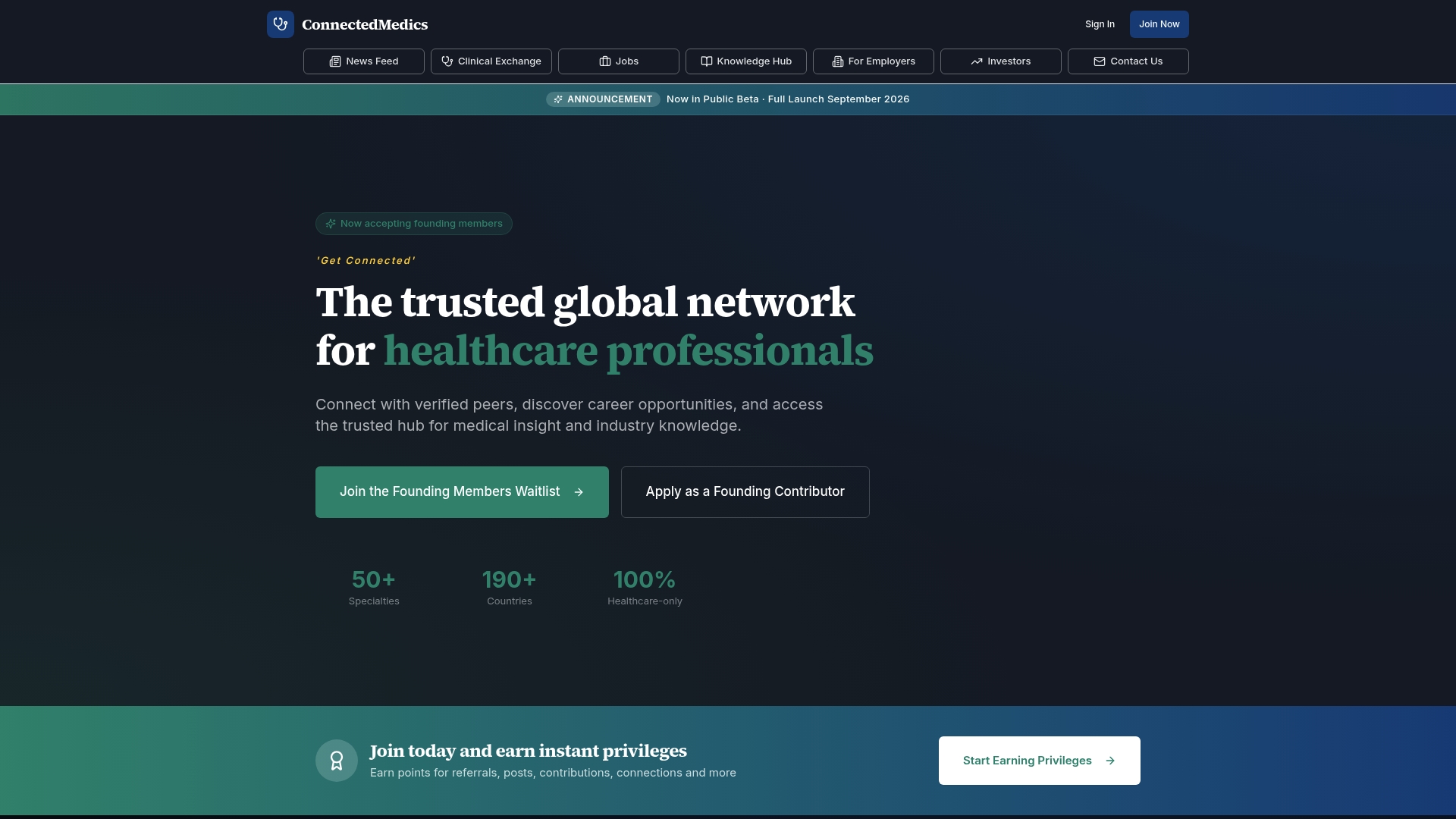
Whether you are actively searching or building your pipeline for future opportunities, ConnectedMedics gives you the tools to search with precision. The Knowledge Hub adds clinical guides and industry news contributed by verified professionals, making it a resource for career development beyond the job search itself. For recruiters seeking verified healthcare talent, the recruiter platform connects employers directly with qualified candidates. Start your search at ConnectedMedics and access the healthcare-specific network your job search actually needs.
FAQ
What is the main difference between a medical job board and a general job board?
A medical job board lists exclusively healthcare roles and filters candidates by clinical credentials, licenses, and certifications. General job boards like Indeed cover all industries and lack the specialty-specific filters that healthcare hiring requires.
Are specialized healthcare job boards worth the higher cost for employers?
Specialized boards justify their higher posting costs of $300 to $1,200 through significantly better candidate quality, with qualified candidate rates of 60 to 80 percent compared to 20 to 30 percent on general platforms.
How many job boards should a healthcare professional use at once?
Healthcare recruitment experts recommend using no more than 2 to 3 primary platforms, including 1 to 2 niche boards. Limiting platform use improves focus and produces higher application conversion rates than spreading applications across many sites.
Do referrals matter more than job board applications in healthcare?
Referral-augmented applications convert at 15 to 30 percent, far above the rates for cold job board applications. Job boards account for 49 percent of applications but only 24.6 percent of actual hires, making networking a critical complement to any board-based search.
What should healthcare professionals look for in a job listing to assess fit?
Listings that specify clinical unit, patient population, EMR systems, and required certifications signal stronger clinical and cultural alignment. These details allow candidates to assess fit beyond job title alone and prioritize applications accordingly.