
Finding a healthcare job through a general job board often means sifting through hundreds of irrelevant postings before finding a single role that matches your credentials. A healthcare jobs board solves that problem directly. These are specialized online platforms built exclusively to connect healthcare employers with qualified clinical and non-clinical candidates, using filters and workflows designed around the realities of regulated healthcare hiring. This guide covers what these platforms are, how they work, and how to use them effectively.
Table of Contents
- Key takeaways
- What is a healthcare jobs board
- Core features of healthcare jobs boards
- Healthcare boards vs. general job boards
- Beyond listings: resources and AI search
- How to use a healthcare jobs board effectively
- My take on healthcare job boards
- Find your next role with Connectedmedics
- FAQ
Key takeaways
| Point | Details |
|---|---|
| Specialized focus | Healthcare jobs boards filter listings by specialty, license, and credentials — not just job title. |
| Reduced search noise | Specialized platforms remove irrelevant results, connecting you directly with roles that fit your qualifications. |
| ATS integration | Most healthcare boards link directly to employer application systems, so your profile feeds into hiring workflows. |
| AI-powered search | Some platforms use natural language search to match your intent with the right roles faster. |
| Profile alignment matters | Aligning your resume and credentials with job descriptions improves your chances of clearing automated screening. |
What is a healthcare jobs board
A healthcare jobs board is an online platform where employers post job openings specifically for clinical and healthcare-adjacent roles, and where healthcare professionals search those listings by specialty, location, and credential requirements. This is the core definition. But the actual experience goes far beyond a simple list of open positions.
Unlike a general job board, a healthcare jobs board is built around the specific hiring logic of the healthcare sector. That means filters for medical specialty, license type, years of clinical experience, and geographic scope. It means job descriptions that speak the right language, whether you are a registered nurse, a radiologic technologist, a physician assistant, or a healthcare administrator.
The distinction matters because healthcare hiring is not like hiring for most other industries. Roles have strict eligibility requirements tied to licensure and credentialing. A general board has no way to surface only the jobs you are actually qualified for. A healthcare-specific board is built to do exactly that.
Platforms built for this purpose serve both sides of the hiring equation. Employers get access to a pool of candidates who have already self-selected by entering a healthcare-focused space. Job seekers get listings that are relevant by default, not by accident.

Core features of healthcare jobs boards
The features that define a strong healthcare jobs board go well beyond a search bar and a list of postings. Here is what to expect from a platform built specifically for healthcare roles.
-
Specialty and credential filters. The most useful feature on any healthcare jobs board is the ability to filter by clinical specialty, license type, and credential. This maps directly to role eligibility requirements, which is why credential and license filters must align with specific regulatory requirements to produce accurate results.
-
Clinical and non-clinical listings. A complete platform covers both patient-facing clinical roles and administrative, operational, and support roles. This makes it useful for the full breadth of healthcare employment.
-
Resume and profile submission. Most platforms allow you to build a profile and upload a resume. Healthcare job boards connect with employer application systems requiring resume submission, which means your profile feeds directly into ATS workflows on the employer side.
-
Job alerts. You can set up alerts by keyword, specialty, location, or employer so new listings reach you without requiring daily manual searches. This is one of the most underused features on any healthcare employment website.
-
Recruiter access. Many platforms give healthcare recruiters the ability to search candidate profiles directly. This means that a strong, complete profile does not just help when you apply. It puts you in front of recruiters who may contact you first.
-
Employer branding tools. Hospitals, health systems, and staffing agencies can present themselves to job seekers through dedicated employer profiles, which helps you evaluate organizations before applying.
Pro Tip: Set up at least two job alerts with different search parameters. One alert for your primary specialty and location. A second, broader alert that includes adjacent roles or a wider geographic area. This gives you both precision and range without extra effort.
Healthcare boards vs. general job boards
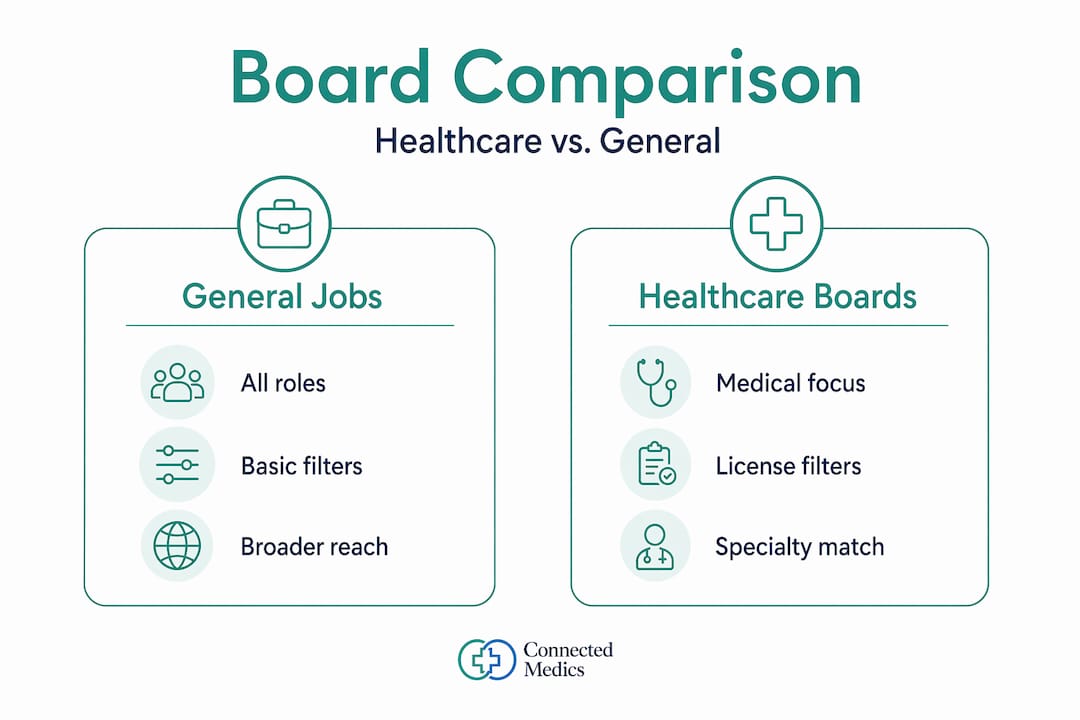
The practical difference between a healthcare-specific platform and a general job board is most visible when you search for a regulated clinical role. On a general board, a search for "nurse practitioner" returns travel nurse ads, nurse aide listings, hospital administrator roles, and unrelated results that happen to include similar words. On a specialized platform, that same search returns only the roles that match the professional scope.
| Feature | General job board | Healthcare jobs board |
|---|---|---|
| Role specificity | All industries | Healthcare roles only |
| Credential filters | Rarely available | Standard feature |
| License verification support | Not available | Built into workflows |
| Recruiter specialization | General recruiters | Healthcare-focused recruiters |
| Candidate pool relevance | Mixed | Healthcare professionals only |
| Compliance with hiring regulations | Limited | Supported by design |
Specialized healthcare boards reduce search noise and better meet the regulated, skills-specific recruitment needs of healthcare organizations. That is not a minor advantage. For a nurse practitioner or a physical therapist applying for a position that requires specific state licensure, a platform that cannot filter by those criteria wastes time for everyone involved.
From the employer side, healthcare boards attract candidates with specific clinical or administrative skills efficiently, reducing the volume of unqualified applications. Less screening time means faster hiring, and faster hiring is a real operational concern for health systems dealing with staffing shortages.
Some platforms specialize even further, focusing on specific professions. Free-access boards for physician and advanced practice registered nurse roles exist, where both employers and job seekers can use the platform at no cost. This makes niche specialization accessible even for smaller healthcare organizations or rural facilities.
Pro Tip: Before creating a profile on any healthcare employment website, check whether the platform specializes in your profession or remains broad. A platform focused on nursing roles may have deeper recruiter networks for nurses than one that covers all healthcare. Matching the platform to your specialty improves your visibility.
Beyond listings: resources and AI search
The best healthcare jobs boards function as career hubs, not just listing aggregators. This distinction matters when you are actively managing a career, not just passively waiting for the right posting to appear.
Several key features go beyond the standard job listing model:
-
Career advice and industry news. Platforms that publish content relevant to healthcare professionals help you stay informed about hiring trends, salary benchmarks, and specialty-specific career paths.
-
AI-powered natural language search. Generative AI search allows candidates to find relevant roles faster using descriptive queries rather than exact keyword matching. Instead of searching "RN pediatrics ICU," you might describe the type of role you want and receive matches based on intent. This reduces friction significantly for searches that do not fit neatly into standard filters.
-
Daily and weekly listing updates. The best platforms refresh their listings frequently so you are not comparing against stale postings. Some boards update roles daily, ensuring that the most current opportunities are always visible.
-
Networking and community features. Virtual career fairs, specialty-specific forums, and direct messaging with recruiters extend the function of a jobs board into something closer to a professional network. This matters especially for healthcare professionals in narrow specialties where personal connections carry significant weight in hiring decisions.
-
Educational resources. Some platforms connect users with continuing education, certification programs, or specialty training content. The Institute for Functional Nurses is one example of a career-adjacent resource for healthcare professionals looking to expand their clinical scope beyond a standard job search.
These features collectively change how a healthcare jobs board functions in your career. A platform that only lists jobs asks you to visit when you need something. A platform that provides ongoing value gives you a reason to stay engaged, which keeps your profile active and visible.
How to use a healthcare jobs board effectively
Knowing what a healthcare jobs board offers is one thing. Using it well is another. These steps apply whether you are just starting out or are a seasoned clinician exploring new opportunities.
-
Build a complete profile. Fill out every field. Specialty, license, certifications, years of experience, preferred locations. A partial profile does not surface in recruiter searches the same way a complete one does.
-
Use credential and specialty filters from the start. Searching by license type or clinical specialty produces far better results than searching by job title alone. Specialty and credential filters map directly to role eligibility requirements, which improves both fit and compliance.
-
Align your resume to the job description. Resume alignment improves your odds of advancing through ATS-mediated healthcare hiring workflows. Mirror the language in the posting. If a job description mentions "BLS certification" or "Epic experience," those exact terms should appear in your resume if they apply to you.
-
Set up job alerts immediately. Do not rely on memory to check the platform. Alerts deliver new listings to your inbox on a schedule you control, so you see relevant opportunities as soon as they are posted.
-
Engage with recruiters directly. When a recruiter reaches out, respond promptly. When you apply to a role, follow up through any messaging feature the platform provides. Recruiters on healthcare-specific platforms are often handling multiple open roles and respond well to candidates who show consistent interest.
-
Keep your profile updated. An outdated profile signals inactivity to recruiters. After completing a certification, accepting a new role, or adding a skill, update your profile within a week.
Pro Tip: When applying through a healthcare jobs board that feeds into an employer's ATS, treat your profile as a living document. The keywords and credentials you include are what the automated system scans before a human reviewer ever sees your application.
My take on healthcare job boards
In my experience, the single biggest mistake healthcare professionals make with job boards is treating them as passive tools. You upload a resume, check back occasionally, and wait. That approach ignores most of what these platforms actually offer.
What I've found is that the professionals who move fastest through healthcare job searches are the ones who use every feature available: alerts, recruiter messaging, profile optimization, and community engagement. They treat the platform like a professional environment, not a bulletin board.
I've also seen how AI-driven search is changing the dynamic. The ability to describe what you want in plain language and receive accurate results is a genuine shift from keyword-only searching. It benefits professionals in niche specialties most. If you are a wound care nurse or a pediatric physiatrist, natural language search finds roles that keyword matching misses entirely.
My honest view is that general job boards are not the right tool for regulated healthcare roles. The fit between what a clinical professional needs and what a healthcare-specific platform provides is too different to ignore. Using a general board for a licensed clinical role is like using a general medical reference when you need specialty-specific clinical guidance. It gets you part of the way there, and then it stops.
Healthcare job boards will keep evolving. The platforms that add verified credentialing, specialty-specific networking, and AI-powered matching are the ones worth your time. The ones that just list jobs without supporting your broader career trajectory are worth less of it.
— David
Find your next role with Connectedmedics
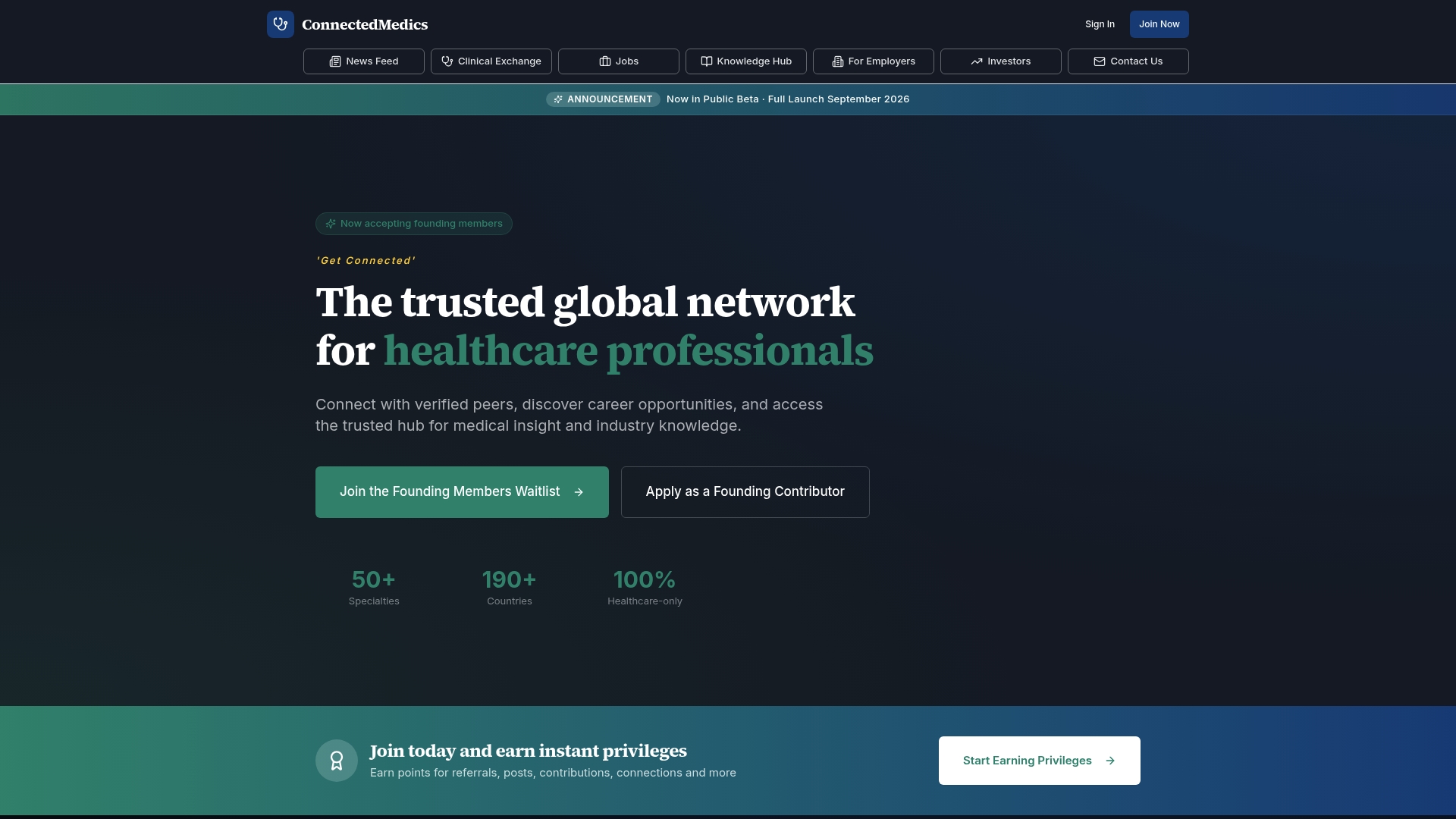
Connectedmedics is built specifically for healthcare professionals who need more than a generic job listing. The platform combines a global healthcare jobs board with verified professional profiles, giving you access to over 4,600 active healthcare vacancies across clinical and non-clinical specialties. Every listing is healthcare-specific. Every recruiter connection is within your industry.
Beyond job listings, Connectedmedics includes a knowledge hub with clinical insights and research summaries, plus a professional marketplace where healthcare professionals connect within their specialties. Recruiters on the platform are specifically looking for verified healthcare candidates, which means your profile reaches the right people. If you are ready to move beyond general boards, Connectedmedics gives you the tools for healthcare recruiters and job seekers in one place.
FAQ
What is a healthcare jobs board used for?
A healthcare jobs board connects healthcare employers with qualified clinical and non-clinical candidates through specialty-specific listings and credential filters. Job seekers use it to find relevant roles faster, and employers use it to attract qualified applicants.
How do healthcare jobs boards differ from general job boards?
Healthcare jobs boards include credential filters, license requirements, and specialty-specific search tools that general boards do not offer. They also connect directly to employer ATS workflows, making the application process more structured for regulated roles.
Are healthcare job boards free to use?
Many healthcare job boards offer free access to job seekers, and some also provide free employer posting in certain programs. Costs vary by platform, with premium features typically available for recruiters or organizations needing advanced search tools.
How do you find healthcare jobs on these platforms?
Use credential and specialty filters rather than broad keyword search, build a complete profile, and set up job alerts. Aligning your resume with the specific language in job descriptions also improves your chances of advancing through automated screening systems.
What features should a healthcare jobs board include?
A strong healthcare jobs board includes specialty and license filters, resume and profile submission, job alerts, recruiter access, and integration with employer application systems. Platforms that add AI-powered search and career resources provide the most complete experience for job seekers.