
Many healthcare assistants want to advance their careers but struggle to identify training opportunities for healthcare assistants that are affordable, accessible, and actually recognized by employers. The gap between wanting to grow and knowing where to start is real. This guide breaks down the types of programs available, how to research options that fit your goals and schedule, what obstacles to watch for, and how to turn completed training into concrete career progress. Whether you are just starting out or looking to specialize, the path forward starts with knowing what is out there.
Table of Contents
- Key Takeaways
- How to identify training opportunities for healthcare assistants
- Researching programs that fit your goals
- Common barriers and how to handle them
- Turning training into career advancement
- My take on training as a career tool
- Find your next training opportunity with Connectedmedics
- FAQ
Key Takeaways
| Point | Details |
|---|---|
| Know your training types | Mandatory certifications and developmental programs serve different purposes; pursue both strategically. |
| Research before committing | Check accreditation, cost, schedule, and employer recognition before enrolling in any program. |
| Barriers are manageable | Funding support, flexible online formats, and employer sponsorship reduce the most common obstacles. |
| Document everything | Keeping records of certifications and soft skills training directly improves your promotion prospects. |
| Use your network | Platforms like Connectedmedics connect you to verified training resources and career opportunities in one place. |
How to identify training opportunities for healthcare assistants
The first step is understanding what kinds of programs exist. Not all training serves the same purpose, and mixing up mandatory compliance training with career development programs is a common mistake.
Mandatory vs. developmental training
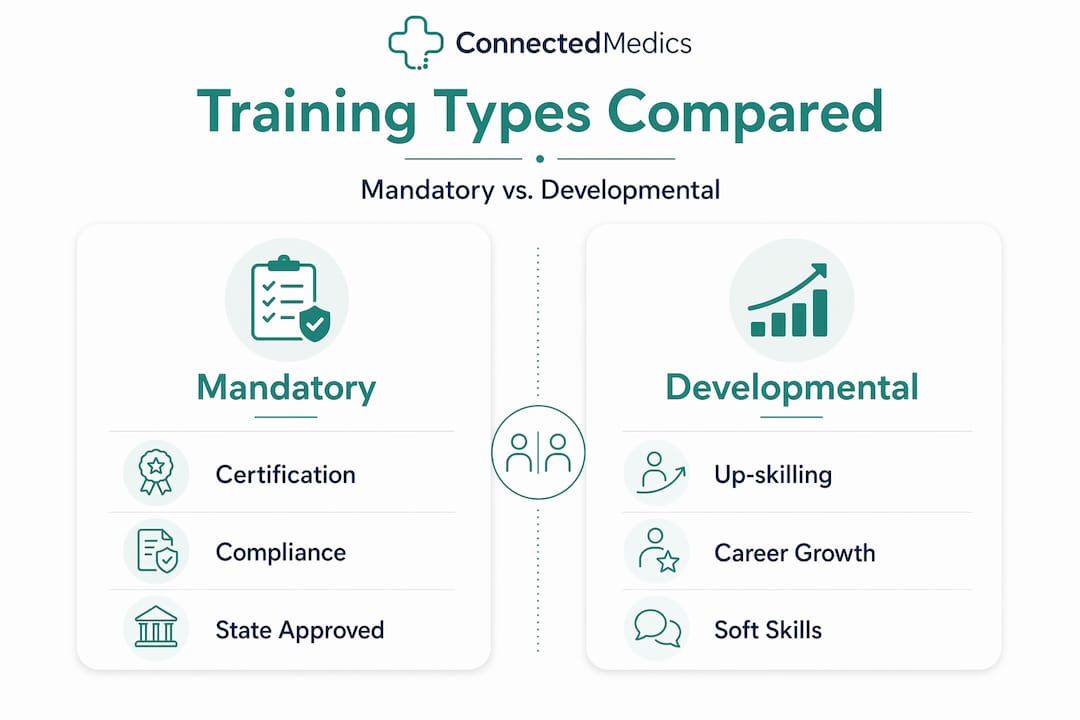
Mandatory training covers the baseline requirements for your role. In the U.S., this includes state-approved Certified Nursing Assistant (CNA) programs. CNA programs run 4 to 12 weeks, combining online coursework with hands-on clinical hours. SSM Health, for example, offers an accelerated format with 59 hours online and 32 hours of clinical training. Completing this gets you licensed. It does not get you promoted.
Developmental training is what separates candidates who stay in entry-level roles from those who move up. This includes specialty certifications, leadership skills programs, communication training, and courses in areas like dementia care or behavioral support. A West Yorkshire healthcare assistant program runs 8 focused sessions, while a Certified Clinical Medical Assistant (CCMA) program at CCNY requires 320 hours of preparation. The scope varies significantly depending on the credential and the setting.
Employer-sponsored and apprenticeship programs
Many healthcare employers offer paid training as part of hiring or retention packages. These programs cover tuition costs and sometimes include a salary during training. The trade-off is a work-back commitment. SSM Health, for instance, requires a 24-month service agreement after completing its sponsored CNA program. If you leave before that period ends, you may owe back the training costs. These deals are worth taking, but read the terms carefully before signing.
Online and hybrid formats
Online training for healthcare support roles has expanded significantly. Self-paced modules work well for care workers managing shift schedules or family responsibilities. Hybrid programs that combine online theory with in-person clinical hours offer a practical middle ground. Look for programs that are accredited and recognized in your state or region.

Soft skills training
This is the category most healthcare assistants overlook. Soft skills like empathy, communication, and de-escalation are trainable competencies, not personality traits. Employers increasingly value them for advanced roles and leadership positions. Training that uses reflection and experiential learning has been shown to measurably improve these skills. The Connectedmedics marketplace includes resources covering both technical and interpersonal competencies relevant to care roles.
Pro Tip: When evaluating any program, check whether it is accredited by a recognized body in your state or country. An unaccredited certificate may look good on paper but carry no weight with employers.
Researching programs that fit your goals
Once you know the types of training available, the next step is finding specific programs that match your career direction, location, and schedule. Here is a practical approach.
-
Define your target role. Before searching for programs, get specific about where you want to be in two to three years. Do you want to specialize in geriatric care, pediatrics, or surgical support? Each path has different certification requirements. Aligning your training with a defined goal prevents wasted time and money.
-
Check your employer first. Your HR or training department is the most underused resource in skills development for care workers. Many healthcare systems have internal education programs, tuition reimbursement, or partnerships with local colleges. Ask directly. Some employers will fund training you find externally if it aligns with your role.
-
Search accredited community colleges and vocational schools. These institutions offer affordable certification courses for assistants, often with evening or weekend scheduling. Look for programs that include clinical placement hours, since hands-on experience is required for most certifications.
-
Use professional associations. Organizations like the American Association of Medical Assistants (AAMA) or the National Healthcareer Association (NHA) maintain directories of accredited programs. These are reliable starting points for finding recognized credentials.
-
Evaluate each program on five criteria. Check accreditation status, total cost, schedule flexibility, employer recognition in your area, and any post-completion commitments. Training costs range from free in employer-sponsored programs to $2,000 or more for certification courses, and up to $15,000 for advanced nursing credentials. Know what you are committing to financially before you enroll.
-
Tap into healthcare networks. Platforms designed for healthcare professionals give you access to learning resources for healthcare staff, job postings, and peer connections that general job boards do not offer. Connectedmedics provides a knowledge hub with clinical guides and professional development content specifically for healthcare workers.
Pro Tip: Ask current or former students about their experience before enrolling. Program quality varies even among accredited providers, and peer feedback reveals things that marketing materials never will.
Common barriers and how to handle them
Knowing where to find training is one thing. Getting through it is another. These are the most common obstacles healthcare assistants face, along with practical ways to address each one.
-
Cost. Even modest program fees can be a barrier on a care worker's salary. Start by asking your employer about tuition assistance. Many states also offer workforce development grants for healthcare training. Federal programs like the Workforce Innovation and Opportunity Act (WIOA) fund training for eligible workers. Do not assume you have to pay out of pocket.
-
Time. Balancing shifts, family, and study is genuinely hard. Online and self-paced formats help, but they still require consistent effort. Build a weekly study schedule and treat it like a shift. Even 30 to 45 minutes of focused study per day adds up over a 10-week program.
-
Work-back agreements. Employer-sponsored training often comes with return-to-service contracts that require you to stay for a set period after completing the program. These are standard practice. Read the repayment terms before signing, and factor the commitment into your career planning.
-
Unrecognized programs. The online training space includes programs that look credible but are not recognized by employers or licensing boards. Billing and reimbursement complexities can also limit training availability in some care settings. Verify accreditation independently through your state's nursing or healthcare licensing board before paying for any course.
-
Motivation gaps. Long programs are hard to finish without a clear sense of progress. Break your goal into smaller milestones. Track completed modules, clinical hours, and new skills. Sharing your progress with a colleague or mentor keeps you accountable.
"The biggest risk is not starting because the path looks complicated. Pick one program, one goal, and move forward. Complexity shrinks when you are actually in motion."
Turning training into career advancement
Completing a program is not the finish line. How you use that training determines whether it actually moves your career forward.
-
Document every credential. Keep digital and physical copies of all certificates, transcripts, and completion letters. Documentation of additional certifications is as important as attaining them. Developmental training differentiates candidates for promotion beyond mandatory compliance requirements. A well-organized professional portfolio makes this easy to present to hiring managers.
-
Add soft skills to your profile. Do not list only clinical certifications. Communication, empathy, and behavioral support training are measurable competencies that employers look for in advanced and leadership roles. Describe specific situations where you applied these skills during your training or on the job.
-
Set structured career goals. Proactive goal setting is one of the most consistent factors in healthcare assistant career advancement. Write down where you want to be in one year, three years, and five years. Identify which certifications or skills each stage requires, and work backward to build a training plan.
-
Find a mentor. A more experienced colleague or supervisor who has taken a similar career path can shorten your learning curve significantly. Ask directly. Most experienced healthcare workers are willing to guide someone who shows genuine initiative. Setting goals and finding mentors are consistently cited as the most effective strategies for career advancement in healthcare.
-
Explore specialty tracks. Once you have your base certification, look at specialty areas that interest you. Dementia care, surgical assistance, oncology support, and pediatric care all have dedicated certification pathways. Specializing increases your value to employers and often opens access to higher pay grades and more complex roles.
Pro Tip: Update your professional profile immediately after completing any training. Employers and recruiters search for specific credentials, and a current profile means you show up in the right searches at the right time.
My take on training as a career tool
I have seen healthcare assistants treat training as a box to check and others treat it as a genuine career strategy. The difference in outcomes is stark. The ones who advance consistently are not always the ones with the most certifications. They are the ones who understand why they are training, apply what they learn deliberately, and keep going when the process gets inconvenient.
What I have found is that soft skills training is where most people leave real career progress on the table. Clinical certifications get you in the room. Communication, empathy, and the ability to de-escalate a difficult situation are what get you promoted and trusted with more responsibility. These are not personality traits you either have or do not. They are skills you can build with the right training and practice.
Balancing work, study, and life requires planning, but it also requires self-compassion. Missing a study session is not failure. Stopping entirely is. Build a schedule that accounts for hard days, and give yourself credit for consistent effort over time.
Finally, advocate for yourself. Ask your employer about funded programs. Tell your supervisor you want to advance. Seek out peers and mentors who have done what you want to do. The healthcare professionals who build strong careers do not wait for opportunities to appear. They go looking for them.
— David
Find your next training opportunity with Connectedmedics
Connectedmedics is built specifically for healthcare professionals, not general job seekers. The platform gives healthcare assistants access to verified training resources, a global healthcare jobs board with over 4,600 active vacancies, and a knowledge hub with clinical guides and professional development content. You can connect with verified healthcare professionals in your specialty, discover employer-sponsored training options, and find mentors who have navigated the same career path. For healthcare assistants ready to move beyond mandatory certifications and build a real career strategy, Connectedmedics provides the tools and connections to make that happen. Healthcare employers and training providers also use the platform to reach verified professionals actively seeking opportunities.
FAQ
What types of training programs are available for healthcare assistants?
Healthcare assistants can access mandatory certification programs like CNA licensing, employer-sponsored apprenticeships, community college courses, and online self-paced modules. Programs range from 4-week CNA courses to 320-hour CCMA preparation programs depending on the credential.
How much does healthcare assistant training cost?
Costs vary widely. Employer-sponsored programs may be free with a work-back commitment, while certification courses typically cost $500 to $2,000. Advanced nursing certifications can reach up to $15,000.
How do I find accredited training programs in my area?
Check with your employer's HR department, search accredited community colleges, and use directories from professional associations like the AAMA or NHA. Always verify accreditation through your state's licensing board before enrolling.
What are work-back agreements in sponsored training?
Work-back agreements require you to remain employed with the sponsoring organization for a set period after completing training. For example, some employers require a 24-month commitment or repayment of training costs if you leave early.
Why do soft skills matter for healthcare assistant career advancement?
Soft skills like communication, empathy, and de-escalation are measurable competencies that employers prioritize for advanced and leadership roles. Clinical certifications meet baseline requirements, but soft skills training is what distinguishes candidates for promotion.