
A medical job alert is an automated notification that delivers new healthcare job openings directly to your inbox, phone, or app based on criteria you define. The industry standard term for this function is a "job alert" or "candidate alert," and it operates through applicant tracking systems (ATS) and job board platforms used by major employers. Systems at UCLA Health and VA Careers send these alerts to candidates who engage with their career portals or join Talent Communities. For healthcare professionals managing demanding schedules, this automation removes the need to manually scan medical job listings every day. You define the parameters once, and relevant roles come to you.
What is a medical job alert and how does it work?
A medical job alert is a rule-based notification triggered when a new job posting matches the filters a candidate has set in advance. The underlying technology is typically an ATS platform, such as Oracle Recruiting Cloud, which monitors new postings and dispatches alerts on a configured schedule. Ohio State Medical Center exemplifies this model, matching candidates to roles based on specialty, location, and job category filters set during registration.

Core components of a healthcare job alert
Every alert system shares four functional components:
- Job role and specialty filter. You specify whether you want notifications for registered nurse positions, radiology technologist roles, hospitalist openings, or any other clinical category. Broad filters generate volume; narrow filters generate precision.
- Location preference. Alerts can be scoped to a city, state, region, or set to remote-only. This is particularly useful for physicians and allied health professionals weighing relocation.
- Delivery frequency. Oracle's recruiting system documents configurable schedules including instant delivery, every 2 days, every 7 days, or custom intervals. Instant alerts suit active job seekers; weekly digests suit passive candidates.
- Notification channel. Alerts arrive via email, SMS, or in-app push notification depending on the platform. Email remains the most common delivery method across employer portals and job boards.
Pro Tip: Set two separate alerts on the same platform: one narrow alert for your primary specialty and location, and one broader alert for adjacent roles. This gives you both precision and peripheral visibility without overwhelming your inbox.
The ATS monitors the job database continuously. When a new posting matches your saved filters, the system queues it for delivery at the next scheduled interval. This means the alert is only as current as its delivery frequency, which is a critical detail covered in the setup section below.
What types of medical job alerts exist?
Three distinct alert types serve different purposes in a healthcare job search. Understanding the differences helps you build a multi-source alert strategy rather than relying on a single feed.
| Alert type | Source | Trigger | Best for |
|---|---|---|---|
| Employer portal alert | Hospital or health system career site (e.g., UCLA Health) | New posting on that employer's ATS | Targeting specific health systems |
| Job board alert | General or healthcare-specific job boards | New posting matching keyword search | Broad market visibility |
| Talent Community alert | Employer-managed candidate pool | Curated recommendations and hiring news | Passive candidates and pipeline building |
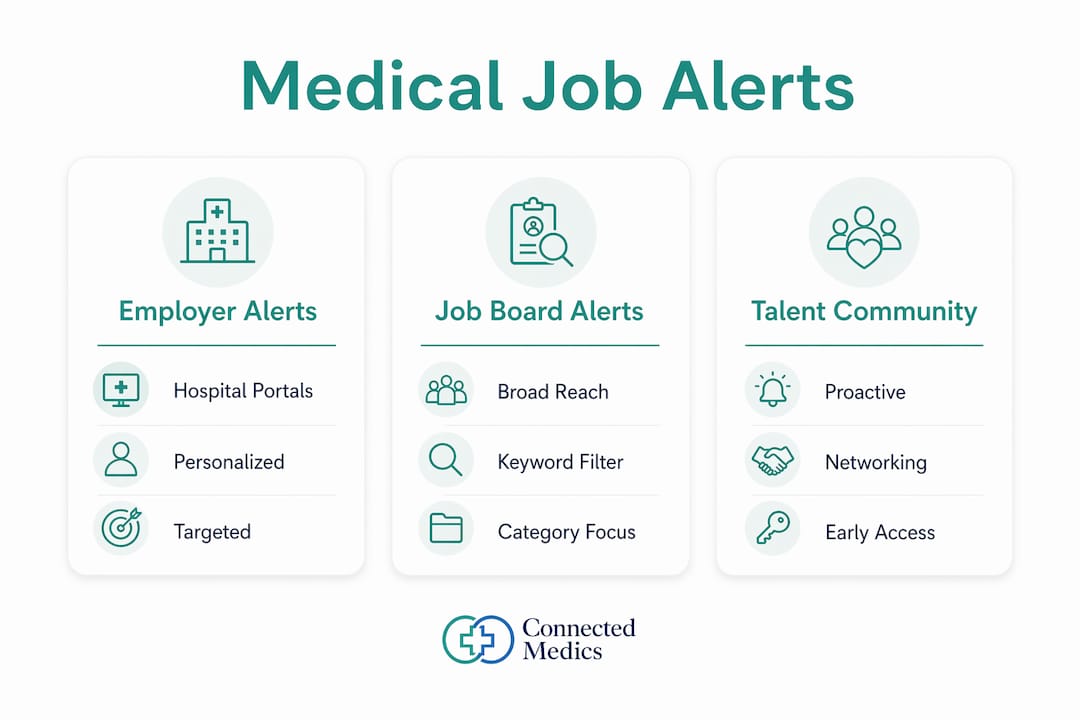
Employer portal alerts are the most targeted type. UCLA Health begins sending personalized alerts once a candidate applies to a position or registers on their career portal. These alerts are driven by the employer's own ATS and tend to be more accurate than third-party aggregators because the data is sourced directly.
Job board alerts cast a wider net. Platforms with healthcare-specific job boards allow keyword and category filtering, but results may include duplicate listings or roles that have already been filled on the employer's own site.
Talent Community alerts are the most proactive option. The VA Careers Talent Community and University of Missouri Health Care both use this model: candidates share their specialty interests and upload a resume, and the system delivers tailored job recommendations and hiring updates without requiring a formal application. Talent Communities act as standing pipelines. You are visible to recruiters before a role is even posted publicly.
The most effective approach combines all three. Employer alerts give you depth on target organizations, job board alerts give you breadth, and Talent Communities give you early access.
What are the advantages of using medical job alerts?
Healthcare job alerts reduce the time cost of job searching by automating the discovery phase entirely. For a physician, nurse practitioner, or allied health professional working full-time shifts, that time savings is not trivial.
The core advantages break down as follows:
- Early access to new postings. Alerts notify you within hours or days of a role going live, before it accumulates a large applicant pool. Early applicants consistently receive more recruiter attention than those who apply after a posting has been live for two weeks.
- Specialty-accurate matching. Smart alerts with advanced keyword filtering and Boolean logic reduce irrelevant notifications, delivering 3 to 10 highly targeted job updates weekly for healthcare users. A cardiologist does not need alerts for general practice roles; precise filters eliminate that noise.
- Passive search capability. Alerts work while you are on shift, in clinic, or off duty. You do not need to be actively searching to stay informed about the market.
- Location and relocation planning. Setting alerts for target cities before you are ready to move gives you months of market data. You learn which specialties are in demand, which health systems hire frequently, and what compensation ranges look like in that region.
The relevance factor deserves emphasis. High-quality job alerts improve the healthcare job search experience by matching specialty-appropriate roles and reducing irrelevant notifications for clinicians. A poorly configured alert that sends 50 unrelated postings per day trains you to ignore it. A well-configured alert that sends 5 relevant roles per week gets acted on.
How to set up and optimize medical job alerts
Setting up alerts takes under 10 minutes per platform. Optimizing them takes a bit more thought. Follow these steps to build a system that works.
-
Choose your platforms. Start with the career portals of the three to five health systems you most want to work for. Add one or two healthcare-specific job boards for broader coverage. Connectedmedics, which hosts over 4,600 active healthcare vacancies, is one option built specifically for medical professionals. Avoid setting up alerts on every platform simultaneously; alert fatigue is real.
-
Define specific filters. Enter your exact job title or specialty, preferred location or radius, and employment type (full-time, part-time, locum tenens, remote). Vague filters like "nurse" across a whole country generate volume without value.
-
Set delivery frequency deliberately. If you are actively searching, configure alerts to deliver every one to two days. If you are passively monitoring the market, weekly digests are sufficient. Oracle's documentation confirms that scheduled delivery frequencies directly affect how quickly you receive new postings.
-
Join Talent Communities on employer sites. Upload a current resume or CV and specify your specialty and availability. VA Careers and similar systems use this data to send curated recommendations before roles are publicly listed. This is one of the most underused tactics in healthcare job searching.
-
Activate alerts immediately when you start searching. Alerts only notify you of jobs posted after the alert is created. They do not surface existing listings. Oracle notes that alerts send only for newly posted jobs from the point of setup, which means delayed activation means missed opportunities.
-
Build a review routine. Alert digests arrive on a schedule, not in real time. Set a fixed time each day or every other day to review incoming alerts and act on relevant ones. Applying within 24 to 48 hours of a posting going live puts you in the early applicant window.
-
Audit and adjust monthly. If alerts are generating too many irrelevant results, tighten the filters. If you are seeing too few results, broaden the location radius or add a related job title. Treat alert configuration as an ongoing process, not a one-time setup.
Pro Tip: Use the healthcare job search checklist alongside your alert setup to confirm your profile, resume, and application materials are ready before the first relevant alert arrives. Being prepared to apply immediately is what makes early access valuable.
Key takeaways
Medical job alerts are most effective when configured with specific filters, activated early, and reviewed on a fixed schedule aligned to the alert delivery frequency.
| Point | Details |
|---|---|
| Core definition | A medical job alert is an automated notification delivering new healthcare job openings based on preset filters. |
| Alert types | Employer portal alerts, job board alerts, and Talent Community alerts each serve a different search strategy. |
| Activate early | Alerts only capture jobs posted after setup, so early activation is critical to avoid missing openings. |
| Precision over volume | Smart filtering with specific specialty and location criteria delivers more useful results than broad keyword searches. |
| Review routine matters | Aligning a daily or every-other-day review habit to your alert frequency keeps you in the early applicant window. |
Why job alerts alone are not enough
Job alerts are a strong starting point, but they are a passive tool. After 15 years of watching healthcare professionals navigate career transitions, the pattern is consistent: the candidates who move fastest are the ones who combine automated alerts with active networking.
An alert tells you a role exists. It does not tell you that the hiring manager at that facility prefers candidates with a specific subspecialty background, or that the department is expanding because of a new service line, or that three of your colleagues already know someone on the team. That context comes from professional networks, specialty communities, and conversations with peers who work at target organizations.
The other underappreciated factor is timing. Alerts often arrive as digest emails, not instant notifications. A role posted Monday morning may not reach your inbox until Tuesday's digest. By then, a candidate who had a direct connection to the recruiter has already submitted an application. Alerts close the information gap, but they do not eliminate it entirely.
My recommendation: treat job alerts as your market intelligence feed and treat your professional network as your competitive advantage. Keep your profile on specialty-specific platforms current. Engage with peers in your field. When an alert surfaces a role at an organization where you have a connection, use that connection before you submit the application. The alert gets you to the door; the network gets you through it.
— David
Find medical job alerts built for healthcare professionals
ConnectedMedics is a verified professional network built exclusively for healthcare professionals, with over 4,600 active healthcare vacancies across clinical and allied health specialties. Unlike generic job platforms, ConnectedMedics filters roles by specialty, location, and role type so that medical job notifications reach the right professionals without the noise of unrelated industries.
Joining ConnectedMedics gives healthcare professionals access to a global healthcare jobs board with alert functionality, verified peer connections, and a knowledge hub with clinical insights. Whether you are actively searching or monitoring the market, the platform is structured to surface relevant medical career opportunities without requiring constant manual searching. Visit ConnectedMedics to set up your profile and configure job alerts tailored to your specialty.
FAQ
What is a medical job alert?
A medical job alert is an automated notification sent via email, SMS, or app that delivers new healthcare job openings matching a candidate's preset criteria, including specialty, location, and job type. It eliminates the need to manually check job boards or employer career sites.
How do I sign up for medical job alerts?
Register on an employer's career portal or a healthcare job board, enter your specialty and location preferences, and select a delivery frequency. Joining a Talent Community, such as the VA Careers Talent Community, also triggers curated job recommendations without a formal application.
Do job alerts show all available healthcare jobs?
No. Job alerts only notify candidates of positions posted after the alert is activated. Existing listings at the time of setup are not included, which is why early activation is critical when starting a healthcare job search.
How often should I receive healthcare job alerts?
Active job seekers benefit from alerts set to every one to two days. Passive candidates monitoring the market can use weekly digests. The key is aligning your review routine to the delivery schedule so you can apply within the early applicant window.
What filters improve medical job alert accuracy?
Specific job title, clinical specialty, geographic location or radius, and employment type (full-time, locum tenens, remote) are the filters that most improve alert relevance. Broad keyword searches generate volume; specialty-specific filters generate precision.