
Strong medical job application tips start with one principle: every document you submit must be customized to the specific role, not recycled from a previous application. Generic resumes and vague cover letters are the leading cause of rejection before a hiring manager ever reads your name. Healthcare recruiters in 2026 use Applicant Tracking Systems (ATS) to filter candidates before any human review occurs. That means your resume must satisfy both an algorithm and a clinical hiring panel. The strategies below cover resume tailoring, behavioral interview preparation, ATS keyword optimization, and the most common mistakes that cost qualified professionals their next role.
How can you tailor your medical resume and cover letter for each job?
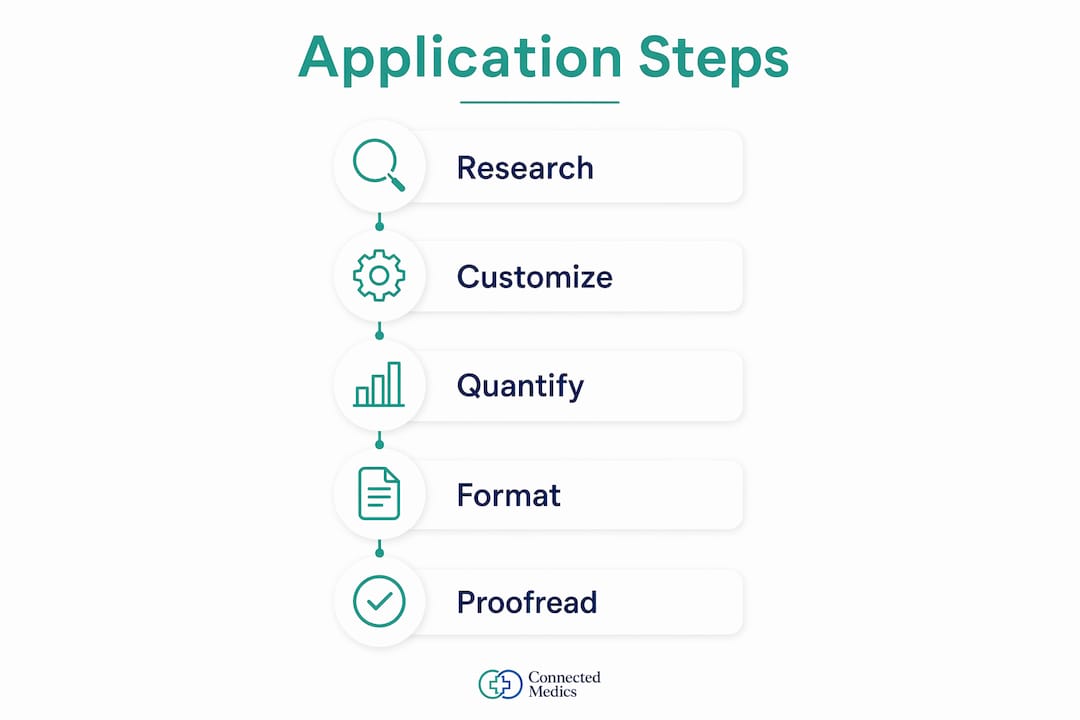
The single most effective change you can make to your resume is replacing duty lists with quantified clinical outcomes. Healthcare hiring managers prioritize resumes that explicitly measure clinical impact. Phrases like "managed 5–7 high-acuity patients per 12-hour shift" or "reduced medication errors by 22% through protocol standardization" tell a hiring panel exactly what you delivered. A generic bullet like "provided patient care" tells them nothing.
Your cover letter follows the same logic. Map each paragraph directly to the job description's stated requirements. If the posting asks for experience with Epic or Cerner, name those systems explicitly and rate your proficiency. Naming specific EHR platforms like Epic or Cerner instead of writing "proficient in electronic health records" improves your chances of passing ATS filters. The system searches for exact terms, not paraphrases.

Resume and cover letter: do's and don'ts
| Element | Do | Don't |
|---|---|---|
| Work experience | Quantify outcomes with metrics | List generic duties |
| EHR systems | Name Epic, Cerner, or Meditech with proficiency level | Write "familiar with EHR software" |
| Certifications | Write "ACLS – Advanced Cardiac Life Support" | Write "ACLS" alone |
| Resume format | Single-column, text-only layout | Use tables, graphics, or text boxes |
| Cover letter | Address each essential criterion directly | Submit a generic template |
Formatting is not cosmetic. ATS systems misinterpret table cells, graphics, and text boxes, which causes critical data to disappear from the parsed version. A single-column, text-only resume is the safest format for any healthcare application system. This applies whether you are applying through an NHS portal, a hospital careers page, or a third-party job board.
Pro Tip: Run your resume through Grammarly before submission to catch errors, then paste the plain text into a blank document and read it top to bottom. If a sentence does not contain a specific skill, metric, or credential, cut it.
What are the best practices for preparing for healthcare job interviews?
Behavioral interview preparation is a structured process, not a last-minute review. The STAR method (Situation, Task, Action, Result) is the standard framework for answering behavioral questions, but healthcare interviews require a clinical adaptation. Effective behavioral responses allocate roughly 15% to the situation, 15% to the task, 50% to the action, and 20% to the result. The action section is where you demonstrate clinical reasoning, not just what you did.
Here is a step-by-step preparation process:
- Review the job description and identify 5–7 core competencies the role requires.
- Select one story per competency from your clinical experience that demonstrates that skill directly.
- Draft each story using STAR and time yourself. Aim for 2–3 minutes per answer.
- Name clinical frameworks in your action section. Frameworks like SBAR and the Five Rights of Medication Administration signal clinical maturity to interviewers. Saying "I used SBAR to communicate the deterioration to the attending physician" is more credible than "I reported the situation."
- Practice with a colleague or mentor who can give feedback on clarity and clinical accuracy.
- Record yourself once. Watching a playback reveals filler words and pacing issues that you cannot catch in the moment.
Behavioral interview questions test safety awareness and judgment, not just personality. Candidates who fail to demonstrate patient-centered values and interdisciplinary communication skills are often rejected despite strong technical knowledge. That means your stories must show how you worked with a team, protected a patient, or escalated a concern correctly.
Pro Tip: Prepare one story that did not go as planned and what you learned from it. Interviewers ask about failure specifically to assess self-awareness and professional growth. A polished answer to this question separates strong candidates from average ones.
Which clinical keywords and competencies should your application feature?
ATS keyword optimization is a technical skill that most healthcare applicants underestimate. The system does not read context. It scans for exact strings. Listing certifications by both acronym and full name, such as "ACLS – Advanced Cardiac Life Support," prevents the system from filtering you out when a recruiter searches either version.
The following competencies and keywords are high-value for most clinical roles in 2026. Use those that apply to your specialty and match the language in the job posting:
- EHR platforms: Epic, Cerner, Meditech, Allscripts (with proficiency level)
- Certifications: BLS, ACLS, PALS, NRP, CEN, CCRN (acronym and full name)
- Clinical frameworks: SBAR, Chain of Command, Five Rights of Medication Administration, ISBAR
- Competency areas: patient triage, medication reconciliation, care coordination, clinical documentation, infection control
- Soft skills with clinical context: interdisciplinary communication, patient advocacy, critical thinking under pressure
For experienced professionals, age-neutral positioning is a practical concern. Recent continuing education dates and certification renewal years should appear prominently. Graduation dates from degrees completed more than 15 years ago can be removed without affecting your application. Recruiters care about what you know now, not when you first learned it.
Check the top skills healthcare employers are seeking in 2026 to align your keyword list with current hiring priorities before you finalize your resume.
What common mistakes do healthcare applicants make?
The most damaging mistake in any healthcare application is submitting a document that was not written for the specific role. Healthcare job applications must function as evidence-based exercises, mapping essential job criteria precisely rather than offering narrative career stories. A supporting statement that describes your career journey without addressing each criterion directly will be scored low or disqualified outright.
| Mistake | Why it fails | Correction |
|---|---|---|
| Generic duty lists | Provides no evidence of impact | Replace with quantified outcomes |
| ATS-incompatible formatting | Data is lost before human review | Use single-column, text-only layout |
| Acronyms without full names | ATS misses the match | Write "ACLS – Advanced Cardiac Life Support" |
| Unrehearsed behavioral stories | Answers sound vague and unstructured | Prepare and time 5–7 STAR stories in advance |
| Omitting essential criteria | Application is scored incomplete | Address every criterion with a specific example |
A second common error is using a template resume downloaded from a general job site. These templates often include graphics, columns, and text boxes that confuse ATS parsing and cause your qualifications to disappear from the system's output. The resume may look polished on screen but arrive as a blank or scrambled file on the recruiter's end.
Pro Tip: Print the job description and highlight every essential criterion. Then open your application and check that each highlighted item has a matching example. If any criterion has no example, your application is incomplete regardless of how strong the rest of it is.
Applying for medical positions through a specialized healthcare job board rather than a general recruitment site also reduces the risk of ATS mismatch, since healthcare-specific platforms use terminology that matches clinical resumes more accurately.
Key takeaways
Strong medical job applications require quantified clinical evidence, ATS-compatible formatting, and structured behavioral interview preparation using clinical frameworks like SBAR and the Five Rights.
| Point | Details |
|---|---|
| Quantify clinical impact | Replace duty lists with metrics like patient volumes and outcome improvements. |
| Use ATS-compatible formatting | Single-column, text-only resumes prevent data loss during automated screening. |
| Name EHR systems explicitly | List Epic, Cerner, or Meditech with proficiency levels to pass keyword filters. |
| Prepare STAR stories with clinical frameworks | Allocate 50% of your answer to the action section and name frameworks like SBAR. |
| Address every essential criterion | Match each job requirement with a specific example to avoid disqualification. |
What I have learned from watching strong candidates get rejected
I have reviewed hundreds of healthcare applications over the years, and the pattern that surprises most professionals is this: the rejected candidates are often more qualified than the ones who advance. The difference is almost never clinical skill. It is documentation.
The strongest nurses, physicians, and administrators I have seen lose roles they deserved did so because they treated the application as a formality. They submitted resumes that described their careers instead of proving their competencies. They walked into interviews with general stories instead of specific, timed, framework-driven answers.
What actually works is treating the application as a clinical audit. You gather evidence, map it to criteria, and present it in a format the reviewer can process quickly. That is not a soft skill. It is a professional discipline. The STAR method paired with SBAR or the Five Rights is not a trick. It is the language that clinical hiring panels are trained to evaluate.
The other thing I would push back on is the idea that networking is separate from applying. The professionals who land roles fastest are the ones who already have a presence in their specialty community before a vacancy opens. That means contributing to clinical discussions, maintaining a verified professional profile, and staying visible to peers who make referrals. Applying cold to a job board posting is the least efficient path to a role. It works, but it is slower and more competitive than being known.
— David
How Connectedmedics supports your healthcare career search
Connectedmedics is a global networking platform built exclusively for healthcare professionals, with over 4,600 active healthcare vacancies listed at any time. Unlike general job boards, every role on the platform is healthcare-specific, and every profile is verified.
The Connectedmedics Knowledge Hub provides clinical guides, career resources, and summarized research contributed by verified medical experts. For professionals applying for medical positions right now, it is a direct source of current hiring guidance and specialty-specific career advice. Explore the full Connectedmedics platform to search verified vacancies, connect with peers in your specialty, and access resources that support every stage of your job search.
FAQ
What is the most important medical resume tip for 2026?
Quantify your clinical impact with specific metrics. Phrases like "managed 5–7 high-acuity patients per shift" outperform generic duty descriptions in both ATS screening and hiring manager review.
How should I list certifications on a healthcare resume?
Write both the acronym and the full name, for example "ACLS – Advanced Cardiac Life Support." This format ensures ATS systems match your credentials regardless of which version a recruiter searches.
What is the STAR method in healthcare job interviews?
STAR stands for Situation, Task, Action, and Result. In healthcare interviews, the Action section should make up about 50% of your response and include named clinical frameworks like SBAR or the Five Rights of Medication Administration.
How do I avoid age bias when applying for medical positions?
Replace graduation dates with recent certification renewal dates and continuing education completions. Recruiters evaluate current competency, so recent credentials carry more weight than the year you completed your degree.
Why do qualified healthcare applicants get rejected?
The most common reason is failing to address every essential criterion in the application. Each criterion must be matched with a specific example. Applications that tell a career story without mapping to job requirements are scored lower regardless of the applicant's experience level.