
Upgrading healthcare assistant job applications means tailoring your CV and supporting statement to the exact care setting, matching NVQ or Care Certificate qualifications to role requirements, and embedding compliance keywords that both applicant tracking systems (ATS) and NHS recruiters scan for. The difference between a shortlisted application and a rejected one is rarely about experience level. It is about how precisely you present what you already know and do. This guide covers CV structure, supporting statement strategy, certification presentation, and interview readiness, all mapped to 2026 NHS hiring expectations.
How to upgrade your healthcare assistant CV for ATS and recruiters
The CV is the first filter. Recruiters and ATS systems scan for setting fit, qualification level, and compliance training before a human reads a single sentence. Tailoring your CV to the exact care setting and explicitly showing NVQ Level 2 or 3 status, or Care Certificate completion, is the single most effective structural change you can make.
Start with a ward-fit profile at the top of your CV. This is a three to four sentence summary that states your care setting (acute ward, community, residential), your NVQ or Care Certificate level, your typical patient volume per shift, and the ward bed count where relevant. A profile that reads "Band 2 HCA with NVQ Level 3, experienced in a 28-bed acute medical ward supporting 8 to 10 patients per shift" gives a recruiter everything they need in under ten seconds.

Measurable operational metrics like ward size, patient counts, and shift patterns reduce follow-up questions and signal realistic workload experience to both ATS and hiring managers. This matters because many shortlisting processes in 2026 are automated or semi-automated, and vague phrases like "supported patients with daily needs" score lower than "assisted with personal care, mobility aids, and vital sign observations for up to 10 patients per 12-hour shift."
Use the job advert language directly. If the posting mentions "timely electronic care notes" or "accurate nurse handovers," those exact phrases belong in your CV. Mirror the terminology, not just the concept.
Compliance keywords to include in your CV:
- Basic Life Support (BLS) with date and renewal status
- Manual handling and moving and handling certification
- Safeguarding adults and children training level
- Infection prevention and control (IPC) with completion date
- Medication awareness or administration (if applicable)
- Dementia awareness or end-of-life care training
Listing mandatory and refresher certifications with dates and renewal status improves both ATS scoring and onboarding readiness assessments. Recruiters want to see that your BLS is current, not just that you have it.
Pro Tip: Format certifications as a dedicated table in your CV with three columns: certification name, issuing body, and expiry or renewal date. This layout is ATS-friendly and takes seconds to scan.
| Certification | Issuing body | Renewal date |
|---|---|---|
| Basic Life Support (BLS) | Resuscitation Council UK | March 2026 |
| Manual Handling | In-house Trust training | January 2026 |
| Safeguarding Level 2 | NHS e-Learning | September 2026 |
| Care Certificate | Previous employer | Completed 2023 |
How do you write a supporting statement that gets shortlisted?
The supporting statement is where most healthcare assistant applications lose ground. NHS recruitment panels score applications by person specification criteria, so a statement that does not address each criterion directly will score lower regardless of the quality of the experience behind it.
The method that works is straightforward. Use the person specification from the job posting as your structural guide. Address essential criteria first, then desirable criteria. Each criterion gets its own short paragraph or subheading, and each paragraph contains a specific, verifiable example rather than a general claim.
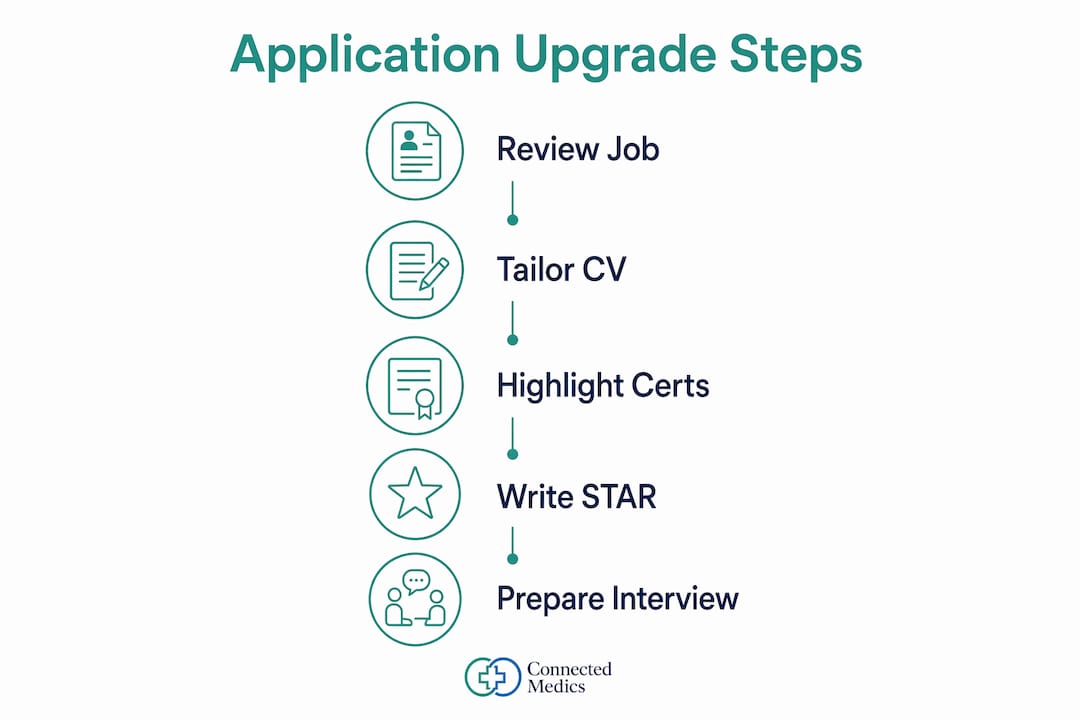
Here is a step-by-step approach to structuring your supporting statement:
- Open with a brief positioning sentence. State your current role, setting, and NVQ or Care Certificate level. Keep it to two sentences.
- Address each essential criterion with a named example. Use the STAR or STARR method: Situation, Task, Action, Result, and Reflection. One paragraph per criterion is enough.
- Use the Trust's own language. Personalized statements that reference the specific Trust's values and job details score higher and avoid AI-detection flags that NHS shortlisting panels are increasingly watching for in 2026.
- Cover desirable criteria briefly. One to two sentences per desirable criterion is sufficient if you have relevant evidence.
- Close with a single sentence that connects your goals to the role and Trust without sounding generic.
Writing supporting information that tracks the job's person specification criteria with examples increases shortlisting chances significantly. The key word is "tracks." You are not writing an essay about your career. You are walking the panel through evidence that you meet their stated requirements.
The most common mistake is generic phrasing. Phrases like "I am a caring and dedicated individual" appear in thousands of applications and score zero against any person specification criterion. Replace every generic claim with a specific scenario. "I supported a patient with dementia who became distressed during personal care by using a calm, familiar routine and notifying the nurse in charge" is evidence. "I am compassionate" is not.
Pro Tip: Before writing, print the person specification and highlight every essential criterion. Write one STAR example for each highlighted item before you open the application form. This prevents you from writing around the criteria instead of to them.
What certifications should healthcare assistants highlight?
Care Certificate completion is the baseline expectation for new and recent healthcare assistants. It covers 15 standards including safeguarding, duty of care, and person-centered care, and NHS Trusts treat it as the gold standard for entry-level onboarding. If you have completed it, list it prominently. If you are working toward it, state the expected completion date.
Beyond the Care Certificate, the certifications that carry the most weight in healthcare assistant applications are:
- BLS and CPR: Mandatory in most acute and community settings. List the issuing body and renewal date.
- Safeguarding adults and children: State the level (1, 2, or 3) and the training provider.
- Manual handling: Required in virtually every HCA role. Include the date and whether it was practical or e-learning.
- Infection prevention and control: Especially relevant post-2020. Mention specific IPC training modules if applicable.
- Condition-specific training: Dementia awareness, palliative care, or learning disability awareness training adds real differentiation, particularly for specialist or community roles.
Fully completing application forms including mandatory qualifications and relevant training avoids shortlisting delays. Incomplete entries in the qualifications or training sections of NHS application forms are one of the most common reasons for automated rejection before a human reviewer sees the application.
Pro Tip: Integrate compliance keywords naturally into your CV and supporting statement rather than listing them in isolation. "Maintained IPC standards including correct PPE use and hand hygiene protocols across a 28-bed ward" reads better than a bare list and scores on both ATS and human review.
How does interview preparation connect to your application?
The interview is a direct extension of your application. Common interview questions for healthcare assistants assess safeguarding, confidentiality, infection control, and escalation pathways. Interviewers check whether your answers match the claims in your supporting statement.
Typical scenario questions include:
- "Describe how you would respond if you noticed a patient's condition deteriorating."
- "How do you maintain infection prevention standards when managing multiple patients?"
- "What would you do if a patient disclosed abuse to you?"
Candidates who explain how they maintain infection prevention and escalation protocols under pressure by prioritizing tasks and following correct pathways score higher in structured NHS interviews. The panel is not just assessing knowledge. They are assessing whether you can apply it under realistic ward conditions.
The practical preparation step most candidates skip is mapping their application examples to likely questions before the interview. If your supporting statement includes a STAR example about escalating a patient concern, rehearse that example out loud. The story you wrote should be the story you tell.
"Documenting evidence during the interview, such as referencing specific ward protocols or Trust policies by name, reinforces the credibility of your application and signals that your written claims are grounded in real practice."
Pro Tip: Practice explaining how you handle competing priorities during a shift. For example, describe managing personal care for three patients while monitoring a fourth for signs of deterioration. This type of answer demonstrates both clinical awareness and workload management, two things hiring panels consistently look for.
You can find more detail on NHS application processes and how shortlisting decisions are made in the Connectedmedics NHS application guide.
Key takeaways
Removing ambiguity by providing verifiable qualifications, setting-fit details, and measurable operational examples is the most effective way to upgrade healthcare assistant job applications in 2026.
| Point | Details |
|---|---|
| Ward-fit CV profile | Open with care setting, NVQ level, bed count, and patients per shift for instant recruiter clarity. |
| Compliance keyword placement | List BLS, safeguarding, manual handling, and IPC with dates and renewal status for ATS scoring. |
| Person specification mapping | Structure supporting statements by criteria, using STAR examples for each essential requirement. |
| Care Certificate as baseline | Completed Care Certificate signals onboarding readiness and should be listed prominently. |
| Interview and application alignment | Rehearse the same STAR examples from your statement so interview answers match written claims. |
What I have learned about healthcare assistant applications
The applications that consistently get shortlisted share one quality: specificity. Not length, not formal language, not impressive-sounding phrases. Specificity. A candidate who writes "supported 9 patients per shift in a 24-bed stroke rehabilitation ward, including mobility assistance, vital sign monitoring, and electronic care record updates" will outperform a candidate who writes "provided high-quality patient care in a busy ward environment" every time.
The rise of AI-generated content in NHS applications is creating a new problem. Panels are increasingly flagging statements that read as polished but generic, because they contain no verifiable detail. The irony is that the fix is simple. Write about what you actually did, in the ward you actually worked in, using the protocols your actual Trust used. That specificity is what AI cannot replicate and what recruiters are actively looking for.
One more thing worth stating directly: the healthcare assistant career path rewards candidates who treat each application as a skills audit. Every time you map your experience to a person specification, you identify gaps. Those gaps point to the next training course, the next certification, the next conversation with your line manager about development. The application process is not just a hiring filter. It is a practical tool for understanding where you stand and what to do next.
— David
Find healthcare assistant jobs on Connectedmedics
Connectedmedics is a verified healthcare professional network with over 4,600 active vacancies across NHS Trusts, private hospitals, and community care settings. Healthcare assistants can search roles filtered by setting, band, and location, and access career guides built specifically for HCA applications and progression. The platform connects you directly with recruiters who post verified, healthcare-specific roles rather than generic job board listings. If you are ready to put your upgraded application to work, browse healthcare assistant jobs on Connectedmedics and apply to roles matched to your qualifications and care setting.
FAQ
What does it mean to upgrade a healthcare assistant application?
Upgrading a healthcare assistant application means tailoring your CV and supporting statement to the specific care setting, qualification level, and compliance training requirements of each role. It includes using ATS-compatible keywords, measurable workload metrics, and STAR-structured examples mapped to the person specification.
How important is the Care Certificate for NHS applications?
The Care Certificate is treated as the gold standard for new healthcare assistant starters and is expected by most NHS Trusts. Listing it with a completion date signals onboarding readiness and supports interview discussions on safeguarding and duty of care.
Should I use AI to write my NHS supporting statement?
AI-generated supporting statements are increasingly flagged by NHS shortlisting panels for lacking specific, verifiable detail. Personalized statements that reference the exact Trust, role, and your real clinical examples score higher and avoid detection issues in 2026 values-based shortlisting.
What compliance keywords should I include in my healthcare assistant CV?
Include Basic Life Support, manual handling, safeguarding (with level), infection prevention and control, and any condition-specific training such as dementia awareness. List each with the issuing body and renewal date for maximum ATS and recruiter impact.
How do I connect my application to interview performance?
Map each STAR example in your supporting statement to a likely interview question before the panel date. Candidates who reference specific protocols and escalation pathways by name during interviews score higher because their answers align with and reinforce their written application claims.