
Understanding how HCA job applications work NHS is something many candidates get wrong before they even start. The process is more structured than most people expect, with specific platforms, scoring criteria, and pre-employment checks that can catch unprepared applicants off guard. This guide walks through every stage of the NHS healthcare assistant application process, from finding vacancies to passing pre-employment checks, so you know exactly what to expect and how to give yourself the best shot.
Table of Contents
- Key takeaways
- How HCA job applications work in the NHS
- Eligibility and qualifications for NHS HCA roles
- How to fill out the NHS HCA application form
- What happens after you submit your application
- Common mistakes that cost applicants the job
- My take on the NHS HCA application process
- Find NHS HCA roles through Connectedmedics
- FAQ
Key takeaways
| Point | Details |
|---|---|
| Use official NHS platforms | Apply only through NHS Jobs or NHS Trac to access verified listings and faster processing. |
| Tailor to person specification | Applications scored against specific criteria; generic statements score poorly and get filtered out. |
| NHS values matter throughout | Demonstrate compassion, respect, and dignity in both written applications and interview answers. |
| Pre-employment checks take time | DBS, occupational health, and reference checks are mandatory and can extend your start date by weeks. |
| Apply early, not just on time | Vacancy windows often close before the deadline when high volumes of applications come in. |
How HCA job applications work in the NHS
The NHS HCA job process starts in one place: the official NHS Jobs website or NHS Trac, depending on the Trust. These are the two primary platforms where Band 2 and Band 3 HCA vacancies are posted daily, and applying through them is the only reliable way to access genuine job, salary, and contract information.
To get started, create a profile on NHS Jobs. Fill in every section completely. Incomplete profiles are a red flag to recruiters and can result in your application being screened out before anyone reads your supporting statement. Use the search filters to narrow results by band, location, and job category. Searching specifically for "Band 2" or "Band 3" healthcare assistant roles helps cut through unrelated listings quickly.
A few things worth knowing before you search:
- NHS Jobs and NHS Trac are the primary official application platforms
- Some NHS Trusts use their own recruitment portals linked from NHS Jobs
- Third-party recruitment agencies may advertise NHS-style roles but cannot guarantee sponsorship, accurate salary details, or direct NHS contracts
- Applying directly to NHS Trusts is faster, more transparent, and reduces the risk of misinformation
Pro Tip: Vacancy adverts often close early when applications reach a high volume. The typical advertised window is two weeks, but many close within days. Submit your application as soon as you find a suitable vacancy.
Eligibility and qualifications for NHS HCA roles
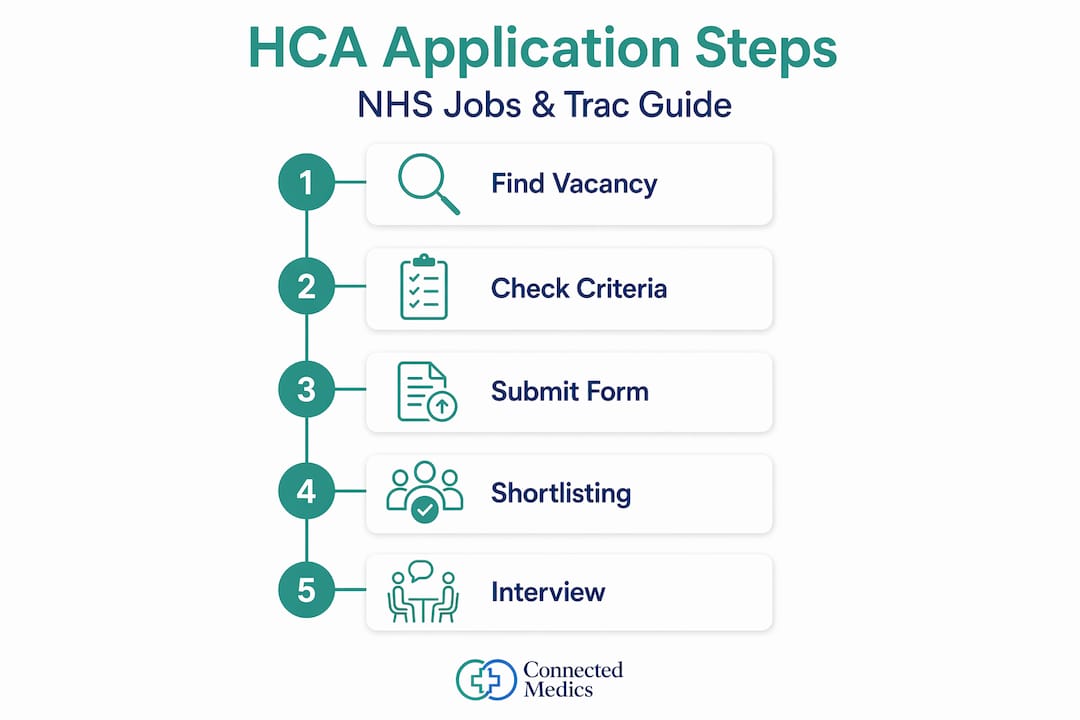
Not every HCA role has the same entry requirements. Band 2 and Band 3 positions differ in what they expect from candidates, and knowing where you fit saves time.

For Band 2 roles, the baseline requirement is typically an NVQ Level 2 in Health and Social Care or an equivalent qualification. Many Trusts also expect the Care Certificate or a willingness to complete it during induction. Band 3 roles generally require additional specialized training or experience, such as phlebotomy, clinical observations, or a specific ward background.
Here is what most NHS Trusts look for when reviewing HCA applications:
- NVQ Level 2 in Health and Social Care or equivalent (Band 2 minimum)
- Care Certificate completion or willingness to complete within the induction period
- Basic literacy and numeracy skills, often assessed at application stage
- Evidence of understanding NHS values: compassion, respect, dignity, and quality care
- Relevant work or voluntary experience in a care setting, even informal caregiving counts
No prior clinical experience? The NHS offers apprenticeship routes that last 12 to 18 months and lead to a Level 2 Healthcare Support Worker qualification. You earn while you learn, and the qualification is recognized across NHS Trusts. This is a legitimate and increasingly common entry point. You can also explore HCA career growth paths to understand where the role can take you long term.
For international applicants, additional requirements apply. You will need a certificate of good conduct from your home country's police authority, and you should verify whether the specific Trust offers visa sponsorship before applying. Not all NHS Trusts are licensed sponsors.
Pro Tip: Read the person specification attached to each job posting before applying. It lists essential and desirable criteria. If you do not meet the essential criteria, your application will not pass shortlisting regardless of how strong your supporting statement is.
How to fill out the NHS HCA application form
The NHS application form has several components, and each one matters. Recruiters do not just skim your supporting statement. They review your employment history, qualifications section, and compliance declarations too.
Here is what the form covers and how to approach each part:
- Employment history: List all relevant roles, including part-time, volunteer, and informal care work. Gaps in employment need brief explanations. Leaving sections blank raises questions.
- Qualifications: Include every relevant qualification with accurate dates and awarding bodies. Do not round up or approximate.
- Supporting statement: This is the most critical section. The supporting statement should map directly to each essential criterion listed in the person specification. Use specific examples with measurable outcomes, not vague claims.
- References: Provide accurate employer contact details. NHS Trusts contact references directly, and delays here slow down your start date.
- Compliance declarations: Answer honestly. Discrepancies between your form and background checks are grounds for withdrawal of an offer.
The most common mistake applicants make is writing a generic supporting statement and copying it across multiple applications. Shortlisting uses a scoring matrix that rewards explicit evidence and penalizes vague statements. A sentence like "I am a caring and dedicated person" scores nothing. A sentence like "While supporting a patient with limited mobility during daily personal care, I adapted my approach based on their preferences, which reduced their anxiety and improved their cooperation with the care plan" scores well.
Structure your supporting statement so each paragraph addresses one criterion from the person specification. Keep your language clear and direct. Avoid copying the job description back at the recruiter. Show what you did, how you did it, and what the outcome was.
What happens after you submit your application
The post-submission stage is where many applicants lose momentum because they do not know what to expect or how long it takes.
Shortlisting and interview
After the vacancy closes, a panel reviews all applications against the person specification using a scoring matrix. Only candidates who meet the essential criteria and score above the threshold are invited to interview. This process typically takes one to two weeks after the closing date.
NHS interviews are structured and values-based. Interview panels use scenario and behavioral questions to assess how you respond to real situations. Expect questions like "Tell me about a time you supported someone who was distressed" or "How would you handle a situation where a colleague was not following hygiene protocols?" Some roles include a practical assessment or a ward observation.
NHS recruiters assess alignment with NHS values through every answer. Prepare examples that show compassion, dignity, and respect in action, not just in theory.
Pre-employment checks
Once you receive a conditional offer, pre-employment checks begin. Here is what to expect:
| Check | What it involves | Typical timeline |
|---|---|---|
| Enhanced DBS | Criminal record check for roles with vulnerable adults | 1 to 4 weeks |
| Occupational health | Health questionnaire and possible medical review | 1 to 3 weeks |
| Reference verification | Direct contact with previous employers | 1 to 2 weeks |
| Right to work | Verification of documents proving legal right to work in the UK | 1 to 5 days |
| Certificate of good conduct | Required for international applicants only | Variable by country |
The full pre-employment process can take four to eight weeks. Do not resign from your current role until you have a confirmed start date in writing.
Common mistakes that cost applicants the job
Most failed NHS HCA applications come down to the same avoidable errors. Knowing them in advance puts you ahead of a large portion of applicants.
- Submitting an application after the vacancy has already closed due to high volume
- Writing a supporting statement that does not address the person specification criteria
- Using the same generic statement for every application without tailoring it to the role
- Failing to provide evidence of NHS values in written responses or interview answers
- Listing references who are unavailable or unresponsive, which delays pre-employment checks
- Providing inaccurate employment dates or qualifications that do not match official records
- Applying through third-party agencies for roles that require direct NHS Trust applications
Pro Tip: Before submitting, read your supporting statement out loud. If it sounds like it could apply to any healthcare job at any organization, rewrite it. Every statement should reference specific situations, specific outcomes, and the NHS values that guided your actions.
For a practical breakdown of how to apply for healthcare vacancies efficiently, including time-saving strategies for managing multiple applications, that resource covers the process in useful detail.
My take on the NHS HCA application process
I have reviewed enough NHS applications and spoken with enough recruiters to say this clearly: the biggest gap between successful and unsuccessful applicants is not experience. It is preparation.
Most people who do not make it past shortlisting were not underqualified. They submitted applications that could have been written by anyone. They did not read the person specification. They wrote about what they want from the role instead of what they bring to it. That is the real problem.
The NHS values are not a box-ticking exercise. They are the actual framework recruiters use to evaluate every answer you give, in writing and in person. I have seen candidates with years of care experience fail interviews because they could not give a concrete example of how they demonstrated dignity in practice. And I have seen candidates with minimal experience get hired because they understood what the NHS is looking for and showed it clearly.
Apply directly through NHS Jobs. Read every word of the person specification. Build your supporting statement around the essential criteria, one example per criterion. Then prepare your interview answers the same way. That is the process. It is not complicated, but it requires genuine effort.
Timelines are longer than most people expect. Four to eight weeks from application to start date is normal. Plan accordingly.
— David
Find NHS HCA roles through Connectedmedics
Connectedmedics gives healthcare professionals direct access to verified job listings, including NHS HCA roles across the UK. The platform lists over 4,600 active healthcare vacancies with verified salary information and employer details, so you are not relying on outdated postings or agency intermediaries.
Whether you are searching for your first HCA position or looking to move into a specialized NHS role, Connectedmedics connects you with verified opportunities and healthcare-specific career resources. Recruiters on the platform are also accessible directly, which speeds up the process for candidates who want to ask questions before applying. Visit the Connectedmedics marketplace to browse current NHS HCA vacancies and set up job alerts for your preferred band and location.
FAQ
What platforms are used for NHS HCA applications?
NHS HCA applications are submitted through NHS Jobs or NHS Trac, depending on the Trust. These are the official platforms and the only reliable sources for verified NHS vacancies.
How long does the NHS HCA recruitment process take?
From application submission to a confirmed start date, the process typically takes four to eight weeks. Pre-employment checks including DBS, occupational health, and reference verification account for most of that time.
What qualifications do you need for a Band 2 HCA role?
Most Band 2 HCA roles require an NVQ Level 2 in Health and Social Care or equivalent, plus the Care Certificate or a commitment to complete it during induction.
What is a supporting statement in an NHS HCA application?
The supporting statement is a written section of the application where you provide evidence that you meet the person specification criteria. Strong statements map each criterion to a specific example with a clear outcome, rather than using generic descriptions.
Can international applicants apply for NHS HCA roles?
Yes. International applicants can apply for NHS HCA roles, but they must check whether the specific Trust offers visa sponsorship and will need to provide a certificate of good conduct from their home country as part of pre-employment checks.