
Career progression at HCA Healthcare matters because it raises your pay, reduces burnout, and expands your clinical impact — and HCA provides structured programs to get you there. Through tools like the HCA Talent Network, Centers of Excellence, and the Galen College partnership, advancement is planned, not accidental.
Key benefits at a glance:
- Higher pay and better benefits through promotions, certifications, and specialty roles
- Less burnout and longer tenure linked to structured career development pathways
- Internal mobility via the Talent Network and cohort programs that surface hidden roles
Table of Contents
- 1. Why HCA career progression matters for your pay and wellbeing
- 2. How career growth benefits patients and HCA as an employer
- 3. What HCA actually offers to help you advance
- 4. How to build a simple career progression plan at HCA
- 5. What leadership and research say about HCA's investment in progression
- Key Takeaways
- The case for being proactive, not passive
- Connectedmedics supports your career beyond HCA's walls
- Useful sources and next steps
1. Why HCA career progression matters for your pay and wellbeing
Promotions and new credentials translate directly into higher pay bands and expanded benefits at HCA. Moving from a patient care technician (PCT) role into a specialty technical position, or from a staff nurse into a nurse leader role, typically brings a salary increase alongside new responsibilities. Healthcare salary trends confirm that clinicians who actively pursue certifications and role changes consistently out-earn peers who stay static.
Career development also cuts burnout. Structured growth pathways give clinicians a sense of forward motion, which is one of the strongest predictors of long-term job satisfaction. Staying in the same role without a clear path forward is a common driver of early exit from the profession.
Statistic: Access to professional development increases job satisfaction and can significantly reduce turnover intent among employees.
Pro Tip: Prioritize credentials tied to HCA's cohort programs (Director Development, Practice Manager Academy) over standalone certifications. Cohort graduates have a direct internal audience for their new skills.
2. How career growth benefits patients and HCA as an employer
Staff development and patient safety move together. Clinicians who advance through structured programs bring deeper clinical knowledge, better decision-making, and stronger team communication — all of which show up in quality and safety measures. Identifying training opportunities early is one of the clearest ways to build that depth before a role change.
Internal pipelines also reduce reliance on contract labor, which is expensive and disruptive to continuity of care. HCA's Workforce Development Centers of Excellence demonstrate this directly.
Statistic: HCA's COE programs achieved an average retention rate of 91% across 1,005 participants in 2025 and saved over $4.2M in contract labor costs that same year.
Key employer-level benefits:
- Predictable staffing through internal pipelines rather than agency fills
- Lower recruitment and onboarding costs when experienced staff advance rather than leave
- Stronger team capability as more clinicians hold specialty credentials
3. What HCA actually offers to help you advance
HCA Healthcare runs one of the most structured advancement ecosystems in U.S. healthcare. Laura DeMotte, American Group vice president of Human Resources and lead for HCA Healthcare's Workforce Development Center of Excellence, put it plainly: "We are investing more in workforce development than we ever have."
Core programs and tools:
- HCA Talent Network — the internal mobility hub where colleagues can view and apply for posted roles across HCA's hospital network before they go external
- Centers for Clinical Advancement — hands-on learning labs; HCA committed to doubling these sites to expand access
- Galen College of Nursing partnership — Galen bills HCA directly, so eligible colleagues pay no upfront tuition; two master's degree programs in nursing leadership are available
- FastTrack upskilling program — targets environmental services, food service, and PCT staff for rapid conversion into nursing, radiology, surgical, and respiratory care roles
- Director Development and Practice Manager Academy — cohort-based leadership programs for clinicians moving into management
- Leadership Institute and nurse leader certification programs — structured tracks for nurses targeting senior clinical or executive roles
- Tuition assistance and career coaching — HCA coaches guide colleagues through financing education and mapping career tracks
Pro Tip: Join the Talent Network before you apply to any cohort program. Internal postings often appear there first, and being a registered network member signals active career intent to hiring managers.

4. How to build a simple career progression plan at HCA
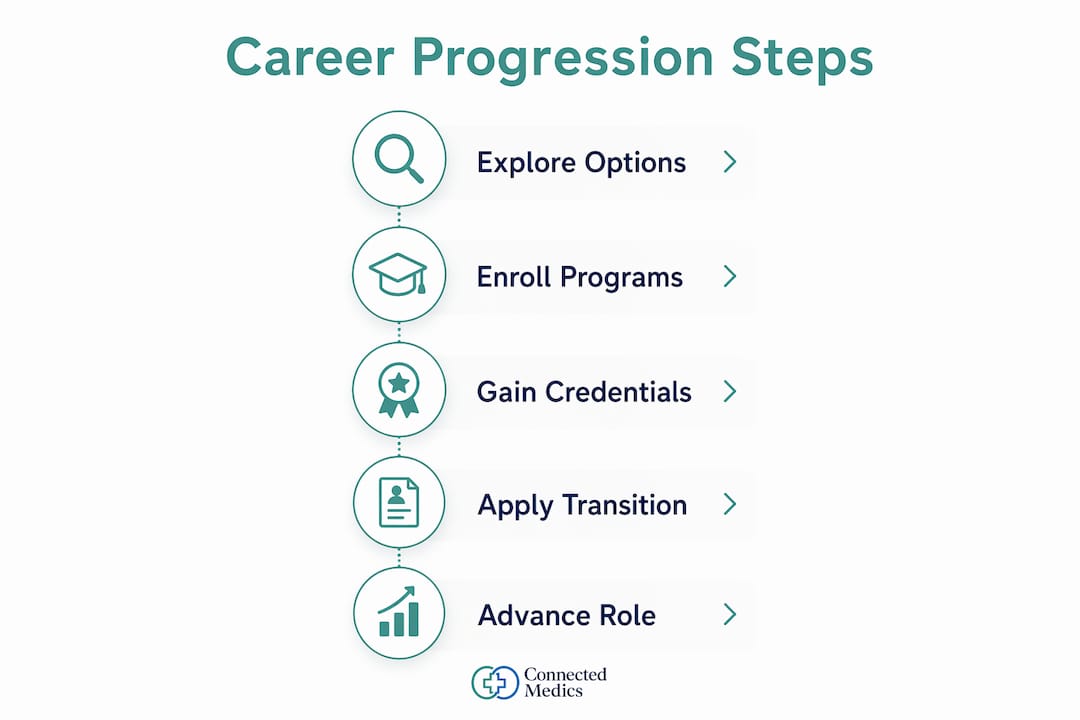
A clear sequence matters more than speed. Follow these steps:
- Self-assess — identify your current role, credentials, and the gap between where you are and your target position.
- Name the target role — use the Talent Network to research what credentials and experience posted roles actually require.
- Map required credentials — check whether HCA's tuition assistance, FastTrack, or a cohort program covers the gap. Review nursing advancement pathways for role-specific timelines.
- Apply to programs — submit cohort applications early; seats are limited and competitive.
- Use mentorship and internal postings — request a formal mentor through the Leadership Institute and monitor the Talent Network weekly.
Typical progression timelines:
| Move Type | Typical Timeline | Who Usually Funds It |
|---|---|---|
| Lateral move (department transfer) | 3–12 months | Employee-initiated; no tuition cost |
| Specialty conversion (e.g., PCT to radiology tech) | 6–24 months | HCA tuition assistance / FastTrack |
| Leadership track (charge nurse to director) | 12–36 months | HCA cohort programs / Galen partnership |
HCA covers tuition for Galen programs through direct billing, meaning no out-of-pocket cost for eligible colleagues. Employee-paid options exist for external certifications not covered by the assistance program.
Pro Tip: Treat cohort participation as your primary networking channel inside HCA. Cohort-based programs consistently surface hidden internal roles and mentorship connections that never appear on a public job board.
5. What leadership and research say about HCA's investment in progression
HCA's approach to advancement is deliberate. HCA Healthcare's leadership pipeline uses structured transition plans, mentorship, and leadership institutes to prepare colleagues for increasing responsibility at every stage, not just at the point of promotion.
The numbers behind the programs are concrete. HCA secured $2.4M in grants in 2025 to expand workforce training, with $1.9M more in the pipeline. Over 1,450 COE graduates have advanced their careers through these programs. In 2023, more than 800 nurses received upward of $3 million in nursing leadership development, with 75% using those funds toward a Master of Science in Nursing degree.
Career development programs consistently show that employees who engage in structured growth pathways are statistically harder to replace and more likely to stay committed through organizational change — a finding that aligns directly with HCA's 91% COE retention rate.
Key Takeaways
HCA career progression matters because it raises pay, reduces burnout, and improves patient care — and HCA funds most of the pathway through tuition assistance, cohort programs, and the Talent Network.
| Point | Details |
|---|---|
| Pay and credentials | Specialty conversions and leadership tracks move clinicians into higher pay bands with HCA funding most tuition costs. |
| Retention and burnout | HCA's COE programs achieved a 91% average retention rate across 1,005 participants in 2025. |
| Employer cost savings | COE programs saved HCA over $4.2M in contract labor costs in 2025. |
| First steps | Join the Talent Network, ask about FastTrack or tuition assistance, and apply to a cohort program early. |
| Connectedmedics | Use Connectedmedics to find specialty roles, peer communities, and career resources that complement HCA's internal pathways. |
The case for being proactive, not passive
Most clinicians wait to be tapped for advancement. That approach rarely works at a system the size of HCA. The programs — Leadership Institute, FastTrack, Director Development, Galen partnership — are there, but they require you to seek them out. Peer networking inside cohorts is where the real career intelligence lives: who is moving, which roles are opening, and which managers are actively developing their teams.
The argument for pursuing progression at HCA is not just personal. A more skilled, credentialed workforce delivers measurably better patient outcomes. When you advance, your patients benefit directly. That connection between individual growth and care quality is what makes HCA's investment in these programs worth taking seriously — and worth acting on now rather than later.
Connectedmedics supports your career beyond HCA's walls
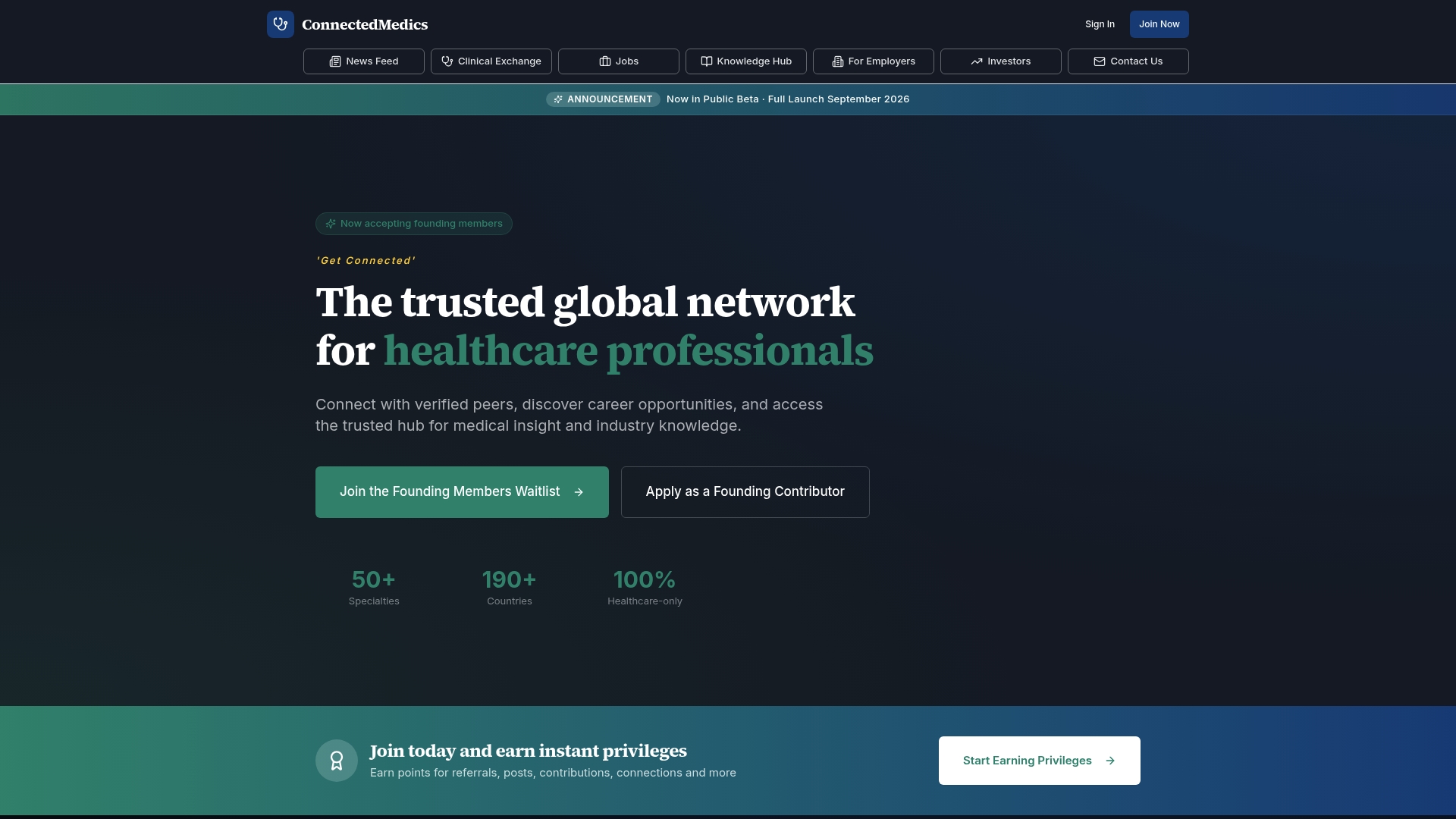
HCA's internal programs are strong, but career growth also depends on what you know about the broader market — salary benchmarks, specialty demand, and peer connections outside your facility. Connectedmedics gives healthcare professionals a verified network built specifically for clinical careers, not a generic job board.
Relevant features for HCAs, nurses, and allied health workers:
- Verified professional profiles — connect with peers and mentors in your specialty
- Over 4,600 active healthcare vacancies with specialty-specific filters
- AI-powered job matching aligned to your credentials and target roles
- Curated clinical knowledge hub with research summaries and workforce trend coverage
- Specialty communities for peer discussion and career guidance
Explore top skills healthcare employers prioritize and then use Connectedmedics to find roles that match them. Sign up at connectedmedics.com to access the jobs board, knowledge hub, and peer network.
Useful sources and next steps
- HCA Healthcare Impact Report — Workforce Development — COE retention rates, grant funding, and program graduate data
- HCA Healthcare Magazine — Continually Learning and Growing — program details for Centers for Clinical Advancement and Galen partnership
- HCA Healthcare Magazine — Creating Workforce Solutions — FastTrack, tuition assistance, and leadership pipeline overview
- Becker's — HCA Leadership Pipeline Strategy — leadership perspective on structured transition plans and mentorship
- HCA Talent Network / LEAD Program — internal mobility hub and cohort program access
- Galen College of Nursing — degree programs available to HCA colleagues with direct-billing tuition assistance
- Healthcare Assistant Career Growth: Real Examples and Paths — practical HCA advancement examples on Connectedmedics
- Connectedmedics Knowledge Hub — curated career resources, salary trends, and specialty job leads