
Work-life balance for doctors is the deliberate integration of professional duties and personal priorities through boundary setting, workload control, and cultural change within healthcare environments. The medical profession frames this concept in two ways: traditional "balance," which implies equal weight on both sides, and the more realistic "physician work-life harmony," which acknowledges that energy and focus shift with career stage and personal circumstances. According to the AMA, 54.6% of physicians cite higher compensation as a top need, while 53% want workflow improvements and 49.6% want less after-hours work. Those numbers reveal that burnout is not a personal failure. It is a structural problem demanding structural solutions.
What are the core challenges to work-life balance for doctors?
Physician burnout originates from a combination of clinical volume, administrative overload, and cultural expectations that discourage self-advocacy. Understanding each factor is the first step toward addressing it.
The hidden workload problem
Doctors spend nearly two hours on EHR documentation for every hour of patient care. A physician seeing 20 patients in an 8-hour day generates roughly 16 hours of administrative work. That math alone explains why so many physicians work well past their scheduled hours without anyone formally acknowledging it.

The invisible tasks compound the problem. Prior authorizations, inbox management, prescription refills, and insurance correspondence rarely appear on a clinical schedule. They exist in the margins of the day, after clinic ends, during lunch, or late at night. Physicians who track all tasks for one week consistently discover their actual workload far exceeds what their official schedule suggests.
Cultural and emotional labor
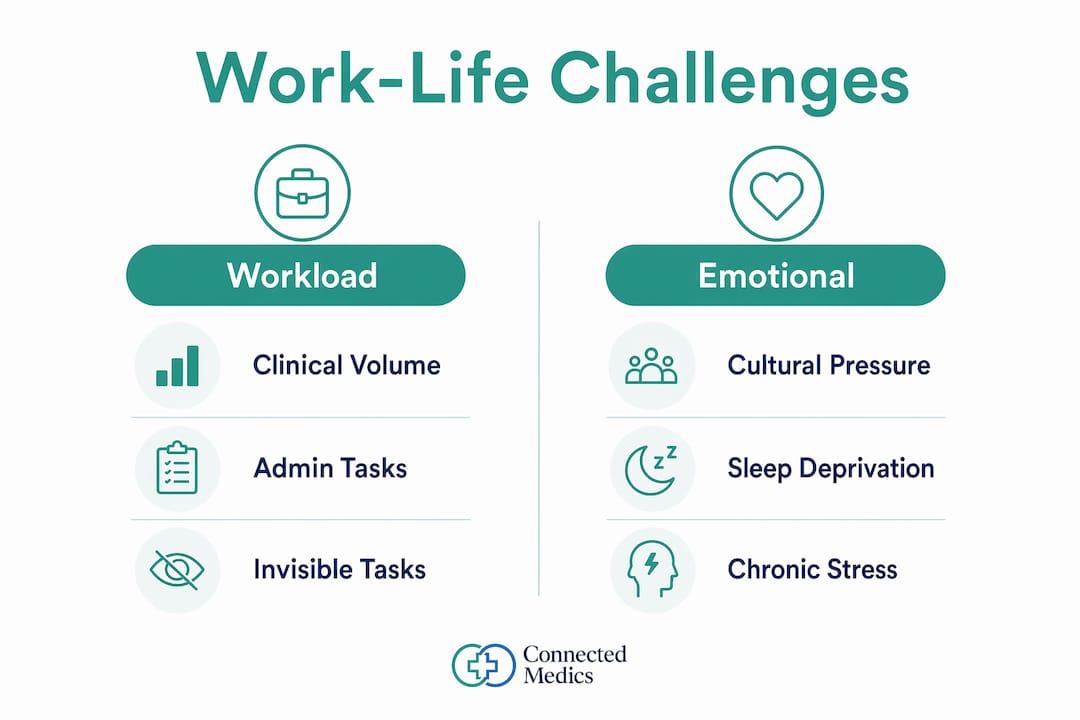
Medicine carries a professional culture that equates long hours with dedication. Physicians who leave on time or decline extra call are sometimes perceived as less committed. This cultural pressure adds an emotional labor burden on top of the clinical one. Doctors must manage not only patient emotions but also the internal cost of appearing "available" to colleagues and administrators.
The key factors driving imbalance include:
- After-hours documentation that extends the workday invisibly
- Prior authorizations consuming clinical decision-making time
- Inbox overload from patient messages, lab results, and referrals
- Call responsibilities that fragment sleep and recovery
- Inadequate recovery time between shifts, which degrades cognitive performance and increases error risk
Inadequate recovery does more than cause fatigue. Research consistently links sleep deprivation and chronic stress to measurable declines in clinical judgment, which means physician well-being and patient safety are directly connected.
Which strategies effectively improve physician work-life harmony?
Evidence-backed strategies exist. The challenge is that most require either institutional support or deliberate contract negotiation. Physicians who wait for their employer to act rarely see change. Those who advocate for specific structural adjustments do.
-
Block protected administrative time. Replacing a physician costs $500,000 to $1 million, which gives physicians real leverage when requesting protected time. Two 4-hour administrative blocks per week prevent after-hours charting and reduce burnout without reducing patient access.
-
Negotiate a compressed workweek. A four-day clinical week with one protected administrative day reduces the sense of constant reactivity. Physicians report higher satisfaction when they control at least one full day of non-patient-facing work.
-
Integrate telehealth strategically. Hybrid clinic models that mix in-person and telehealth visits reduce commute time, allow schedule flexibility, and can cut the physical fatigue associated with full in-person days. Telehealth also enables physicians to handle follow-up visits more efficiently.
-
Set visible communication boundaries. Establish clear expectations with patients and staff about response times for non-urgent messages. A written policy stating that inbox messages receive a response within 48 business hours reduces the pressure to respond immediately and trains patients to use urgent channels appropriately.
-
Delegate non-clinical tasks. Medical assistants, scribes, and care coordinators can handle documentation support, prescription routing, and prior authorization initiation. Delegation is not a sign of weakness. It is a clinical efficiency decision.
-
Negotiate reassessment clauses in contracts. A one-year reassessment clause allows physicians to renegotiate call burden and administrative duties before scope creep becomes entrenched. Without this clause, workload tends to expand silently over time.
Pro Tip: Before your next contract renewal, track every work task for two full weeks, including inbox time, documentation, and after-hours calls. Present that data to your employer as the basis for requesting protected administrative time or a reduced call schedule.
How do medical specialties influence work-life balance?
Specialty choice is one of the most significant predictors of long-term physician satisfaction. The relationship between specialty and work-life balance in medicine is well documented, and the differences are substantial.
Dermatology and preventive medicine consistently report higher satisfaction scores. Both specialties offer predictable schedules, limited emergency call, and defined patient panels. Physicians in these fields can plan personal time with reasonable confidence that it will not be disrupted.
Neurosurgery and emergency medicine sit at the opposite end. Neurosurgery involves long operative cases, high-stakes decisions, and unpredictable call. Emergency medicine, despite fewer total annual hours in some systems, generates about 60% burnout due to fragmented shift work, overnight rotations, and the emotional intensity of acute care without continuity.
| Specialty | Schedule predictability | Call burden | Reported satisfaction |
|---|---|---|---|
| Dermatology | High | Low | High |
| Preventive medicine | High | Very low | High |
| Family medicine | Moderate | Moderate | Moderate |
| Emergency medicine | Low | Shift-based | Low to moderate |
| Neurosurgery | Very low | High | Low |
Physicians considering a specialty change or subspecialty training should weigh specialty-specific workload characteristics against their personal life priorities. A specialty that looks prestigious in residency may not align with the life you want at age 45. That mismatch is a leading driver of mid-career burnout.
What mindset and boundary-setting approaches support sustainable careers?
The shift from "balance" to physician work-life harmony is not just semantic. Balance implies a static state where work and life receive equal weight at all times. Harmony acknowledges that during residency, work dominates. During a family health crisis, personal life takes priority. The goal is not equality. It is intentional allocation based on current circumstances.
Boundary setting in medicine requires treating every decision as a negotiation with real costs. Every "yes" to an extra shift is implicitly a "no" to something personal. Physicians who recognize this trade-off explicitly make better decisions about where to spend their capacity. Those who operate on autopilot tend to accumulate commitments until they hit a wall.
Practical boundary-setting approaches that work:
- Define your non-negotiables in writing. Identify two or three personal commitments, such as dinner with family or a weekly exercise block, that you protect as firmly as a surgical case.
- Communicate limits proactively. Tell patients and colleagues your response-time expectations before a conflict arises, not after.
- Treat self-care as a clinical duty. Self-care is a priority maintenance task equivalent to clinical responsibilities. Skipping it degrades your ability to care for patients.
- Recognize early burnout signals. Cynicism, emotional detachment from patients, and persistent fatigue are early warning signs. Catching them early allows course correction before they become entrenched.
- Seek mentorship actively. Mentorship helps mid-career physicians validate their decisions, reduce isolation, and prioritize workload control. It is one of the most underused tools in medicine.
Pro Tip: Frame boundary setting as an investment in career longevity, not as a rejection of professional commitment. Physicians who sustain long careers do so by protecting their capacity, not by depleting it.
Physicians who adopt the harmony model and treat boundaries as deliberate negotiations report higher career satisfaction and lower rates of early departure from practice. The healthcare professional wellness strategies that work long-term are those built on self-awareness, not willpower alone.
Key Takeaways
Sustainable physician careers require structural changes, not individual resilience alone. The most effective approach combines protected administrative time, deliberate boundary setting, and specialty-informed career planning.
| Point | Details |
|---|---|
| Hidden workload drives burnout | Track all tasks including inbox and documentation to reveal true work hours and build a case for change. |
| Protected admin time reduces after-hours work | Two 4-hour blocks per week prevent charting from spilling into personal time and improve retention. |
| Specialty choice predicts satisfaction | Dermatology and preventive medicine offer predictable schedules; neurosurgery and emergency medicine carry the highest burnout risk. |
| Harmony beats balance as a framework | Shifting focus and energy with life seasons is more realistic than seeking equal weight between work and personal life. |
| Contract clauses protect long-term workload | A one-year reassessment clause allows physicians to renegotiate call and administrative duties before burnout sets in. |
What I've learned about balance that most articles won't tell you
The conversation around work-life balance for doctors tends to focus on individual coping strategies: meditate more, exercise regularly, set better limits. That advice is not wrong. It is just incomplete. The physicians I have seen sustain long, satisfying careers are not the ones with the best stress management techniques. They are the ones who got structural about it early.
The most underrated move is tracking your actual hours, including every invisible task, for two weeks and then presenting that data to your department head or administrator. Most physicians assume their employer knows how much they work. They do not. Invisible labor stays invisible until someone makes it visible with numbers.
The second thing most articles skip is the social cost of boundary setting in medicine. Saying no to an extra call shift does not just affect your schedule. It affects how colleagues perceive you. That cost is real, and pretending it is not does physicians a disservice. The better frame, as Medscape's 2026 reporting on physician boundaries confirms, is to treat each decision as a deliberate negotiation rather than a binary yes or no. That framing gives you agency without the guilt.
The cultural shift in medicine is real and it is accelerating. Younger physicians are demanding predictable hours and protected time at rates that are forcing health systems to respond. Technology, including AI-assisted documentation and asynchronous telehealth, is reducing the documentation burden that has historically consumed physician evenings. The structural conditions are improving. But they improve faster for physicians who advocate clearly and specifically for what they need.
— David
Connectedmedics: a network built for healthcare professionals
Doctors managing stress and seeking career sustainability need more than generic professional advice. They need a community that understands the specific pressures of medical practice.

Connectedmedics is a global network built exclusively for healthcare professionals, with verified profiles, a knowledge hub of clinical insights, and over 4,600 active healthcare vacancies. Physicians use it to connect within their specialty, access career resources, and find roles that align with their personal and professional priorities. Whether you are evaluating a specialty change, looking for a position with better schedule control, or simply want to connect with peers who understand the demands of medicine, join Connectedmedics to access a community built around your career.
FAQ
What is physician work-life harmony and how does it differ from balance?
Physician work-life harmony is the practice of intentionally shifting focus and energy between professional and personal priorities based on current life circumstances. Unlike traditional balance, which implies equal weight at all times, harmony accepts that priorities change by career stage and personal season.
How can doctors reduce after-hours documentation?
Doctors can reduce after-hours documentation by scheduling two protected 4-hour administrative blocks per week, using medical scribes or AI-assisted documentation tools, and delegating prescription routing and prior authorization initiation to support staff.
Which medical specialties have the best work-life balance?
Dermatology and preventive medicine consistently report the highest work-life satisfaction due to predictable schedules and low call burden. Emergency medicine and neurosurgery carry the highest burnout rates due to shift fragmentation and high-stakes unpredictability.
How does contract negotiation affect physician burnout?
A one-year reassessment clause in a physician contract allows workload and call responsibilities to be renegotiated before scope creep becomes entrenched. Without this clause, administrative and call duties tend to expand silently over time, increasing burnout risk.
When should a doctor seek mentorship for work-life concerns?
Physicians should seek mentorship at the first signs of cynicism, emotional detachment, or persistent fatigue, which are early burnout indicators. Mid-career mentorship helps physicians validate their decisions and prioritize workload control before burnout becomes severe.