
Specialty matching in medical hiring is the systematic process of aligning physician candidates' skills, preferences, and career goals with the specific needs of healthcare organizations. Formal systems like the National Resident Matching Program (NRMP) operationalize this through rank order lists and algorithmic placement, ensuring candidates land in positions that reflect their stated preferences. The NRMP's Charting Outcomes dashboard tracks matched specialty by program placement, distinguishing between preferred and non-preferred outcomes. Understanding the role of specialty matching in medical hiring is no longer optional for recruiters. It is the foundation of every effective medical specialty recruitment strategy.
How does the specialty matching process work?
The NRMP matching algorithm places applicants into programs based entirely on mutual preference rankings. Both applicants and programs submit rank order lists through the NRMP's R3 system, and the algorithm works to place each person in the highest-ranked program that also ranked them. No side can game the system by strategically misrepresenting preferences. Honest ranking is always the optimal strategy.
Advanced vs. preliminary positions
The NRMP distinguishes between Advanced and Preliminary positions. Advanced positions are specialty-specific and filled one year ahead of the start date. Preliminary positions serve as one-year entry points before a candidate transitions into a specialty program. Recruiters who conflate these two categories misread fill-rate data and draw incorrect conclusions about specialty demand.

How preference signaling changes outcomes
Preference signaling is one of the most underused tools in medical specialty recruitment. Applicants formally signal interest in specific programs before interview invitations go out. A meta-analysis of 10,448 applicants found that preference signaling increases interview rates by over 9-fold and match rates by 6-fold in surgical subspecialties. That is not a marginal improvement. It is a structural advantage for both the applicant and the program.
Here is a step-by-step view of how the process flows:
- Applicants apply to programs and submit preference signals where available.
- Programs review applications and extend interview invitations.
- Both sides submit rank order lists to the NRMP R3 system.
- The algorithm runs and produces match results.
- Unmatched positions enter the Supplemental Offer and Acceptance Program (SOAP).
Pro Tip: If you are a recruiter building a specialty hiring pipeline, treat preference signals as early intent data. Candidates who signal your program are statistically far more likely to rank you highly.
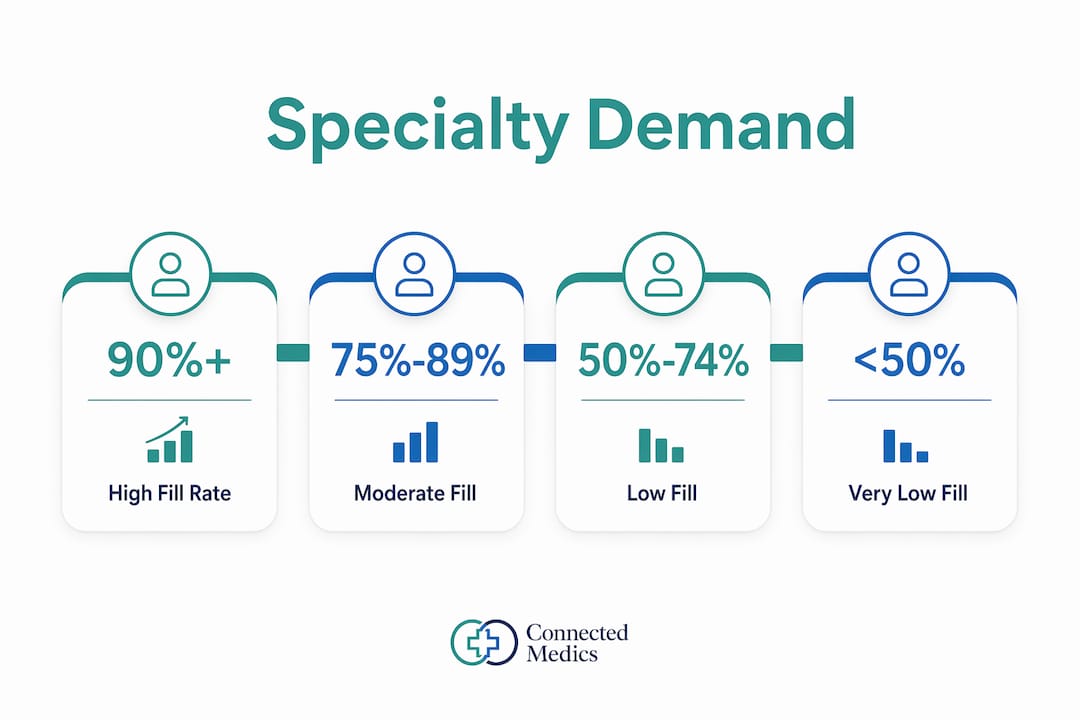
The table below shows how fill rates varied across the 2026 Specialties Matching Service:
| Fill Rate Category | Number of Subspecialties |
|---|---|
| 90%+ positions filled | 26 of 81 subspecialties |
| 75%+ positions filled | 49 subspecialties |
| Below 50% fill rate | 8 subspecialties |
The 2026 SMS report shows that fill-rate performance varies sharply across subspecialties. That variance is the single most important data point for building a specialty-specific recruitment plan.
Why does specialty alignment matter for hiring outcomes?
Specialty alignment produces measurable improvements in recruitment efficiency, candidate satisfaction, and long-term retention. When a physician is placed in a specialty that matches their stated preferences and training, the fit extends beyond credentials. It reflects career intent, which is a stronger predictor of retention than board scores or program prestige.
The benefits of specialty matching include:
- Reduced time-to-fill for high-demand roles when preference signals are used early in the cycle.
- Higher candidate satisfaction because placement reflects genuine career goals, not default availability.
- Lower early attrition in specialty roles where the physician chose the field deliberately.
- Better organizational fit when values alignment is assessed alongside technical credentials.
- Stronger workforce planning because NRMP specialty data gives recruiters transparent benchmarks for each specialty.
"A specialty becomes competitive when 70% of healthcare organizations are recruiting for the same physician role, regardless of whether a formal shortage has been declared." — AMA recruitment survey data
That AMA threshold reframes how recruiters should think about competition. You do not need a federal shortage designation to face a tight market. You need to know what your peers are hiring for right now.
Pro Tip: Map your open specialty roles against AMA recruiter demand data each quarter. If 70% of organizations are chasing the same specialty, your standard posting strategy will not be enough. You need a direct outreach plan.
Specialty alignment also protects organizations from the hidden cost of mismatched placements. A physician who trained for one specialty but accepted a role in another due to limited options is a retention risk from day one. Structured specialty fit assessment at the hiring stage prevents that outcome.
How do fill rates and specialty demand shape recruitment strategy?
Fill-rate variability across subspecialties means one recruitment playbook cannot serve every specialty. The 2026 NRMP SMS data confirms this directly. Eight subspecialties filled fewer than 50% of available positions. That is not a pipeline problem. It is a signal that standard recruitment approaches are failing in those fields.
The table below compares recruitment tactics by specialty demand level:
| Specialty Demand Level | Recruitment Approach | Key Tactics |
|---|---|---|
| High demand (90%+ fill) | Competitive differentiation | Early preference signaling, fast interview scheduling, strong program branding |
| Moderate demand (75–89% fill) | Targeted outreach | Specialty-specific job boards, direct candidate engagement, values-based screening |
| Low demand (below 50% fill) | Alternative pathways | Fellowship pipeline development, international medical graduate outreach, role redesign |
Specialty fill-rate variability requires recruiters to build separate strategies for each tier. Treating a low-fill subspecialty the same as a high-fill one wastes resources and produces poor outcomes.
For hard-to-fill specialties, stronger fit signals matter more, not less. Candidates considering a low-demand field often have multi-specialty interests. Recruiters who acknowledge that openly and present clear career pathways attract more qualified applicants than those who demand exclusive commitment upfront. Reviewing a medical specialty career guide can help both recruiters and candidates understand where demand concentrates across the 2026 market.
High-demand specialties require speed and differentiation. When 70% of organizations compete for the same cardiologist or orthopedic surgeon, the program that moves fastest and communicates its values most clearly wins. Slow interview scheduling is one of the most common and preventable reasons high-demand candidates disengage.
What are the limits of credential-only specialty matching?
Credential alignment is necessary but not sufficient for effective specialty matching. A 2026 peer-reviewed critique challenges the "specialty soulmate" framing, which assumes every physician has one ideal specialty and the matching system's job is to find it. That framing is too narrow. It penalizes candidates who hold genuine interest in multiple specialties and discourages honest multi-ranking.
The critique recommends that hiring systems integrate broader fit dimensions, including:
- Values alignment: Does the candidate's approach to patient care match the organization's clinical culture?
- Career trajectory: Is the candidate's long-term goal compatible with the role's growth path?
- Multi-specialty openness: Does the system allow candidates to rank multiple specialties without being penalized for exploring alternatives?
- Lifestyle and practice setting preferences: Does the role's structure match what the candidate actually wants from their work life?
Allowing honest multi-specialty rankings produces better match outcomes and reduces early attrition. Candidates who feel forced to commit to a single specialty before they are ready often disengage from the process or accept placements they later leave.
Pro Tip: When screening candidates for hard-to-fill specialties, ask directly about multi-specialty interests. Candidates who name your specialty as one of two or three genuine interests are often stronger long-term fits than those who claim it is their only option.
Recruiters who rely exclusively on board scores, fellowship credentials, and publication records miss the values layer entirely. The importance of specialty alignment now extends to culture, values, and career intent. Organizations that build assessment frameworks around these dimensions report stronger retention in specialty roles. A practical starting point is reviewing a healthcare job search checklist to understand what candidates prioritize when evaluating specialty roles.
Key takeaways
Specialty matching works best when organizations combine algorithmic preference alignment with values-based fit assessment and specialty-specific recruitment strategies.
| Point | Details |
|---|---|
| Preference signaling drives results | Signaling increases match rates by 6-fold in surgical subspecialties, making it a critical early-stage tool. |
| Fill rates vary sharply by specialty | Eight subspecialties filled below 50% in 2026, requiring distinct recruitment approaches for each tier. |
| Credential matching is not enough | Values, career intent, and multi-specialty openness predict retention better than credentials alone. |
| AMA demand threshold signals competition | When 70% of organizations recruit the same specialty, standard posting strategies fail without direct outreach. |
| Data transparency improves planning | NRMP's specialty-specific reporting gives recruiters benchmarks to build informed, specialty-targeted hiring plans. |
What i have learned about specialty matching after years in healthcare recruitment
Most recruiters treat specialty matching as a sorting problem. Find a cardiologist, fill the cardiology slot. That framing misses the point entirely.
The organizations that consistently outperform in specialty hiring treat matching as a two-sided commitment. They invest time in understanding what a candidate actually wants from a specialty, not just whether their credentials qualify them for it. That distinction sounds small. In practice, it separates teams with 18-month retention from teams with 5-year retention.
The NRMP data is more useful than most recruiters realize. The fill-rate breakdowns by subspecialty are not just statistics. They are a map of where your standard approach will fail and where you need a different strategy. Eight subspecialties below 50% fill in 2026 is not a coincidence. Those fields have structural recruitment problems that no amount of job posting will solve without a redesigned approach.
The critique of "specialty soulmate" framing also resonates with what I have seen on the ground. Candidates who feel pressured to commit to a single specialty before they are confident often make that commitment dishonestly. They say what the system rewards. Then they leave when reality does not match the performance. Allowing honest multi-specialty ranking is not a concession. It is better data.
My recommendation: define what specialty match means inside your organization before you post a single role. Does it mean credential match? Values match? Practice setting match? All three? Clarity at that stage shapes every downstream decision, from how you screen to how you onboard.
— David
Find specialty-matched candidates faster with Connectedmedics
Connectedmedics is a global network built exclusively for healthcare professionals, with over 4,600 active vacancies across verified specialty categories. Recruiters on the platform reach candidates with confirmed credentials and specialty backgrounds, removing the noise that generic job boards introduce. The Connectedmedics recruiters portal gives hiring teams direct access to verified medical professionals filtered by specialty, location, and role type. For candidates in career transition, the Connectedmedics platform connects specialty-specific job leads with clinical knowledge resources contributed by verified medical experts. Whether you are filling a high-demand surgical subspecialty or building a pipeline for a hard-to-fill role, Connectedmedics provides the infrastructure to do it with precision.
FAQ
What is specialty matching in medical hiring?
Specialty matching is the process of placing physician candidates into training or employment positions that align with their stated specialty preferences and qualifications. The NRMP operationalizes this through rank order lists and an algorithm that prioritizes mutual preference alignment.
How does the NRMP matching algorithm work?
Both applicants and programs submit ranked preference lists to the NRMP R3 system. The algorithm places each applicant in the highest-ranked program that also ranked them, making honest ranking the optimal strategy for both sides.
Why do some specialties have low fill rates?
Fill-rate variability reflects differences in specialty demand, candidate supply, and recruitment approach quality. In 2026, eight subspecialties filled fewer than 50% of positions, signaling structural gaps that require alternative recruitment pathways beyond standard matching cycles.
Does preference signaling actually improve match outcomes?
Yes. A meta-analysis of 10,448 applicants found preference signaling increases interview rates by over 9-fold and match rates by 6-fold in surgical subspecialties. Programs that receive signals can prioritize high-intent candidates earlier in the cycle.
Should recruiters allow candidates to rank multiple specialties?
A 2026 peer-reviewed study recommends allowing honest multi-specialty ranking to improve match outcomes and reduce early attrition. Penalizing candidates for exploring multiple specialties produces dishonest rankings and weaker long-term retention.