
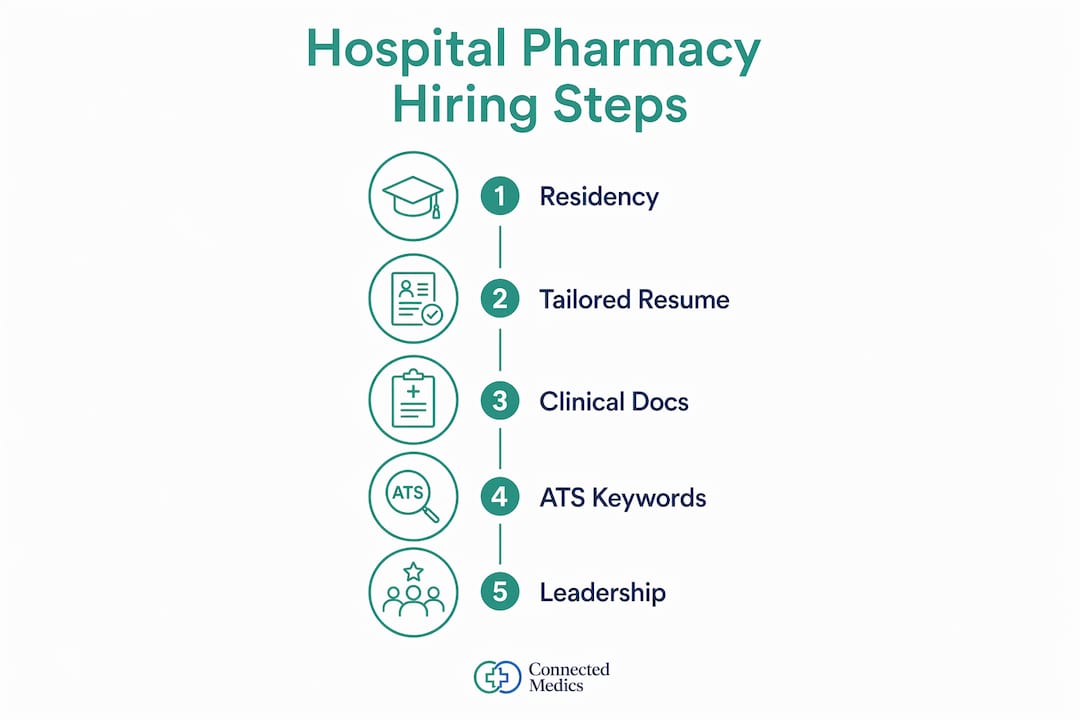
Attracting hospital pharmacy job offers is defined by three factors: completed residency training, precisely tailored application materials, and documented clinical competency. Pharmacists who align their credentials with hospital-specific hiring criteria, including PGY1 residency completion, licensure eligibility, and sterile compounding documentation, consistently outperform candidates who rely on general experience alone. This guide covers the prerequisites, resume strategies, ASHP Match navigation, and differentiation tactics that give pharmacists and pharmacy graduates the best chance of landing hospital pharmacy positions in 2026.
What credentials do you need to attract hospital pharmacy job offers?
Hospital employers filter candidates against a defined checklist before a resume reaches a human reviewer. Meeting every item on that checklist is the minimum entry point for hospital pharmacy career opportunities.
The most important credential is PGY1 residency completion. Mayo Clinic requires PGY1 residency, hospital pharmacy experience, licensure eligibility within 60 days of hire, and Basic Life Support (BLS) certification within 3 months of hire. This combination reflects the standard that most academic medical centers and large health systems apply. Candidates without residency training are screened out before interviews begin at institutions of this caliber.
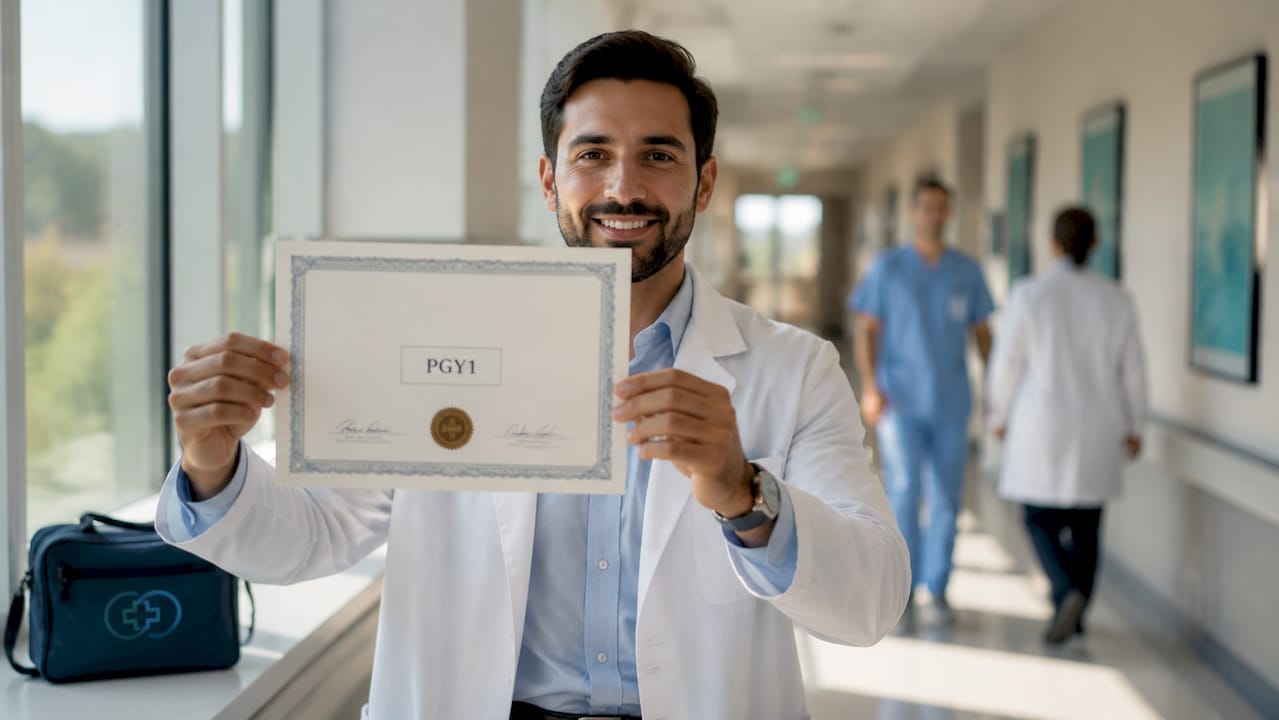
Licensure timing matters as much as the license itself. Most hospital postings specify a window, typically 60 to 90 days, within which a new hire must hold an active state license. Pharmacy graduates who plan their NAPLEX and MPJE timelines around anticipated start dates signal organizational readiness to recruiters.
Sterile compounding competency is a non-negotiable credential for inpatient roles. The Joint Commission requires ongoing competency demonstrations including written testing, media-fill testing every 6 or 12 months depending on risk category, and gloved fingertip sampling. Candidates who can document completed competency cycles before applying hold a concrete advantage over those who cannot.
- PGY1 residency completion or active enrollment in an accredited program
- State licensure eligibility within the hospital's specified hiring window
- BLS certification or documented plan to obtain it within 90 days
- Sterile compounding competency records including media-fill and fingertip sampling results
- Inpatient clinical rotation hours with documented patient care interventions
Pro Tip: Attach a one-page competency summary to your application packet that lists each completed Joint Commission competency with dates and risk categories. Most candidates skip this step, and it immediately separates your file from the stack.
How do you tailor your resume to pass hospital ATS filters?
Low ATS scores block qualified applicants by filtering out resumes that miss job-specific hospital terms, regardless of actual clinical experience. The fix is precise language alignment, not a longer resume.
Hospital pharmacy resumes require different vocabulary than retail or community pharmacy resumes. Terms like antimicrobial stewardship, formulary management, medication therapy management (MTM), and pharmacokinetic dosing appear in hospital job postings and must appear in your resume. Generic phrases like "detail-oriented team player" carry zero ATS weight and waste space that clinical metrics could occupy.
Software names matter. Epic Willow and Cerner are the two dominant pharmacy information systems in U.S. hospitals. If you have used either platform during rotations or residency, name them explicitly. ATS systems scan for exact software matches, and a resume that says "electronic health record experience" instead of "Epic Willow" will score lower than one that names the system directly.
Quantifying outcomes converts clinical experience into recruiter-readable evidence. ResumeAdapter advises against generic phrasing and instead recommends hospital-relevant metrics like antimicrobial stewardship interventions, MTM patient volume, and documented medication error reductions. A bullet point that reads "Completed 47 MTM consultations per month with 92% medication adherence improvement" communicates far more than "provided patient counseling."
Follow this sequence when building each resume bullet point:
- Start with a clinical action verb: managed, documented, optimized, evaluated, reconciled
- Name the specific drug class, system, or protocol involved
- Add a measurable outcome or volume figure
- Reference the setting (ICU, oncology, sterile compounding suite) to confirm hospital context
- Mirror the exact language from the job posting wherever it fits naturally
Cover letters follow the same logic. Open with the specific role title from the posting, reference one institutional priority from the hospital's website, and connect it to a documented outcome from your training. Effective pharmacist CVs structure work entries with action verbs, dates, locations, supervisors, and activity bullets to mirror residency expectations. Applying this structure to cover letters signals that you understand hospital culture before the interview.
Pro Tip: Paste the full job description into a keyword frequency tool before writing your resume. The terms that appear most often are the ones the ATS weights most heavily. Build your bullet points around the top 10 terms.
For a broader look at applying to healthcare vacancies efficiently, the process shares several principles with pharmacy-specific applications.
How does the ASHP Match process work for pharmacy residencies?
The ASHP Resident Matching Program is the primary pathway for PGY1 and PGY2 hospital pharmacy residencies, using the National Matching Services (NMS) algorithm to place applicants into accredited programs beginning in 2026. Understanding the mechanics of this system is not optional. It is the process that determines whether you get placed.
Registration and application happen through PhORCAS, the pharmacy-specific application platform. Applicants submit a single application through PhORCAS that reaches all selected programs, similar to how medical students use ERAS. Each program then conducts its own independent interview process outside the Match. No offers are made during interviews. Placement results come entirely from the matching algorithm after both applicants and programs submit their Rank Order Lists.
Key steps in the ASHP Match process:
- Register with NMS and create a PhORCAS profile before the application deadline
- Research programs by specialty focus, patient population, and scholarly activity requirements
- Apply to programs that align with your PGY2 or career goals, not just geographic preference
- Attend interviews and evaluate programs on culture, preceptor access, and clinical breadth
- Submit your Rank Order List by the published deadline, ranking programs in true preference order
- Review Match Day results and, if unmatched, participate in the Post-Match Scramble for remaining open positions
PGY2 candidates have access to the Early Commitment Process, which allows programs to commit to a candidate before the formal Match. This pathway rewards candidates who have built strong relationships with preceptors and program directors during PGY1. The Post-Match Scramble fills positions that went unfilled on Match Day and represents a real opportunity for candidates who were not placed in the primary cycle.
How does clinical documentation differentiate you to hospital employers?
Clinical competency documentation is an underused differentiator in hospital pharmacy applications. Most candidates list clinical rotations. Fewer candidates provide structured evidence of what those rotations produced.
| Documentation Type | Hospital Value |
|---|---|
| Media-fill test records with risk category and date | Confirms sterile compounding readiness per Joint Commission standards |
| Documented clinical interventions in electronic systems | Demonstrates direct patient safety impact and EHR proficiency |
| Pharmacokinetic dosing adjustments with outcome data | Shows independent clinical decision-making in high-acuity settings |
| Antimicrobial stewardship participation records | Aligns with formulary management priorities at academic medical centers |
Baystate Health's Clinical Pharmacist posting highlights monitoring medication order appropriateness, patient follow-up, and documenting interventions in electronic systems as core responsibilities. Candidates who arrive with existing documentation of these exact activities reduce the perceived onboarding risk for hiring managers. That perception directly influences offer decisions.
Sterile compounding competency timelines and documentation, including media fill and gloved fingertip sampling records, represent underused interview and resume differentiators. Bringing a competency portfolio to an interview, a physical or digital record of completed assessments with dates and outcomes, is a concrete signal that you operate at hospital compliance standards before day one.
What advanced strategies help pharmacists stand out in hospital hiring?
Meeting baseline credentials gets you past the ATS. Advanced strategies determine whether you receive an offer over equally qualified candidates. Hospitals are expanding pharmacy roles focusing on complex therapies that require advanced readiness and governance skills. Positioning yourself within that growth area is a concrete competitive move.
UF Health Shands lists adult critical care and med/surg experience, communication skills, research activities, and tuition support as components of their pharmacist opportunities. This signals that top health systems want pharmacists who contribute to institutional knowledge, not just daily dispensing operations.
Strategies that separate competitive candidates from the rest:
- Document experience with cell and gene therapy protocols, CAR-T administration support, or specialty infusion programs if applicable to your training
- Communicate staffing flexibility explicitly, including willingness to cover evenings, weekends, or cross-departmental assignments during onboarding
- List scholarly activities: poster presentations, published case reports, quality improvement projects with measurable outcomes
- Identify the hospital's current service expansion priorities from their annual report or news releases, then connect your skills to those priorities in your cover letter
- Track pharmacy workforce trends to identify which specialties are growing fastest and align your continuing education accordingly
Leadership experience carries weight even at the entry level. Serving as a resident representative, leading a P&T committee project, or precepting pharmacy students during rotations demonstrates governance readiness. Hospitals that are expanding clinical pharmacy services need pharmacists who can eventually lead those programs, and early evidence of that capacity accelerates hiring decisions.
Key takeaways
Attracting hospital pharmacy job offers requires residency completion, ATS-optimized application materials, and documented clinical competency evidence presented before and during interviews.
| Point | Details |
|---|---|
| Residency is the baseline | PGY1 completion is required at top systems like Mayo Clinic; without it, most applications are filtered before review. |
| ATS keywords determine visibility | Mirror exact terms from job postings, including Epic Willow, antimicrobial stewardship, and formulary management, to pass automated filters. |
| ASHP Match mechanics are fixed | No offers occur during interviews; placement results entirely from Rank Order List submissions through the NMS algorithm. |
| Competency documentation differentiates | Media-fill records, clinical intervention logs, and pharmacokinetic dosing data reduce perceived onboarding risk for hiring managers. |
| Advanced positioning wins offers | Scholarly activity, specialty therapy experience, and alignment with hospital growth priorities separate finalists from the rest. |
What I've learned about standing out in hospital pharmacy hiring
Most pharmacists treat their application as a credential submission. The ones who receive offers treat it as a clinical argument. The difference is whether you can show a hiring manager, in writing and in person, that you already operate at hospital standards before your first shift.
The candidates I have seen succeed consistently do two things that others skip. They document clinical interventions with specificity, not just "participated in antimicrobial stewardship rounds" but "recommended de-escalation in 14 of 22 cases reviewed, with attending acceptance rate of 86%." And they research the institution's current priorities before applying, not after receiving an interview.
Retail experience is not a disqualifier. Retail pharmacy experience must be translated into hospital-relevant clinical outcomes like documented interventions, medication safety, and formulary adherence. The translation is the work. Candidates who do that translation in their resume and cover letter, rather than leaving it to the recruiter's imagination, consistently advance further in the process.
The ASHP Match is not a lottery. It is an algorithm that rewards preparation. Programs rank candidates who demonstrated clinical depth, institutional fit, and professional maturity during interviews. Your Rank Order List should reflect genuine preference, not strategic gaming. The algorithm rewards honest ranking, and programs remember candidates who tried to manipulate the process.
— David
How Connectedmedics supports your hospital pharmacy job search
Connectedmedics is built for healthcare professionals who need more than a generic job board. The platform provides verified profiles, a global healthcare jobs board with over 4,600 active vacancies, and a knowledge hub with clinical guides contributed by verified medical experts.
For pharmacists targeting hospital roles, the Connectedmedics knowledge hub offers clinical updates, workforce trend summaries, and career development resources specific to pharmacy and allied health. Profiles on the platform are visible to healthcare recruiters searching for candidates with verified credentials, which adds a passive visibility layer to your active application strategy. Creating a complete profile with your residency training, competency certifications, and clinical specialties takes less than 30 minutes and puts your credentials in front of employers actively hiring in 2026.
FAQ
What credentials do hospitals require for pharmacy positions?
Most hospital systems require PGY1 residency completion, state licensure eligibility within 60 to 90 days of hire, and BLS certification. Mayo Clinic and similar academic medical centers list all three as non-negotiable prerequisites.
How do ATS systems filter pharmacy resumes?
ATS platforms scan for exact keyword matches from the job posting, including software names like Epic Willow and clinical terms like antimicrobial stewardship. Resumes missing these terms are filtered out before a recruiter reviews them, regardless of actual experience.
When do offers get made in the ASHP Match?
No offers are made during interviews in the ASHP Match process. Placement results come entirely from the NMS algorithm after both applicants and programs submit their Rank Order Lists by the published deadline.
How does sterile compounding documentation help in applications?
Completed media-fill test records and gloved fingertip sampling results confirm Joint Commission compliance readiness before hire. Presenting this documentation in an interview reduces perceived onboarding risk and signals that you meet hospital standards from day one.
What separates finalists from other qualified candidates?
Scholarly activity, specialty therapy experience such as CAR-T or critical care, and explicit alignment with the hospital's current service expansion priorities consistently differentiate finalists. Healthcare job search strategies that include institutional research before applying apply equally to pharmacy candidates.