
The strongest nonclinical tracks for physicians are medical writing and education, pharma and medical affairs, clinical research, healthcare consulting, health tech and informatics, and medical-legal work. Each converts clinical judgment into a different currency: writing and education trade income ceiling for flexibility, medical affairs and hospital leadership often match clinical pay, and expert witness work pays by the hour. License dependence, not interest level, is usually what narrows the list first.
TL;DR:
- Medical writing and education roles often do not require a license and generally offer remote work, with modest initial pay that can increase with experience.
- Medical affairs and drug development roles typically pay median salaries above $200,000 and often do not require an active license, especially in biotech and pharma companies.
- Transition timelines usually span 12 to 18 months, involving side projects, skill building, and testing through informational interviews before a full switch.
- Successful nonclinical career moves depend on clear translation of clinical achievements into business outcomes and targeted networking based on verified roles.
- Physicians should consider a hybrid work model initially to balance income, license maintenance, and exploration before committing fully to a new nonclinical path.
Table of Contents
- What Are the Best Nonclinical Physician Careers?
- How Do You Choose the Right Nonclinical Path?
- What Does a Realistic Transition Timeline Look Like?
- What Should You Expect to Earn in a Nonclinical Role?
- How Do You Update Your CV and Network for a Nonclinical Job?
- Rethinking Physician Identity Beyond the Bedside
- Find Verified Nonclinical Roles With ConnectedMedics
- Sources
What Are the Best Nonclinical Physician Careers?
Every nonclinical path draws on the same core asset: years of clinical judgment. What differs is how a role converts that judgment into value, and what it demands in return.
Medical writing and education. Medical writers turn trial data, regulatory submissions, and clinical guidelines into documents that pharma companies, journals, and medical education firms can actually use. Typical employers include pharmaceutical companies, medical communications agencies, and continuing medical education (CME) providers. Academic teaching roles, meanwhile, often skip the license requirement entirely once a physician steps away from direct patient care, and they offer scheduling flexibility that clinical faculty positions rarely match, though pay usually trails clinical salaries at the same institutions. Physicians tend to do well here because their training already centers on translating complex science for other people.
- Definition: converting clinical or scientific content into written or instructional material
- License required: no, in most academic and industry writing roles
- Remote potential: high
- Entry compensation: often modest at first, with upside as expertise and output scale
Pharma, medical affairs, and drug development. Medical science liaisons, drug safety physicians, and medical affairs directors bridge clinical evidence and commercial strategy inside pharmaceutical and biotech companies. Many of these roles do not require an active license because the work centers on scientific communication rather than patient contact, which makes this one of the more accessible entry points for physicians whose licensure has lapsed.
- Definition: shaping how clinical evidence informs drug development, safety monitoring, and messaging to physicians
- Typical employers: pharma companies, biotech firms, contract research organizations (CROs)
- License required: varies, often no
- Remote potential: high for medical affairs and safety roles
Clinical research. Principal investigators, medical monitors, and clinical development physicians design and oversee trials, often for CROs or academic research centers. This track stays closest to clinical reasoning while shifting the unit of impact from one patient to a population.
- Definition: designing, monitoring, or interpreting clinical trials
- License required: varies by role and sponsor
- Remote potential: moderate, with periodic site visits
Healthcare consulting and strategy. Consulting firms, health systems, and private equity groups hire physicians to evaluate clinical operations, assess new markets, or advise on healthcare investments. The pay ceiling here is high, but the work usually demands a fast learning curve in finance and strategy frameworks that medical school never covers.
- Definition: advising organizations on clinical operations, market entry, or investment decisions
- License required: no
- Remote potential: high, with travel for client engagements
Hospital leadership and administration. Chief medical officers, VPs of medical affairs, and physician executives run departments, manage budgets, and set clinical policy. These roles are place-bound by nature and usually require an active license, since many carry oversight responsibility for clinical staff and patient safety.
- Definition: managing clinical operations, staffing, and quality at a hospital or health system
- License required: yes, in most cases
- Remote potential: low
Health tech and informatics. Chief medical information officers and clinical product advisors help software companies build tools that clinicians will actually use. Demand here has grown alongside telehealth adoption, and remote work is common, though senior product roles sometimes require occasional onsite collaboration with engineering teams.
- Definition: guiding clinical accuracy and usability in health software and digital tools
- License required: rarely
- Remote potential: high
Medical-legal and expert witness work. Physicians review malpractice cases, testify in court, and consult for law firms and insurers. Rates run high per hour, but the work is often irregular, and building a caseload takes time and a credible track record.
- Definition: applying clinical expertise to legal disputes, malpractice review, or insurance claims
- License required: usually yes, though case review work sometimes does not
- Remote potential: moderate
Beyond these six, NEJM CareerCenter also tracks public health, health insurance and utilization management, and entrepreneurship as common landing spots for physicians leaving full-time practice.
How Do You Choose the Right Nonclinical Path?
Start with five variables: values, income floor, license preference, how close you want to stay to clinical work, and your realistic timeline. A physician with a mortgage and two kids in college has a different risk tolerance than someone five years from a planned retirement, and that difference should drive the shortlist more than personal interest alone.
A three-step framework keeps the search from sprawling:
- Inventory. List your transferable skills (writing, data analysis, committee leadership, quality improvement projects) separately from your clinical skills.
- Shortlist. Pick two or three categories from the list above that fit your income floor and license preference, and ignore the rest for now.
- Microtest. Run informational interviews, take on a small consulting project, or produce one writing sample before committing to a full transition.
Use these questions in early conversations to separate real opportunity from wishful thinking:
- What does a typical week look like in this role, hour by hour?
- Does this position require an active medical license, and if so, in which state?
- What percentage of people in this role came from clinical practice versus a business or PhD background?
- What is the realistic timeline from application to offer?
- Is remote work standard, occasional, or unavailable?
Watch for a red flag if a recruiter cannot answer the licensing question directly. That usually signals the role description was written by someone unfamiliar with physician credentialing, which often means the compensation band is misaligned with the actual duties too.
Pro Tip: Book three informational interviews before you touch a single job application. You will learn more from thirty minutes with someone doing the job than from an hour of scrolling postings.
What Does a Realistic Transition Timeline Look Like?
Most physicians who leave full-time clinical practice cleanly do it in stages, not in one leap. A hybrid model, often something like 0.6 FTE clinical work paired with 0.4 FTE in a nonclinical role, lets you test a new field without losing income, license currency, or the option to return to full-time practice if the new path does not fit. NEJM CareerCenter points to this mixed-portfolio approach as the lower-risk default for physicians exploring work outside patient care.
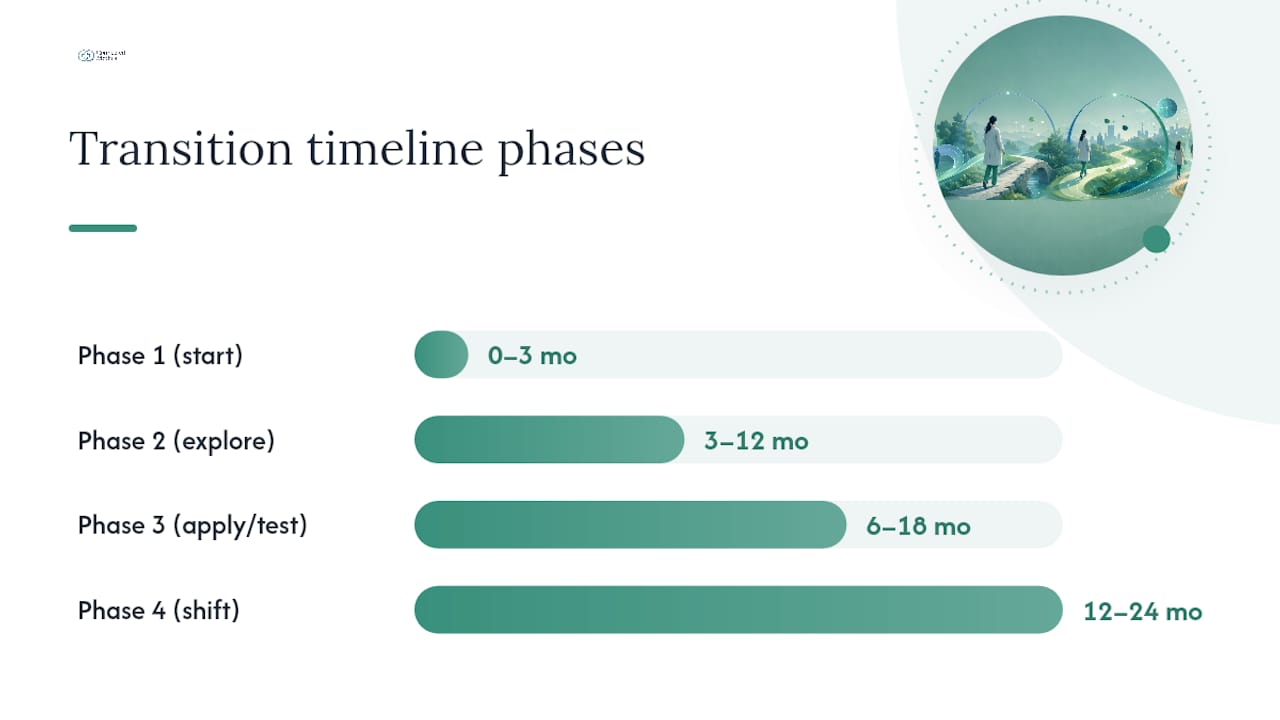
A realistic timeline usually breaks into four phases:
- 0 to 3 months: inventory skills, start informational interviews, update your LinkedIn profile with nonclinical keywords.
- 3 to 12 months: produce a writing sample or small project in your target field, narrow your shortlist to one or two tracks.
- 6 to 18 months: apply to hybrid or part-time roles, negotiate reduced clinical hours if staying at your current employer.
- 12 to 24 months: transition to your target role at the intensity you want, whether that is fully nonclinical or a durable hybrid split.
Physician Pivot notes that most successful transitions take 12 to 18 months of deliberate preparation, covering financial planning, skill-building, and testing through side projects before a physician makes the leap final.
Credentials matter selectively. An MBA or MHA carries real weight for hospital leadership tracks, but ResidencyAdvisor notes that internal committee leadership and quality improvement work often predict hireability just as well as an outside degree. A certificate from the American Medical Writers Association (AMWA) helps for medical writing roles, and an ICF coaching certification can matter for physicians moving into executive coaching or leadership development.
The most common mistake is quitting clinical practice before the nonclinical income is proven. The second most common mistake is treating clinical achievements as self-explanatory instead of translating them into business language a hiring manager outside medicine can score quickly.
What Should You Expect to Earn in a Nonclinical Role?
Pay varies sharply by track, and physicians who skip this research often set unrealistic expectations in either direction. Medical affairs director roles frequently pay median salaries above $200,000, and hospital executive compensation in some surveys runs around a median of $342,500, putting both tracks at or above many clinical specialties. Expert witness and legal consulting work can command $300 to $600 or more per hour at market rates, though the caseload is rarely steady enough to replace a full clinical income right away, according to Physician Pivot's compensation data.
Medical writing and early-stage entrepreneurship sit at the other end. Both often start below clinical pay and scale slowly, rewarding physicians who build a track record over a few years rather than those looking for an immediate income match.
Demand signals point toward flexibility as the biggest structural shift. Remote work is standard in medical affairs, drug safety, and medical writing, while hospital leadership and most clinical research roles still expect a physical presence.
Places worth checking regularly:
- Specialty-specific job boards and physician networking platforms, including ConnectedMedics
- Pharma and biotech company career pages, filtered by "medical affairs" or "clinical development"
- CRO career sites for clinical research and medical monitor roles
- Professional associations tied to your target track (AMWA for writing, AAPL for leadership)
Screen every posting for two things before applying: whether it lists "active license required" or "license not required," and whether remote work is explicitly stated rather than implied. Vague postings on either point tend to waste the most time.
How Do You Update Your CV and Network for a Nonclinical Job?
Clinical achievements need translation, not just listing. "Managed a panel of 2,000 patients" becomes something closer to "reduced readmission rates by coordinating a 12-person care team," because hiring managers outside medicine score outcomes and scale, not clinical vocabulary. Review a physician CV guide before your first nonclinical application, since the format that works for a hospital credentialing committee rarely works for a pharma recruiter.

Employers in medical affairs, consulting, and health tech consistently ask for the same core skills: clear writing, data literacy, and project management. ResidencyAdvisor found that a single writing sample or informational interview often does more to convert recruiter interest into an actual interview than a polished resume alone. One practical microtest: write a 1,000-word clinical summary or short review article in your target therapeutic area and use it as a work sample.
A quick checklist to work through this week:
- Rewrite three bullet points to show measurable business outcomes.
- Add a skills section naming the specific competencies each target role asks for.
- Cut clinical jargon that a nonclinical hiring manager would not recognize.
- Draft two outreach templates: one for cold informational interview requests, one for warm referrals.
- Complete one short course or certificate relevant to your top track.
- Publish one writing sample, even informally, before applying anywhere.
Pro Tip: Send your informational interview request with a specific question attached, not a general "can I pick your brain." "How did you negotiate a 0.6 FTE clinical schedule?" gets answered. "Can we chat about your career?" usually does not.
A verified network shortens this process considerably. Platforms built specifically for physicians, like ConnectedMedics, let you find people who have already made a specific transition instead of guessing who to cold-message on a generic professional network.
Rethinking Physician Identity Beyond the Bedside
Stepping back from full-time patient care rattles something most physicians never expected to question: who they are when they are not the one making the call at the bedside. That discomfort is normal, and it usually fades once the hybrid phase proves the new work matters too.
The physicians who navigate this best test in small doses, protect their license and clinical hours while exploring, and lean on someone who has already made a similar move rather than guessing alone.
— David
Find Verified Nonclinical Roles With ConnectedMedics
Most nonclinical job boards mix generic postings with recruiter noise, which makes it hard to tell a real medical affairs opening from a mislabeled sales role. ConnectedMedics filters that out. Verified profiles mean you are networking with actual physicians and healthcare professionals, not recruiters padding a database, and the jobs board carries more than 4,600 active healthcare vacancies with specialty-specific filters built around tracks like medical affairs, clinical research, and health tech.
Specialty communities on the platform let you find physicians who have already made the exact transition you're considering, and the knowledge hub curates clinical and career research so you're not piecing together scattered sources on your own. Consider it a resource that sharpens the search this article just walked through, not a substitute for the interviews and microtests that actually confirm a fit.
Ready to see what's open in your target track? Create your ConnectedMedics profile and start browsing verified nonclinical roles today.
Sources
- Outside the Fold: Exploring Nonclinical Work Opportunities for Physicians - NEJM CareerCenter Resources
- Teaching and Nonclinical Physician Careers | AAPL Publication
- Best Non-Clinical Careers for Physicians (2026 Guide) | Physician Pivot
- Top 5 Non-Clinical Careers for Physicians: How to Thrive Beyond the Bedside - The Developing Doctor