
Physician job searches fail for three core reasons: demand is fragmented across micro-markets rather than distributed evenly, hiring timelines are far longer than most trainees expect, and most searches are run as single-track processes that create desperation rather than leverage. The fastest fixes are straightforward: run 3–5 active opportunities in parallel, start the licensing process before you have an offer, and get a physician contract attorney to review any offer before you sign.
Three actions to take in the next 30–90 days:
- Open conversations with at least three employers simultaneously — not sequentially — so you have comparison data and negotiating room.
- Apply for your target state medical license now. State licenses take 2–12 months depending on the state; hospital credentialing adds another 3–5 months.
- If no permanent role has materialized, pursue locum tenens as a bridge. It generates income, builds references, and keeps your clinical skills current while the permanent search continues.
Table of Contents
- Why physicians struggle to find relevant jobs: the core causes
- How physician hiring actually works in the U.S.
- What red flags in job ads and offers actually look like
- How to run a physician job search that actually works
- Compensation and contracts: what to ask before you sign
- How the job search affects physician mental health and career fulfillment
- How healthcare policy and reimbursement changes affect physician hiring
- Key Takeaways
- The conventional wisdom on physician job searches gets one thing wrong
- Connectedmedics gives physicians a faster, more relevant search
- Authoritative sources and further reading
Why physicians struggle to find relevant jobs: the core causes
The physician job market is not one national market. It is a collection of local micro-markets where a genuine shortage in rural Kansas can coexist with a glut of cardiologists in San Francisco. Understanding which forces are working against you is the first step toward routing around them.
-
Geographic maldistribution. Desirable metros are often saturated in competitive specialties. Employers in those markets can afford to be selective and slow. Rural and exurban areas carry aggressive recruitment packages precisely because supply is thin.
-
Specialty-specific saturation. Dermatology, orthopedic surgery, and certain subspecialties in major cities attract far more applicants than open positions. The national shortage headline does not apply uniformly.
-
Corporate consolidation and APP substitution. Hospital systems and private equity-backed groups have consolidated hiring decisions, extended approval chains, and in some specialties replaced physician roles with advanced practice providers at lower cost. This compresses the number of physician-specific openings in primary care and urgent care.
-
Payer pressure and reimbursement shifts. Value-based contracts and declining fee-for-service rates have made some specialties less financially attractive to hire. Employers delay or restructure positions when reimbursement is uncertain.
-
Late starts and single-track searches. Many residents begin searching 3–6 months before graduation. For most specialties, that is too late. Surgical subspecialties may need up to 18 months of lead time. A single-track search — one conversation at a time — removes all negotiating leverage.
-
Vague job ads and misaligned expectations. Postings that omit salary ranges, call schedules, or productivity formulas attract applicants who later discover the role does not match their priorities. Time is lost on both sides.
-
Licensure and credentialing barriers. A signed offer is not a start date. State licensing, DEA registration, payer enrollment, and hospital credentialing each run on their own timelines. Physicians who do not start these processes early routinely push start dates back by months.
-
Visa and work authorization restrictions. J-1 and H-1B holders face geographic and employer restrictions that narrow the viable job pool significantly, often to underserved areas or specific sponsoring institutions.
-
Fellowship oversupply in some subspecialties. Certain fellowship programs produce more graduates than the market absorbs each year. Graduates compete for a small number of academic or high-acuity positions, and many pivot to general practice roles they did not train for.
-
Poor negotiation leverage. Physicians who receive one offer and no alternatives sign under pressure. Accepting the first offer without comparison commonly means underestimating non-salary costs: call burden, limited APP support, and restrictive noncompetes that limit future mobility.
How physician hiring actually works in the U.S.
Most physicians underestimate how many sequential steps sit between "interested" and "first day of work." Each step has its own timeline, and delays compound.
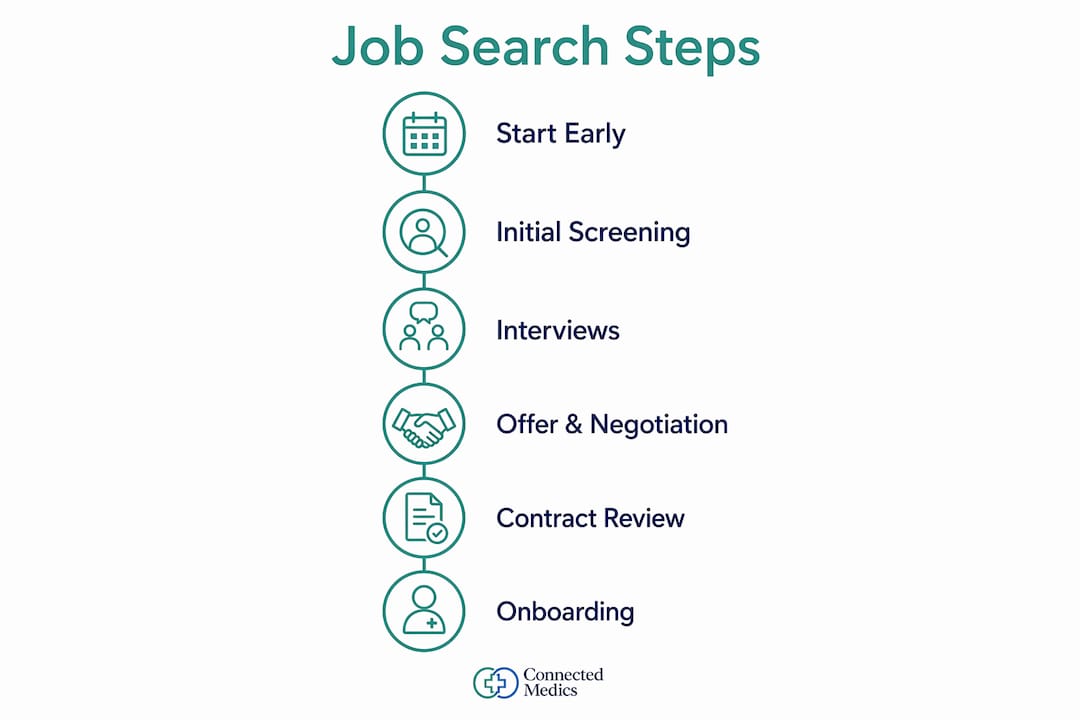
Typical hiring sequence: initial screen → phone/video interview → site visit → offer letter → contract negotiation → state license application → DEA registration → payer enrollment → hospital credentialing → start date.
Timeline reference table
| Step | Typical Duration | Who Drives It |
|---|---|---|
| Initial screen to offer | 4–12 weeks | Employer |
| Contract negotiation | 2–6 weeks | Both parties |
| State medical license | 2–12 months (state-dependent) | Physician |
| DEA registration | 4–6 weeks | Physician |
| Payer enrollment (Medicare/Medicaid) | 2–6 months | Employer/billing team |
| Hospital credentialing | 3–5 months | Hospital medical staff office |
| Total: offer to start date | 6–18 months | Both |
The 6–12 month general estimate and the 18-month window for surgical subspecialties are not worst-case scenarios. They are standard. Plan accordingly.
Common bottlenecks to anticipate:
- State licensing boards vary widely in processing speed, with some states notably slower than others.
- Hospital credentialing committees meet on fixed schedules, often monthly. Missing one cycle adds 4–6 weeks automatically.
- Payer enrollment is employer-driven but physician-dependent. Missing documentation from the physician side is the most common delay.
- Employers rarely pay for licensing fees upfront; negotiate reimbursement as part of the offer.
What red flags in job ads and offers actually look like
Ambiguous language in a job posting is not neutral. It usually signals a compensation model or work environment the employer knows will not sell itself on its own merits.
High-risk phrases and what they mean:
- "Competitive salary" with no range listed: the range is likely below market, or the employer is testing how little you will accept.
- "Unlimited earning potential": the base is low and the productivity formula is aggressive. Ask for the production formula and the actual earnings of the physician in the role for the past 12 months.
- "Flexible schedule" with no call schedule listed: call burden is likely heavy or undefined. Get the call schedule in writing before the site visit.
- "Growing practice": could mean opportunity, or it could mean the practice is understaffed and the prior physician left. Ask directly why the position is open.
- "Partnership track available": ask for the written partnership track criteria, the timeline, and how many physicians have made partner in the last five years.
Turnover signals to verify:
- The same position posted repeatedly on job boards over 12–24 months is a reliable indicator of high turnover or a structural problem with the role.
- Short tenures visible on professional profiles (under two years) for multiple physicians in the same group warrant a direct question: "What is the average tenure of physicians in this group?"
- Ask the recruiter for references from current physicians in the practice, not just the medical director.
Pro Tip: Employers that refuse to provide a salary range after two substantive conversations are often hiding unfavorable terms. Transparent employers list ranges and discuss them openly. Lack of transparency after reasonable inquiry is itself a red flag.
How to run a physician job search that actually works
A reactive, single-track search is the most common reason physicians end up in mismatched roles. The fix is a parallel, systematized process that creates options and leverage at every stage.
-
Open 3–5 active conversations simultaneously. Running multiple opportunities in parallel gives you comparison data and prevents desperation-based signings. One offer with no alternatives is not a negotiation — it is an ultimatum.
-
Start with your specialty society's job board. Specialty boards surface roles that match your training and filter out irrelevant postings. Expand to general boards only after you have a baseline sense of the market.
-
Use alumni and peer networks for direct outreach. A warm introduction from a residency colleague or program director carries more weight than a cold application. Identify two or three target employers and ask your network for a connection before submitting a CV.
-
Engage one or two specialty-focused recruiters. Recruiters with deep specialty knowledge surface roles that are not publicly posted. Be direct about your priorities and geographic flexibility. Treat them as partners: get their approval before they submit your CV anywhere, and avoid any recruiter who is vague about compensation or contract terms.
-
Consider locums as a parallel track, not a fallback. Locum tenens generates income, builds references across multiple settings, and often surfaces permanent opportunities organically. It is a strategic tool, not a consolation prize.
-
Apply for state licensure before you have an offer. Licensing timelines are independent of hiring timelines. Starting the process early removes a major bottleneck from your start date.
-
Prepare your CV and references before you contact anyone. A polished CV and three ready references are prerequisites, not afterthoughts. Ask a mentor to review the CV for completeness and tone before it goes anywhere.
-
Set up medical job alerts for your specialty and target geographies. Automated alerts surface new postings immediately, which matters in competitive specialties where roles fill quickly.
-
Target conferences and professional society meetings. Many hiring decisions begin at specialty conferences. Attend with a clear goal: two or three substantive conversations with potential employers or connectors, not general networking.
-
Build an 18-month timeline and work backward. If your target start date is July, your contract should be signed by January, your license application filed by the prior spring, and your first conversations started 15–18 months out. Use a job search checklist to track each step.
Pro Tip: Maintain momentum by setting a weekly minimum: two new outreach contacts, one follow-up, and one application review. Consistency prevents the search from stalling during slow response periods.
Compensation and contracts: what to ask before you sign
Understanding pay models before you receive an offer is not optional. Physicians who do not know how productivity formulas work cannot evaluate whether an offer is fair.
Common physician pay models
| Model | How it works | Best for | Key risk |
|---|---|---|---|
| Straight salary | Fixed annual pay, no productivity component | Early career, academic roles | No upside; may cap earnings |
| Base + productivity | Salary floor plus RVU or collections bonus | Most employed positions | Formula complexity; base may be low |
| RVU-only | Pay tied entirely to work RVUs generated | High-volume proceduralists | Income volatility; no floor |
| Locum/per diem | Daily or hourly rate, no benefits | Bridge income, flexibility | No benefits, no partnership track |
Must-ask contract items
- Base salary vs. productivity formula: Ask for the formula in writing and the actual earnings of the physician currently in the role.
- Call schedule: How many nights and weekends per month? Is call compensated separately?
- Malpractice coverage: Is it occurrence-based or claims-made? If claims-made, who pays the tail?
- Noncompete scope: Geographic radius and duration. A 30-mile, 2-year noncompete in a metro area can effectively lock you out of the local market.
- Signing bonus clawback terms: Most signing bonuses require repayment if you leave within 1–3 years. Know the exact terms.
- Loan repayment: Is it offered? Is it taxable? What are the service obligations?
- Partnership track: Written criteria, timeline, and buy-in cost if applicable.
A physician contract attorney typically charges $500–$1,500 for a full contract review and routinely identifies noncompete language, clawback terms, and RVU thresholds that are unfavorable or negotiable. That fee is almost always worth it. The NIH-published guidance on first physician job searches specifically recommends legal review before signing.
Three highest-leverage negotiation asks: base salary floor, noncompete radius reduction, and malpractice tail coverage. These three items have the largest long-term financial and career impact and are the most commonly negotiable.
How the job search affects physician mental health and career fulfillment
A prolonged or mismatched job search does real damage. Burnout does not begin on the first day of a bad job. It often starts during the search itself, when uncertainty, financial pressure, and isolation compound over months.

Approximately 50% of physicians leave their first job within five years, and many departures trace back to prioritizing the wrong criteria during the search: prestige of the city, brand of the employer, or salary floor, rather than call burden, practice culture, and long-term growth structure. The mismatch between what a physician expected and what the role actually delivers is a primary driver of early departure and burnout.
Practical steps matter here. Physicians who run parallel searches report less anxiety than those waiting on a single offer, because they have options and a sense of control. Setting a weekly search routine, maintaining clinical work through locums, and checking in with a mentor or peer group regularly all reduce the psychological cost of a long search. If the search extends beyond six months without progress, a structured review of geographic flexibility and specialty positioning is more productive than intensifying the same approach.
Career fulfillment is also a selection criterion, not a bonus. Asking about practice culture, physician autonomy, and administrative burden during the interview process is not soft — it is due diligence. Physicians who ask those questions and weight the answers appropriately are more likely to stay in their first role long enough to build equity, partnership, and referral networks.
How healthcare policy and reimbursement changes affect physician hiring
Policy shifts do not stay abstract for long. They show up in hiring decisions, compensation structures, and the types of roles employers create.
The ongoing transition from fee-for-service to value-based care models has changed which specialties employers prioritize. Primary care and care coordination roles have grown in demand under value-based contracts, while some high-volume procedural specialties face pressure as payers scrutinize utilization. Physicians entering the market now need to understand which reimbursement model their target employer operates under, because it directly determines how their productivity will be measured and compensated.

Medicare reimbursement cuts, particularly the repeated reductions to the physician fee schedule, have compressed margins for independent practices and accelerated consolidation into larger health systems. Fewer independent practices means fewer independent employer options, which concentrates hiring power in large systems and private equity-backed groups. That concentration gives employers more leverage in compensation negotiations, which is one more reason to run a parallel search with multiple offers.
Scope-of-practice expansions for nurse practitioners and physician assistants in many states have directly reduced physician-only openings in primary care and urgent care. This is not a temporary trend. Physicians in those specialties benefit from understanding which states have full practice authority for APPs and factoring that into geographic decisions. For physicians considering anesthesia careers, specialty-specific workforce dynamics between CRNAs and anesthesiologists are worth reviewing before committing to a geographic market.
The expansion of telehealth reimbursement has created a new category of physician employment: hybrid and fully remote roles that were not viable five years ago. These roles carry different credentialing requirements (multi-state licensure compacts, for example) but expand the geographic reach of a search considerably.
Key Takeaways
Physicians who start early, run parallel searches, and review contracts with an attorney before signing consistently achieve better first-job outcomes than those who search reactively.
| Point | Details |
|---|---|
| Start early | Most specialties need 6–12 months; surgical subspecialties often require up to 18 months for licensing and credentialing. |
| Run 3–5 parallel opportunities | Multiple active conversations create leverage and prevent desperation-based signings. |
| License early, independently | State licensing takes 2–12 months; start the application before you have a signed offer. |
| Review contracts with an attorney | A physician contract attorney catches noncompete scope, clawback terms, and RVU thresholds before you sign. |
| Use Connectedmedics for specialty search | The platform's specialty filters and verified listings reduce search fragmentation and surface relevant roles faster. |
The conventional wisdom on physician job searches gets one thing wrong
Most advice tells physicians to "network more" and "start early." Both are correct, but they miss the structural issue: the physician job market is built to favor employers, not candidates, and most trainees do not realize this until they are already in a weak position.
The real problem is not effort. Physicians are not failing to search hard enough. The problem is search design. A single-track search, no matter how diligent, produces one data point. One data point is not enough to evaluate whether an offer is fair, whether the culture is sustainable, or whether the noncompete will trap you in three years. The physicians who navigate this well are not the ones who work harder. They are the ones who treat the search as a parallel process from the start, who apply for licenses before they have offers, and who walk into contract negotiations with at least two alternatives on the table.
The other thing most guides understate is the cost of the first bad job. Leaving within two years means repaying a signing bonus, potentially triggering a noncompete, and restarting a search from a weaker position. The time spent in a mismatched role is not neutral. It delays partnership track, limits referral network development, and often accelerates burnout. Getting the first job right is worth the extra months of a careful, parallel search.
Connectedmedics gives physicians a faster, more relevant search
Physicians running a parallel search across multiple channels need tools that surface relevant roles quickly, without the noise of a general job board. Connectedmedics is built specifically for that problem.
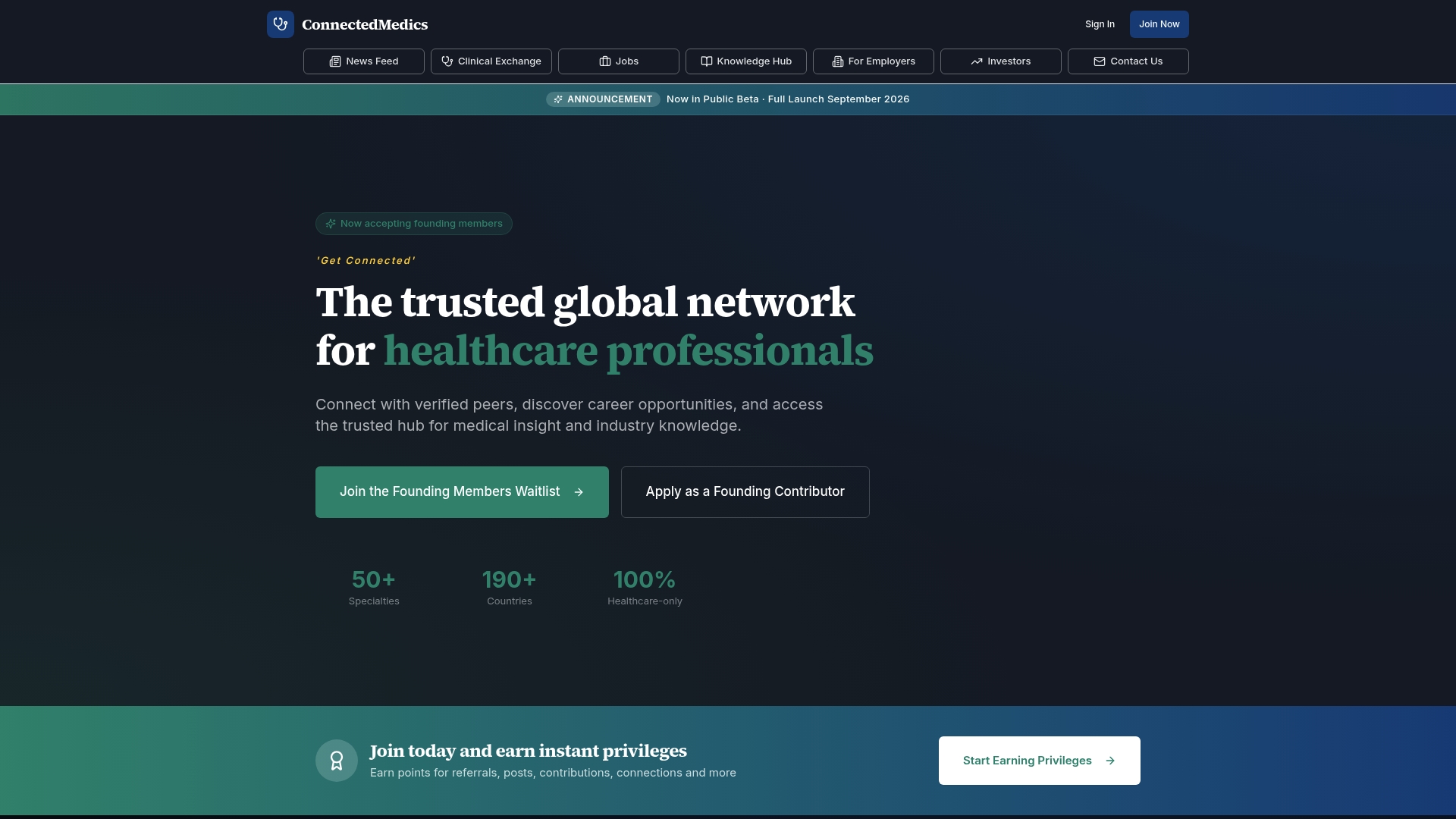
The platform combines a specialty-focused jobs board with over 4,600 active healthcare vacancies, verified clinician profiles, and AI-powered job matching that filters by specialty, location, and employment model. Employers on the platform are verified, which reduces the risk of engaging with vague or misleading postings. The knowledge hub provides clinical insights and salary trend analysis that help physicians benchmark offers against real market data before they negotiate.
For physicians who want to run a smarter parallel search, the practical next step is to create a verified profile on Connectedmedics, set specialty and location filters, and activate job alerts for your target market. The platform is free to browse; premium membership unlocks advanced matching and direct employer access.
Authoritative sources and further reading
- How to Approach the First Physician Job Search (NIH/PMC) — Academic guidance on search timing, priorities, and process for new physicians.
- Physician Job Search Guide 2026 (SalaryDr) — Compensation benchmarks, timeline data, and red-flag language to watch for.
- The Physician Job Market: What's Actually Happening (PhysEmp) — Market dynamics, parallel search strategy, and first-job departure data.
- The Physician Shortage Myth (ResidencyAdvisor) — Explains micro-market fragmentation and why national shortage data misleads individual job seekers.
- No Job by Graduation? 90-Day Emergency Plan (ResidencyAdvisor) — Structured fallback plan for physicians finishing training without a signed offer.
- 2025 Doctor Job Outlook: Why Go Locum Tenens? (Barton Associates) — Strategic case for locum tenens as a bridge and market-exploration tool.
- How to Launch and Manage a Successful Physician Job Search (NEJM CareerCenter) — Practical, step-by-step search management from a high-authority clinical career resource.
- Healthcare Job Search Checklist for Doctors in 2026 (Connectedmedics) — Printable checklist covering CV prep, licensing, outreach, and offer review steps.
- Medical Specialty Job Categories 2026 (Connectedmedics) — Specialty-by-specialty demand overview to help physicians assess their market position.