
Physician mental health refers to the psychological well-being of doctors, encompassing their ability to manage stress, avoid burnout, and maintain emotional resilience across demanding medical careers. The clinical term used in occupational medicine is occupational well-being, though "physician mental health" captures the full scope of what doctors face. The national burnout rate among US physicians declined to 41.9% in 2025, down from 48.2% in 2023. That progress is real, but it still means nearly half of all practicing physicians carry a significant psychological burden every day. Understanding the scope of that burden is the first step toward doing something about it.
What are the primary mental health challenges faced by physicians today?
Burnout, moral distress, depression, and anxiety are the four conditions that most consistently affect doctor mental wellness. Each is distinct, and treating them as interchangeable leads to interventions that miss the mark.
Burnout is defined by three core symptoms: emotional exhaustion, depersonalization (a detached or cynical attitude toward patients), and a reduced sense of personal accomplishment. For physicians, it typically develops from prolonged exposure to high-stakes decisions, administrative overload, and insufficient recovery time. Burnout is not a character flaw. It is a predictable response to a system that demands more than it gives back.
Moral distress is a separate but related condition. It occurs when a physician knows the right course of action but is prevented from taking it, usually by institutional constraints, resource limits, or conflicting directives. Physicians report significantly higher moral distress than non-physician healthcare workers, with 39.1% experiencing high levels. That figure correlates directly with both burnout and intent to leave medicine entirely.
"Moral distress is not just an emotional reaction. It is a signal that the system is asking physicians to act against their professional values. When that happens repeatedly, the psychological cost compounds."
Depression and anxiety complete the picture. 46% of physicians report worse mental health than before the pandemic. Among all physicians, 42% screen positive for depression and 21% report moderate to severe anxiety. Among residents and fellows, the depression rate climbs to 58%. These are not outliers. They represent the statistical norm for a profession under sustained pressure.
The downstream effects extend beyond the individual. Physician mental health is a patient safety issue. Doctors experiencing burnout make more clinical errors, communicate less effectively, and are more likely to leave their positions, which worsens staffing shortages and places additional burden on colleagues.
How does physician mental health vary across medical specialties?
Burnout rates differ sharply by specialty, and those differences matter for designing effective support. A one-size-fits-all wellness program fails physicians in high-acuity environments just as surely as it fails those in lower-stress settings.

| Specialty | Burnout Rate | Risk Level |
|---|---|---|
| Emergency medicine | 49.8% | Highest |
| Urological surgery | ~48% | Very high |
| Hematology/oncology | ~47% | Very high |
| Psychiatry | 30.5% | Lowest |
| Dermatology | ~32% | Low |
| Infectious diseases | ~33% | Low |
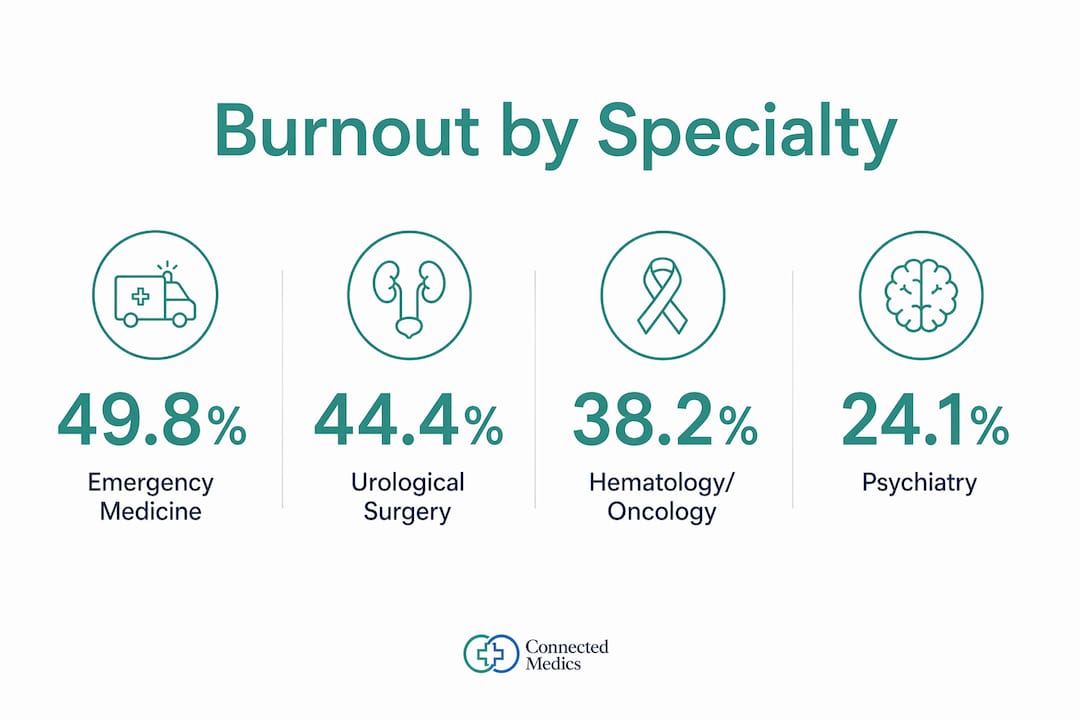
Emergency medicine carries the highest burnout rate at 49.8%, driven by unpredictable patient volumes, high-acuity decisions, and limited control over workflow. Surgical specialties face similar pressures, compounded by long operating hours and high liability exposure. Research on burnout in emergency medicine trainees shows that the psychological strain begins well before independent practice.
Psychiatry and dermatology report the lowest burnout rates. Psychiatrists, notably, have more control over their schedules and work in environments where discussing emotional difficulty is normalized. That cultural difference is not incidental. It is a structural advantage that other specialties can learn from.
Administrative burden is a key driver of specialty differences. Specialties with heavy electronic health record (EHR) documentation requirements and complex billing codes report higher stress levels, regardless of clinical acuity. The specialty-specific nature of these stressors means that targeted interventions outperform generic wellness programs. The AMA has emphasized that data-driven, specialty-specific strategies produce more meaningful improvements than broad institutional mandates.
Pro Tip: If you are evaluating a career move between specialties, factor burnout rates and workflow culture into your decision. Connectedmedics offers a specialty career guide that maps these differences across medical fields.
What strategies and resources effectively support physician mental health?
Effective mental health support for physicians requires both individual tools and institutional commitment. Neither works well without the other.
-
Seek care outside your immediate network. Physicians consistently prefer mental health care from providers who are not connected to their hospital system or local colleagues. Confidentiality is the primary concern. Seeing a therapist within your own institution creates real and perceived risks around licensing and peer perception. Virtual mental health platforms address this directly by providing access to licensed providers outside your professional circle.
-
Use peer support programs. Programs like RISE (Resilience In Stressful Events) offer confidential, non-judgmental peer support specifically designed for physicians processing traumatic clinical events. Trained peer supporters are colleagues who understand the clinical context, which makes conversations more effective than traditional external therapy alone for acute stressors. Peer support does not replace professional mental health treatment. It complements it.
-
Reduce administrative burden where possible. EHR inefficiency is one of the top drivers of physician stress. Advocating for scribes, voice-to-text documentation tools, or workflow redesign within your institution directly reduces the cognitive load that feeds burnout. Physicians who report adequate leadership support on administrative issues show measurably lower burnout rates.
-
Engage with specialty-specific wellness resources. Generic wellness programs have limited effectiveness. Specialty societies and platforms like Connectedmedics offer resources calibrated to the specific pressures of your field. The knowledge hub at Connectedmedics includes clinical guides and mental health resources contributed by verified medical professionals.
-
Normalize help-seeking within your team. Physician mental health improves when leadership actively models and encourages care-seeking behavior. A single attending who openly discusses therapy or peer support changes the culture of an entire department.
Pro Tip: Schedule mental health check-ins the same way you schedule CME hours. Treating psychological maintenance as a professional obligation, not a personal weakness, removes the stigma from the act of seeking help.
How do systemic and cultural factors impact physician mental health?
The barriers to mental health care for physicians are not primarily psychological. They are structural.
About 40% of physicians are reluctant to seek formal mental health treatment because of credentialing and licensing systems that ask broad questions about mental health history. A physician who discloses a depression diagnosis risks triggering a licensing investigation, even when their clinical performance is unaffected. That fear is rational, and it keeps physicians from getting care they need. Regulatory reforms are underway in several states to narrow these questions, but the process is slow and uneven.
Staffing shortages compound the problem. When a department is understaffed, the physicians who remain absorb additional patient loads, administrative tasks, and emotional labor. Administrative burden, staffing shortages, and inefficient workflows remain the top drivers of physician job stress. These are system failures, not individual failures. Framing burnout as a personal resilience problem misidentifies the cause and misdirects the solution.
Cultural stigma within medicine remains a significant barrier. Physicians are trained to project competence and composure. Admitting psychological difficulty feels professionally dangerous in environments where stoicism is rewarded. Leadership engagement and a culture that normalizes seeking help are the most effective tools for changing this dynamic. When department chairs and hospital executives openly support mental health resources, utilization rates increase.
Key systemic barriers physicians face include:
- Licensing questions that penalize disclosure of mental health history
- Insufficient staffing that prevents recovery time between high-demand periods
- EHR systems designed for billing rather than clinical efficiency
- Lack of dedicated time for peer support or wellness activities within work schedules
- Absence of specialty-specific data to guide targeted interventions
Addressing moral distress at the institutional level requires giving physicians more agency over clinical decisions and creating clear channels to raise ethical concerns without professional risk. Without that, moral distress accumulates silently until it becomes burnout or departure.
Key Takeaways
Physician mental health requires specialty-specific, confidential, and institutionally supported interventions to produce lasting improvement across the medical workforce.
| Point | Details |
|---|---|
| Burnout is declining but persistent | The US physician burnout rate fell to 41.9% in 2025, but nearly half of doctors still report significant strain. |
| Moral distress is distinct from burnout | 39.1% of physicians report high moral distress, which correlates directly with burnout and intent to leave. |
| Specialty risk varies widely | Emergency medicine burnout reaches 49.8%; psychiatry sits at 30.5%, showing that specialty culture shapes outcomes. |
| Confidentiality drives care-seeking | Physicians prefer mental health care outside their local networks to avoid licensing and peer-perception risks. |
| Systemic change is required | Licensing reform, staffing investment, and leadership modeling are more effective than individual resilience programs alone. |
What I've learned watching medicine resist its own mental health crisis
Medicine is the only profession I know of where admitting you are struggling is treated as evidence that you should not be there. That contradiction has real costs. Physicians are trained to identify distress in patients and then systematically discouraged from identifying it in themselves.
What I have observed is that the physicians who do seek support, whether through peer programs like RISE, virtual therapy platforms, or specialty-specific wellness resources, do not become less effective clinicians. They become more present ones. The fear that getting help signals weakness is not supported by outcomes data. It is supported by a culture that has never been asked to examine its own assumptions.
The most effective interventions I have seen share three features: they are confidential, they are accessible outside the immediate work environment, and they are endorsed by someone in leadership. Without that third element, even the best programs go unused. Physicians watch what their department chairs do, not what the wellness committee emails them about.
The Dr. Lorna Breen Health Care Provider Protection Act exists because physician mental health is a patient safety issue, not just a workforce issue. That framing matters. It shifts the conversation from "take care of yourself" to "this is a system responsibility." That shift is where real change begins.
If you are a physician reading this and you recognize yourself in these numbers, the most useful thing you can do is treat your own mental health with the same clinical seriousness you bring to your patients.
— David
Connectedmedics as a resource for physician wellness
Physicians looking for mental health resources, career guidance, and peer connection have a verified, healthcare-specific option in Connectedmedics.
Connectedmedics is a global network for medical professionals built exclusively for healthcare providers. The platform offers a knowledge hub with clinical guides, mental health resources, and specialty-specific insights contributed by verified medical experts. Physicians can access wellness content, connect with peers across specialties, and find career opportunities through a jobs board with over 4,600 active healthcare vacancies. For doctors navigating burnout, career transitions, or the search for specialty-aligned support, Connectedmedics provides a focused, professionally relevant environment that generic networks do not.
FAQ
What is physician burnout and how common is it?
Physician burnout is a state of emotional exhaustion, depersonalization, and reduced personal accomplishment caused by chronic workplace stress. The US burnout rate among physicians was 41.9% in 2025, according to AMA data.
How does moral distress differ from burnout?
Moral distress occurs when a physician knows the right clinical action but cannot take it due to institutional constraints. Burnout is a broader state of exhaustion; moral distress is a specific ethical conflict that frequently contributes to burnout.
Why are physicians reluctant to seek mental health care?
About 40% of physicians avoid formal mental health treatment because licensing and credentialing systems ask broad questions about mental health history, creating fear of professional consequences. Regulatory reforms are ongoing but not yet universal.
Which medical specialties have the highest burnout rates?
Emergency medicine reports the highest burnout rate at 49.8%, followed by urological surgery and hematology/oncology. Psychiatry reports the lowest rate at 30.5%, largely due to schedule control and a culture more open to discussing emotional difficulty.
What mental health resources are available specifically for physicians?
Peer support programs like RISE, virtual therapy platforms that operate outside hospital networks, and specialty-specific wellness resources through organizations like the AMA and platforms like Connectedmedics all provide targeted support for physician mental health.