
Switching medical specialties is achievable, but it requires meeting new board certification standards, completing additional training, and building a structured plan before making any move. The American Board of Medical Specialties (ABMS) governs certification across 24 member boards, and each specialty carries its own training prerequisites. This switch specialties career guide covers every stage of the process: pathways by career stage, certification obligations, step-by-step planning, and a realistic comparison of how difficult different switches actually are. Whether you are still in residency or years into practice, the options are real and the timelines are manageable with the right preparation.
What pathways exist to switch specialties?
The right pathway depends on where you are in your training. Two distinct windows exist: during residency and after residency completion.
Switching during residency

Transferring during residency is the faster route, but it is not simple. Around 1,000 residents transfer yearly across the United States. That number is small relative to the total resident population, which reflects how many structural barriers exist.
The core requirements for a successful transfer are:
- An open position in the target program
- Program director support from both your current and receiving programs
- Institutional capacity at the receiving hospital
- Compatibility with Medicare funding rules tied to your original match
Funding and operational constraints tied to Medicare residency payment duration add a layer of complexity that most residents underestimate. Medicare caps the number of funded residency slots per institution, so even a willing program director may not have the financial room to absorb a transfer. This is why personal relationships and early conversations with program directors matter more than most residents expect.
Switching after residency
Post-residency switches require formal retraining. The two main options are:
- Fellowship training: Typically 1–3 years, suited for specialty shifts within related clinical domains
- Additional residency: Typically 2–5 years for more dramatic shifts, such as moving from internal medicine to surgery
The financial cost is significant. Additional residencies often run 3–4 years, and your income drops to trainee salary for that entire period. A physician earning $250,000 annually who re-enters a residency earning $65,000 is looking at a multi-year income gap that requires deliberate financial planning before the switch begins.
What are the certification requirements for switching?
Board certification in a new specialty is not a single exam. ABMS continuing certification uses longitudinal assessments reflecting specialty knowledge and judgment over years, not a one-time test.
| Certification Stage | What It Involves | Timeline |
|---|---|---|
| Initial certification | Complete specialty-specific training or fellowship, pass board exam | After training completion |
| Formative assessment | Ongoing feedback and learning activities during practice | Years 1–3 post-certification |
| Summative certification | Longitudinal data reviewed for final certification decision | Every 5–10 years depending on board |
| Continuing education | Documented competence through structured CME and assessments | Ongoing throughout career |
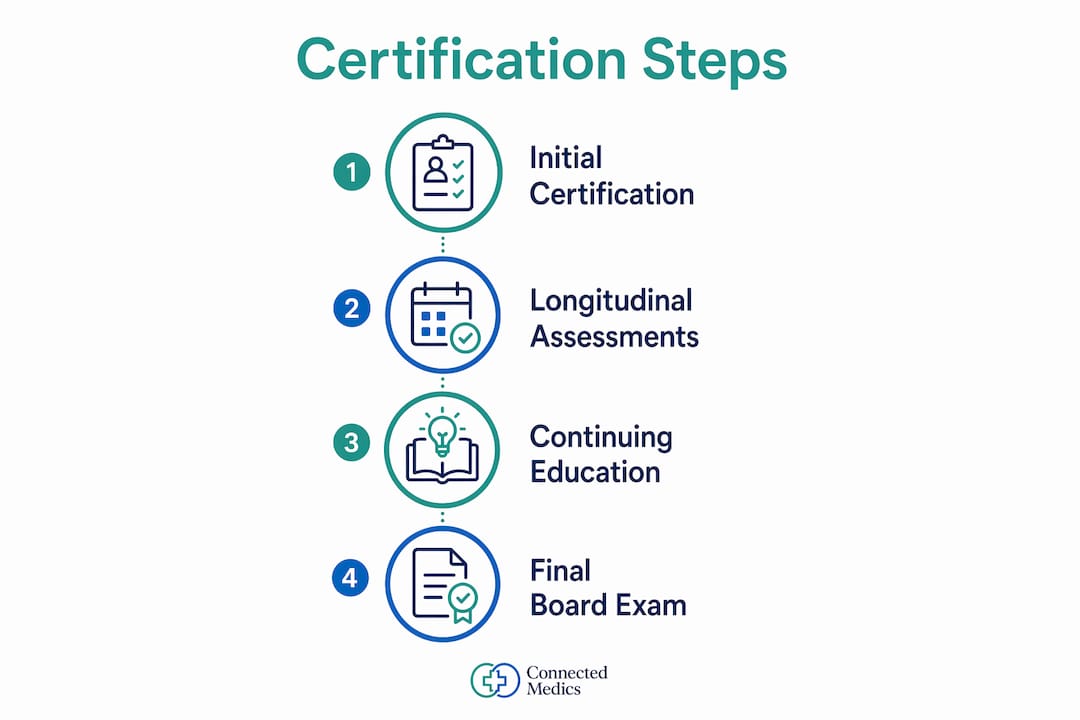
The ABMS Standards for Continuing Certification, effective January 1, 2024, formalized this multi-year structure. This means your planning timeline must account for both the training phase and the years of post-certification assessment that follow. Many physicians focus only on completing the fellowship or residency and are caught off guard by the ongoing certification demands.
Pro Tip: Before committing to a specialty switch, contact the specific ABMS member board for your target specialty and request their current certification pathway document. Requirements vary significantly between boards, and the 2024 updates changed timelines for several specialties.
How to plan a specialty switch step by step
The Harvard Extension School's 5-step career change framework applies directly to medical specialty transitions. It emphasizes evidence-driven planning over impulse decisions. Here is how to apply it to a specialty switch.
-
Conduct an honest self-assessment. Identify which clinical skills you already have and which the target specialty requires. A hospitalist considering radiology brings strong diagnostic reasoning but lacks procedural imaging skills. Map the gap before anything else.
-
Research the target specialty in depth. Review the daily workflow, call schedules, procedural demands, and income trajectory. Talk to physicians currently practicing in that specialty, not just those who switched into it. Use resources like the medical specialty job categories guide to understand what roles actually look like day to day.
-
Build an action plan with milestones. Set a target start date for training applications, identify three to five programs you would apply to, and map out the certification timeline using the ABMS board requirements for your target specialty.
-
Gain bridging experience before applying. Observerships, part-time locum work in adjacent roles, or volunteer clinical hours in the target specialty all strengthen your application and confirm your interest is grounded in reality. A physician considering palliative care, for example, should spend time in a palliative consult service before committing to a fellowship application.
-
Run a reality check on your personal situation. Account for family obligations, geographic constraints, financial reserves, and the support of people close to you. A 3-year fellowship in a different city is a life decision, not just a career decision.
Pro Tip: Use the healthcare job search checklist to organize your research phase. Treating a specialty switch as a structured project with deadlines produces better outcomes than approaching it as an open-ended exploration.
How difficult is it to switch between different specialties?
Difficulty varies sharply depending on the direction of the switch. Residency Advisor rates shifts like internal medicine to family medicine as low difficulty, while general surgery to anesthesia or radiology ranks as high difficulty requiring a full new residency.
| Switch Type | Difficulty | Training Required | Estimated Time |
|---|---|---|---|
| Internal medicine to family medicine | Low | Minimal additional training | 0–1 years |
| Internal medicine to hospitalist | Low | No formal retraining required | Immediate |
| Pediatrics to internal medicine | Moderate | Fellowship or additional training | 1–2 years |
| General surgery to anesthesia | High | Full anesthesia residency | 4 years |
| Family medicine to radiology | Very high | Full radiology residency | 5 years |
Some physicians use an intermediate specialty as a stepping stone to reduce training time and risk. A surgeon targeting interventional radiology, for example, might first complete a vascular surgery fellowship before pursuing IR training. This approach extends the overall timeline but reduces the credentialing gap at each stage.
Key factors that increase difficulty:
- Procedure-heavy specialties require hands-on training that cannot be self-taught
- Competitive specialties like dermatology and orthopedic surgery have limited fellowship slots
- Lifestyle-intensive fields often require geographic relocation for training programs
- Pay reduction during retraining is steeper for higher-earning specialties
The financial sacrifice is real. A physician leaving a $400,000 orthopedic surgery position to retrain in psychiatry will spend 4 years at trainee salary. That gap requires savings, a working spouse, or a financial plan built years in advance.
Key takeaways
Switching medical specialties is a structured, multi-year process that requires meeting ABMS certification standards, completing formal retraining, and planning for both financial and credentialing timelines before making any move.
| Point | Details |
|---|---|
| Timing determines your pathway | Switching during residency is faster; post-residency requires fellowship or a full new residency. |
| ABMS certification is ongoing | New 2024 standards require longitudinal assessments for years after initial certification. |
| Difficulty varies by specialty direction | Shifts within related domains are easier; procedure-heavy specialties require full retraining. |
| Financial planning is non-negotiable | Trainee salaries during retraining can represent years of significant income reduction. |
| Evidence-driven planning works best | Use structured frameworks like Harvard's 5-step model to build a realistic action plan. |
What i've learned about specialty switching after years of research
Most physicians who consider switching specialties underestimate one thing: the certification timeline after training ends. Everyone focuses on getting into the fellowship or residency. Far fewer people plan for the 5–10 years of longitudinal ABMS assessments that follow. That gap in planning is where transitions stall.
The physicians I have seen navigate this well share one habit. They start the conversation early, often 2–3 years before they plan to apply. They use that time to build relationships with program directors, gain observership hours, and get honest feedback about their candidacy. The ones who struggle tend to make the decision quickly and then discover the structural barriers after the fact.
Funding constraints at the institutional level are genuinely underappreciated. A program director who wants to accept you may simply not have a funded slot available. This is not a reflection of your qualifications. It is a Medicare reimbursement issue. Knowing this in advance means you apply to more programs and build a wider network rather than betting on one or two relationships.
One more thing: the direction of your switch matters more than the motivation behind it. A highly motivated physician switching from family medicine to neurosurgery faces a harder structural path than a less enthusiastic physician switching from internal medicine to geriatrics. Motivation matters, but the training pipeline is what actually governs your timeline. Plan around the pipeline, not around your enthusiasm.
— David
How Connectedmedics supports your specialty transition
Connectedmedics is built specifically for healthcare professionals making career moves like specialty switches. The platform provides verified peer connections, a global jobs board with over 4,600 active vacancies, and a knowledge hub with clinical guides and medical news relevant to career transitions.
For physicians researching specialty options, the Connectedmedics knowledge hub offers curated clinical resources and career guides that support every stage of the transition process. The trusted global network connects you with verified medical professionals across specialties, including those who have completed the exact switch you are considering. Peer insight from physicians who have navigated fellowship applications, ABMS certification updates, and program transfers is the most practical resource available during a specialty change.
FAQ
Can you switch specialties after completing residency?
Yes. Post-residency specialty changes typically require fellowship training lasting 1–3 years or a second residency lasting 2–5 years, depending on how different the target specialty is from your original training.
How hard is it to transfer residency programs to switch specialties?
Transfers are possible but depend on finding an open slot, securing program director support, and navigating institutional funding limits. Around 1,000 residents transfer annually, which reflects the real but limited availability of transfer opportunities.
What does ABMS board certification require after switching specialties?
ABMS continuing certification requires formative assessments and longitudinal evaluations over multiple years following initial certification, not just a single board exam. The 2024 standards formalized this multi-year structure across all 24 member boards.
Which specialty switches are the easiest to make?
Shifts within related clinical domains carry the lowest difficulty. Internal medicine to family medicine or hospitalist roles requires minimal retraining. Procedure-based specialties like radiology or anesthesia require full new residency programs and rank among the most difficult switches.
How should a physician start planning a specialty switch?
Start with a structured self-assessment using a framework like the Harvard Extension School's 5-step model, then research the target specialty's ABMS certification requirements and identify fellowship or residency programs at least 2–3 years before you plan to apply.