
The role of continuing medical education careers play in healthcare is far bigger than most professionals realize. CME, the standard industry term for structured ongoing learning after initial licensure, is often treated as a licensing checkbox. That framing undersells it. When designed well, CME changes prescribing patterns, shortens hospital stays, and puts clinicians on the path to executive roles. This article breaks down how accredited continuing education in medicine actually works in practice, where it creates real career momentum, and how to choose programs that move the needle.
Table of Contents
- Key takeaways
- The role of continuing medical education careers and clinical outcomes
- CME as a pathway to leadership roles
- Overcoming barriers to CME participation
- Selecting CME that maximizes career impact
- How CME shapes long-term career trajectories
- My take on CME as a career tool
- Find CME and career resources on Connectedmedics
- FAQ
Key takeaways
| Point | Details |
|---|---|
| CME goes beyond credits | Accredited CME measurably improves physician performance, patient safety, and clinical outcomes. |
| Leadership pathways exist | Programs like Emory's CMO curriculum show CME can directly prepare clinicians for executive roles. |
| Barriers are real but solvable | Financial support and leave availability significantly increase CME participation, especially for nurses. |
| Strategic selection matters | Choosing CME tied to measurable practice change maximizes both career visibility and patient impact. |
| Interprofessional CME signals readiness | Programs involving multidisciplinary teams demonstrate collaborative leadership to employers. |
The role of continuing medical education careers and clinical outcomes
CME is not just about maintaining a license. Accredited CME reduces unnecessary procedures, cuts avoidable prescriptions, and lowers readmission rates. Those outcomes matter to patients. They also matter to administrators reviewing who to promote.
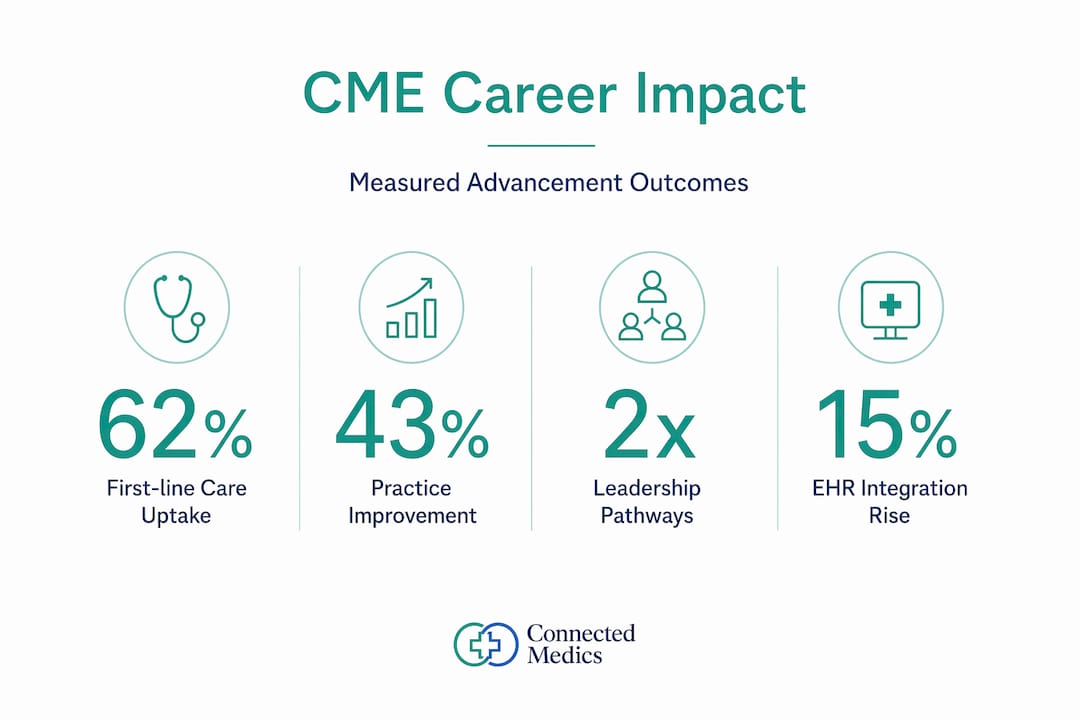
The Colorado Permanente Medical Group example makes this concrete. A CME intervention targeting antibiotic prescribing for pediatric urinary tract infections produced measurable shifts across 27 outpatient clinics. First-line antibiotic use rose from 43% to 62%. Treatment duration dropped from 7.3 to 6.0 days. Short-course treatments for older children increased from 26% to 69%. These are not trivial numbers. They reflect a direct link between structured learning and clinical behavior change at scale.
"CME's role extends into practice and outcomes improvement, not just licensing." — ACCME research synthesis
Accreditation also provides a layer of protection most clinicians overlook. Independent, evidence-based CME shields physician learners from commercial influence, which protects both patient safety and professional reputation. When a drug company sponsors an unaccredited seminar, the educational content may favor their product. Accredited programs are held to independence standards that keep learning grounded in evidence.
| CME Outcome Area | Example Result |
|---|---|
| Antibiotic stewardship | First-line use rose from 43% to 62% at Colorado Permanente |
| Hospital stay reduction | Hip fracture stay length decreased at University of Chicago program |
| Diabetes management | HbA1c dropped by over 10% in a multidisciplinary CME initiative |
| Readmission rates | Targeted CME activities linked to measurable reductions in preventable readmissions |
The University of Chicago's CME program reinforces this pattern. By integrating multidisciplinary team planning, they achieved reduced hospital stays for hip fracture patients and drove hemoglobin A1c down by more than 10% in a diabetes program. The mechanism was not a single lecture. It was a culture of systematic, team-based learning.
CME as a pathway to leadership roles
Most clinicians think of professional development as adding clinical knowledge. The more useful frame is this: the right CME can get you into rooms you were not previously invited into.

The Emory Chief Medical Officer Program is a direct example. Physicians can earn up to 185 AMA PRA Category 1 Credits while working through leadership, business strategy, and executive operations content. The program treats CME not as a passive learning exercise but as preparation for organizational influence. That shift in framing changes what you look for when evaluating any CME offering.
Here is what to prioritize when selecting CME for career advancement beyond clinical practice:
- Leadership and operations content. Look for programs that explicitly teach healthcare finance, strategic planning, or organizational management. Clinical knowledge alone rarely opens executive doors.
- Interprofessional structure. Programs that bring together physicians, nurses, administrators, and pharmacists signal to employers that you can work across organizational silos.
- Practice change integration. CME tied to EHR order sets or workflow redesign requires you to lead implementation, not just absorb information. That visibility matters.
- Measurable outcomes. Programs that require participants to define a practice gap, implement a change, and report results teach the project management skills that leadership roles demand.
Pro Tip: When reviewing a CME program's description, look for language about "practice improvement" or "performance change." If the program only mentions credit hours and topics covered, it is unlikely to produce the kind of visible outcomes that advance a career.
Selecting CME for leadership goals is a concrete step clinicians aiming for executive roles can take now. It does not require a full MBA or stepping away from clinical work. The right program builds the vocabulary, the frameworks, and the professional network that executive roles require.
Overcoming barriers to CME participation
Access to quality CME is uneven. Time constraints, program costs, and lack of employer support create real obstacles, particularly for nurses and non-physician clinicians. A 2026 study confirmed that financial assistance and leave availability improve CME participation, especially among nurses. The career development gap this creates is not trivial. Clinicians without access to quality CME fall behind in both clinical knowledge and advancement opportunities.
Here is a practical approach to reducing those barriers:
- Map your employer's CME policy. Many organizations offer reimbursement or paid leave for accredited CME. If the policy is unclear, ask HR directly and document the answer in writing.
- Identify low-cost accredited options. ACCME-accredited online modules often cost far less than conference attendance and carry the same credential weight for licensing purposes.
- Advocate for institutional support. If your department lacks a formal CME support structure, make the case using outcome data. Programs like the Colorado Permanente antibiotic initiative show measurable ROI that administrators respond to.
- Plan CME alongside performance reviews. Scheduling CME activities before annual reviews creates a direct link between your learning investments and career conversations with supervisors.
Pro Tip: When advocating for CME funding, bring one specific outcome study from an accredited program in your specialty. Concrete data converts budget conversations faster than general arguments about professional development.
Addressing CME access barriers through organizational policy change benefits entire departments, not just individual clinicians. If you are in a supervisory role, reviewing whether your team has equitable access to CME is both a management responsibility and a retention strategy.
Selecting CME that maximizes career impact
Not all continuing education in medicine produces the same career return. Choosing strategically means matching programs to specific career goals and then evaluating whether the program design actually supports change in practice.
Here is how to compare CME options before committing time and money:
- Outcomes data. Does the provider publish results from past cohorts? Programs that track and report practice change are more likely to deliver it.
- Faculty independence. Accredited programs disclose conflicts of interest and maintain editorial independence. This protects the clinical value of what you learn.
- Interprofessional design. Programs that build in collaboration across specialties and roles develop the soft skills that distinguish clinical contributors from organizational leaders.
- Alignment with career goals. A hospitalist targeting a chief of medicine role needs different CME than a nurse practitioner seeking advanced practice scope. Match the program to the destination.
| CME Selection Factor | Lower Value Programs | Higher Value Programs |
|---|---|---|
| Outcome tracking | Credits only, no performance data | Measures and reports practice changes |
| Commercial independence | Sponsored without disclosure | ACCME-accredited, conflict-free |
| Interprofessional design | Single discipline only | Multidisciplinary team participation |
| Career applicability | Generic clinical updates | Tied to leadership or operational goals |
Physicians who align CME with measurable practice change and EHR-integrated tools become visible as clinical improvement leaders within their organizations. That visibility creates promotion opportunities, speaking invitations, and consulting roles. It also makes you easier to recruit for senior positions because your impact is documented, not just claimed.
How CME shapes long-term career trajectories
The medical education career growth argument ultimately rests on a simple idea: your clinical knowledge and your leadership capability both depreciate without active maintenance. CME addresses both when selected well.
The evidence across multiple programs and health systems confirms that interprofessional CME programs that measure practice gaps and integrate team-based learning produce sustained behavior change and build the leadership credibility that career advancement requires.
"Real-world CME programs that include team-based planning and measure practice gaps enable clinicians to gain leadership skills and become change agents within healthcare systems." — ACCME, Colorado Permanente outcomes
CME career advancement is not accidental. Clinicians who treat continuing education as a deliberate career tool, selecting programs tied to measurable outcomes, building interprofessional skills, and documenting their results, consistently outpace peers who collect credits passively. The resources exist. The evidence supports the investment. The missing piece is usually intentional planning.
Exploring healthcare specialization categories alongside your CME planning can help clarify which competency gaps are worth addressing first.
My take on CME as a career tool
I have watched clinicians with identical credentials take completely different career paths. The consistent differentiator was not talent. It was whether they treated CME as a growth tool or an administrative requirement.
In my experience, the clinicians who end up in leadership roles picked CME the way others pick mentors: deliberately, with a clear idea of where the relationship should take them. They attended programs that required them to bring a problem, work on it with a team, and present results. That process is uncomfortable. It is also exactly what executive roles ask of you every day.
What I have learned is that the visibility factor is underestimated. When a physician leads a CME-driven quality improvement project in their department and the data gets presented at a system-wide meeting, that is a leadership audition. Nobody announces it as such. But the chief medical officer in the room notices who ran the project and who just attended.
I also think the interprofessional piece gets skipped too often. Clinicians default to specialty-specific CME because it feels directly applicable. The problem is that staying siloed limits your organizational reach. The most career-defining CME I have seen clinicians complete involved working alongside people with entirely different professional training. It changes how you think and how you communicate across departments.
If you are not yet using CME intentionally, start with one program in the next 12 months that requires you to produce a documented outcome. The credit hours will follow. The career impact requires that extra step.
— David
Find CME and career resources on Connectedmedics
Connectedmedics is built specifically for healthcare professionals who want more than a generic job board. The platform connects verified medical professionals with clinical insights, career resources, and over 4,600 active healthcare vacancies across specialties and regions.
For healthcare professionals mapping CME to career growth, Connectedmedics offers a knowledge hub with clinical guides and research summaries contributed by verified medical experts. Whether you are identifying which skills to develop next or looking for roles that reward advanced credentials, the Connectedmedics platform gives you access to verified opportunities and a professional network that understands the clinical world you work in. Explore the platform to connect your CME investments with the career moves they deserve.
FAQ
What is the primary role of CME in healthcare careers?
CME improves physician performance, patient safety, and clinical outcomes while opening pathways to leadership and specialized roles beyond standard clinical practice.
How does accredited CME differ from non-accredited programs?
Accredited CME maintains editorial independence from commercial sponsors, protecting clinicians from biased content and ensuring learning is grounded in current evidence.
Can CME help with career advancement beyond clinical roles?
Yes. Programs like the Emory Chief Medical Officer curriculum offer CME credits alongside leadership, business strategy, and executive operations training specifically designed for physicians targeting senior roles.
What barriers most commonly limit CME participation?
Time, cost, and lack of employer support are the leading barriers. Research shows that financial assistance and leave policies significantly increase participation rates, particularly among nurses and non-physician clinicians.
How do you choose CME that actually advances your career?
Select programs that publish outcome data, maintain commercial independence, incorporate interprofessional collaboration, and tie learning directly to measurable practice improvements aligned with your career goals.