
Doctor CV writing is the process of creating a targeted, metric-driven document that authentically represents your clinical experience, certifications, and achievements to secure medical job opportunities. The term covers two distinct documents: the comprehensive physician CV and the shorter clinical resume. Knowing which to submit, and how to write it, directly determines whether your application reaches a hiring manager or stalls in credentialing. Bodies like the American Board of Internal Medicine (ABIM) and the Accreditation Council for Graduate Medical Education (ACGME) set the standards that credentialing committees use to evaluate your documents. Getting this right from the start is the single most effective step you can take to improve your interview rate.
What is the difference between a physician CV and a clinical resume?
The physician CV and the clinical resume serve entirely different purposes. Submitting the wrong one signals poor attention to detail and can stall your application before anyone reads a word of your experience.
A clinical resume versus a full CV breaks down like this: clinical resumes run 1–2 pages and target recruiters filling employed physician roles, while comprehensive CVs range from 10 to 20 pages for credentialing or academic use. That length difference reflects a fundamental difference in audience. Recruiters scan resumes for fit in under a minute. Credentialing committees read CVs line by line, checking every license, board certification, and procedure volume.

| Feature | Clinical Resume | Physician CV |
|---|---|---|
| Length | 1–2 pages | 10–20 pages |
| Primary audience | Recruiters, hiring managers | Credentialing committees, academic bodies |
| Publications | Omitted or briefly listed | Included in Vancouver format by subtype |
| Metrics focus | Patient volume, outcomes | Procedure volumes, malpractice history |
| When to use | Job applications, locum roles | Hospital privileges, academic appointments |
The most common error doctors make is sending a full CV to a private practice recruiter. That document overwhelms a recruiter who wants a concise summary of your clinical fit. The reverse error, sending a two-page resume to a credentialing committee, leaves out the detail those committees require and stalls the credentialing process entirely. Maintain both documents and update them in parallel.
How do you structure a high-impact doctor CV or clinical resume?
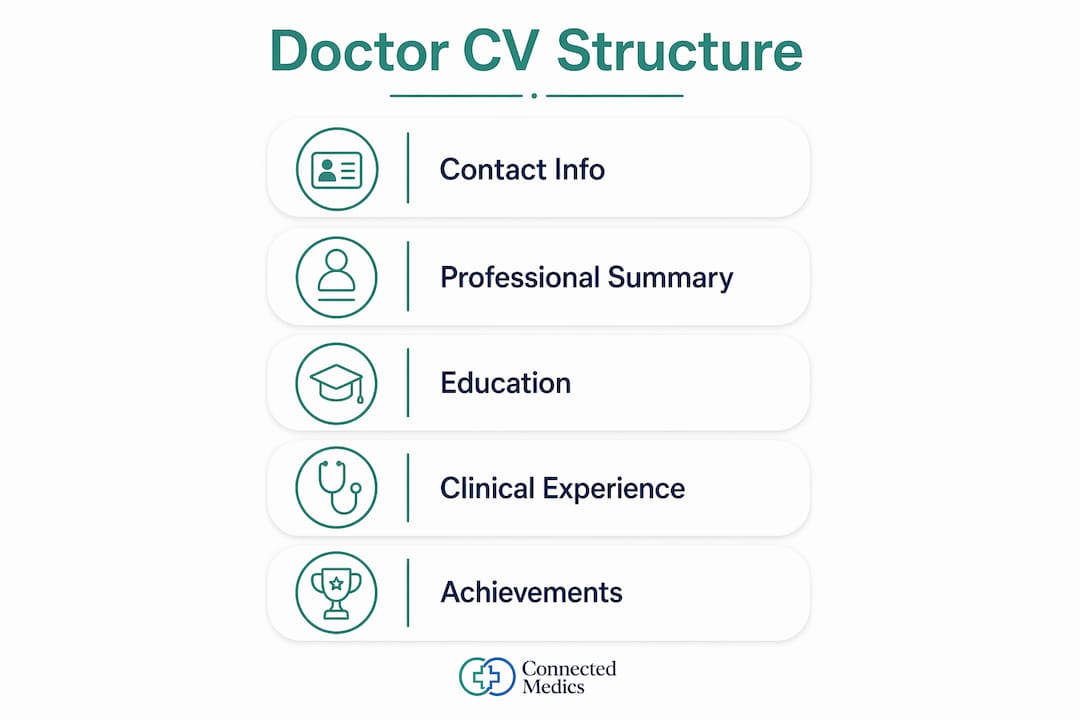
Structure is the foundation of effective CV writing for doctors. A well-organized document signals professionalism before the reader evaluates a single achievement.
For a clinical resume, include these sections in order:
- Professional summary: Two to three sentences stating your specialty, years of experience, and top clinical strength.
- Clinical experience: Roles listed in reverse chronological order with metric-rich bullet points.
- Licensure: State medical licenses with license numbers and expiration dates.
- Board certifications: Full name of the certifying board, specialty, and certification and recertification dates. Spelling out certifications fully is required to optimize ATS keyword scoring.
- Education: Medical school, residency, and fellowship with dates and institution names.
- EHR proficiency: Name platforms by exact name and module, such as Epic Ambulatory or Cerner PowerChart.
For a full physician CV, add these sections after the core content:
- Publications in Vancouver citation format, grouped by type (peer-reviewed articles, book chapters, case reports)
- Research grants with funding amounts and funding bodies
- Teaching appointments and academic titles
- Hospital privileges and committee memberships
- Continuing Medical Education (CME) credits with dates
Reverse chronological order applies to every experience section. Credentialing committees and ATS systems both expect this structure. ATS parsers specifically look for structured licensing information, including DEA and NPI numbers, with precise section labeling to expedite credential verification.
Pro Tip: Name EHR platforms exactly as they appear in the job posting. If the posting says "Epic Inpatient," write "Epic Inpatient," not just "Epic." ATS filters match exact strings, and a near-match can still cause rejection.
What are best practices for writing doctor experience and achievements?
Hiring managers seek quantifiable impact, not task lists. Every bullet point in your experience section should answer one question: what changed because of your actions?
Follow this numbered approach to writing strong bullets:
- Start with an action verb. Use words like "reduced," "managed," "implemented," "led," or "trained." Avoid "responsible for" or "helped."
- State the clinical context. Name the setting, patient population, or procedure type.
- Add a metric. Include patient volume, length-of-stay reduction, complication rates, readmission rates, or satisfaction scores.
- Show the result. Describe what improved, by how much, and over what period.
"Generic duty descriptions cause rejection. Metrics like patient volume and LOS reduction increase ATS pass rates. Specific, outcome-focused achievements are preferred over task descriptions, and soft skills like 'dedicated' are unmatchable by ATS filters."
Examples by career stage:
- Early career (resident or fellow): "Managed 18 patients daily in a 32-bed internal medicine unit, achieving a 4.2-day average length of stay against a department benchmark of 4.8 days."
- Mid-career (attending): "Reduced 30-day readmission rate for CHF patients from 22% to 14% over 18 months by implementing a structured discharge protocol."
- Senior physician: "Led a 12-physician hospitalist group, growing annual patient encounters from 8,400 to 11,200 while maintaining a complication rate below the national average."
For academic contributions on a clinical resume, list only your three to five most impactful publications. Include the journal name, year, and your authorship position. Omitting or summarizing publications for clinical resumes keeps the document focused and recruiter-friendly.
Pro Tip: Keep a running log of your clinical metrics throughout the year. Tracking patient volume, outcomes, and quality improvement results monthly makes writing strong bullets far faster when you update your documents.
How to tailor your doctor CV to specific job postings and pass ATS software?
Most hospital systems and large group practices use Applicant Tracking Systems to filter applications before a human reviews them. A well-written CV that ignores ATS requirements will not reach a recruiter.
- Mirror the job posting's language. If the posting says "board-certified hospitalist," use that exact phrase in your summary and experience sections.
- Name EHR platforms precisely. ATS systems scan for EHR platforms by exact name and module. Omitting them causes rejection despite strong clinical experience. List Epic, Cerner, Meditech, or any other platform you have used, with the specific module where relevant.
- List board certifications in full. Write "American Board of Internal Medicine, Internal Medicine, certified 2018, recertified 2028" rather than "ABIM certified."
- Include multi-state licenses when applying across state lines. List each state, license number, and expiration date.
- Avoid non-scannable formatting. Tables, text boxes, headers, footers, and graphics confuse ATS parsers. Use plain text with standard section headings.
- Keep the resume to 1–2 pages. Early-career physicians should target one page; experienced attendings can extend to two pages. More than three pages reduces recruiter engagement.
- Omit publication lists from clinical resumes unless the role explicitly requires research experience. A separate publications addendum is the right format for extensive research output.
Tailoring your document for each application takes 15–20 minutes but significantly increases your pass rate. Treat each job posting as a keyword list and check your resume against it before submitting.
Common doctor CV writing mistakes and how to avoid them
The most frequent errors in physician resume writing are structural, not clinical. They are also entirely preventable.
- Submitting the wrong document type. Sending a 15-page CV to a recruiter or a two-page resume to a credentialing committee both create problems. Know your audience before you submit.
- Missing credentialing details. Credentialing committees require board certification, active licenses, malpractice history, and procedure volumes. Missing any of these stalls the process.
- Generic bullet points. Phrases like "helped attendings" or "did rounds" are ATS blind spots and recruiter turnoffs. Replace every vague description with a metric-backed achievement.
- Poor formatting. Inconsistent fonts, irregular spacing, and non-standard section headings confuse both ATS systems and human readers.
- Spelling and grammar errors. A single typo in a clinical document raises questions about your attention to detail in patient care.
- Outdated documents. Failing to update certifications, licenses, and clinical metrics before each application cycle is one of the most common and costly errors.
- Overused language. Words like "dedicated," "passionate," and "team player" add no value. ATS systems cannot match them to job requirements, and recruiters ignore them.
Pro Tip: Set a calendar reminder every six months to update your CV and resume. Add new certifications, CME credits, and clinical outcomes as they occur rather than reconstructing them from memory before a deadline.
Key takeaways
Effective doctor CV writing requires maintaining two separate documents, structuring each for its specific audience, and quantifying every clinical achievement with measurable outcomes.
| Point | Details |
|---|---|
| Use the right document | Submit a 1–2 page clinical resume for jobs and a 10–20 page CV for credentialing. |
| Quantify every achievement | Replace task descriptions with metric-rich bullets showing patient volume, outcomes, and improvements. |
| Name EHR platforms exactly | List Epic, Cerner, or Meditech with specific modules to pass ATS keyword filters. |
| Spell out certifications fully | Include certifying board, specialty, and certification dates to maximize ATS scoring. |
| Update documents regularly | Review and refresh your CV and resume every six months to keep credentials and metrics current. |
What I have learned after years of watching physician applications succeed and fail
Most doctors treat their CV as a one-time task. That is the single biggest mistake I see. The physicians who consistently land interviews maintain two live documents: a full credentialing CV and a tailored clinical resume. They update both every six months, not just when they start a job search.
The second pattern I have noticed is that doctors undersell their impact by describing duties instead of outcomes. A hospitalist who managed 20 patients a day and reduced average length of stay by half a day has a compelling story. Writing "managed inpatient cases" tells no one anything. The metric is the differentiator, and most doctors have the data. They just do not put it on the page.
The ATS issue is more serious than most physicians realize. A well-qualified cardiologist can be filtered out because they wrote "EHR proficient" instead of naming Epic or Cerner by module. The 2026 job search guide for physicians makes this point clearly: ATS systems are not reading your experience. They are matching strings. Write for the machine first, then refine for the human reader.
The last thing worth saying: recruiter attention spans are short. Three pages is the outer limit for a clinical resume, and even that requires justification. If you have extensive publications, use a separate addendum. Keep the main document tight, specific, and scannable.
— David
Connectedmedics resources for your medical career
Doctors who treat their CV as a living document, not a static file, move through hiring and credentialing faster. Connectedmedics supports that process with a global healthcare jobs board listing over 4,600 active vacancies, verified professional profiles, and a knowledge base built by practicing clinicians.
The Connectedmedics Knowledge Hub offers career guides, clinical insights, and application resources written by verified medical experts. Whether you are updating your credentials, applying across borders, or preparing for a credentialing committee, the platform connects you to the right roles and the right information. Doctors at every career stage use Connectedmedics to find positions that match their specialty, location, and career goals.
FAQ
What is the correct length for a physician CV?
A clinical resume for employed physician roles should be 1–2 pages. A full credentialing or academic CV ranges from 10 to 20 pages and must include board certifications, licenses, publications, and procedure volumes.
How do I pass ATS filters on a physician resume?
Name EHR platforms by exact name and module, spell out board certifications in full with dates, and mirror the language used in the job posting. Avoid tables, text boxes, and graphics that ATS parsers cannot read.
Should I include publications on a clinical resume?
Limit publications to three to five high-impact entries on a clinical resume, or omit them entirely for non-academic roles. Use a separate publications addendum if you have extensive research output.
How often should doctors update their CV?
Update your CV and clinical resume every six months. Add new certifications, CME credits, licenses, and clinical metrics as they occur to avoid reconstructing records under deadline pressure.
What details do credentialing committees require on a physician CV?
Credentialing committees require board certification with recertification dates, active state licenses with numbers, malpractice history, DEA and NPI numbers, procedure volumes, and hospital privileges. Missing any of these items stalls the credentialing process.