
The Health and Care Worker visa is the primary immigration route for qualified international doctors seeking to work in the NHS. This sub-route of the Skilled Worker visa offers reduced application fees, full exemption from the Immigration Health Surcharge, and a direct path to settlement after five years. To qualify, doctors need a licensed NHS employer sponsor, active General Medical Council (GMC) registration, and English proficiency at CEFR B2 level. Understanding these requirements before you apply saves time and prevents costly delays.
What is the visa for NHS doctors and who qualifies?
The Health and Care Worker visa covers doctors working in roles classified under Standard Occupational Classification (SOC) codes 2211 (medical practitioners) and 2212 (psychologists, but also covering specialist medical roles). Your employer must hold an approved sponsor license, which most NHS trusts and many NHS-contracted private providers already hold. Without a licensed sponsor, no application can proceed.
Eligibility also depends on meeting the salary threshold. The threshold calculation counts only your basic guaranteed gross pay. Salary items like bonuses or one-time payments such as "golden hellos" do not count toward the minimum. High-Cost Area Supplements (HCAS) count only when they are pensionable and treated as basic pay. Most NHS pay bands comfortably exceed the threshold, but doctors should confirm the exact figure with their sponsoring trust before signing a contract.

English language proficiency is non-negotiable. Since 2024, the requirement moved from CEFR B1 to B2 for medical roles. Accepted tests include IELTS Academic, OET, and TOEFL iBT. GMC registration itself satisfies the English requirement for many applicants, since the GMC conducts its own language checks during the registration process.
Pro Tip: Check whether your GMC registration evidence already satisfies the Home Office English language requirement. If it does, you can avoid paying for a separate language test.
What steps must international doctors complete before applying?
Preparation for the NHS employment visa process follows a clear sequence. Skipping or rushing any step creates delays that can push back your start date by months.
-
Begin GMC registration immediately. GMC registration takes 3–9 months, including PLAB 1 and PLAB 2 exams for most international graduates. The GMC process is consistently the longest stage. Treat it as your first immigration step, not a parallel task.
-
Secure a confirmed job offer. NHS trusts cannot issue a Certificate of Sponsorship (CoS) without a signed offer. Use platforms like Connectedmedics, which lists over 4,600 active healthcare vacancies, to identify roles that match your specialty and SOC code.
-
Obtain your Certificate of Sponsorship. The CoS is a unique reference number your employer generates through the Home Office sponsorship management system. It is tied to the specific job, salary, and employer. You can apply for the visa up to three months before your start date once you have the CoS.
-
Gather English language evidence. If your GMC registration does not satisfy the Home Office requirement, submit an approved test certificate. Check the expiry date on your test results since some tests have a two-year validity window.
-
Compile supporting documents. These include your passport, CoS reference number, GMC registration certificate, proof of English proficiency, and financial evidence showing you can support yourself during the application period.
Pro Tip: Align your GMC exam dates with your job search timeline. Doctors who pass PLAB 2 and begin applying for NHS roles simultaneously often secure a CoS within weeks of receiving GMC registration, cutting total waiting time significantly.
How to apply for the Health and Care Worker visa
The application process is straightforward once your documents are in order. Doctors can apply from outside the UK or switch to this route from inside the UK if already on an eligible visa.
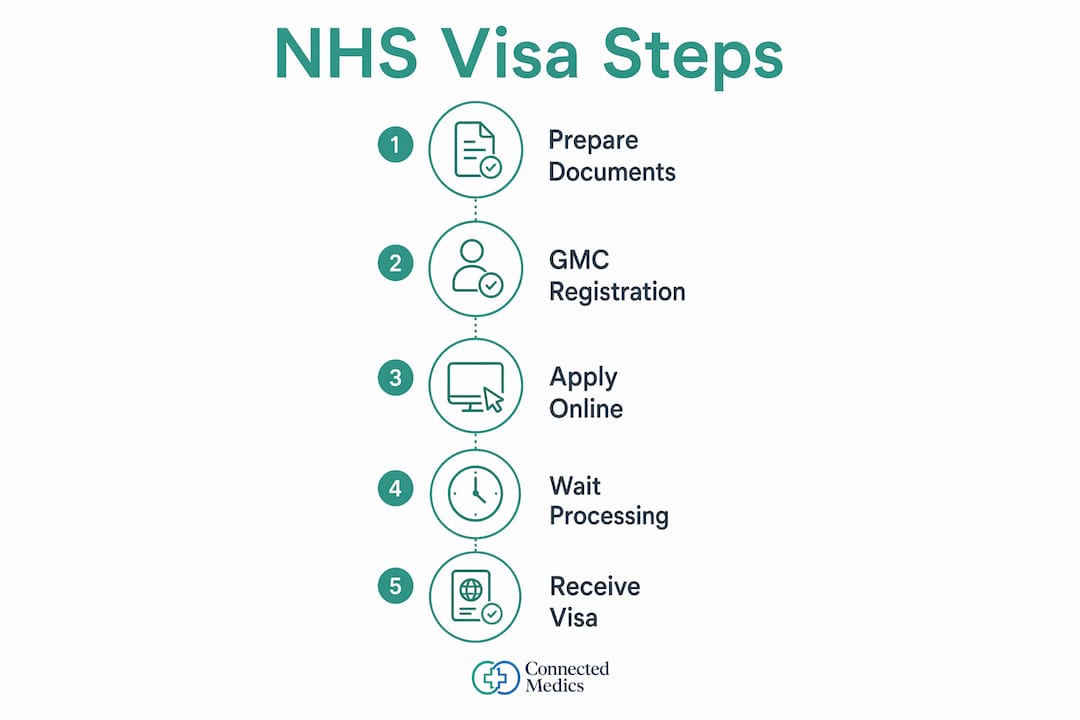
Standard processing takes three weeks. Priority service reduces this to five working days, and super-priority service delivers a decision by the next working day. Both faster options carry additional fees, but they are worth considering if your NHS start date is firm.
Fee structure and financial benefits
The Health and Care Worker visa costs significantly less than the standard Skilled Worker route. The IHS exemption saves £1,035 per person per year. That exemption extends to dependents, which represents a substantial saving for doctors relocating with family.
| Feature | Health and Care Worker Visa | Standard Skilled Worker Visa |
|---|---|---|
| Application fee | Reduced | Full rate |
| Immigration Health Surcharge | Exempt | £1,035 per year |
| Dependents' IHS | Exempt | £1,035 per year each |
| Processing time | 3 weeks standard | 3 weeks standard |
| Settlement eligibility | After 5 years | After 5 years |
Common reasons for delays or refusals
Most refusals trace back to documentation gaps rather than genuine ineligibility.
- Incomplete GMC registration evidence submitted with the application
- English language test certificates that have expired
- CoS details that do not match the submitted passport or job offer
- Salary figures that include non-qualifying pay elements
- Employer sponsor license that has lapsed or been suspended
Checking each document against the Home Office checklist before submission eliminates the majority of these issues.
What are the common challenges while working under the NHS visa?
Compliance does not end at approval. Doctors working under this route face ongoing obligations that affect both their visa status and their employer's sponsor license.
Sponsor scrutiny tightened post-2025, and NHS trusts now face stricter Home Office checks on whether actual job duties match the declared SOC occupation code. A doctor hired under SOC 2211 must perform duties that genuinely reflect that classification. Role drift, where day-to-day responsibilities shift away from the sponsored role, creates compliance risk for both the doctor and the trust.
Key compliance points to monitor throughout employment:
- Job role alignment. Confirm that your daily duties match the SOC code on your CoS. Raise any discrepancies with your HR department immediately.
- Salary threshold maintenance. If your pay changes, verify that the new basic salary still meets the threshold. Pay cuts or restructuring can trigger a compliance issue.
- Visa extensions. Apply for an extension before your current visa expires. Extensions follow the same process as the initial application and require a new CoS from your employer.
- Changing employers. Switching NHS trusts requires a new CoS from the new employer. You cannot start work with a new sponsor until the new CoS is issued and the application is submitted.
- Route to settlement. After five years of residence under this route, doctors can apply for Indefinite Leave to Remain (ILR). ILR removes the need for further visa renewals and opens the path to British citizenship.
Pro Tip: Keep a personal compliance file with copies of your CoS, pay slips, and any correspondence with your employer's HR team. If the Home Office ever audits your sponsor, having organized records protects your position.
What resources and support networks are available for international doctors?
Several authoritative sources cover the NHS employment visa process in detail. Knowing where to look saves time and reduces the risk of acting on outdated information.
- NHS Employers website. The official NHS Employers resource covers sponsor obligations, salary thresholds, and CoS requirements. It updates regularly when government policy changes.
- General Medical Council (GMC). The GMC website outlines every stage of the registration process, including PLAB exam dates, portfolio assessment routes, and accepted qualifications. GMC registration is the prerequisite that unlocks the visa application.
- Home Office guidance. The official UK Visas and Immigration pages publish the definitive rules on eligible occupations and salary thresholds. Visa rules and eligible occupations are subject to ongoing updates, so check the current version before applying.
- Connectedmedics. The platform connects international doctors with verified NHS job listings and a knowledge hub built by medical professionals. Its healthcare job search tools help doctors identify roles that match their specialty and SOC code before approaching a trust for sponsorship.
- Immigration solicitors. For complex cases, such as previous visa refusals or unusual qualification pathways, a regulated immigration advisor adds a layer of protection that online resources cannot replicate.
Key Takeaways
The Health and Care Worker visa is the fastest, most cost-effective route for international doctors to gain legal NHS employment, but GMC registration, employer sponsorship, and salary compliance are all required before approval.
| Point | Details |
|---|---|
| Start GMC registration first | Registration takes 3–9 months and must complete before the visa application can proceed. |
| Confirm salary calculation rules | Only basic guaranteed gross pay counts toward the threshold; bonuses and one-time payments are excluded. |
| Secure a CoS before applying | A Certificate of Sponsorship from a licensed NHS employer is required to submit any visa application. |
| Check English proficiency requirements | The CEFR B2 standard applies as of 2024; GMC registration may satisfy this requirement automatically. |
| Plan for settlement after five years | Doctors on this route can apply for Indefinite Leave to Remain after five continuous years of residence. |
The part most doctors get wrong about the NHS visa process
The visa itself is rarely the hard part. I have seen doctors spend months preparing their Home Office application with meticulous care, only to realize they are still six months away from completing GMC registration. The visa cannot move forward without it. That sequencing mistake costs real time, and in some cases, it costs a job offer.
The second mistake is treating the Certificate of Sponsorship as a formality. It is not. The CoS locks in your job title, salary, and SOC code. If any of those details change between CoS issuance and your application, the document becomes invalid. Doctors who negotiate a pay increase or a role title change after the CoS is issued often need their employer to revoke and reissue it, which adds weeks to the timeline.
The third thing I would flag is the tightening of sponsor scrutiny since 2025. NHS trusts are under more pressure than before to demonstrate that sponsored roles genuinely match their declared occupation codes. That is not a problem if your role is straightforward. But doctors moving into hybrid or management-adjacent positions should confirm with their HR team that the duties on paper match the SOC code on the CoS. A mismatch is grounds for refusal, and it can also put the trust's sponsor license at risk.
Start early, get the sequence right, and keep your documentation clean. The visa process is genuinely manageable when those three things are in place.
— David
Connectedmedics: a direct path to NHS roles for international doctors
International doctors navigating the UK work permit process need more than visa guidance. They need verified job leads, specialty-specific connections, and a network that understands healthcare hiring.
Connectedmedics is a global network built exclusively for healthcare professionals. The platform lists over 4,600 active healthcare vacancies, including NHS roles that match specific SOC codes relevant to the Health and Care Worker visa. Verified profiles, a clinical knowledge hub, and direct access to NHS employers make it a practical starting point for any doctor beginning the NHS international recruitment process. Create a profile, search by specialty, and connect with trusts that are actively sponsoring international doctors in 2026.
FAQ
What visa do NHS doctors need to work in the UK?
The Health and Care Worker visa is the standard route for qualified doctors joining the NHS. It is a sub-route of the Skilled Worker visa with reduced fees and full Immigration Health Surcharge exemption.
How long does the NHS doctor visa application take?
Standard processing takes three weeks. Priority service delivers a decision in five working days, and super-priority service provides a next-working-day decision for an additional fee.
Is GMC registration required before applying for the visa?
Yes. GMC registration is a prerequisite for the Health and Care Worker visa application. The process, including PLAB exams, typically takes 3–9 months and should begin as early as possible.
Can doctors bring family members on the Health and Care Worker visa?
Dependents can join the primary applicant and are also exempt from the Immigration Health Surcharge, which saves £1,035 per person per year compared to the standard Skilled Worker route.
What happens to the visa if a doctor changes NHS employers?
Changing employers requires a new Certificate of Sponsorship from the new NHS trust. Doctors must not begin work with the new employer until the new CoS is issued and the updated visa application is submitted.