
Yes, physicians can successfully redesign their careers, and most do it without burning down the life they already built. A 2024 CHG Healthcare survey found a majority of physicians made some kind of career change in the prior two years. Practical transitions generally require a 12 to 18 month runway. The first move is not resigning. It's clarifying your "why" and booking two informational interviews this month.
TL;DR:
- A career transition typically requires a 12 to 18 month runway focused on clarifying motivations, assessing financial stability, and building relevant skills and networks.
- Physicians in early career stages, those with flexible licensure, or seeking low-risk hybrid roles are better positioned for a gradual change, while fully nonclinical paths carry higher reentry challenges.
- Maintaining an active or partially active license during transition improves job prospects and income security, with around 20% clinical practice often being sufficient.
- Building a proof portfolio through small projects and targeted certificates proves more effective than expensive degrees when demonstrating readiness for nonclinical roles.
- Connecting through specialty networks and informational interviews is the most reliable way to uncover real opportunities and understand the realities of pay and pace in new roles.
Table of Contents
- What Are the Main Paths for a Physician Career Transition?
- How Do You Choose the Right Transition Path?
- What Does a 12 to 18 Month Transition Timeline Look Like?
- What Nonclinical Careers Are Realistic for Physicians?
- Should You Keep Your Medical License During a Transition?
- Which Credentials Actually Help You Get Hired?
- How Do You Network Your Way Into a New Role?
- What Are the Emotional Stages of Leaving Clinical Practice?
- What Should You Do This Week to Start Your Transition?
- A Straight Answer on Why Most Physicians Wait Too Long
- Where to Read More on Physician Career Transitions
- Find Verified Roles and Peer Support Through Connectedmedics
- Sources
What Are the Main Paths for a Physician Career Transition?
A physician career transition rarely means picking between medicine and something entirely new on day one. Three broad categories cover almost every real-world case, and each carries a different risk profile.
Clinical pivots keep you inside patient care but change the shape of the job. Locum tenens work, concierge medicine, and reduced-hour partnerships fall here. These pivots require an active license, preserve income closest to your current baseline, and stay fully reversible if the new arrangement doesn't fit.
Hybrid or side work layers a nonclinical activity on top of continued practice. Consulting a few hours a month, reviewing cases for an insurer, or teaching a course while still seeing patients are common examples. This category is low-risk by design. You're testing a direction without giving up your income floor.
Fully nonclinical tracks move you out of direct patient care into roles like medical affairs, health tech, or informatics. These offer the most dramatic change in daily work and often the hardest reentry into clinical practice if you change your mind.
Who fits where usually comes down to three factors:
- Career stage: Early career physicians move faster and more often. The CHG survey data shows younger doctors and those in specialties like emergency medicine, psychiatry, and family medicine change roles more frequently than their peers in other fields.
- Income needs: A mortgage, tuition, or partner's income all change how much runway you actually have.
- License dependency: Some nonclinical roles want your license active. Others don't care whether you've held one in a decade.
How Do You Choose the Right Transition Path?
Choosing a direction starts with naming your real constraints, not your ideal ones. Write down your compensation floor, the minimum income you need for the next 12 months, and be honest about it. Add whether you're willing to let your license lapse or want to keep it active as insurance. Then note how much time per week you can actually give to exploration without wrecking your clinical performance or your marriage.

Once the constraints are on paper, get specific about motivation. "I'm burned out" is not a career strategy. Are you chasing autonomy, better hours, intellectual variety, or a return on the skills you already have? Your answer changes which path makes sense.
Run every option through four filters:
- Reversibility. Can you go back to full clinical practice if this doesn't work?
- Time to income replacement. How many months before this path pays what you need?
- Credential requirements. Does it need a new certificate, degree, or fellowship, or can you start with what you have?
- License dependency. Does the role require active licensure, and what does maintaining that cost you annually?
Informational interviews are where these filters get tested against reality. Ask contacts how they actually broke in, what they'd do differently, and what the compensation ramp looked like in year one. Career-transition guidance from NEJM CareerCenter consistently points to networking and structured informational conversations as the highest-leverage early step, ahead of degrees or certificates.
Pro Tip: Ask every contact one blunt question: "What surprised you most about the pay or the pace in your first year?" The answer tells you more than any job description will.
What Does a 12 to 18 Month Transition Timeline Look Like?
A physician career transition works best on a fixed clock, not an open-ended search. Practitioner guidance commonly recommends 12 to 18 months to move from first serious consideration to a signed offer, and that window breaks into three phases.
Months 0 to 3: Clarify and test.
- Write out your "why" in one paragraph and revisit it weekly.
- Run a full financial assessment: savings, debt, and a bare-bones monthly budget.
- Start two informational interviews per month in your target field.
- Take on one small side project, paid or unpaid, to test the work itself.
Months 3 to 9: Build and pilot.
- Close specific skill gaps through targeted coursework or certificates, not broad degrees.
- Turn your side project into a visible credential: a published piece, a completed consulting engagement, a speaking slot.
- Expand your network inside the target industry, not just among physicians who've already left.
- Start tracking a simple KPI, such as number of qualified conversations per month or portfolio pieces completed.
Months 9 to 18: Apply and negotiate.
- Apply for roles or formal credentialing programs with your proof-of-work portfolio attached.
- Negotiate the transition itself with your current employer, including reduced hours or a defined exit date.
- Keep a contingency plan on paper: what happens if the new role falls through in month 14.
Checkpoints matter more than motivation here. If month 6 arrives and you haven't run a single informational interview, the plan isn't failing. It never started.
What Nonclinical Careers Are Realistic for Physicians?
Nonclinical work for physicians has expanded well beyond the old short list of "pharma or teaching." Current market guides identify several high-opportunity tracks, and license requirements vary sharply by category.
- Medical affairs: Medical science liaison and similar roles at pharmaceutical or device companies typically don't require an active license, though clinical credibility matters heavily in interviews.
- Clinical research: Principal investigator and medical monitor roles often keep licensure requirements in place, especially where patient contact continues.
- Consulting: Health care strategy and payer consulting firms hire physicians for judgment and domain knowledge; license status rarely blocks entry.
- Health informatics: Chief medical information officer and clinical informaticist roles reward technical fluency over active practice, though some organizations prefer a maintained license.
- Medical writing: Regulatory writing, continuing education content, and medical journalism generally don't require licensure at all.
- Payer roles: Medical director positions at insurers usually require an active or recently active license, since utilization review carries clinical liability.
- Health tech: Product, clinical strategy, and advisory roles at digital health companies value practicing experience but rarely mandate current licensure.
The common entry tactics across all of these are contract work, short fellowships, targeted certificates, and publication. A single well-placed article or a three-month consulting contract often opens more doors than a full second degree, since it gives employers concrete proof you can do the work rather than a credential suggesting you might.
Should You Keep Your Medical License During a Transition?
Keeping your license active for two to three years into a transition is worth the cost for most physicians, even those aiming for fully nonclinical work. It keeps clinical roles reachable if the new path stalls, and it signals credibility to employers who value hands-on experience over theory.
The most effective hedge is partial practice. AAFP guidance on physician career transitions points to maintaining roughly 20% clinical time as a way to protect income, keep licensure current, and preserve professional identity while you pilot something new.
By the Numbers: Maintaining a partial clinical caseload, often cited around a 20% full-time equivalent, is a common strategy physicians use to protect both income and licensure during a transition, according to AAFP's guidance for family physicians.
On the financial side:
- Build a runway covering at least 6 to 12 months of baseline expenses before making any irreversible move.
- Review loan refinancing options early. Rates and terms shift, and a transition period is the wrong time for a surprise payment jump.
- Bring in a financial advisor once you're seriously modeling a income drop of more than 20%. That's the threshold where DIY spreadsheets stop being enough.
Which Credentials Actually Help You Get Hired?
Not every physician career transition needs a new degree, and plenty of physicians overspend on credentials that employers barely notice. An MBA or MPH-style program helps when you're targeting executive leadership, health system administration, or population health roles where the degree itself is a screening filter. For most other nonclinical tracks, a focused certificate or short course does the job faster and cheaper.
- Certificates in clinical informatics, regulatory affairs, or medical writing carry real weight with employers who need working knowledge, not theory.
- Short courses in data analysis or health economics can round out a resume without a two-year commitment.
- Employers increasingly screen for specific skills like project management and data fluency over generic leadership language.
The strongest move, according to NEJM CareerCenter's guidance on midcareer pivots, is building a proof portfolio: a sample consulting deliverable, a published article, a small supervised project. A single completed engagement often outweighs a transcript, because it answers the question every hiring manager actually has: can this person do the work today, not eventually.
How Do You Network Your Way Into a New Role?
Job boards matter, but they're rarely where a physician career transition actually starts. Niche healthcare boards outperform general sites because postings match your credential set instead of burying it. Recruiters who specialize in physician placements can surface roles that never get publicly listed. Employer career pages, checked directly rather than through a search engine, often show openings weeks before they hit aggregators.
Informational interviews still do the heaviest lifting. Career guidance on nonclinical opportunities consistently ranks structured outreach and networking above formal applications for landing a first nonclinical role. A simple script works: introduce yourself, name the specific role or industry you're exploring, and ask for 20 minutes, not a favor. Follow up within a week with a specific thank-you tied to something they said, not a generic note.
This is also where a platform built specifically for healthcare professionals earns its place. Connectedmedics lists thousands of verified healthcare openings and connects you directly with peers who've made similar moves, which matters more than it sounds. A generic network gives you volume. A specialty network gives you people who've actually done what you're trying to do.
- Build a CV that speaks two languages: clinical credibility and transferable skill.
- Track every outreach conversation in one place so follow-up never falls through.
- Join specialty-specific communities before you need them, not after.
Pro Tip: Send your outreach message on a Tuesday or Wednesday morning. Response rates for professional outreach consistently drop on Mondays and Fridays.
What Are the Emotional Stages of Leaving Clinical Practice?
A physician career transition is an identity event, not just a job change, and AMA guidance frames it as a three-stage process: letting go of the clinical identity you built over a decade or more, processing that loss, and rebuilding a new professional sense of self.
Skipping the middle stage is the most common mistake. Physicians who rush straight from "letting go" to "rebuilding" often report a lingering sense of grief that resurfaces months later, usually during the first hard week at the new job.
- Coaching and structured peer groups help physicians name the loss instead of powering through it.
- Therapy is appropriate, not a sign of failure, especially when the transition follows burnout.
- Low-risk pilots, like a single consulting project, let you rebuild identity gradually instead of all at once.
- When telling colleagues, lead with the plan, not the complaint. "I'm building toward X" lands better than "I'm done with Y."
What Should You Do This Week to Start Your Transition?
Five things determine whether a physician career transition succeeds: a realistic 12 to 18 month timeline, an honest financial runway, a clear decision on license status, a network in your target field before you need it, and a first move that's reversible.
- Write your "why" in one paragraph today.
- Schedule two informational interviews before the week ends.
- Build a bare-bones 3-month expense checklist this weekend.
- Decide now whether you're keeping your license active, and for how long.
- Pick one small, low-risk pilot project to start within 30 days.
The single task that moves everything else: book those two informational interviews. Everything downstream depends on real information from someone who's already made the move you're considering.
A Straight Answer on Why Most Physicians Wait Too Long
Most physicians don't fail at transitioning because the market lacks options. They fail because they wait for certainty that never arrives. The data backs this up. Nearly two thirds of physicians in the CHG survey had already made some change in two years, which tells you the "safe" choice of staying put is statistically less common than people assume.
The bigger problem I see in transition planning is physicians treating the decision as binary: full clinical practice or full exit. That framing manufactures anxiety that doesn't need to exist. It's the single most rational hedge available, and it's the one AAFP and NEJM guidance both point toward.
Where a platform designed specifically for healthcare professionals earns its keep is in the unglamorous middle of the process: verified job listings you don't have to vet yourself, and peer communities where someone has already answered the exact question you're about to ask. Members most often use it to test the waters quietly, comparing notes with physicians one or two years ahead of them before making any public move.
The instinct to wait for the "right" moment is understandable. It's also usually just fear wearing a strategic costume.
— David
Where to Read More on Physician Career Transitions
For deeper reading, start with the CHG Healthcare survey on physician mobility, the AMA's guidance on planning senior transitions, and AAFP's tips for family physicians considering a shift. Connectedmedics' knowledge hub also curates clinical research summaries worth bookmarking.
Find Verified Roles and Peer Support Through Connectedmedics
Connectedmedics is built for exactly the moment you're in: deciding whether to pivot and needing real information instead of recycled advice. Where a generic job site buries physician roles under thousands of unrelated postings, Connectedmedics filters by specialty and verifies every profile, so the leads you see and the peers you message are actually relevant to your field.
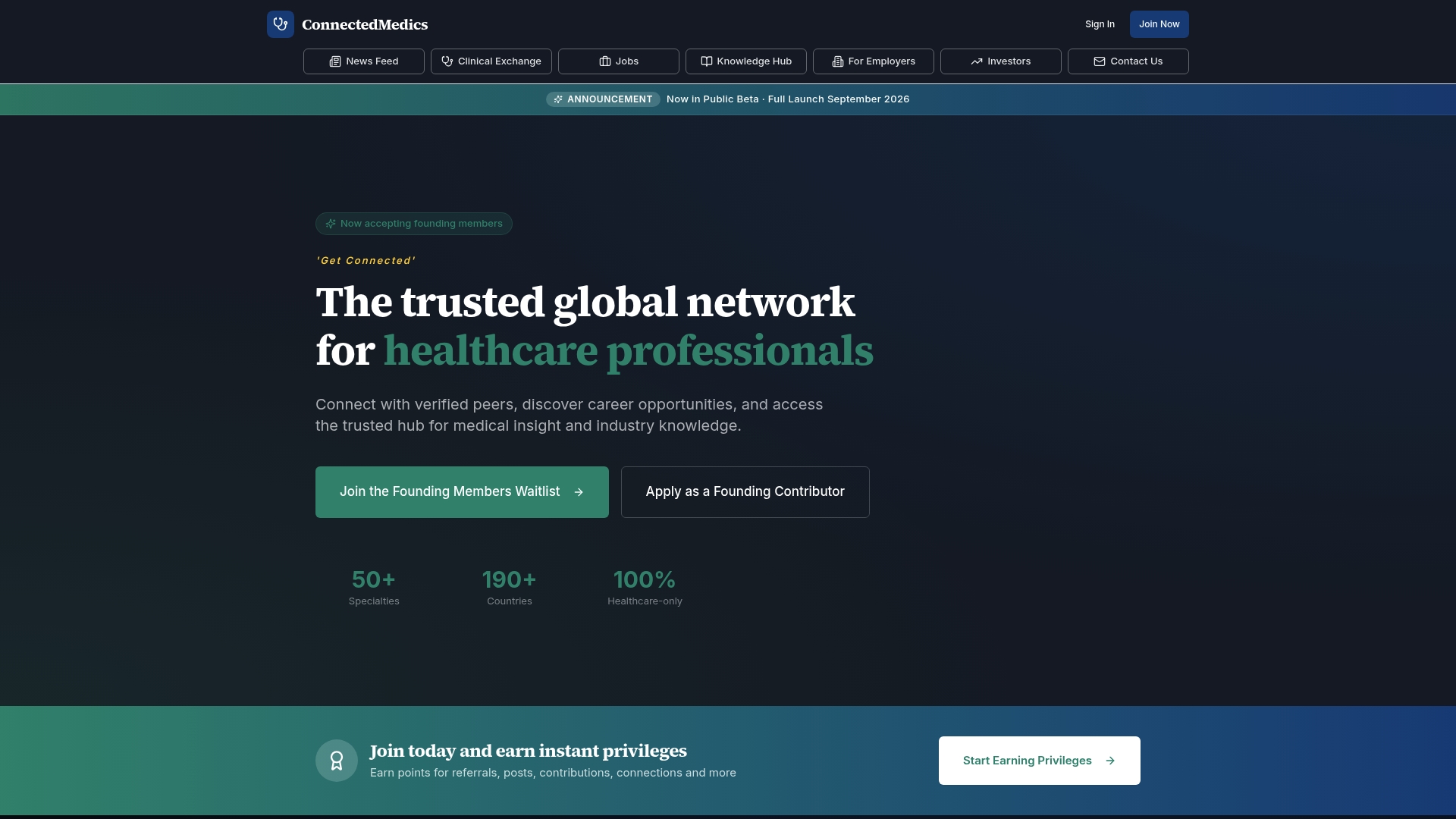
The platform's jobs board carries over 4,600 active healthcare vacancies, spanning clinical pivots and fully nonclinical roles, alongside specialty-led communities where physicians who've already made a similar move answer questions directly. If coaching support is part of your plan, structured coaching programs pair well with the peer insight you'll find on the platform. For anyone weighing a hybrid approach, the guide to nonclinical careers without quitting clinical work is a useful next read.
Create a verified profile on Connectedmedics today, browse current openings in your target field, and message one peer who's already made the jump you're considering.
Sources
- Survey: 62% of physicians made a career change in the last two years
- Career Transitions: What Are Other Options to Clinical Practice That May Align with New or Evolving Priorities/Goals? - PMC
- What's next? How senior physicians can plan a career transition - AMA
- Career Change: A Physician’s Guide to Medical Career Options - The Developing Doctor