
Professional Development medical CPD courses are accredited educational programs that help healthcare professionals maintain certifications, enhance clinical skills, and stay current with medical advances. Continuing professional development (CPD) is the recognized industry term for this ongoing learning process. In the United States, CME accreditation bodies such as the AMA, AAFP, and AOA define the requirements physicians must meet to keep their licenses active. For nurses, the ANCC sets contact hour standards. Choosing the right program from the growing catalog of options directly affects both career trajectory and patient outcomes.
What to look for in professional development medical CPD courses
The single most important criterion is accreditation. A course must carry recognized credit types before it counts toward license renewal. The most common are AMA PRA Category 1 Credits for physicians and ANCC Contact Hours for nurses. Pharmacists typically need ACPE credits. Always confirm which credit type a course awards before enrolling.
Beyond accreditation, five factors separate useful CPD from time spent on box-checking:
- Specialty relevance. A cardiology nurse gains little from a general public health module. Match course content to your clinical role.
- Delivery format. In-person, virtual, and hybrid options each suit different schedules and learning styles.
- Credit volume and timeline. Check how many credits the course awards and whether they fit your renewal deadline.
- Practical application focus. Courses built around case discussions and hands-on labs transfer faster to clinical practice than lecture-only formats.
- Interprofessional design. Interprofessional CPD programs that bring together physicians, nurses, pharmacists, and allied health professionals improve collaboration and patient care outcomes.
Pro Tip: Before registering, download your state licensing board's CME requirement sheet and cross-reference it with the course's credit type and hour count. Mismatched credits are the most common reason professionals fall short at renewal.
Top medical CPD courses: a curated list for 2026

The courses below represent a range of specialties, formats, and credit structures. Each entry covers what the course offers, who it suits best, and what accreditation it carries.
1. Mass General Brigham Medical Psychiatry Update Conference
This four-day conference grants 26.25 cross-disciplinary credits covering AMA PRA Category 1, Nursing CME, and Physician Assistant CME in a single event. It runs September 17–20, 2026. The cross-disciplinary credit structure makes it one of the most efficient options for clinicians who need to satisfy multiple board requirements at once. Psychiatrists, internists, and primary care nurses working with complex patients are the primary audience.
2. CDC TRAIN
CDC TRAIN consolidates multiple legacy continuing education systems into one free platform as of january 2026. It offers up to 10 CE credit types covering public health, emergency response, and clinical topics for physicians, nurses, and pharmacists. The cost is zero, which makes it the default starting point for any clinician building a CPD plan on a limited budget. Content depth varies by module, so pair it with a specialty-specific course for full coverage.
3. WHO/Europe Antimicrobial Stewardship Course
This six-day online course combines expert presentations with live clinical case discussions focused on improving prescribing behavior in primary care. Delivered in English across may and june 2026, it targets GPs, nurses, and pharmacists managing common infections. The course emphasizes diagnostic stewardship, meaning participants leave with tools they can apply from the next patient consultation. That immediate clinical transfer is what separates this program from passive lecture-based alternatives.
4. Mass Eye and Ear Sialendoscopy Course
This one-day in-person course at Mass Eye and Ear awards 7.5 AMA PRA Category 1 Credits through joint accreditation. It combines live surgical demonstrations with hands-on lab work covering endoscopic management of salivary gland disorders. The format suits otolaryngologists and head and neck surgeons who need procedural skills, not just theoretical updates. One day of focused lab time delivers more retained skill than several hours of online video.
5. UK Sepsis Trust Train the Trainer Program
This institutional program costs £495 + VAT for an initial cohort of three participants, with £99 + VAT per additional participant. The license runs for one year and includes update options at renewal. Hospital education leads and clinical nurse specialists use it to build internal sepsis training capacity rather than sending staff to external courses. The tiered pricing rewards larger cohorts, making it cost-effective for ward-level rollout.
6. Rutgers School of Health Professions Continuing Education
Rutgers SHP offers stackable certificate credits that apply toward formal degree programs if completed within five years. This structure benefits clinicians who want CPD credits now and a graduate degree later without starting from scratch. Programs span health informatics, clinical nutrition, and rehabilitation sciences. The stackable model is one of the most underused features in university-based CPD, and it changes the return on investment calculation significantly.
7. Northeastern University Bouvé College Interprofessional CPD
Northeastern's continuing education division explicitly designs programs for interprofessional teams, placing physicians, pharmacists, nurses, and allied health professionals in shared learning environments. This mirrors real clinical settings where care decisions involve multiple disciplines. Professionals who work in hospital systems or integrated care networks benefit most from this format. The collaborative structure also builds the communication skills that reduce medical errors.
8. Specialty society online modules (general category)
Most major specialty societies, including the American College of Physicians, the American Academy of Family Physicians, and the American Nurses Association, publish self-paced online modules aligned to their board requirements. These asynchronous options suit clinicians with unpredictable schedules. Credit counts per module are typically lower than multi-day conferences, but the flexibility offsets that limitation for many practitioners. Check your specialty society's CME catalog before purchasing third-party content.
Comparing CPD delivery formats
Format choice affects how much learning actually reaches clinical practice. The table below maps the main delivery types to their practical trade-offs.
| Format | Best for | Credit potential | Clinical transfer speed |
|---|---|---|---|
| In-person hands-on lab | Procedural and surgical skills | Moderate (e.g., 7.5 credits per day) | High. Skills practiced immediately |
| Multi-day live conference | Broad updates across disciplines | High (e.g., 26.25 credits per event) | Moderate. Depends on follow-through |
| Synchronous online with case discussions | Primary care and prescribing behavior | Moderate | High. Live cases mirror real decisions |
| Asynchronous online modules | Schedule-constrained clinicians | Low to moderate per module | Lower without structured application |
| Institutional train-the-trainer | Hospital-wide rollout | Variable by program | High when embedded in ward protocols |
Asynchronous vs. synchronous formats affect more than convenience. Fixed-session live case discussions force real-time clinical reasoning in a way that self-paced video cannot replicate. That distinction matters most for courses targeting prescribing behavior or diagnostic decision-making.
Pro Tip: If your renewal deadline is within six months, prioritize synchronous or in-person formats. The accountability of a scheduled session reduces the dropout rate that plagues self-paced modules.
How to maximize the value of your CPD investment
Completing a course is the minimum. Getting value from it requires a plan before, during, and after the event.
- Align credits to your renewal calendar. Map your licensing board's requirements at the start of each year and schedule courses to fill gaps before the deadline, not after.
- Apply learning within 48 hours. Diagnostic stewardship training shows that clinicians who apply new protocols to real cases within two days retain significantly more than those who wait.
- Stack credits toward a degree. If your institution or a university like Rutgers offers stackable certificates, enroll in programs that count toward a future graduate qualification. The five-year stackable window at Rutgers SHP means credits earned now can reduce future tuition costs.
- Use conferences for network building. Medical conference networking produces referral relationships and collaborative research opportunities that extend the value of attendance well beyond the credit hours earned.
- Budget for license renewals in group programs. Institutional CPD programs like the UK Sepsis Trust's Train the Trainer model require annual renewal fees to maintain accreditation. Build that cost into your department's education budget at the start of the fiscal year, not as an afterthought.
- Prioritize interprofessional formats when possible. Shared learning environments produce better communication habits across care teams, which translates directly to fewer handoff errors and better patient outcomes.
Key takeaways
The most effective CPD strategy combines accredited, specialty-specific courses with formats that force immediate clinical application and credits that align with licensing deadlines.
| Point | Details |
|---|---|
| Accreditation is non-negotiable | Match AMA PRA, ANCC, or ACPE credit types to your specific licensing board requirements. |
| Format drives retention | Hands-on labs and live case discussions transfer faster to clinical practice than asynchronous video. |
| Stackable credits multiply value | University programs like Rutgers SHP let credits earned now count toward a future graduate degree. |
| Group programs need renewal budgets | Institutional licenses such as the UK Sepsis Trust model require annual fees. Plan for them early. |
| Interprofessional learning improves care | Programs mixing physicians, nurses, and pharmacists build the collaboration skills that reduce errors. |
Why CPD planning deserves more than a renewal checklist
Most clinicians I speak with treat CPD as a compliance task. They accumulate the minimum credits, file the paperwork, and move on. That approach keeps a license active. It does not build a career.
The shift I find most significant right now is the move toward interprofessional formats. When a GP, a clinical pharmacist, and a ward nurse complete the same antimicrobial stewardship module together, they leave with a shared vocabulary for prescribing decisions. That shared vocabulary shows up in fewer unnecessary antibiotic courses and faster escalation when resistance patterns emerge. The learning is the same. The outcome is better because the team trained together.
The other underused lever is the stackable credit model. A clinician who spends three years completing certificate programs through a university like Rutgers SHP can enter a master's program with a meaningful credit bank already built. That changes the time and cost calculation for advanced education entirely. Most professionals do not know this option exists until someone points it out.
Balancing clinical duties with formal education is genuinely hard. The clinical skills development programs that work best are the ones designed around clinical schedules, not academic ones. Fixed-session courses that run across six weeks of evenings tend to hold completion rates better than weekend intensives that compete with family time.
The future of CPD accreditation will likely move toward competency verification rather than credit counting. Demonstrating that you can apply a skill matters more than proving you sat through a lecture about it. Programs built around case-based assessment and direct observation are already ahead of that curve.
— David
Connectedmedics and your ongoing CPD needs
Healthcare professionals seeking CPD opportunities, career resources, and specialty connections use Connectedmedics as a central hub. The platform hosts verified profiles of medical professionals, a global jobs board with over 4,600 active healthcare vacancies, and a knowledge hub built from clinical insights contributed by verified experts.
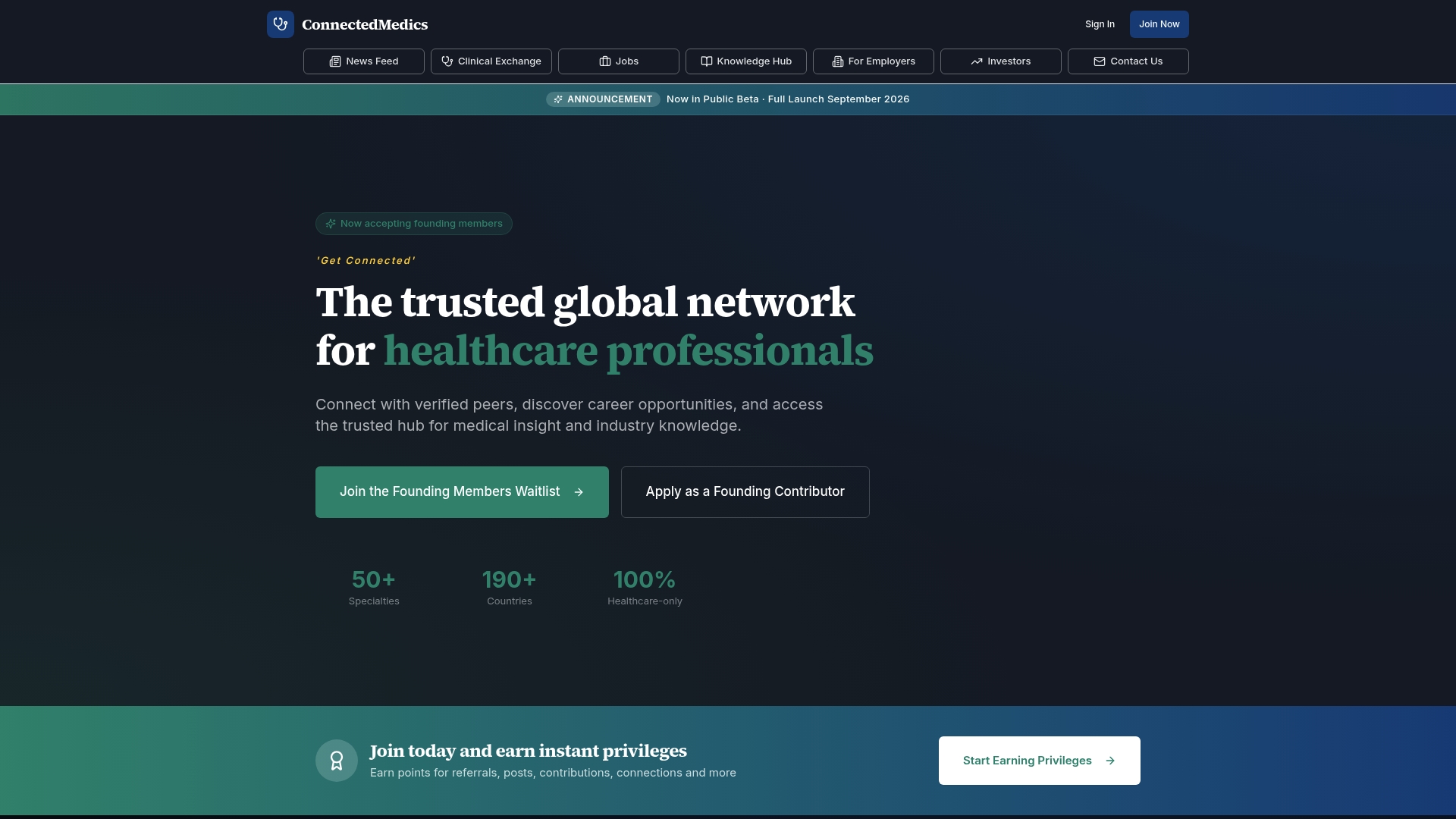
Connectedmedics aggregates educational resources and CPD opportunities relevant to physicians, nurses, and allied health professionals across specialties. The platform's knowledge hub surfaces research summaries and clinical trend updates that complement formal CPD coursework. For professionals who want to connect with peers in their specialty while tracking career and learning opportunities in one place, joining as a founding member provides early access to the full feature set.
FAQ
What are CPD courses in medicine?
CPD courses in medicine are accredited educational programs that help healthcare professionals maintain licenses, update clinical skills, and meet specialty board requirements. The term CPD (continuing professional development) covers all structured learning after initial qualification.
How many CME credits do doctors need per year?
Credit requirements vary by state licensing board and specialty. Most U.S. states require between 20 and 50 AMA PRA Category 1 Credits per renewal cycle, typically spanning two years.
Are free accredited CPD courses available for healthcare professionals?
CDC TRAIN offers free accredited CE for physicians, nurses, and pharmacists across up to 10 credit types, covering public health and emergency response topics at no cost.
Can CPD credits count toward a graduate degree?
University-based programs like Rutgers SHP allow stackable certificates to apply toward formal degree programs if completed within five years, reducing future tuition and time requirements.
What is the difference between CME and CPD?
CME (continuing medical education) refers specifically to accredited learning for physicians. CPD is the broader term covering all healthcare professions, including nursing, pharmacy, and allied health, and encompasses a wider range of learning activities beyond formal courses.