
Most healthcare professionals attend conferences for the scheduled content: keynotes, clinical updates, research presentations. That framing leaves significant value on the table. Why medical conference networking matters goes well beyond collecting business cards or filling downtime between sessions. Professional networking at medical events, the recognized practice of building and sustaining relationships with peers and colleagues, is where careers shift, collaborations form, and clinical thinking evolves. This article breaks down the evidence behind networking's impact and gives you a concrete plan to make the most of every conference you attend.
Table of Contents
- Key takeaways
- Why medical conference networking matters
- Where the most impactful networking happens
- Practical strategies for networking at conferences
- Sustaining connections after the conference
- My take on medical conference networking
- Expand your network with Connectedmedics
- FAQ
Key takeaways
| Point | Details |
|---|---|
| Informal moments drive collaboration | Coffee breaks and dinners produce more productive partnerships than formal sessions. |
| Follow-up converts contacts into colleagues | Timely, specific post-event messages are what turn brief meetings into lasting relationships. |
| Planning before arrival pays off | Researching attendees and setting goals before the event increases your networking outcomes significantly. |
| Peer discussions shape clinical practice | Two in three healthcare professionals report that conference peer interactions influence their clinical thinking. |
| Digital platforms extend conference value | Tools like Connectedmedics keep connections active long after the event ends. |
Why medical conference networking matters
The formal term for what happens in conference hallways and dinner tables is professional networking. In healthcare settings, it carries specific weight because the field depends on trust, collaboration, and peer validation in ways most industries do not.
Here is what medical conference connections actually produce:
- Collaborative research and clinical projects. Collaboration quality through conference contacts consistently surpasses what professionals achieve within their own institutions, because conferences bring together practitioners with complementary expertise who would never otherwise cross paths.
- Exposure to peer insight that informs decisions. Two in three healthcare professionals say insights from symposia influence their clinical thinking and prescribing behavior. Peer conversation, not just lectures, is where that influence originates.
- Career opportunities that are never posted publicly. Department heads, research leads, and hiring managers attend the same events you do. A conversation over lunch has opened more doors than a formal job application in countless cases.
- Access to diverse expertise across specialties. A cardiologist speaking with a pharmacist about medication adherence, or a radiologist connecting with an oncologist about imaging protocols, produces the kind of cross-disciplinary insight that improves patient outcomes.
The importance of medical networking compounds over time. A contact made at a conference this year may become a co-author, a reference, or a collaborator on a grant three years from now. The relationship has to start somewhere.
Pro Tip: Before each conference, write down one clinical problem you are currently working on. Use it as a conversation opener. Specific problems attract specific expertise faster than generic introductions.
Where the most impactful networking happens
The most productive professional connections at conferences do not form during keynote addresses. Informal moments such as coffee breaks and dinners drive most collaboration formation because unstructured time allows for the reciprocal, exploratory conversations that reveal shared interests and build trust.
| Setting | Networking quality | Why it works |
|---|---|---|
| Formal sessions | Lower | One-directional; limits conversation |
| Coffee breaks | High | Relaxed, reciprocal, easy to approach speakers |
| Conference dinners | Very high | Extended time; trust builds more naturally |
| Poster sessions | High | Presenters are approachable; topics are focused |
| Pre-event receptions | High | Smaller groups; people are fresh and open |
The pattern is consistent. Reciprocal exploratory conversations in unstructured time enable people to discover overlap in interests and goals, which is the foundation of any productive collaboration.
One common mistake worth addressing directly: defaulting to the people you already know. When you spend conference breaks with your existing colleagues, you reinforce existing relationships but miss the entire point of attending. Talking with your hospital team at a national conference is comfortable. It is also a wasted opportunity.
"The highest networking ROI at conferences comes not from sessions, but from the unstructured spaces in between. Plan for those moments as deliberately as you plan for the schedule."
Chance encounters matter too. A hallway conversation with a researcher whose poster you saw, an introduction from a mutual colleague, a seat next to someone at dinner — these seemingly random moments are where many significant professional partnerships begin.
Practical strategies for networking at conferences
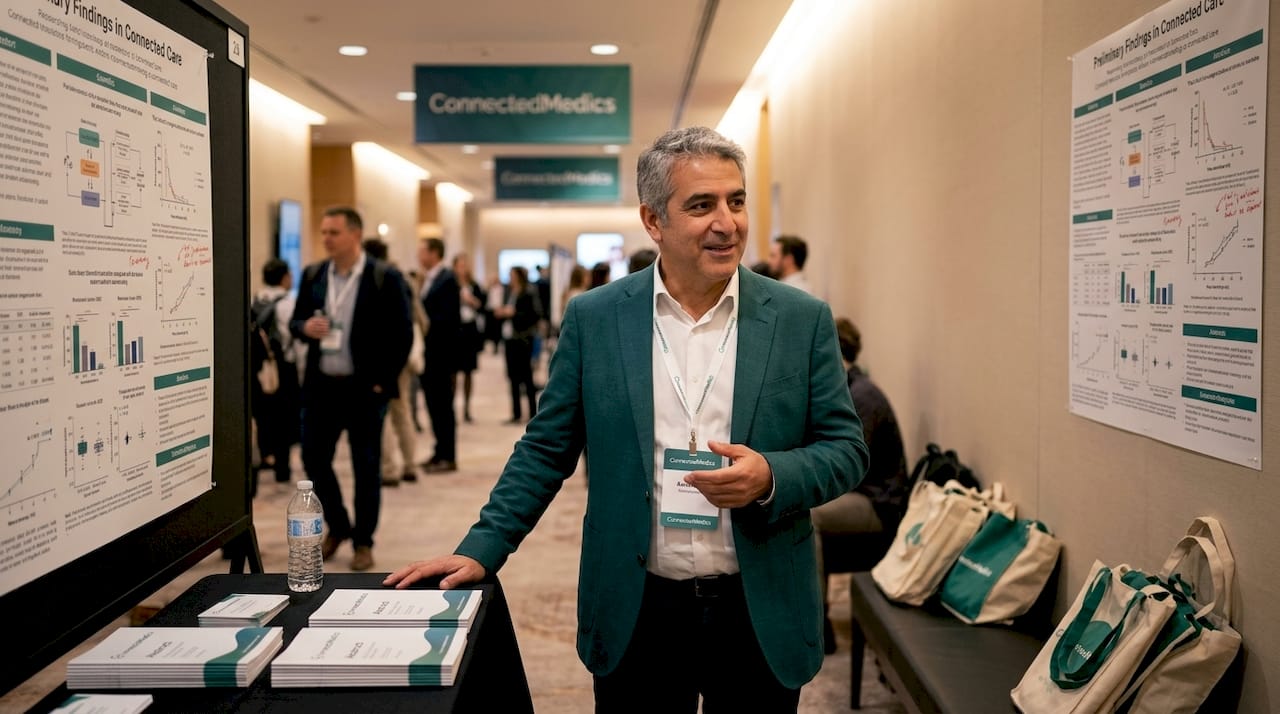
Effective networking in healthcare events does not happen by instinct. It is a system with measurable inputs and outputs.
Here is how to run that system:
-
Research attendees before you arrive. Conference apps, attendee lists, and speaker bios give you a map. Planning outreach before the conference leads to higher networking outcomes than attempting to meet the right people on-site by chance. Identify five to ten people you specifically want to speak with and understand their work beforehand.
-
Set a concrete networking goal. Not "meet people" but "have three substantive conversations about my current research focus" or "connect with two professionals working in emergency medicine outside my region." Specific goals produce specific results.
-
Prepare a focused professional introduction. Know your name, your role, your current work or interest, and one question you are thinking about. Two to three sentences. Practiced out loud so it sounds natural, not rehearsed.
-
Use structured formats if you are early in your career. Speed mentoring, trainee receptions, and career fairs at medical conferences are designed specifically to build meaningful connections beyond what chance encounters produce. Use them.
-
Schedule meetings before you arrive. Send brief messages through the conference app or email in the week before the event. A short note referencing someone's published research or a session they are presenting is enough to open the door.
-
Navigate social events with purpose. At dinners and receptions, resist the habit of staying in one conversation for the entire event. Aim for three to four substantive conversations rather than one extended one. Quality matters more than duration at this stage.
-
Avoid these common errors. Talking only about yourself, failing to ask questions, collecting contact information without any shared context, and staying exclusively with known colleagues are the four habits that most reliably reduce networking outcomes.
Pro Tip: At poster sessions, ask the presenter what surprised them most in their results. It is a better question than "what does this mean for clinical practice?" and it opens far more interesting conversations.
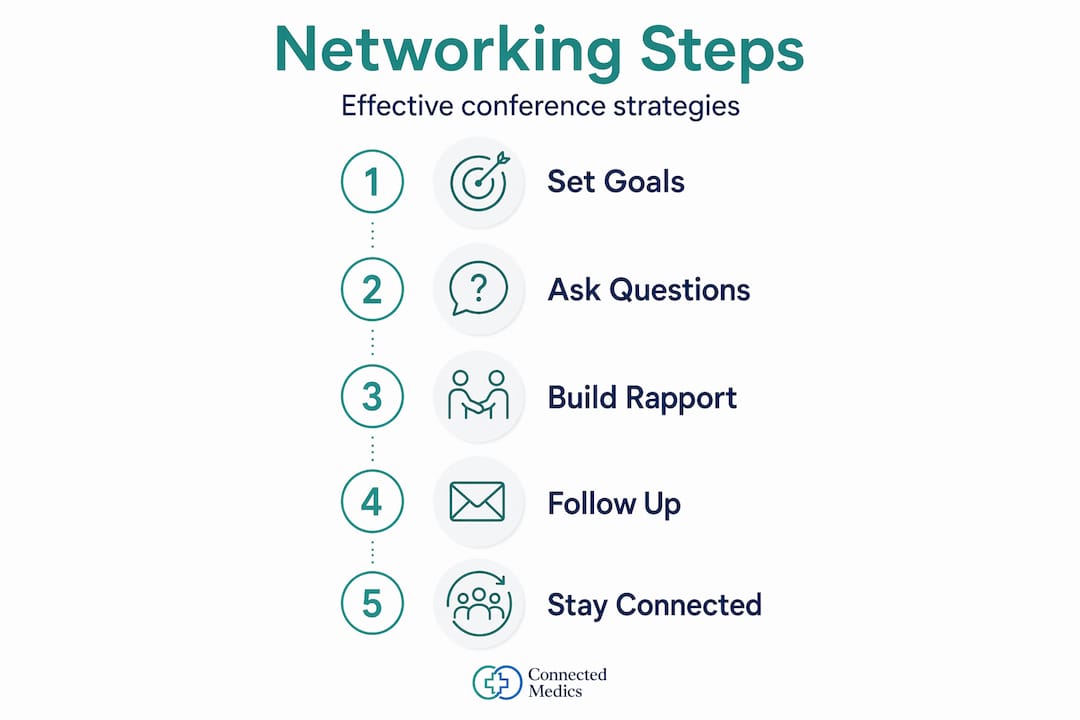
Networking as a system requires goal-setting, research, deliberate action, and structured follow-up. Professionals who treat it that way consistently outperform those who rely on personality or luck.
Sustaining connections after the conference
The conference ends. Most connections do not survive the week unless you act on them quickly.
Here is what effective post-conference follow-up looks like:
- Send messages within 48 hours. A specific, contextual follow-up message within two days of meeting someone dramatically increases the chance of that relationship continuing. Generic "great to meet you" notes add nothing. Reference the exact conversation you had.
- Capture context during the conference. Take brief notes on your phone after each meaningful conversation: the person's name, their role, what you discussed, and any next steps mentioned. This is what makes personalized follow-up possible. Without specific context in follow-up, momentum from conference meetings rapidly disappears.
- Propose a specific next step. A follow-up that ends with a concrete suggestion ("Would you be open to a 20-minute call next month about the registry project you mentioned?") converts a meeting into a potential collaboration. Vague interest rarely leads anywhere.
- Use digital platforms to stay connected. Healthcare-specific professional networks make it easier to maintain relationships between conferences. Following a colleague's published work, commenting on their updates, or sharing relevant research keeps the relationship active without requiring a major time commitment. The impact of networking on careers is most visible when connections are maintained consistently, not just activated at the next event.
- Look for collaboration or career opportunities in your network. Referrals for open positions, invitations to join research groups, and co-authorship opportunities often come from professional contacts made at conferences. The relationship has to be warm and active for those opportunities to flow naturally.
Tailored post-congress follow-up is what extends the value of attending far beyond the event itself. Without it, the conference produces little more than a few days away from the office.
My take on medical conference networking
I have watched healthcare professionals attend the same conferences year after year and come home with nothing to show for it except a tote bag and a stack of brochures. The reason is almost always the same. They treated the networking as incidental, something that might happen rather than something to plan for.
What I have learned over years of working at the intersection of healthcare and professional development is that the professionals who build the best networks are not necessarily the most outgoing or senior. They are the most prepared. They know who they want to speak with, they have a clear sense of what they offer and what they are looking for, and they follow up immediately with something specific.
The other thing most articles on this topic miss: speaking and volunteering at conferences change your networking outcomes entirely. When you present a poster, chair a session, or volunteer at the registration desk, people approach you. You become findable. That inbound dynamic is far more productive than working through a room of strangers.
The uncomfortable truth about conference networking is that collecting contacts is nearly worthless. What matters is the quality of the conversation and the speed and specificity of what comes after. A conference where you had four deep conversations and followed up with all four beats a conference where you collected forty business cards and emailed no one.
— David
Expand your network with Connectedmedics
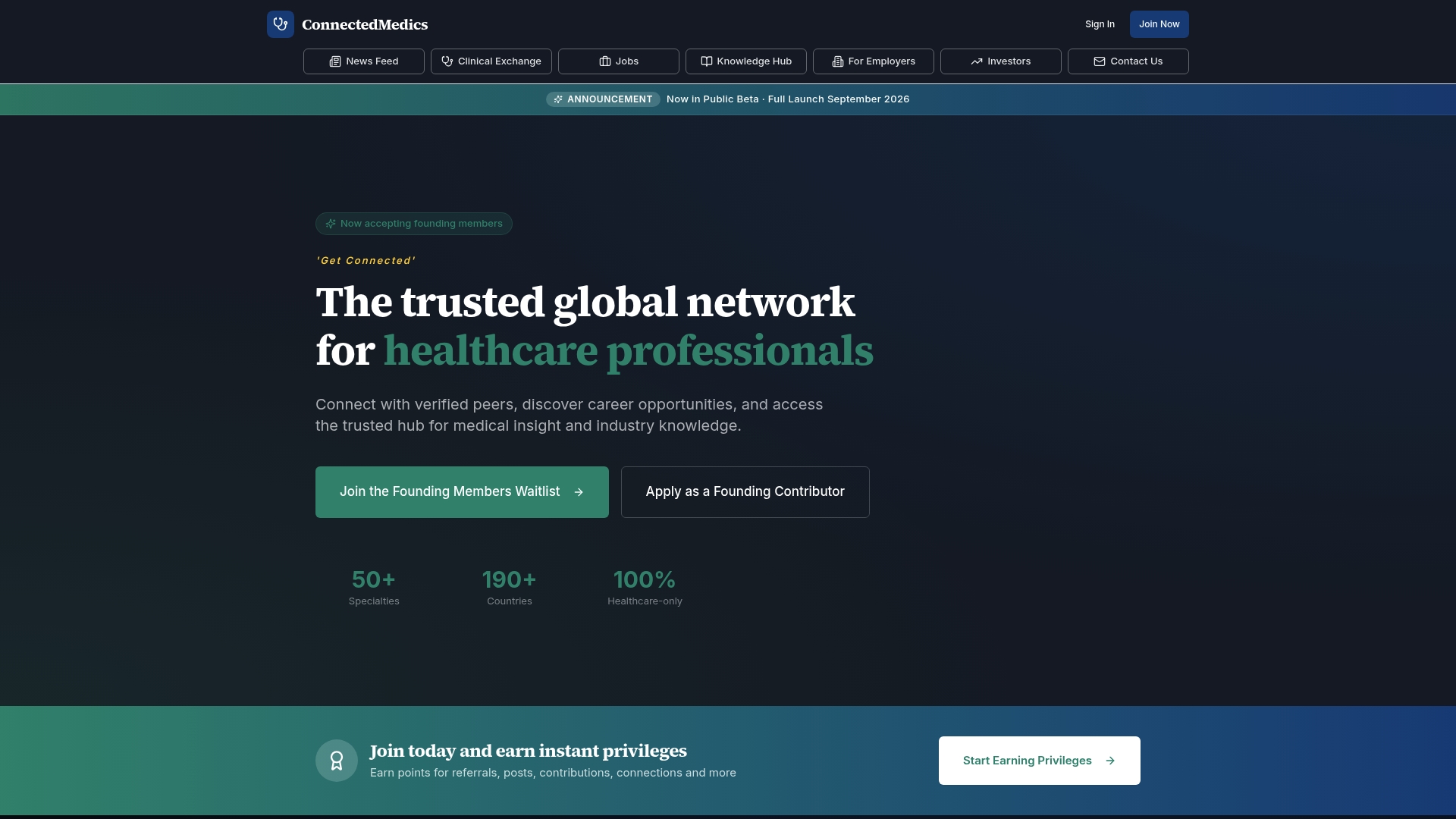
Conference connections are valuable. They are also temporary unless you have a place to maintain them. Connectedmedics is a professional network built exclusively for healthcare professionals, which means every profile, job posting, and clinical resource on the platform is relevant to your specialty and career stage.
After your next conference, use Connectedmedics to find verified healthcare professionals across specialties, stay engaged with the people you met, and access the Connectedmedics knowledge hub for clinical updates that give you real things to share with your growing network. With over 4,600 active healthcare vacancies and a marketplace connecting medical professionals across institutions, the platform turns the momentum from a conference into sustained career progress. You can also explore applying to healthcare vacancies efficiently when connections lead to opportunities.
FAQ
Why does networking at medical conferences matter?
Networking at medical conferences builds the professional relationships that drive career advancement, research collaboration, and clinical knowledge sharing. Evidence shows conference-based connections produce stronger collaborations than typical institutional contacts.
When is the best time to network at a conference?
Informal settings like coffee breaks, dinners, and poster sessions produce the most productive connections. Unstructured time at conferences allows for the reciprocal conversations that lead to collaboration.
How do you follow up after a medical conference?
Send a personalized message within 48 hours that references your specific conversation and proposes a concrete next step. Generic follow-ups rarely convert into ongoing professional relationships.
How should early-career clinicians approach conference networking?
Early-career professionals should use structured formats like speed mentoring and trainee receptions, which are designed to build meaningful connections beyond chance encounters. Preparing a clear professional introduction and specific goals before arriving also increases outcomes significantly.
How do you sustain connections made at medical conferences?
Use healthcare-specific professional platforms, share relevant research, and propose specific collaboration opportunities. Timely, tailored follow-up is the single most effective way to turn a conference meeting into a lasting professional relationship.