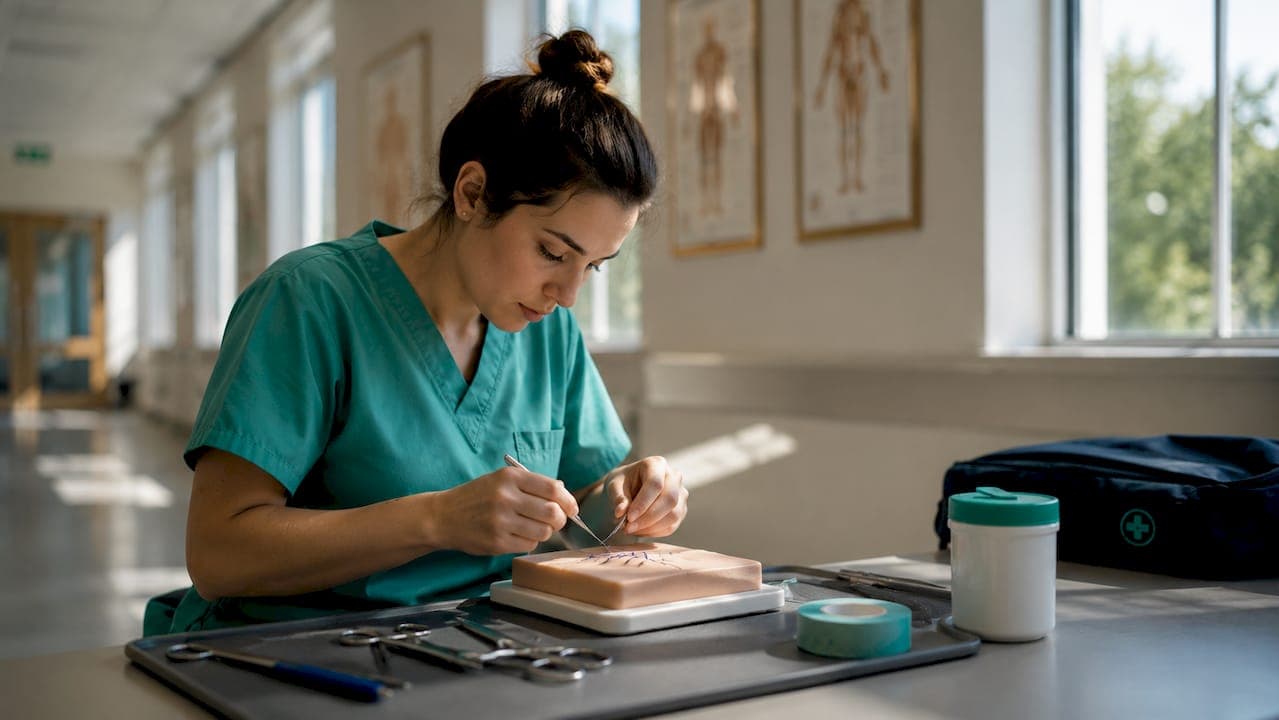
Clinical skills courses are training programs designed to teach healthcare professionals practical competencies such as physical examinations, clinical reasoning, and patient communication. These programs sit at the intersection of academic knowledge and real-world practice, covering core abilities like history taking, clinical assessment, and structured consultation. Regulatory bodies and medical education standards increasingly require documented competency, not just attendance. Whether you are a nurse expanding your scope, a pharmacist preparing for clinical roles, or a doctor sharpening assessment technique, the right medical skills training program determines how quickly you move from supervised to independent practice.

What are the main types of clinical skills courses available in 2026?
Clinical skills courses fall into five broad categories, each suited to different career stages and learning goals.
- Single-day intensive workshops. These are the most accessible entry point. Clinical skills workshops range from 8-hour sessions costing $100 to $900, with same-day certification exams. That price range means a pharmacist or newly qualified nurse can access credentialed training without a major financial commitment.
- Extended part-time academic modules. These run up to 6 months and cover advanced clinical assessment, including cardiovascular, respiratory, and abdominal examinations. Advanced clinical training typically requires at least 1 year of clinical experience before enrollment. This format suits clinicians pursuing formal postgraduate credit.
- Multi-station practical workshops. These use rotating stations to cover multiple examination systems in one session. Participants receive direct feedback at each station and leave with a competency sign-off.
- Virtual and blended eLearning courses. These combine recorded content with live virtual sessions or in-person simulation days. They work well for clinicians with shift-based schedules who cannot commit to fixed classroom dates.
- Profession-specific programs. Courses designed for nurses, pharmacists, or allied health professionals address scope-of-practice differences directly. A pharmacist's clinical assessment course covers different competencies than a physician's advanced physical examination module.
Pro Tip: Before enrolling, check whether the course provider is recognized by your licensing board or employer. A certificate from an unrecognized provider may not count toward revalidation or credentialing requirements.
How do clinical skills courses structure hands-on training and assessments?
The format of a course determines how much practical skill you actually retain. The best healthcare skills workshops use structured, repeatable formats that mirror real clinical environments.
- Four-station modular rotation. Most clinical skills workshops use a 4-station modular format with small supervised groups. Rotating through stations covering different body systems builds both breadth and confidence within a single session.
- Supervised small-group sessions. Groups of 4 to 8 participants allow instructors to observe technique, correct errors in real time, and provide individual feedback. Larger groups reduce hands-on time per participant significantly.
- Simulated patient encounters and OSCE-style stations. Objective Structured Clinical Examination (OSCE) formats test both technique and communication simultaneously. Verbalizing clinical reasoning aloud during OSCE stations is as important as technique, because examiners award marks for demonstrated reasoning, not just correct actions.
- Same-day certification exams. Many workshops tie a written or practical exam directly to the training day. This approach reinforces learning while knowledge is fresh and removes the delay between training and credentialing.
- Real equipment and clinical environment simulation. Using actual stethoscopes, examination couches, and clinical tools rather than diagrams or videos accelerates skill transfer to real patient encounters.
Pro Tip: Treat every simulated patient encounter as a real one. Clinicians who narrate their findings aloud during practice sessions perform measurably better in formal OSCE assessments.
What should healthcare professionals consider when choosing the best clinical skills course?
Choosing the right course requires matching the program to your professional role, experience level, and career goals. The wrong choice wastes time and money without advancing your practice.
- Match course content to your scope of practice. A nurse practitioner needs assessment modules aligned with independent prescribing. A junior doctor needs structured history-taking frameworks. Generic courses may not address profession-specific competency gaps.
- Check prerequisites honestly. Advanced clinical training programs require documented clinical experience, often at least 1 year. Enrolling without meeting prerequisites leads to poor outcomes and wasted fees.
- Understand the difference between certificate types. A certificate of attendance does not legally authorize expanded clinical practice. A certificate of competence, signed off by a qualified supervisor, does. This distinction carries legal and insurance implications that affect your ability to practice independently.
- Verify instructor credentials and accreditation. Courses delivered by practicing clinicians with current registration carry more weight with employers and licensing boards than those delivered by educators without active clinical roles.
- Factor in total cost, including time away from work. Workshop fees range from $100 for a single-day session to several thousand dollars for a 6-month postgraduate module. Time off for shift workers adds an indirect cost that affects the real value calculation.
- Confirm employer or licensing board recognition. Some employers require specific course providers for revalidation. Checking this before enrolling prevents the frustration of completing a course that does not count toward your professional requirements.
- Bring required documentation. Many workshops require participants to present professional ID and proof of licensure on the day. Without these, certification may be withheld even after completing the full training.
Understanding what healthcare employers value in 2026 helps narrow course selection to programs that directly address hiring criteria.
What are the top 10 clinical skills courses recommended for healthcare professionals?
The following courses represent the strongest options across different professions, budgets, and learning formats in 2026.
-
Clinical Examination and Consultation Skills Masterclass. A practical, single-day workshop using a 4-station modular format. Covers cardiovascular, respiratory, abdominal, and neurological examinations. Offers same-day certification. Best for: doctors and nurses seeking rapid competency sign-off.
-
History Taking and Physical Assessment (Solent University, 6-month module). A postgraduate part-time module covering advanced consultation and examination skills. Requires at least 1 year of clinical experience. Offers academic credit. Best for: advanced practice nurses and physician associates.
-
AlliedSkillsPrep 1-Day Certification Workshop. Hands-on training with same-day national certification exams for multiple healthcare roles. Covers a range of allied health competencies. Best for: allied health professionals seeking nationally recognized credentials quickly.
-
Academy of Communication in Healthcare (ACH) Workshops. Focused entirely on communication as a clinical skill. Covers relationship-centered care, structured consultation, and difficult conversations. Best for: any clinician whose training lacked formal communication instruction.
-
Clinical Skills Lab Experience (Chequers Academy). A hands-on lab-based program covering physical examination with real clinical equipment. Includes competency feedback and sign-off. Best for: students and early-career clinicians building foundational examination skills.
-
OSCE Preparation Course (PharmDecks). Designed specifically for pharmacists preparing for clinical skills assessments. Covers OSCE station technique, clinical reasoning verbalization, and time management under exam conditions. Best for: pharmacists entering clinical roles or preparing for registration assessments.
-
Cross-Cultural Communication Workshop (NZSE). Addresses cultural humility, unconscious bias, and effective communication across diverse patient populations. Best for: clinicians working in multicultural settings or preparing for international practice.
-
Defense Health Agency Clinical Training Program. A structured program emphasizing supervised case-based learning and active feedback. Recognized within military and federal healthcare systems. Best for: clinicians in federal or military healthcare roles seeking structured competency development.
-
Advanced Clinical Assessment Module (various universities). University-delivered modules covering full-system examination, differential diagnosis, and clinical decision-making. Typically 3 to 6 months, part-time. Best for: nurses and allied health professionals pursuing advanced practice registration.
-
Blended eLearning Clinical Skills Programs. Combine self-paced online content with in-person simulation days. Flexible scheduling suits shift workers. Certification varies by provider. Best for: experienced clinicians who need to update specific skills without taking extended leave.
For a broader view of how these programs fit into long-term career planning, the continuing medical education landscape provides useful context on how course choices affect career trajectories.
How do clinical skills courses improve communication and cultural competence?
Communication is a clinical skill, not a personality trait. Clinicians receive minimal formal training in communication despite its direct impact on diagnosis accuracy, patient adherence, and clinical outcomes. Structured consultation frameworks like the ICE method (Ideas, Concerns, Expectations) teach clinicians to elicit patient perspectives systematically rather than relying on instinct.
Cultural humility goes further than cultural awareness. Effective cross-cultural care requires practitioners to challenge their own unconscious biases rather than simply memorizing cultural facts about patient groups. Courses that address this distinction produce clinicians who adapt their communication style to the individual, not to a stereotype.
"Communication and relationship-building are as vital as diagnostic skills for clinical outcomes, yet they remain among the most under-taught competencies in clinical training programs." — Academy of Communication in Healthcare
The connection between communication and clinical reasoning is direct. A clinician who cannot explain their diagnostic thinking to a patient also struggles to present it clearly to a supervisor or examiner. Courses that integrate communication training with clinical assessment produce more complete practitioners.
Key takeaways
The most effective clinical skills courses combine hands-on supervised practice with recognized certification, because competency sign-off, not attendance, is what advances clinical scope and career standing.
| Point | Details |
|---|---|
| Certificate type matters | A certificate of competence authorizes expanded practice; a certificate of attendance does not. |
| Format drives retention | Four-station modular workshops with small groups produce better skill transfer than lecture-based formats. |
| Communication is a core skill | Structured consultation training and cultural humility modules belong in every clinician's development plan. |
| Prerequisites are real barriers | Advanced modules require at least 1 year of clinical experience; enrolling without it wastes fees and time. |
| Documentation prevents delays | Bring professional ID and licensure proof to every workshop or risk losing certification on the day. |
What I have learned from watching clinicians choose the wrong courses
The most common mistake I see is clinicians choosing a course based on price or convenience rather than certification outcome. A $150 one-day workshop sounds like a bargain until you realize the certificate carries no weight with your licensing board or employer. The real cost is the lost time and the need to repeat the process with a recognized provider.
The second mistake is treating technique as the only goal. Clinicians who focus entirely on examination mechanics often struggle in OSCE assessments because they cannot articulate their reasoning. The courses that produce the best outcomes are those that treat communication and clinical reasoning as equal partners to physical technique. Seeking structured supervision and feedback throughout training, rather than just clocking hours, is what separates clinicians who advance quickly from those who plateau.
My practical advice: map your course choice to a specific career goal before you enroll. If you want to prescribe independently, you need a certificate of competence from a supervisor-signed program. If you are preparing for an OSCE, you need a course that drills verbalized reasoning, not just technique. Viewing clinical skills training as a direct pathway to independent practice, rather than a box to check, changes how you engage with every session.
— David
Connectedmedics: a resource for clinical skills development
Healthcare professionals looking for trusted course listings, certification guidance, and peer connections have a direct resource in Connectedmedics. The platform connects verified clinicians across specialties and provides access to a knowledge hub built from expert-contributed content.
Connectedmedics hosts over 4,600 active healthcare vacancies alongside resources covering clinical education and career development. For clinicians weighing course options or looking for roles that require specific certifications, the Connectedmedics global network provides a practical starting point. Membership connects you with verified professionals who have direct experience with the programs and credentials that matter in your specialty.
FAQ
What is the difference between a certificate of attendance and competence?
A certificate of attendance confirms participation only. A certificate of competence, signed by a qualified supervisor, legally authorizes expanded clinical practice and is required for most licensing and insurance purposes.
How long do clinical skills courses typically take?
Course duration ranges from a single 8-hour day for intensive workshops to 6 months for part-time postgraduate modules, depending on the depth of competencies covered.
Do I need prior clinical experience to enroll?
Advanced clinical assessment courses require at least 1 year of documented clinical experience. Single-day workshops and foundational programs are generally open to students and early-career clinicians.
Are online clinical skills courses as effective as in-person ones?
Blended programs that combine online content with in-person simulation days deliver comparable outcomes to fully in-person courses. Fully online programs without a practical component are not sufficient for competency sign-off.
What documents should I bring to a clinical skills workshop?
Most workshops require professional ID and proof of current licensure. Without these, certification may be withheld even after completing all training activities.