
A doctor who has been away from clinical work for about two years or more usually needs a documented plan to return. The plan covers a self-assessment, a check of knowledge and skills, supervised practice, and a license that matches the state's rules. The job search runs alongside it. A role in the right specialty, with an employer that knows the gap, is part of a safe return. A healthcare-only network such as ConnectedMedics lists specialty-specific roles for that search.
This guide covers physicians. Nurses can find the equivalent in the nurse reentry programs guide.
TL;DR
- Physician reentry means a return to clinical work after an extended absence that did not result from discipline or impairment. About 10,000 physicians qualify each year, according to the AMA.
- More than two years away is the commonly accepted point at which a formal reentry process applies, per the FSMB 2025 report. Each state board sets its own rule.
- A typical pathway has four parts: self-assessment, a knowledge and skills assessment, refresher education, and supervised practice.
- Costs usually fall on the physician. Program length and price vary.
- Start the job search early. Specialty-matched roles and a clear explanation of the gap shorten the path back.
Table of Contents
- What physician reentry means
- How long is too long: the two-year line
- What state boards require
- The four steps of a typical reentry pathway
- Cost, length and funding
- Licensing, credentialing and privileges
- Finding a role after time away
- Where ConnectedMedics fits
- Perspective
- FAQ
- Sources
What physician reentry means
Reentry is a return to clinical practice in the discipline a physician trained or was certified in. It follows an extended period of clinical inactivity. The AMA's definition covers personal health, family issues, relocation, career dissatisfaction and burnout. It excludes absences caused by discipline or impairment. Those cases follow a separate board process. The AMA issue brief puts the number of physicians who qualify to reenter at about 10,000 a year.
Typical examples:
- A physician who took several years for caregiving.
- A doctor who moved into industry, consulting or administration and now wants patient care again.
- A physician who relocated abroad and is returning to the US.
- A clinician who stepped back for burnout recovery.
A physician planning a break can read the career transition guide on keeping a license active during 12 to 18 months away.
How long is too long: the two-year line
The FSMB Workgroup report, adopted in April 2025, says more than two years away is commonly accepted as the timeframe when a physician should go through a reentry process. It also encourages boards to decide case by case. Boards weigh specialty, practice type, and clinical or educational engagement during the absence.
An earlier FSMB committee report looked at 30 state boards with a reentry policy. Most used two years of continuous interruption as the trigger. Requirements ranged from one to five years.
Factors the FSMB lists for board decisions:
- Administrative or consultative work during the absence.
- Whether the prior and intended scopes of practice match.
- Teaching, supervisory or mentoring roles while away.
- Whether the physician plans to perform procedures.
- Length of prior practice and time since postgraduate training.
- CME and volunteer participation.
- Board certification status.
- Disciplinary history, and whether illness or impairment contributed to the absence.
A physician who stayed involved in limited practice, kept CME current and maintained certification is in a stronger position than one who disengaged completely.
What state boards require
There is no single national rule. The license is issued by the state, so the state board's policy decides. Examples from official sources:
| State | Trigger | What the board requires |
|---|---|---|
| North Carolina | Two or more years without clinical practice | Demonstrate competence on application. A reentry program may be required before a license is issued. |
| Maine | More than two years | A reentry plan with assessment, refresher education, a clinical preceptorship and a final competency assessment. A lapsed license of more than five years requires a new license. |
| Colorado | Two years before application (3 CCR 713-22) | Competency assessment by a board-approved program. A reentry license valid for three years, non-renewable, is possible. The applicant pays all costs. |
| Nebraska | Statutory period without practice (statute 38-2026.01) | A reentry license valid one year, renewable for up to two more years if approved. |
| Kansas | Two years immediately before reentry (K.A.R. 100-6-6) | A reentry plan with a board-approved supervising physician, an assessment of strengths and weaknesses, and an education component. |
| Washington | 24 months or more inactive | Completing a reentry program is encouraged. For 12 to 24 months, an informal program is worth considering. |
The Washington guidance, dated November 21, 2025, says programs should include at least three things: reflective self-assessment, assessment of medical knowledge and skills, and performance in practice under qualified preceptors.
The FSMB also publishes a board-by-board list of reentry requirements, which the AMA brief describes. It includes the use of the Special Purpose Examination (SPEX), COMLEX and fitness-to-practice evaluations. The FSMB's 2025 work added a template reentry plan.
Two more points from the 2025 FSMB report:
- When a health condition may have contributed to the time away, boards should consider referral to the state physician health program.
- In public health emergencies, boards may apply temporary licensure waivers related to reentry.
The Washington Medical Commission says physicians whose health could affect safe practice must meet with the Washington Physicians Health Program and follow its recommendations before reentering. Physicians in other states should ask the board whether a similar step applies.
The four steps of a typical reentry pathway
The FSMB committee report describes three core components: reflective self-assessment, assessment of knowledge and skills, and performance in practice. Maine adds refresher education as a separate item. In practice the steps run in this order.

1. Contact the licensing board first
The board approves the plan. The FSMB says the board approves plan elements before they begin. Doing a program first and asking afterward risks paying for something the board will not accept. Ask these questions:
- What counts as clinical inactivity in this state?
- Which assessment programs or examinations does the board accept?
- Is a limited or reentry license available for supervised training?
- Does the board require a particular supervisor or preceptor?
2. Self-assessment
The FSMB says boards may recommend a self-assessment to identify clinical deficiencies, and may tailor it to the individual. A practical version:
- List the procedures and conditions that were routine before the break.
- Mark which have changed in guidelines, drugs or technology.
- Note which tasks feel unfamiliar, such as electronic records, prescribing rules or order sets.
The list becomes the starting document for the next step.
3. Assessment of knowledge and skills
This step measures where the physician stands. Formats include a written exam such as SPEX, a structured clinical evaluation, or both. CPEP's Reentry to Clinical Practice Program is one established example. It requires that the clinician left medicine in good standing and plans to return to the prior clinical area. Phase 1 is a one-day clinical skills evaluation in Denver. It includes interviews with specialty-matched clinicians, simulated patient cases, chart analysis, a health information review, cognitive screening and written testing as needed.
4. Refresher education and supervised practice
The results shape the plan. In CPEP's Phase 2, the plan is personalized and usually carried out in the clinician's home community. It includes precepted patient care, training in contemporary medical information and CME. CPEP's Roadmap to Reentry describes resuming clinical activity under gradually decreasing oversight. Maine's rules list a clinical preceptorship or equivalent and a final assessment of current competency. Kansas lists supervised practice with periodic reports to the board, fellowship training, or a board-approved monitoring program, depending on time out of practice.
The American Academy of Pediatrics lists other established programs: Drexel University's Physician Refresher/Reentry Program and UC San Diego School of Medicine's Faculty Physician Retraining and Reentry program. It notes that enrolling helps refresh the skills needed to renew a medical license.
The Washington Medical Commission cites research (Grace and colleagues, 2011) finding that practitioners in a supportive, structured educational program were generally successful in returning to practice.
Cost, length and funding
Program length, activities and price vary widely. The Washington Medical Commission says funding will likely fall on the practitioner, which can be a barrier. Colorado's rule states that all assessment and training expenses belong to the applicant.
Its guidance for practitioners with suspended licenses names possible funding routes:
- Academic medical centers.
- Federal, state or local funding tied to physician shortages.
- Employers that offset costs in exchange for later service.
- Washington's Division of Vocational Rehabilitation.
The employer route matters for planning. A hiring organization that wants a returning physician may share the cost of preceptorship. That makes the job conversation part of the reentry plan, not a step that comes after it.
Licensing, credentialing and privileges
A state license is one gate. Hospital credentialing and payer enrollment are the others. Medical staff offices look at the gap, the reentry documentation and references. A credentialing process for physicians involves enrollments and privileges that can take weeks, so applications should start while the reentry plan is under way. Physicians who plan to work in more than one state can also review the Interstate Medical Licensure Compact checklist.
Hospitals and employers also have a part in a safe return. The Washington Medical Commission frames reentry as shared work among regulators, specialty boards, hospitals, health plans, employers and preceptors. Preceptors are the supervising physicians who observe and sign off on patient care.
Finding a role after time away
The job search carries three tasks: choosing the specialty and setting, explaining the gap, and finding employers who hire returning physicians.
Match the role to the reentry plan
A reentry plan is tied to a prior clinical area. A physician who trained in internal medicine and plans to return to it should search for internal medicine roles in settings that offer supervision. A change of scope, such as dropping procedures or moving from inpatient to outpatient, should be raised with the board before applications go out. The FSMB lists concordance of prior and intended scope as a factor in its decisions.
Explain the gap plainly
A CV needs dates and a short, factual account of the period away. A good account lists:
- The years of the gap, stated openly.
- What continued: CME, board certification, committee work, teaching, volunteer clinics.
- The reentry plan, with its steps and the board's approval status.
- The date the physician expects to be cleared for full clinical work.
The Washington Medical Commission advises physicians planning a leave to keep an active license, maintain board certification, keep up with CME and stay involved in limited practice such as part-time volunteer work. Those items give the CV something concrete to state. The job search checklist for doctors covers CV preparation, and the onboarding checklist shows what employers will ask for after an offer.
Search where relevance is highest
General job boards bury specialty roles under unrelated listings. The reasons doctors struggle to find relevant jobs are mostly about that mismatch. A healthcare-only platform with specialty filters narrows the list to roles the license and reentry plan allow.
Work-life concerns often drive the original break, so they belong in the search criteria too. See the guides on work-life balance for doctors and burnout prevention. Physicians whose break followed health problems can read about physician mental health. The state physician health program remains the contact where a board requires it.
Where ConnectedMedics fits
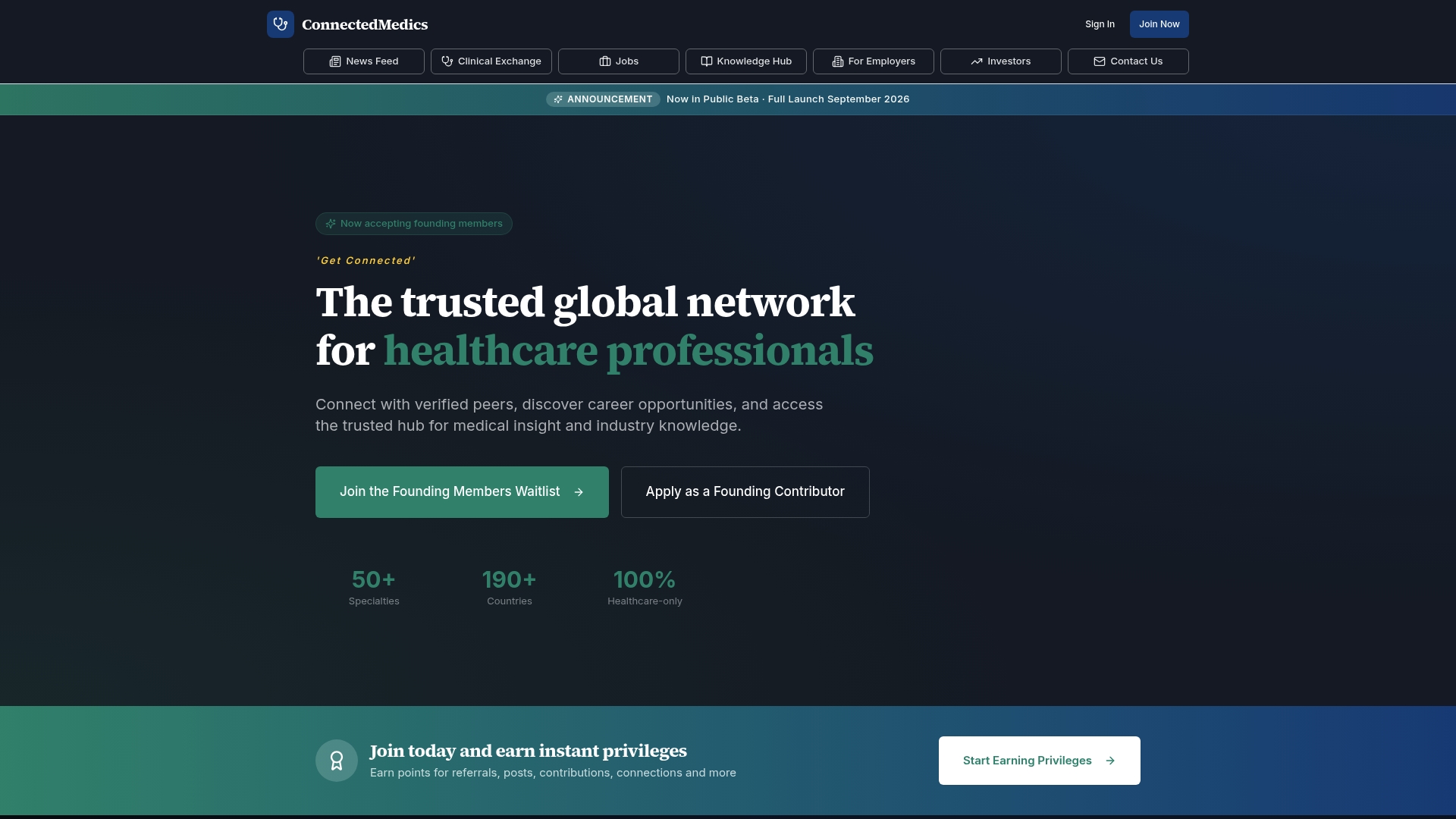
ConnectedMedics is a networking platform built for healthcare professionals. It offers verified profiles of medical professionals, a global jobs board with more than 22,000 active healthcare vacancies, and specialty-specific filters. Its knowledge hub carries clinical insights and research summaries, which can help a returning physician follow changes in the field. Peer-to-peer discussion forums and specialty-led communities let members ask colleagues who work in the same field.
For a returning physician, the practical uses are:
- Filter vacancies by specialty and setting to match the reentry plan.
- Build a verified profile that states specialty and credentials.
- Follow the Knowledge Hub for clinical updates during refresher study.
- Connect with peers in the same specialty.
Work permits are available online on the platform, which helps physicians returning from abroad.
Create a profile and browse specialty roles on ConnectedMedics.
Perspective
Time away from medicine is common, and most of the barriers are about information. Physicians do not know which board rule applies, which program the board accepts, or which employers will talk to a returning clinician.
We built ConnectedMedics for healthcare professionals only, with verified profiles and specialty targeting across 190+ countries. A returning doctor should not have to search through generic listings to find roles in the right specialty. Our jobs board and filters are designed for that.
Peers matter as much as listings. A colleague who has been through reentry in the same state can explain the board's habits better than any document. Specialty-led communities exist for those conversations, and the knowledge hub keeps clinical reading in one place.
Our advice: call the board first, set the plan, and build the job search in parallel, so the first day back is already arranged.
David
FAQ
How long can a doctor be out of practice before reentry is required?
The commonly accepted figure is more than two years, per the FSMB's 2025 report. State boards set their own triggers, and some use shorter or longer periods. Contact the board that issues the license.
Who pays for a physician reentry program?
Usually the physician. Colorado's rule says the applicant carries all expenses, and Washington's guidance says the same is likely. Employers, academic medical centers and shortage-driven public funding can offset costs in some cases.
Can a physician work while completing reentry?
Often only under supervision. Boards may consider whether an existing license type lets reentering physicians take part in training that involves direct patient care. Some states, such as Nebraska, issue a time-limited reentry license. Ask the board which license applies.
Does a physician need a program if the gap is under two years?
Not always. Washington suggests considering an informal program for 12 to 24 months out. Stayed-involved activities such as CME, certification and limited practice count in the board's review.
How should a career gap appear on a CV?
State the dates, list what continued during the gap, and give the reentry plan with its timeline. Facts, kept short, work better than long explanations.
Sources
- Support for physician return to clinical practice, AMA issue brief
- Reentry to Practice, FSMB, April 2025
- Report of the Special Committee on Reentry to Practice, FSMB, 2012
- Reentry to Practice, Washington Medical Commission, November 2025
- Reentry to Practice for Practitioners with Suspended Licenses, Washington Medical Commission
- Reentry to the practice of medicine, NC Medical Board
- Reentry to Practice Guidelines, Maine Board of Licensure in Medicine
- 3 CCR 713-22, Colorado Medical Board
- Nebraska statute 38-2026.01
- K.A.R. 100-6-6, Kansas reentry active license
- Reentry to Clinical Practice, CPEP
- Roadmap to Reentry, CPEP
- Reentering Clinical Practice, American Academy of Pediatrics