
For eligible physicians, the Interstate Medical Licensure Compact provides an expedited path to separate state medical licenses, not a single national license. You still need a qualifying State of Principal License, a clean disciplinary record, and $700 for a non-refundable application fee. Each participating state issues and governs its own license, and its medical board keeps final say over your approval.
TL;DR:
- Physicians must have a full, unrestricted license and meet specific residency, employment, or tax residence criteria in their SPL state to qualify for the Compact.
- The $700 application fee is non-refundable, and each state license will incur additional costs, often ranging from $100 to $600.
- The average license issuance time is around 19 days after LOQ approval, significantly faster than the typical 60 to 90 days for traditional applications.
- Even after obtaining an LOQ, each state reviews and approves licenses independently, so eligibility does not guarantee approval in all chosen states.
- Connecting platforms like Connectedmedics verify licensed credentials, streamlining employer verification after licensing in multiple states.
Table of Contents
- What Is the Interstate Medical Licensure Compact?
- Do You Qualify? SPL Rules and Disqualifiers
- How to Apply: Steps, LOQ Rules, and Fees
- Confirming Participation and Choosing Your States
- Timelines, Costs, and What Trips Applicants Up
- Why Multistate Licensing Is Reshaping Physician Careers
- How Connectedmedics Supports Multistate Physicians
- Sources
What Is the Interstate Medical Licensure Compact?
The Interstate Medical Licensure Compact exists to cut the redundant paperwork of applying to each state medical board from scratch. It works through the Interstate Medical Licensure Compact Commission (IMLCC), an administrative body created by member states rather than a federal agency, which verifies your credentials once and issues a Letter of Qualification (LOQ) that participating states accept in place of a full independent review.
The Compact doesn't override state authority. Compact law defines the practice of medicine as occurring where the patient is physically located, and every member state board retains full jurisdiction and enforcement power over the license it issues to you.
The mechanics come down to three moving parts:
- One centralized application through the IMLCC, reviewed once instead of state by state
- A Letter of Qualification that confirms you've cleared the Compact's eligibility bar
- Individual state licenses, each issued and renewed under that state's own rules
Do You Qualify? SPL Rules and Disqualifiers
Everything starts with your State of Principal License (SPL), the one state that reviews your qualifications and issues your LOQ. You can only claim a state as your SPL if it fits at least one of four tests, according to IMLCC eligibility rules:
- It's your primary residence
- You conduct a significant portion of your medical practice there
- Your employer is located there
- You file federal taxes using that state as your residence
Beyond SPL, the Compact's general requirements are fairly standard for a licensed physician: a full, unrestricted medical license in your SPL state, graduation from an accredited medical school, completed graduate medical education, passage of USMLE or COMLEX within the permitted number of attempts, and current certification by an ABMS or AOA member board.
Certain issues will disqualify you outright: any history of medical board discipline, felony convictions, controlled-substance actions against your DEA registration, or an open investigation you haven't disclosed. SPL status also isn't permanent.

Pro Tip: *Run the SPL test against your actual situation, not your ideal one.
How to Apply: Steps, LOQ Rules, and Fees
The application sequence is linear, and skipping ahead usually backfires:
- Confirm your SPL eligibility before you pay anything
- Complete the IMLCC application and submit supporting documents
- Complete fingerprinting or a background check if your SPL requires it
- Receive your Letter of Qualification once the SPL board approves you
- Select the member states where you want a license
- Pay each state's individual licensing fee
The IMLC application runs $700 and is non-refundable, even if a state board later denies your license request. Your Letter of Qualification stays valid for a full year to add states without restarting the qualification process, though adding states after the fact can trigger extra handling fees.
State licensing fees vary widely, from roughly $100 to several hundred dollars per state, so check each board's current fee schedule before you commit to a list. Fingerprinting requirements aren't uniform either. Some SPL states handle it digitally through a vendor, others require an in-person appointment, and your SPL board will tell you which applies once your application is underway.
Confirming Participation and Choosing Your States
Compact membership keeps growing, so treat any fixed number you read as a snapshot, not a fact. Check the IMLCC's own member map before you apply, since a state's status can change between the time you research and the time you file.
Once your LOQ is active, the smartest move is requesting every state you'll realistically need within that 365 day window. Adding states piecemeal later usually means extra handling fees you could have avoided.
A few practical notes on state selection:
- Compare state fees before choosing. A $600 license in one state and a $150 license in another add up fast across five or six states.
- Some states outside the Compact still require a traditional, standalone application. If you need a license there, budget separate time and paperwork for it.
- A handful of participating states have unique processing quirks even within the Compact, so read that state's board page rather than assuming uniform handling.
Timelines, Costs, and What Trips Applicants Up
Speed is the Compact's real selling point. Practitioner-facing reports cite an average issuance time around 19 days, with many licenses landing in under a week once your LOQ is issued. Traditional single-state applications, by contrast, commonly run 60 to 90 days or longer depending on the board's backlog.
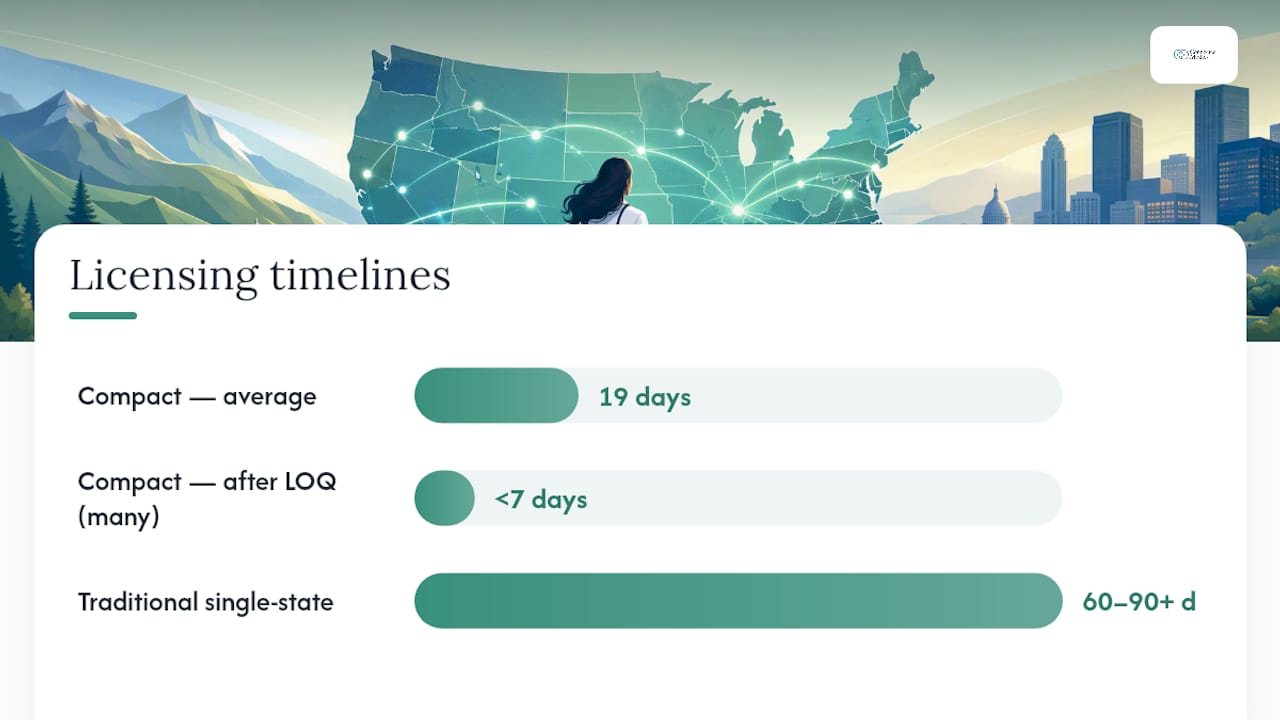
Total cost adds up quickly: the $700 Compact fee, plus each state's license fee (commonly $100 to $600), plus fingerprinting costs if your SPL requires them. Budget for all three before you start.
The pitfalls that trip physicians up are almost always avoidable:
- Assuming SPL eligibility without checking the 25% practice or tax residence tests
- Submitting an incomplete application and restarting the clock
- Failing to disclose a pending investigation, which surfaces during background review anyway
- Believing Compact eligibility guarantees a license in every state you select
Pro Tip: Meeting every Compact requirement doesn't force a state board's hand. Each board still reviews and approves independently, so treat your LOQ as a fast lane, not a guarantee.
Why Multistate Licensing Is Reshaping Physician Careers
Telemedicine made state lines a practical problem, not just a legal one. A physician licensed in one state but treating patients who log in from three others needs those additional licenses, and the Compact makes that realistic instead of a multi-month grind. The same logic applies to locum tenens work and part-time multistate practice arrangements that used to be too slow to set up.
Employers verifying a candidate's multistate credentials face their own version of this problem, which is where a platform built for verified license credentials earns its keep alongside a jobs board built specifically for clinicians.
— David
How Connectedmedics Supports Multistate Physicians
Connectedmedics doesn't process your Compact application, but it solves the problem that comes right after you get licensed: proving your credentials are real to the employers and recruiters who matter.
Every physician profile on Connectedmedics carries verified license and credential data, so a hospital system evaluating you for a multistate telemedicine role or a locum contract can confirm your standing without chasing down separate state board records. Pair that with a jobs board built specifically around healthcare roles, and the platform becomes the natural next stop once your LOQ comes through and your new state licenses are active. Create a verified profile on Connectedmedics and put your expanded licensing to work.
This article is general information, not a substitute for advice from a qualified lawyer. Consult a qualified legal professional about your own circumstances before acting on anything here.
Sources
Primary sources beat secondhand summaries every time, especially for a legal framework that varies by state. Worth keeping open in a browser tab:
- Interstate Medical Licensure Compact (October 27, 2015)
- IMLC Guide for Physicians: States, Costs, and How to Apply in 2026