
A complete physician onboarding checklist covers three phases: pre-arrival tasks (credentialing launch, CAQH completion, payer enrollment, background checks, IT provisioning), day-one essentials (badge, EHR login, workspace, team introductions, orientation agenda), and 30/60/90-day checkpoints (schedule ramp targets, EHR competency sign-off, billing access, formal check-ins). According to PracticeManagementConsultancy, the full onboarding lifecycle commonly spans three to six months, with credentialing and payer enrollment alone requiring 90–120 days. Start those tasks the day the offer is signed.
Quick-copy checklist:
- Pre-arrival: Signed offer, confirmed start date, CAQH profile complete, state license verified, DEA registration initiated, background check ordered, drug screen scheduled, I-9 and W-4 collected, immunizations confirmed, EHR account provisioned, badge request submitted
- Day one: Badge and keys issued, EHR login confirmed, workstation ready, secure email active, workspace tour complete, safety protocols reviewed, team introductions done, orientation agenda distributed
- 30-day checkpoint: Schedule at 25–50% capacity, EHR documentation reviewed, first formal check-in with medical director complete
- 60-day checkpoint: Billing and coding access confirmed, coding accuracy reviewed, mentor check-in documented
- 90-day checkpoint: Schedule at 75% capacity, competency assessment complete, performance review scheduled
Key Takeaways
A complete physician onboarding checklist requires a named owner, credentialing started on offer acceptance, and a phased 30/60/90-day ramp with documented competency checks at each stage.
| Point | Details |
|---|---|
| Start credentialing immediately | Payer enrollment takes 60–120 days; begin on the day the offer is signed. |
| Assign one onboarding owner | A single named coordinator prevents tasks from falling between HR, IT, and credentialing. |
| Use a phased ramp schedule | Target 25–50% capacity at 30 days, 75% at 90 days, and full panel by 180 days. |
| Document every completion | Attestation records with trainer initials and file references protect the organization during audits. |
| Connectedmedics for hiring | Verified clinician profiles and a specialty-filtered jobs board support recruitment before onboarding begins. |
Table of Contents
- Why a structured physician onboarding process matters
- Pre-employment checklist: what to complete before the start date
- How credentialing, privileging, and payer enrollment actually work
- HR, compliance, and occupational health documents to collect and store
- IT access and workstation setup to complete before day one
- Day-one and first-week orientation schedule
- Phased clinical ramp-up and competency checks: 30/60/90/180-day plan
- Mentorship, peer connection, and cultural onboarding
- How to document completion, attestation, and recordkeeping
- Ready-to-use templates: onboarding checklist, orientation agenda, credentialing packet
- Low-resource implementation for small practices and independent groups
- Building an onboarding academy: an operational model
- What hiring managers most often miss
- How Connectedmedics supports hiring and early-stage onboarding
- Sources
Why a structured physician onboarding process matters
Unstructured onboarding costs money before the physician sees a single patient. Delayed credentialing pushes back the first billable day. Missing payer enrollment means claims go unpaid for weeks. And a new hire who feels unsupported in the first 90 days is far more likely to leave within the first year, forcing the organization to absorb another full recruitment cycle.
The AMA STEPS Forward toolkit frames physician onboarding as a multi-step model: pre-orientation preparation, structured orientation, clinical ramp-up, EHR support, and mentorship. Organizations that follow this sequence report faster provider satisfaction and stronger operational readiness. Peer-reviewed evidence supports the same conclusion: structured orientation and social integration reduce the risks associated with poorly managed transitions, including clinician burnout and early attrition.
The business case is direct:
- Revenue capture: Credentialing and payer enrollment delays push back the first billable date. Every week of delay is a week of lost revenue.
- Retention: First-year turnover among physicians is disproportionately linked to onboarding gaps, particularly unclear expectations and inadequate EHR support.
- Patient safety: A physician who does not know the EHR, the order sets, or the escalation protocols is a patient safety risk, regardless of clinical skill.
- Team cohesion: A new hire who is not introduced to the team, the culture, or the mission takes longer to function at full capacity.
The AAFP orientation framework identifies six components that predict a successful transition: social engagement, workspace acclimation, emergency preparedness, a formal orientation checklist, a realistic schedule, and a graduated ramp-up plan. Skipping any one of them creates a gap that shows up later as a performance or retention problem.
Pre-employment checklist: what to complete before the start date
The 90–120 days before a physician's start date are the most operationally dense. Most delays on day one trace back to tasks that were not started early enough in this window.
Immediate actions on offer acceptance
- Confirm signed offer letter and start date in writing
- Assign a single onboarding owner (practice manager, HR lead, or credentialing coordinator)
- Lock compensation model and call schedule in the employment agreement
- Send a welcome communication to the new physician with a named contact and a timeline
The AMA recommends assigning clear owners and stakeholder groups before orientation begins. Without a named owner, tasks fall through the gaps between HR, credentialing, and IT.
Documents to collect
- Current state medical license (verify primary source)
- DEA registration certificate (or initiate new application)
- Board certification certificates
- Curriculum vitae with complete work history
- Malpractice history (five-year minimum, carrier letters)
- CAQH ProView profile number and authorization
- National Provider Identifier (NPI)
- References (three professional, at least one clinical supervisor)
Background and occupational health items
- Criminal background check (typically 5–10 business days)
- Drug screen (typically 3–5 business days)
- Immunization records: MMR, varicella, hepatitis B, influenza, Tdap
- TB screening (two-step PPD or IGRA)
- BLS/CPR certification (current within two years)
- Fit-testing for N95 respirators where required by role
Pro Tip: Order the background check and drug screen within 48 hours of offer acceptance. Delays here cascade directly into the credentialing timeline and can push the start date.
How credentialing, privileging, and payer enrollment actually work
Credentialing and operational onboarding are separate processes that must run in parallel. Credentialing verifies who the physician is and what they are qualified to do. Onboarding prepares the organization to receive them. Waiting for one before starting the other is the single most common cause of start-date delays.
Process flow
- Offer signed → assign credentialing lead and initiate CAQH completion
- CAQH complete → submit hospital privileging application and Medicare/Medicaid enrollment simultaneously
- Primary-source verification → state licensing board, AMA, NPDB, malpractice carriers
- Privileging committee review → typically 30–60 days after complete application
- Payer enrollment → submit to commercial payers after hospital privileges granted (or concurrently where payer allows)
- DEA registration → submit after state license confirmed; allow 4–6 weeks
Realistic timeline estimates
| Task | Typical Duration | Owner |
|---|---|---|
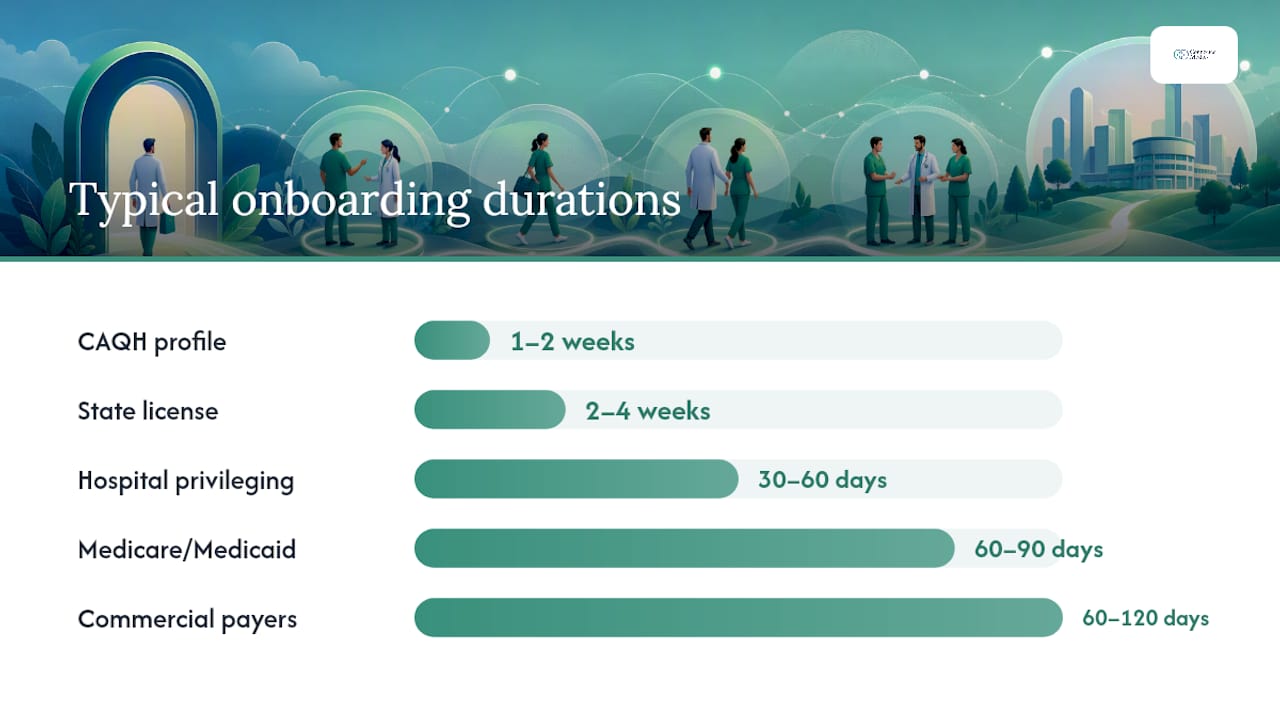
| CAQH profile completion | 1–2 weeks (physician) | Credentialing coordinator |
| State license verification | 2–4 weeks | Credentialing coordinator |
| Hospital privileging | 30–60 days after complete application | Medical staff office |
| Medicare/Medicaid enrollment | 60–90 days | Billing/credentialing lead |
| Commercial payer enrollment | 60–120 days | Billing department |
| DEA registration (new) | 4–6 weeks after state license | Physician + HR |
| Background check | 5–10 business days | HR |
The Atrium Health practice onboarding guide illustrates how large systems document each of these steps with assigned owners, due dates, and verification evidence fields.
Pro Tip: Submit the Medicare enrollment application (CMS-855I or CMS-855R) on the same day as the hospital privileging application. The two processes are independent, and waiting for privileges before enrolling adds 60–90 days to the billing start date.
HR, compliance, and occupational health documents to collect and store
Every item in this section has a compliance or audit implication. Missing documentation is not just an administrative inconvenience; it can trigger regulatory findings during a CMS audit or Joint Commission survey.
Standard HR forms
- Form I-9 (Employment Eligibility Verification) — complete within three business days of start
- Form W-4 (Federal Income Tax Withholding)
- State tax withholding form (varies by state)
- Direct deposit authorization
- Signed employment agreement
- Confidentiality and HIPAA acknowledgment
- Non-disclosure agreement (where applicable)
- Conflict of interest disclosure
Occupational health
- Immunization records reviewed and filed
- TB screening result documented
- BLS/CPR card scanned and stored
- Drug screen result filed
- Fit-test record (N95 or equivalent) where required
- Annual health screening acknowledgment
Attestation and recordkeeping
Each completed item should carry a trainer or reviewer initials, a completion date, and a file reference. A minimal attestation line reads:
"I confirm that [Item Name] has been completed, reviewed, and filed as of [Date]. Reviewer: [Name/Title]."
Store all records in the HRIS or a secure, access-controlled document management system. Retain employment records for a minimum of seven years post-separation, consistent with federal recordkeeping guidance.
Pro Tip: Build a single onboarding folder in your HRIS with a standardized file naming convention (e.g., LASTNAME_FIRSTNAME_ITEM_DATE) from day one. Auditors look for completeness and consistency, not just the presence of documents.
IT access and workstation setup to complete before day one
A physician who arrives on day one without EHR access, a working email address, or a badge is a productivity loss that reflects directly on the organization. IT provisioning must be treated as a pre-arrival task, not a day-one task.
Accounts to provision before start date
- EHR login (with role-appropriate access level)
- E-prescribing account (DEA number required for controlled substances)
- Scheduling system access
- Patient portal administrative access
- Secure messaging platform (e.g., TigerConnect, Imprivata Cortext)
- Institutional email and voicemail
- VPN access for remote work where applicable
- Paging system or mobile phone setup
Physical items to prepare
- Photo ID badge
- Keys or access card for clinical areas
- Workstation or laptop (configured with required software)
- Lab coat with name embroidered
- Business cards (if used by the practice)
- Parking permit or access
EHR-specific preparation
Before the physician's first clinic session, configure:
- Default clinic location and schedule template
- Favorite order sets and preference lists
- Inbox routing rules
- Quick-text or dot-phrase shortcuts
- A printed or digital EHR quick-reference tip sheet
The AMA advises staged EHR education rather than a single training block. EHR elbow support during the first two clinic sessions reduces documentation errors and stress significantly more than classroom training alone.
Pro Tip: Schedule a dedicated "EHR elbow support" session with a super-user or trainer for the physician's first two clinic days. This one step prevents the documentation backlog that typically builds in weeks two and three.
Day-one and first-week orientation schedule
The first day sets the tone. An overloaded day-one agenda is one of the most common onboarding mistakes, and the AMA explicitly recommends gradual education rather than a "firehose" approach.
Sample day-one agenda
| Time | Activity | Owner | Sign-off |
|---|---|---|---|
| 8 AM | Welcome meeting, introductions | Practice manager | _______ |
| 8:30 AM | Badge, keys, parking issued | HR/Security | _______ |
| 9 AM | Workspace and building tour | Office coordinator | _______ |
| 9:30 AM | Safety protocols: fire, emergency codes | Safety officer | _______ |
| 10 AM | EHR login confirmed, basic navigation | IT/super-user | _______ |
| 11 AM | Meet clinical team (nurses, MAs, front desk) | Nurse manager | _______ |
| 12 PM | Lunch with assigned mentor | Mentor | _______ |
| 1 PM | Review schedule template and first-week plan | Practice manager | _______ |
| 2 PM | HIPAA, compliance, and policy review | Compliance officer | _______ |
| 3 PM | Open time: EHR exploration, questions | Super-user available | _______ |
First-week priorities
- Shadow one or two experienced physicians in the same specialty (days 2–3)
- Complete EHR training module (days 2–4, split across sessions)
- Billing and coding introduction: CPT basics, documentation requirements, common denial reasons (day 3 or 4)
- Supply and equipment orientation: lab, imaging, pharmacy contacts
- Review call schedule, coverage protocols, and escalation pathways
- Confirm pager or phone setup and test communication systems
The AAFP framework includes a sample orientation checklist with verification methods and competency assessment columns that administrators can adapt directly into their own orientation packets.
Phased clinical ramp-up and competency checks: 30/60/90/180-day plan
A graduated ramp protects both the physician and the organization. New graduates typically need a longer ramp than experienced hires, and the schedule should reflect that explicitly.
Suggested ramp targets
- 30 days: 25–50% of full panel capacity; focus on EHR documentation quality and workflow familiarity
- 60 days: 50–75% capacity; billing and coding access confirmed, first coding accuracy review complete
- 90 days: 75% capacity; formal competency assessment, performance review with medical director
- 180 days: Full panel; second formal review, mentor relationship transitions to peer relationship
These targets are starting points. Adjust based on specialty complexity, patient acuity, and the physician's prior experience level.
Competency checklist items
- EHR documentation completed within 24 hours of encounter (review at 30 days)
- Order entry accuracy: no critical alerts overridden without documentation (review at 30 and 60 days)
- Coding accuracy: E/M level selection reviewed against documentation (review at 60 days)
- Patient-flow timing: average visit duration within 15% of practice standard (review at 90 days)
- After-visit summary completion rate (review at 90 days)
- Call response time within protocol (ongoing)
Scheduled check-ins
- 30-day check-in: Medical director + practice manager; review schedule adherence, EHR documentation, and any early concerns
- 60-day check-in: Practice manager + billing lead; review coding accuracy, payer enrollment status, and mentor feedback
- 90-day check-in: Medical director; formal competency assessment, performance review, and 180-day plan discussion
- 180-day check-in: Medical director; full performance review, panel size confirmation, and ongoing development goals
If a physician misses a ramp target, document the gap, identify the root cause (EHR difficulty, patient complexity, scheduling issue), and adjust the plan in writing. Remediation steps should be specific and time-bound.
Mentorship, peer connection, and cultural onboarding
Technical onboarding gets a physician operational. Cultural onboarding determines whether they stay. AAFP research shows that sending a short biographical brief to staff before the physician arrives materially shortens the time it takes for the new hire to feel part of the team.
Mentor assignment
- Assign a mentor from the same or adjacent specialty before the start date
- Define expectations: weekly contact for the first 90 days, then monthly through the first year
- Provide the mentor with a brief guide covering discussion topics (EHR tips, call schedule navigation, committee involvement, community resources)
- Document each mentor check-in with a date and brief note
Practical integration steps
- Send the new physician's bio and photo to all staff at least one week before arrival
- Schedule a brief team introduction at the first all-staff meeting after the start date
- Introduce the physician to department heads, committee chairs, and key referral partners in the first 30 days
- Update the practice website, patient portal, and Google Business profile with the new physician's information within the first week
Marketing and communications
- Post a formal announcement on the practice website and social channels
- Submit a press release or community announcement if the hire fills a specialty gap
- Update the physician directory with the new provider's schedule and contact information
Pro Tip: Ask the new physician to record a short 60-second video introduction for the practice website and waiting room screens. Patients who recognize the physician before their first visit report higher satisfaction scores.
How to document completion, attestation, and recordkeeping
Onboarding documentation serves two purposes: it confirms the physician received required training, and it protects the organization during audits. Both require a consistent, retrievable record.
Tracker fields for each onboarding item
- Item name
- Assigned owner
- Due date
- Completion date
- Trainer or reviewer initials
- Verification evidence (file path, scan reference, or HRIS field)
- Attestation status (pending / complete / waived with reason)
Attestation language
A standard sign-off line for HR and clinical items:
"I acknowledge that I have received, reviewed, and understood [Policy/Training Name] as of [Date]. Signature: _______ Date: _______"
Store signed attestations in the HRIS. For clinical competency sign-offs, retain in the credentialing or medical staff file. Recommended retention: seven years post-separation for employment records; indefinitely for credentialing and privileging files per medical staff bylaws.
File naming convention
Use a consistent format: LASTNAME_FIRSTNAME_ITEM_YYYYMMDD. Example: SMITH_JANE_HIPAA_ATTESTATION_20260115. This convention makes audit retrieval fast and reduces the risk of misfiled documents.
Ready-to-use templates: onboarding checklist, orientation agenda, credentialing packet
Templates reduce setup time and create consistency across hires. The following template types cover the full onboarding lifecycle.
Template assets to build or download
- Single-page onboarding checklist: Pre-arrival, day-one, and 90-day items in one printable page; include owner columns and sign-off lines
- First-week orientation agenda: Day-by-day schedule with time blocks, activity descriptions, and trainer initials fields
- Credentialing packet checklist: Document list with submission deadlines, primary-source verification steps, and payer enrollment tracking columns
- Competency assessment form: 30/60/90-day evaluation with scoring rubric for EHR documentation, coding accuracy, and patient-flow metrics
- Mentor check-in log: Date, discussion topics, action items, and next meeting date
The Atrium Health practice onboarding guide is one of the most detailed publicly available examples of how a large health system structures these documents.
Customizing for locum versus permanent hires
Locum physicians need a condensed version of the full checklist. Focus on:
- Temporary credentialing and privileges (confirm locum tenens agency has completed primary-source verification)
- EHR access (temporary login with appropriate access level)
- Site orientation (building layout, emergency protocols, call schedule)
- Billing setup (confirm the agency or practice handles enrollment)
Permanent hires follow the full checklist. The key difference is the depth of cultural integration and the 180-day ramp plan, which locum engagements typically skip.
Converting paper templates to digital forms
Use Google Forms, Microsoft Forms, or your HRIS's built-in form builder to convert paper checklists into digital sign-off workflows. Digital forms create automatic timestamps, reduce lost paperwork, and generate audit-ready completion records without manual filing.
Low-resource implementation for small practices and independent groups
Small practices cannot staff a dedicated onboarding team. The solution is to prioritize ruthlessly and assign one person to own the entire process.
Must-have items (do these first)
- Start credentialing the day the offer is signed
- Confirm EHR access is provisioned at least one week before start
- Complete occupational health requirements before day one
- Assign a mentor before the physician arrives
Practical low-cost tools
- A shared Google Sheet or Excel tracker covers the full checklist without specialized software
- Templated email sequences (drafted once, reused for every hire) handle pre-arrival communications
- EHR vendor training resources (most major EHR platforms offer free online modules) replace expensive in-person training
- A single experienced physician in the practice can serve as mentor without a formal program structure
Borrow from larger systems where possible. The AAFP orientation framework and the Atrium Health guide are both publicly available and adaptable to a two-physician practice with minimal modification.
The single most important decision a small practice makes is assigning one named owner for onboarding. Without that, tasks default to "everyone's responsibility," which in practice means no one's.
Building an onboarding academy: an operational model
An "Onboarding Academy" is a structured, multi-session program that replaces the single-day orientation with a curriculum spanning the first 90 days. The AMA STEPS Forward module describes this model as a key driver of provider satisfaction and operational readiness.
Hattiesburg Clinic's AMA-recognized program pairs formal curriculum with leadership participation. The result: improved satisfaction scores and measurable retention gains in the first year.
Operational checklist for an academy
- Secure leadership buy-in and a named executive sponsor
- Define the curriculum: administrative, clinical workflow, EHR, billing/coding, culture, and well-being
- Build a schedule that distributes content across the first 90 days (not a single orientation day)
- Assign facilitators for each module (medical director, billing lead, IT super-user, HR)
- Include a formal evaluation at 30, 60, and 90 days
- Report metrics to leadership quarterly
Metrics to track
- Time-to-first-billable-day (target: within 30 days of start)
- First-year retention rate
- Physician satisfaction score at 90 days (survey)
- EHR documentation completion rate at 30 days
- Coding accuracy rate at 60 days
- Billing initiation date versus target date
Tracking these metrics quarterly gives leadership the data to justify program investment and identify where the onboarding process breaks down.
What hiring managers most often miss
The three most common blind spots in physician onboarding are not complicated. They are predictable, and they are preventable.
Underestimating credentialing time. Most administrators know credentialing takes time. Few plan for 90–120 days from the start. The result is a physician who is ready to work but cannot bill, because payer enrollment was not started until after the start date.
Stacking EHR training into full clinic days. A physician who is simultaneously learning the EHR and seeing a full patient panel will fall behind on documentation within the first week. That backlog compounds. The AMA's guidance on gradual EHR education is specific: split training into sessions, include shadowing, and provide elbow support during the first live clinic days.
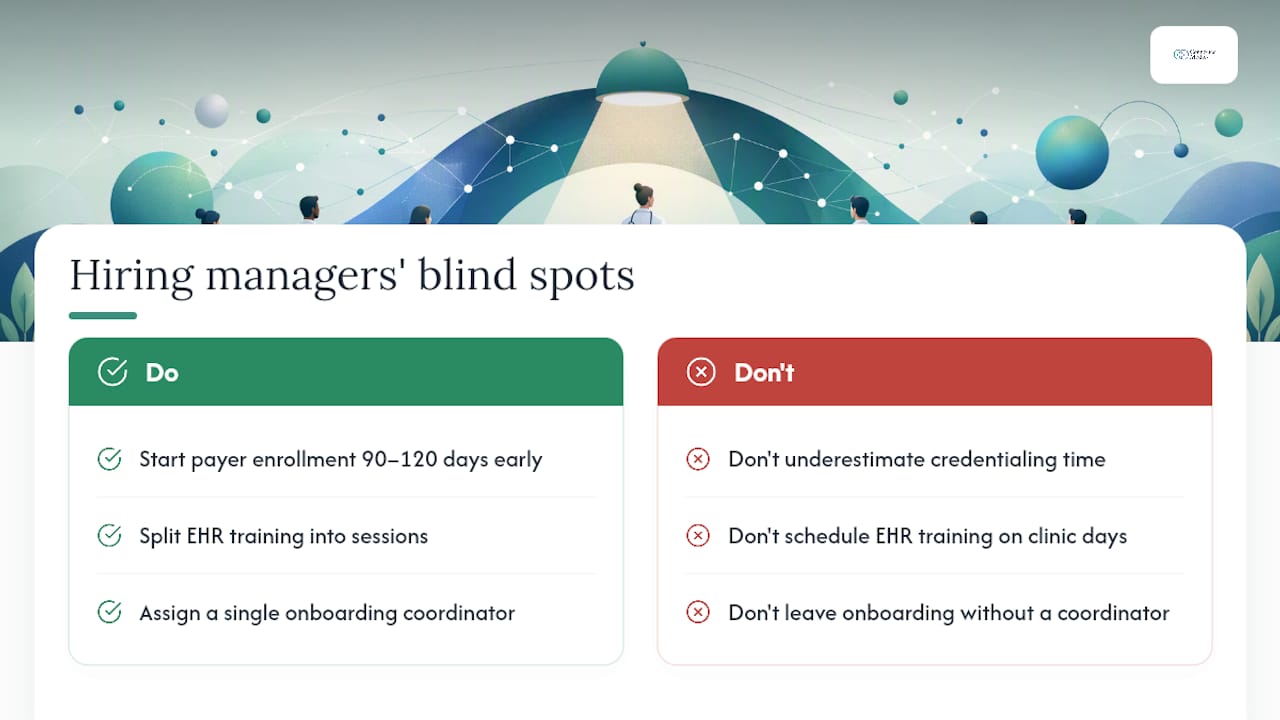
No clear onboarding owner. When onboarding is distributed across HR, credentialing, IT, and the medical director without a single coordinator, items fall through the gaps. A physician who arrives to find no EHR access and no badge has already formed an impression of the organization that is difficult to reverse.
Leadership action checklist
- Assign a named onboarding owner before the offer is extended
- Add onboarding as a line item in the department budget
- Set a reporting cadence: onboarding status reviewed at monthly operations meetings
- Require a 90-day onboarding report for every new physician hire
The cost of neglecting these steps is concrete. A physician who leaves in year one represents a recruitment cost, a lost revenue period, and a patient continuity disruption. A structured onboarding process is the most direct lever available to reduce that risk.
How Connectedmedics supports hiring and early-stage onboarding
Connectedmedics gives hiring teams direct access to verified clinician profiles and a jobs board with over 4,600 active healthcare vacancies, filtered by specialty, location, and role type. For administrators managing the pre-arrival phase, the platform's knowledge hub provides curated clinical resources and onboarding-relevant content that new physicians can access before their start date.
Employers can post roles, review verified credentials, and initiate contact with candidates through a single platform, reducing the fragmentation that typically slows the early stages of the onboarding process. The healthcare recruitment tools available through Connectedmedics are built specifically for clinical roles, which means specialty-specific filters and verified professional profiles rather than generic job board results.
For hiring teams that want to move from recruitment to pre-arrival coordination without switching platforms, Connectedmedics is a practical starting point. Visit Connectedmedics to post a role or explore the employer tools.
Sources
The following resources are the most useful references for administrators building or updating a physician onboarding program.
- Onboarding Optimization: Pave the Way for New Physician Success and Satisfaction | AMA STEPS Forward
- Framework for organizing orientation for new physicians | AAFP
- Practice Onboarding Guide | Atrium Health
- Physician Onboarding: Complete 8-Step Guide for 2026 | PracticeManagementConsultancy
- Peer-reviewed article (PMC) on clinician orientation and professional adjustment