
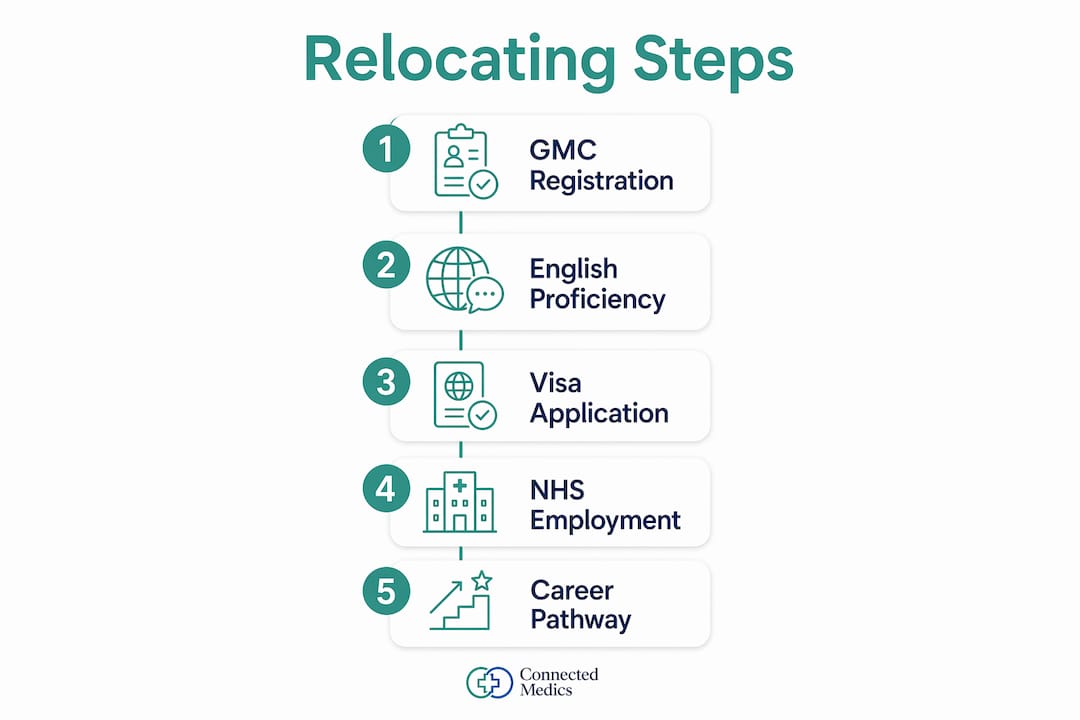
Relocating to the UK as a doctor means completing three non-negotiable steps in order: General Medical Council (GMC) registration, a valid job offer from a licensed NHS employer, and a Health and Care Worker visa. Skip or reorder any of these, and your application fails. The full process, from sitting the PLAB exam to receiving your visa, takes 6–18 months depending on your qualifications and documentation. This guide covers every stage, including licensing exams, visa benefits, NHS career pathways, and the practical adjustments that follow arrival.
What does relocating to the UK as a doctor require first?
GMC registration is the legal prerequisite for practicing medicine in the UK. No employer can hire you as a doctor, and no visa application can proceed, without it. The GMC is the regulatory body that sets and enforces standards for all physicians working in the UK, regardless of where they trained.
The PLAB route
Most international doctors qualify for GMC registration through the Professional and Linguistic Assessments Board (PLAB) test route. PLAB has two parts: Part 1 is a written knowledge exam, and Part 2 is an objective structured clinical examination (OSCE) held at the GMC's clinical assessment center in Manchester. Each part allows a maximum of four attempts. Running out of attempts without passing closes the PLAB route permanently.
Doctors with recognized postgraduate qualifications, such as those from certain Royal College membership exams, may qualify for an exemption from PLAB. Sponsorship by an approved UK medical institution also provides an alternative route. Check the GMC website directly to confirm whether your qualifications qualify for exemption before booking any exams.
English language requirements
The GMC requires proof of English language proficiency before granting registration. Accepted tests are IELTS Academic and the Occupational English Test (OET). The minimum IELTS score is 7.5 overall with no component below 7.0. The OET requires a Grade B in all four components. These thresholds are higher than most general visa requirements, so prepare accordingly.
Pro Tip: Review the IELTS preparation requirements specific to medical registration before booking your test. The medical vocabulary tested in OET often gives clinicians a scoring advantage over the general IELTS format.
Once you pass PLAB and meet the language requirement, the GMC verifies your identity and primary medical qualification. The full GMC registration process takes 3–9 months from start to approval. Build that timeline into your planning before you accept any job offer.
Key steps in the GMC registration process:
- Verify whether your qualifications exempt you from PLAB
- Book and pass PLAB Part 1 (written exam)
- Book and pass PLAB Part 2 (OSCE in Manchester)
- Submit English language test results (IELTS 7.5+ or OET Grade B)
- Complete identity verification and primary medical qualification check
- Receive GMC registration number
How do UK visa options work for overseas doctors?
The Health and Care Worker visa is the standard route for moving to the UK as a physician. It sits within the broader Skilled Worker visa category but carries specific financial advantages that make it the preferred option for NHS doctors.

Financial benefits of the Health and Care Worker visa
The Health and Care Worker visa offers reduced application fees compared to the standard Skilled Worker visa. More significantly, it exempts holders from the Immigration Health Surcharge, which otherwise costs thousands of pounds for a multi-year visa. Processing takes 3–8 weeks after the employer issues a Certificate of Sponsorship (CoS). That is a meaningful saving in both time and money.
Visa application steps
The correct sequence for the UK doctor immigration process is:
- Obtain full GMC registration (no shortcuts exist here)
- Secure a job offer from an NHS trust or approved employer with a sponsor license
- Receive your Certificate of Sponsorship from the employer
- Submit your Health and Care Worker visa application online
- Attend a biometric appointment at a visa application center
- Receive your visa decision, typically within 3–8 weeks
Pro Tip: Do not resign from your current position or book flights until your visa is approved. Visa decisions are not guaranteed, and processing delays do occur.
After five continuous years on a Skilled Worker or Health and Care Worker visa, doctors become eligible to apply for Indefinite Leave to Remain (ILR). ILR opens the path to British citizenship. For a detailed breakdown of NHS visa documentation, the Connectedmedics blog covers current requirements and timelines.
What career entry pathways exist for international doctors in the UK?
Working as a doctor in the UK through the NHS offers several entry points depending on your experience and specialty. The right role depends on your training level, how your qualifications are recognized, and whether you want to pursue specialty training.
Common entry roles for international doctors include:
- Trust grade doctor: A service role within a specific NHS trust, not part of the national training program. Useful for gaining UK clinical experience while pursuing further registration or training applications.
- Clinical fellow: A structured role combining service work with research, audit, or teaching. Many NHS trusts use this to attract international talent.
- Foundation year doctor: Available to those who have recently graduated and whose qualifications align with UK foundation program standards.
Specialty training and the CESR route
Doctors who completed specialty training abroad can apply for the Certificate of Eligibility for Specialist Registration (CESR). The CESR route allows experienced specialists to join the GMC Specialist Register without repeating UK training programs. Thorough documentation of clinical hours and specific competencies is critical for a successful CESR application. Start building that evidence file before you leave your home country.
The Medical Training Initiative (MTI) offers a separate pathway for doctors who want structured training in the UK for up to 24 months before returning to their home country. MTI posts are sponsored by Royal Colleges and provide a clear framework for clinical development.
NHS pay scales follow the nationally agreed consultant and specialty doctor contracts. Salaries for specialty registrars range from approximately £40,000 to £70,000 per year, with consultants earning significantly more. Proactive career management and networking within the NHS system accelerates progression. Connectedmedics lists over 4,600 active healthcare vacancies, including NHS roles suited to international doctor job seekers.
| Career Route | Best For |
|---|---|
| Trust grade doctor | Gaining initial UK clinical experience |
| Clinical fellow | Combining service work with research or teaching |
| CESR application | Experienced specialists seeking direct registration |
| Medical Training Initiative | Short-term structured training before returning home |
How should doctors prepare for life after relocating to the UK?
The practical challenges of relocation hit hardest in the first few weeks. Most doctors feel fully settled after 2–3 months, but the period before that requires financial and logistical preparation.
Financial and housing realities
Upfront costs are significant. Rental deposits in UK cities typically equal five weeks of rent. Opening a UK bank account takes one to three weeks, and many landlords require a UK bank account before accepting a tenancy. Arrive with accessible funds in an international account or a card that works in the UK without fees.
The NHS clinical environment differs from most international healthcare systems. Multidisciplinary team (MDT) meetings are central to patient care decisions. Nurses, physiotherapists, and social workers hold significant input in treatment planning. Understanding NHS team structures before arrival reduces friction in your first weeks on the ward.
Pro Tip: Shadow an NHS doctor virtually or connect with UK-based colleagues before you arrive. Connectedmedics provides a verified network of healthcare professionals who can offer firsthand insight into NHS working culture.
Key adjustments to plan for:
- Budget at least two months of living expenses before your first NHS paycheck
- Research housing options in your destination city before arrival
- Familiarize yourself with NHS documentation systems, including SystmOne and EMIS
- Understand the referral pathway structure between primary and secondary care
- Connect with your trust's international staff support network on your first day
What mistakes do doctors make when moving to the UK?
The most common errors in the UK doctor immigration process are procedural, not clinical. Applying for a visa before completing GMC registration is the single most frequent cause of application failure. The sequence is fixed and cannot be reversed.
Other critical mistakes to avoid:
- Using a non-approved English language test. Only IELTS Academic and OET are accepted by the GMC. General IELTS or TOEFL scores are not valid.
- Assuming fast-track options exist. The GMC process cannot be shortened beyond its set timeframes, which can reach 18 months in complex cases.
- Submitting incomplete clinical documentation. Missing or unverified documents delay registration and can trigger a full re-submission.
- Neglecting to document clinical experience. Doctors who fail to record specific clinical competencies find CESR and specialty training applications significantly harder.
- Accepting a job offer before GMC registration is confirmed. Employers cannot legally employ you as a doctor without your GMC number.
Key Takeaways
Relocating to the UK as a doctor requires GMC registration, a Health and Care Worker visa, and structured career entry, completed in that exact order without exception.
| Point | Details |
|---|---|
| GMC registration comes first | No visa or job offer is valid without a confirmed GMC registration number. |
| PLAB has strict attempt limits | Each of the two PLAB parts allows a maximum of four attempts before the route closes. |
| Visa processing is fast once ready | The Health and Care Worker visa typically processes in 3–8 weeks after sponsorship is confirmed. |
| Financial preparation is critical | Budget at least two months of living expenses to cover deposits and setup costs before your first paycheck. |
| Document clinical experience early | Detailed records of clinical hours and competencies support CESR and specialty training applications. |
What I've learned from watching doctors navigate this process
The doctors who relocate successfully share one trait: they treat the process as a project with fixed dependencies, not a checklist to rush. The GMC timeline is not negotiable. The visa cannot move faster than registration. Accepting that reality early saves months of frustration.
What surprises most physicians is not the paperwork. It is the cultural shift inside the NHS. Even highly experienced clinicians describe feeling like junior doctors again in their first months. The MDT structure, the referral culture, and the documentation expectations are genuinely different. That adjustment is normal. It does not reflect your clinical ability.
My strongest recommendation is to connect with doctors who have already made the move before you submit a single form. Their firsthand knowledge of specific trusts, regional housing markets, and registration pitfalls is more current than any official guide. Professional networks built around verified medical credentials are the most reliable source for that kind of insight.
— David
How Connectedmedics supports doctors relocating to the UK
Connectedmedics is a verified professional network built exclusively for healthcare professionals. For doctors navigating the UK registration and immigration process, the platform provides access to over 4,600 active healthcare vacancies, a knowledge hub with clinical insights from verified medical experts, and a global community of physicians who have completed the same process.
Doctors working through GMC registration, visa applications, or NHS career decisions can use Connectedmedics to find relevant job listings, connect with specialty-specific peers, and access up-to-date guidance. The platform's global healthcare network removes the isolation that many international doctors experience during relocation. Create a verified profile and access the full jobs board and knowledge hub at no cost.
FAQ
What is the first step for a doctor relocating to the UK?
GMC registration is the mandatory first step. No visa application or NHS employment can proceed without a confirmed GMC registration number.
How long does the UK doctor immigration process take?
The full process, from starting GMC registration to receiving a visa, typically takes 6–18 months depending on qualifications, exam results, and document verification timelines.
What English test scores does the GMC require?
The GMC accepts IELTS Academic with a minimum score of 7.5 overall and no component below 7.0, or OET with a Grade B in all four components.
Can experienced specialists avoid the PLAB exam?
Doctors with recognized postgraduate qualifications or Royal College membership may qualify for a PLAB exemption. The CESR route also allows experienced specialists to join the GMC Specialist Register directly.
What visa do most NHS doctors use?
Most international doctors use the Health and Care Worker visa, which offers reduced fees, exemption from the Immigration Health Surcharge, and processing times of 3–8 weeks after employer sponsorship is confirmed.