
IELTS for doctors is the standardized English language test that international medical graduates must pass to register and practice medicine in English-speaking countries. The IELTS Academic version is the only accepted format. Regulatory bodies including the UK General Medical Council (GMC) and the Australian Medical Board enforce strict band score thresholds, and failing to meet them blocks registration entirely. This guide covers exact score requirements, exam structure, preparation strategies, and how to choose between IELTS and the Occupational English Test (OET).
What are the IELTS score requirements for doctors?
Score requirements vary by country and regulatory body. Getting them wrong costs doctors months of delay.
UK General Medical Council requirements
The GMC requires an IELTS Academic overall band score of at least 7.5, with no individual module scoring below 7.0. That threshold is among the highest of any professional registration body in the world. Candidates can combine scores from two sittings within six months, but only if each sitting achieves at least 7.0 in every band. Falling short in even one module invalidates the combination.
IELTS scores are valid for two years. Scores must remain valid at the time the GMC receives the application, not just when the candidate submits it. Delays in document processing can push a score past its expiry date, forcing a retest.
Australian Medical Board requirements
The Australian Medical Board sets a slightly different standard. Candidates must achieve an overall band of 7.0, with 7.0 in Listening, Reading, and Speaking, and 6.5 in Writing, all in a single test sitting. Australia does not allow score combining across sittings. That single-sitting rule makes preparation more demanding, because there is no safety net from a previous attempt.
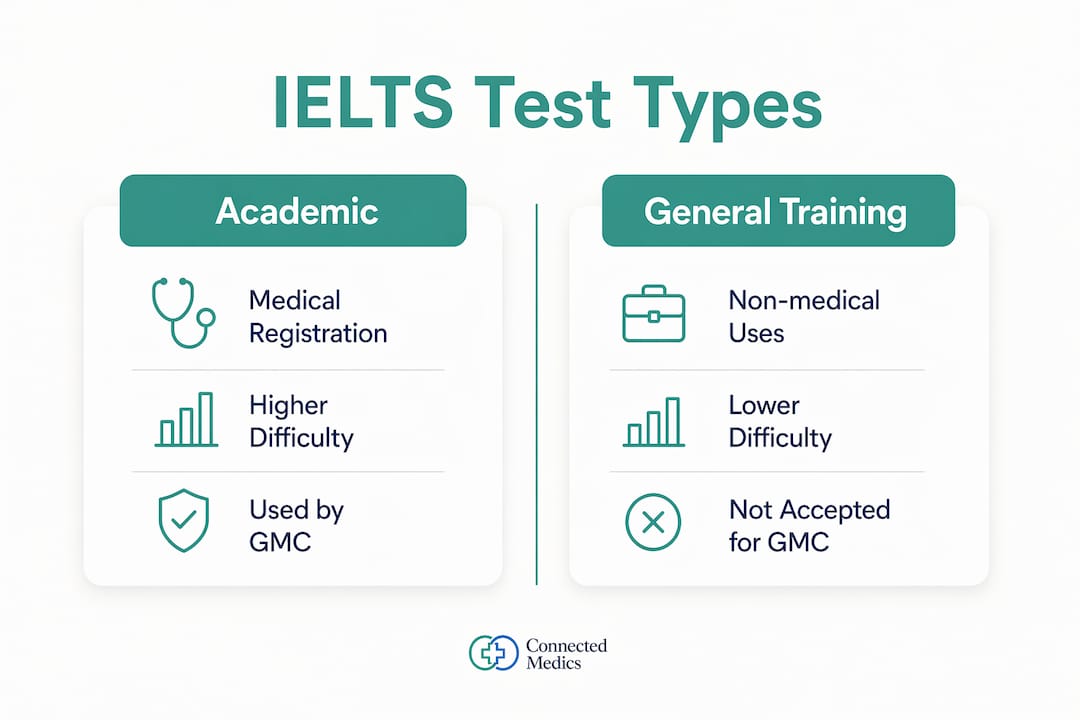
IELTS Academic vs. General Training
| Test version | Accepted for medical registration | Typical use |
|---|---|---|
| IELTS Academic | Yes (GMC, AMC, MCC) | University and professional licensing |
| IELTS General Training | No | Immigration and general work visas |
| Online/at-home IELTS | No | Not accepted for professional registration |
IELTS Academic is mandatory for all medical licensing bodies. The General Training version and online at-home formats are not accepted. Doctors must sit the Academic test at an approved physical test center.
Key score thresholds at a glance:
- UK GMC: Overall 7.5, no band below 7.0
- Australian Medical Board: Overall 7.0, Writing minimum 6.5, single sitting only
- Score validity: Two years from test date, must be valid at time of application
How is the IELTS exam structured for doctors?
The IELTS Academic exam has four modules: Listening, Reading, Writing, and Speaking. Each module tests a different skill, and each presents a distinct challenge for doctors.

Listening and Reading
Listening and Reading both require academic comprehension at a high level. The Listening section uses recordings from lectures, conversations, and academic discussions. Doctors accustomed to clinical briefings may find the range of non-medical topics unfamiliar. Reading passages cover science, social science, and humanities, demanding speed and precision under time pressure.
Writing: the hardest module for most doctors
Writing Task 2 is the most challenging section for doctors. Examiners require structured paragraphs, coherent arguments, and a wide lexical range beyond clinical terminology. Doctors tend to write in concise, jargon-heavy clinical shorthand. That style actively hurts IELTS scores. Academic essay writing demands clear topic sentences, logical progression, and formal vocabulary that does not rely on medical terms.
Doctors must make a conscious shift from clinical to academic English. That shift takes deliberate practice, not just familiarity with the test format.
Speaking: fluency over memorization
The Speaking module is a face-to-face interview with an examiner. It assesses fluency, coherence, lexical resource, and pronunciation. Doctors often prepare by memorizing answers, which is the wrong approach. Examiners recognize rehearsed responses and penalize them. Natural, spontaneous speech scores higher.
Pro Tip: Record yourself answering random questions on non-medical topics for five minutes each day. Play back the recording and count filler words like "um" and "you know." Reducing those fillers directly improves your fluency score.
What preparation strategies help doctors pass the IELTS exam?
Effective medical IELTS preparation is built on consistency, not cramming. Doctors who integrate English into daily routines outperform those who rely on short, intense study blocks.
Build English into your daily clinical life
Speak English with international colleagues. Read English-language medical journals for pleasure, not just study. Watch English-language news and documentaries on non-medical topics. These habits build the broad vocabulary that IELTS tests across all four modules. The exam covers topics from environmental policy to urban planning, so clinical English alone is not enough.
Target your weakest module first
- Identify your baseline. Take a full practice test under timed conditions and score each module separately.
- Read the official band descriptors. Many doctors misunderstand what examiners actually reward, especially in Writing and Speaking. The official descriptors spell it out precisely.
- Allocate study time by gap, not by preference. If Writing is your weakest module, spend 50% of your study time there.
- Practice Writing Task 2 with timed essays. Write one essay per day, then compare it against a model answer using the band descriptors.
- Use the Past-Present-Future technique in Speaking. When answering a question, briefly describe a past experience, your current view, and a future intention. This technique produces natural, extended responses without sounding rehearsed.
Pro Tip: Consider the computer-delivered IELTS format. Typing is faster than handwriting for most doctors, and results arrive within three to five days instead of up to 13 days for paper-based tests.
Use self-recording for Speaking practice
Record your Speaking answers and listen back critically. Identify where you pause, repeat words, or lose coherence. Self-assessment builds awareness faster than any textbook. Pair this with the band descriptors to understand exactly where you lose points.
What alternatives to IELTS exist for doctors?
The Occupational English Test (OET) is the main alternative to IELTS for healthcare professionals. Both are accepted by the GMC and the Australian Medical Council (AMC), but they differ significantly in format, content, and preparation demands.
OET vs. IELTS: key differences
| Feature | IELTS Academic | OET |
|---|---|---|
| Content focus | General academic English | Healthcare-specific scenarios |
| Accepted by GMC | Yes | Yes |
| Accepted by AMC | Yes | Yes |
| Result turnaround | 3–13 days | Approximately 16 days |
| Cost | Lower | Higher |
| Best suited for | Strong academic English background | Clinical English environment |
Doctors who work in clinical English environments often perform better on OET because the test uses real medical scenarios. Doctors with a strong academic English background tend to favor IELTS. The choice is not trivial. Choosing the wrong test can delay a doctor's career by 6–12 months.
Factors to consider when choosing:
- Current English proficiency level and where it was developed
- Whether your daily work is conducted in English or another language
- Cost and test center availability in your country
- How quickly you need results for a registration deadline
Both tests require serious preparation. Neither is easier by default. The right choice depends on where your English skills are strongest.
For doctors targeting the UK specifically, the NHS visa process also has English proficiency requirements that align with GMC registration standards. Understanding both together saves time.
Key takeaways
Doctors targeting medical registration in the UK or Australia must pass IELTS Academic with specific band scores, maintain valid results, and prepare strategically across all four modules.
| Point | Details |
|---|---|
| UK GMC score threshold | Overall 7.5 with no band below 7.0; combining two sittings is allowed under strict conditions. |
| Australian single-sitting rule | Australia requires all required scores in one sitting; no score combining is permitted. |
| Score validity window | IELTS scores are valid for two years and must be valid at the time of application submission. |
| Writing is the hardest module | Doctors must shift from clinical shorthand to structured academic English to score well. |
| Test choice affects timeline | Picking IELTS vs. OET without assessing your English background can delay registration by 6–12 months. |
Why I think most doctors approach IELTS preparation the wrong way
Doctors are trained to master content. That instinct works in medicine. It does not work for IELTS.
The most common mistake I see is treating the exam like a knowledge test. Doctors study vocabulary lists, memorize essay templates, and rehearse Speaking answers until they sound polished. Examiners see through all of it. The Speaking module rewards natural communication, not performance. The Writing module rewards clear thinking expressed in plain academic English, not impressive medical vocabulary.
The second mistake is ignoring the band descriptors. These are the actual scoring rubrics examiners use. Reading them takes 20 minutes. Most doctors never do it. That gap between what doctors think examiners want and what examiners actually score is where most points are lost.
My honest advice: treat IELTS preparation like building a clinical skill. You would not expect to perform a new procedure after reading about it once. English fluency at band 7.5 requires the same kind of repeated, deliberate practice. Use English every day across different contexts. Read non-medical content. Have conversations on topics outside your specialty. The exam tests breadth, not depth.
Confidence in the Speaking room also matters more than most preparation guides admit. Doctors who speak with calm authority, even when they make minor grammatical errors, consistently score higher than those who hesitate and self-correct constantly. Authenticity reads as fluency. Anxiety reads as lack of coherence.
For doctors navigating medical registration across borders, IELTS is one step in a longer process. Treat it as a milestone, not a barrier.
— David
Connectedmedics resources for doctors preparing for registration
Passing the IELTS exam is one part of qualifying to practice medicine abroad. The registration process involves documentation, licensing applications, and understanding country-specific requirements that change regularly.
Connectedmedics is a global network built exclusively for healthcare professionals. The platform provides a knowledge hub with verified clinical insights, guidance on international medical registration, and a jobs board with over 4,600 active healthcare vacancies. Doctors preparing for IELTS and registration can access peer support from verified medical professionals who have completed the same process. For doctors targeting the UK, resources on communities supporting international doctor jobs in the UK are available on the platform.
FAQ
What IELTS score do doctors need for GMC registration?
The GMC requires an IELTS Academic overall band score of 7.5, with no individual module below 7.0. Scores from two sittings can be combined only if each sitting achieves at least 7.0 in all bands.
Is IELTS Academic or General Training required for medical registration?
IELTS Academic is the only accepted version. The General Training test and online at-home formats are not accepted by the GMC, AMC, or other medical licensing bodies.
How long are IELTS scores valid for medical registration?
IELTS scores are valid for two years from the test date. Scores must remain valid at the time the registration body receives the application, not just when it is submitted.
Should doctors choose IELTS or OET?
Doctors with a strong academic English background generally perform better on IELTS. Doctors who work daily in clinical English settings often find OET more intuitive. Choosing the wrong test can delay registration by 6–12 months.
Can Australia combine IELTS scores from multiple sittings?
No. The Australian Medical Board requires all required band scores to be achieved in a single test sitting. Score combining across sittings is not permitted.