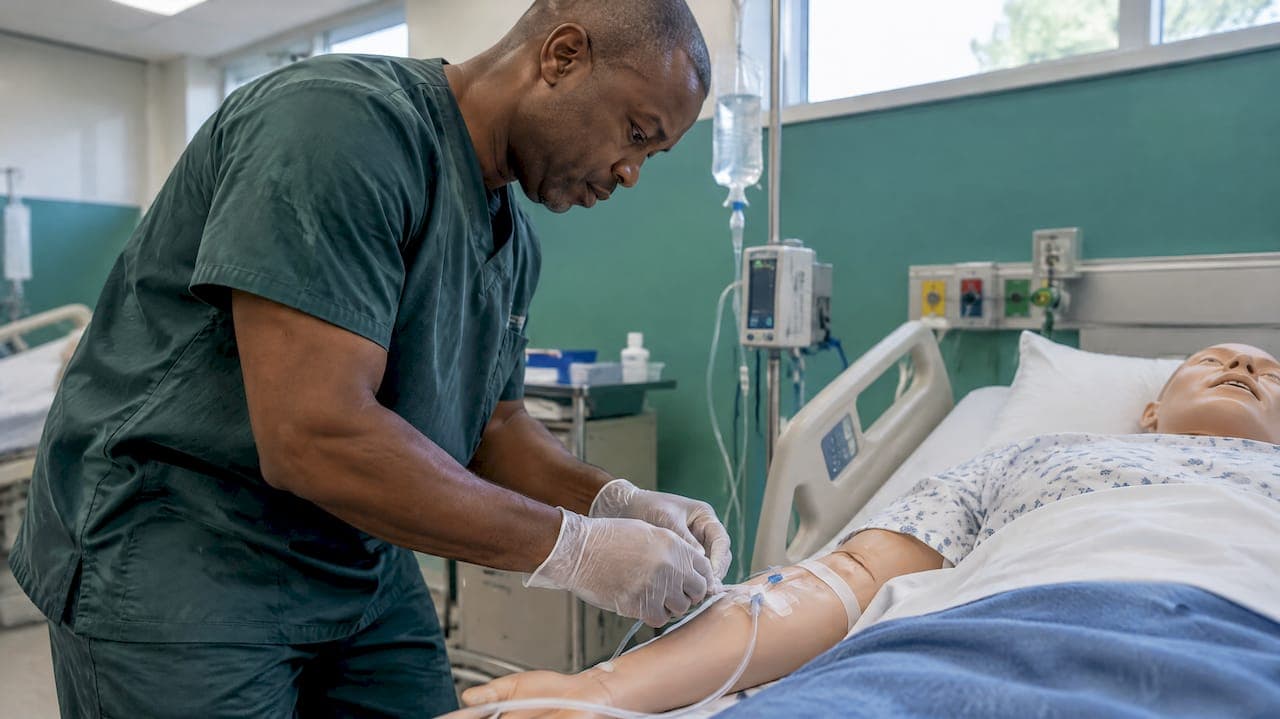
A nurse reentry program (also called a refresher course) is a board-approved course of classroom study and supervised clinical practice. It is for RNs and LPNs who have been away from nursing and need to reactivate or reinstate a license. Whether one is required depends on the state, the license status and the number of practice hours in a set look-back period. Requirements below come from state boards and state rules. Always confirm the current rule with your own board before enrolling.
TL;DR
- Reentry programs are state-regulated. Each board sets the look-back period (often four to six years) and the minimum practice hours.
- Programs combine theory and supervised clinical hours. Totals range from 120 hours in New Hampshire to 240 hours for an RN course in North Carolina.
- Cost varies by program. A draft New York State Education Department list shows tuition examples of $1,998 and $2,200.
- After the course, a reinstatement application, fee and background check are still required.
- Check the board's approved-course list before paying for any program.
Table of Contents
- What a nurse reentry program is
- Who needs one
- What programs include
- How long programs take
- What programs cost
- Steps to reactivate after the course
- Choosing a program
- Returning to the job market
- Our perspective
- Find roles and peers on ConnectedMedics
- FAQ
- Sources
What a nurse reentry program is
The Technical College System of Georgia describes its reentry programs as structured pathways that help licensed nurses return to practice through education, hands-on training and mentorship. They are open to RNs and LPNs who have been away from practice. That includes nurses the Board requires to complete a program for reinstatement.
Terms differ by state:
- Reentry program
- Refresher course
- Reorientation program
- Remedial course (Florida boards use this wording for some approved courses)
The purpose is the same. The program updates clinical skills and knowledge before the nurse returns to patients.
Who needs one
No single national rule exists. Each state board decides. Most rules rest on two factors: how long the license has been inactive, and how many hours of nursing practice the applicant has recently worked.
Look-back periods and hour thresholds by state
The examples below show how much the rules differ.
| State | When a board-approved program is required |
|---|---|
| North Carolina | Inactive, retired or lapsed for five years or more, with no license in another state in the last five years |
| New Hampshire | Fewer than 400 practice hours in the four years before applying |
| Alaska | Fewer than 320 hours of practice in the five years before applying for reinstatement or endorsement |
| Nebraska | Fewer than 500 hours in the past five years |
| Georgia | Under 500 hours of licensed RN practice, or no graduation from an approved program, for endorsement or reinstatement applicants |
| South Dakota | Under 480 hours in the preceding six years, or a board-approved refresher course as the alternative |
| Delaware | A refresher completed in the past two years may be required if the nurse has under 1,000 practice hours in five years or under 400 in two years |
| Mississippi | Five years or more without practice: proof of basic competencies, which can be a board-approved refresher completed within the prior five years |
Two patterns stand out:
- Several states count hours, not calendar years alone. A nurse who worked part-time may avoid a course.
- Some states offer an alternative. South Dakota, for example, accepts either recent employment hours or an approved course. Alaska accepts a refresher or completion of continued competency requirements.
Inactive, expired and lapsed licenses
The license status changes the path. Delaware tells nurses to apply for reinstatement when a license is inactive or when it has expired and the late renewal period has ended. Within the late renewal window, the process is often a simple renewal with fees.
A nurse with a license in good standing in another state may also have a different route. North Carolina's rule, for example, applies when the person has not been licensed elsewhere in the last five years.
A license with disciplinary history needs extra attention. Boards review conduct matters separately from practice hours. A nurse facing an arrest-related issue can read about losing a nursing license after a DUI before contacting the board.

What programs include
Program design follows state rules. Most have a theory (didactic) part and a supervised clinical part.
Hour requirements
| State | Theory | Clinical | Total |
|---|---|---|---|
| New Hampshire (structured refresher or distance option) | 40 hours | 80 hours, supervised by an RN | 120 hours |
| Georgia | 40 contact hours | 160 hours | 200 hours |
| North Carolina, RN | At least 240 hours of instruction in total | At least 120 clinical | 240+ hours |
| North Carolina, LPN | At least 180 hours of instruction in total | At least 90 clinical | 180+ hours |
| Alaska | Classroom instruction | At least 100 supervised clinical hours, 60 percent in direct patient care | 100+ clinical |
Topics covered
Georgia's rule lists didactic areas that include physician orders, medication administration, IV therapy, respiratory care, physical assessment and documentation. The theory part must come from board-approved continuing competency providers.
Other states use similar content: assessment, pharmacology, safety, documentation and current standards of care.
Clinical placement
Clinical hours are where many returning nurses run into trouble. In Georgia's technical college system, the applicant selects program locations and the college identifies a clinical site. Learners should be prepared to travel up to 60 miles from the participating college. The same system describes a 40-hour, self-paced online didactic course to finish within four weeks of the start date.
Before enrolling, confirm:
- Who arranges the clinical site
- How far the site may be from home
- What the clinical schedule looks like (days, nights, weekends)
- Whether a temporary license is needed to start clinical hours
Temporary license and early paperwork
Some states require paperwork before the clinical part begins. New Hampshire requires applicants to submit nursing licensure and temporary licensure applications before the program starts, with an active temporary RN or PN license for the process.
How long programs take
Duration depends on program format and the hours the board sets. New Hampshire limits the refresher course to no more than six months. A New York State Education Department draft listing shows an example refresher program with a 10-week length.
A realistic plan:
- Online theory: a few weeks, self-paced in many programs
- Clinical placement: often the slowest step, because it depends on a host site
- Paperwork after completion: allow time for background checks and board processing
What programs cost
Fees differ widely by state, school and format. The same NYSED draft document lists total tuition of $2,200 for a 10-week university program and $1,998 for another university RN refresher with 46.5 total hours, 22.5 of them in-person. It is a draft listing, so check current figures with each program.
Budget beyond tuition for:
- Books and uniforms
- Background checks
- Board application and reinstatement fees
- Travel to a clinical site
- Temporary license fees where required
Funding exists in some places. The Ingram Institute for Healthcare Access at UNC lists scholarships for nurses enrolling in the NC AHEC RN Refresher Program, for RNs with inactive, lapsed, encumbered or long-unused licenses. Check state workforce agencies and employers for similar help.
Steps to reactivate after the course
Completing the course does not reactivate the license. The nurse still applies.
- Confirm the rule with your board. Check hours, look-back period and approved-course list.
- Pick an approved program. Boards publish lists. Nebraska, for instance, expects an application, fee and letter of enrollment after the nurse chooses a refresher program.
- Complete theory and clinical hours. Keep records of dates and supervisors.
- Collect proof. Nebraska asks for a letter confirming clinical dates and a certificate of completion.
- Apply for reinstatement. In North Carolina, applicants submit a reinstatement application, fee, criminal background check and other documents, and must apply within one year of course completion.
- Wait for board approval before practicing on an active license.
Timing matters. Some boards accept only courses finished within a set window before the application. Mississippi, for example, refers to a refresher completed within the five-year period immediately before the application.
Choosing a program
Use these criteria:
- Board approval. The program must be on your state board's list. A course approved in another state may not count.
- Nurse type. RN and LPN courses differ, as North Carolina's separate hour totals show.
- Clinical arrangement. Placement support saves weeks.
- Format. Online theory suits nurses with jobs or caregiving duties.
- Schedule and start dates. Many programs run only a few times a year. Check the program's own page.
- Total cost. Add tuition and extras.
- Where you plan to work. Some compact-state situations let a nurse practice on a multistate license, so check whether your plan needs a course at all.
Returning to the job market
After reinstatement, the next task is finding a role. Returning nurses often consider settings with orientation programs or flexible schedules. Options to look at:
- Hospital units with structured onboarding
- Long-term care
- Home health and home care
- Outpatient clinics
- Telehealth and case management
Keep a record of the clinical hours and supervisor details. Employers may ask for them.
For nurses thinking about growth after returning, ConnectedMedics publishes career reading, including why nurses pursue advanced practice roles and guidance on the neonatal nurse practitioner role.
Our perspective
Returning to nursing is a process with many separate steps: board rules, a course, clinical placement, paperwork, then a job search. Each step is easier when information sits in one place.
ConnectedMedics is built for healthcare professionals only. Members have verified, credential-checked profiles. The jobs board lists over 22,000 active healthcare vacancies, with specialty filters. The knowledge hub summarizes clinical news and research, so a nurse coming back can see what has changed.
We designed the network around relevance. A returning nurse can connect with peers in the same specialty, follow topics that matter, and find roles that fit a specific background. That is what a healthcare-specific platform offers over a generic professional network.
David
Find roles and peers on ConnectedMedics
ConnectedMedics is a networking platform for healthcare professionals. It includes:
- Verified profiles
- A global healthcare jobs board with specialty filters
- Peer discussion forums
- A knowledge hub with clinical news and research summaries
Employers that hire nurses can use the employer plans. The Growth plan is £99 per month. Free and Enterprise plans are also listed. Visit the ConnectedMedics home page to create a profile and browse roles.
FAQ
Do all states require a nurse refresher course?
No. Each board sets its own rule. Requirements usually depend on how long the license has been inactive and how many practice hours the nurse has recently worked. Some states accept recent employment hours as an alternative to a course, as South Dakota does.
How many hours is a nurse reentry program?
It depends on the state. New Hampshire's structured option requires 120 hours, with 40 theory and 80 clinical. Georgia defines 40 didactic and 160 clinical hours. North Carolina's RN course is at least 240 hours, and the LPN course at least 180.
How much does a refresher course cost?
A NYSED draft listing shows tuition examples of $1,998 and $2,200 for university RN programs. Other costs include books, uniforms, background checks and board fees. Ask each program for its current fee schedule.
Can I take the course online?
Often the theory part is online. TCSG describes a self-paced online didactic course, for example. Clinical hours are supervised and in person, so expect to travel to a clinical site.
What happens after I finish?
You apply for reinstatement with your board. Expect an application, fee, background check and proof of completion. In North Carolina, the application must be filed within one year of finishing the course.
Sources
- Nurse Reentry Programs, TCSG
- Refresher Course, RN, North Carolina Board of Nursing
- Re-entry Process for RNs and LPNs, NH Office of Professional Licensure and Certification
- Refresher Course Information, Alaska Board of Nursing
- Nurse Licensing Refresher Course, Nebraska DHHS
- Reinstatement, Delaware Division of Professional Regulation
- RN/LPN Reinstatement, Mississippi Board of Nursing
- Georgia Chapter 410-4, Licensure by Reinstatement
- South Dakota ARSD 20:48:03:16, Reentry standards
- Draft Nurse Refresher Programs, NYSED
- RN Refresher Scholarship, Ingram Institute for Healthcare Access
- Can You Lose Your Nursing License For A DUI?