
Registered nurses pursue advanced practice roles primarily for greater clinical autonomy, expanded scope of practice, higher earning potential, and the ability to directly improve patient access to care. The Consensus Model for APRN Regulation, developed by the National Council of State Boards of Nursing and nursing organizations, standardizes how these roles are licensed and titled across U.S. states. The U.S. Bureau of Labor Statistics projects nurse practitioner employment to grow 45% through 2033, far outpacing most other occupations.
The three most common motivations:
- Autonomy: The ability to diagnose, treat, and prescribe independently rather than executing physician orders.
- Career growth and earning potential: APRN median annual wages significantly exceed those of registered nurses.
- Broader clinical impact: Managing full episodes of care and improving access in underserved communities.
Table of Contents
- What is an APRN and what are the four recognized roles?
- Why RNs choose APRN careers: the full range of motivations
- How to become an APRN in the U.S.: education, certification, and timeline
- How scope of practice varies by state and what the Consensus Model means for you
- Where APRNs work and what career outcomes look like
- Trade-offs: real benefits and real challenges of APRN practice
- A practical decision checklist and first-steps plan
- What research shows about the system-level value of APRNs
- Key Takeaways
- The shift from RN to APRN: what the transition actually feels like
- Connectedmedics supports APRN candidates at every stage
- Authoritative sources and further reading
- A perspective on what the APRN decision really comes down to
What is an APRN and what are the four recognized roles?
An Advanced Practice Registered Nurse (APRN) is a registered nurse who holds graduate-level education, advanced clinical competencies, and national certification in a recognized specialty population focus. The American Nurses Association defines APRNs as nurses who blend nursing's holistic perspective with diagnostic and therapeutic capabilities, giving them a unique position at the intersection of direct care and system leadership. The International Council of Nurses similarly defines advanced practice nursing as requiring expert knowledge, complex decision-making skills, and clinical competencies shaped by the local context in which the nurse practices.
Under the Consensus Model for APRN Regulation, four roles are officially recognized in the United States:
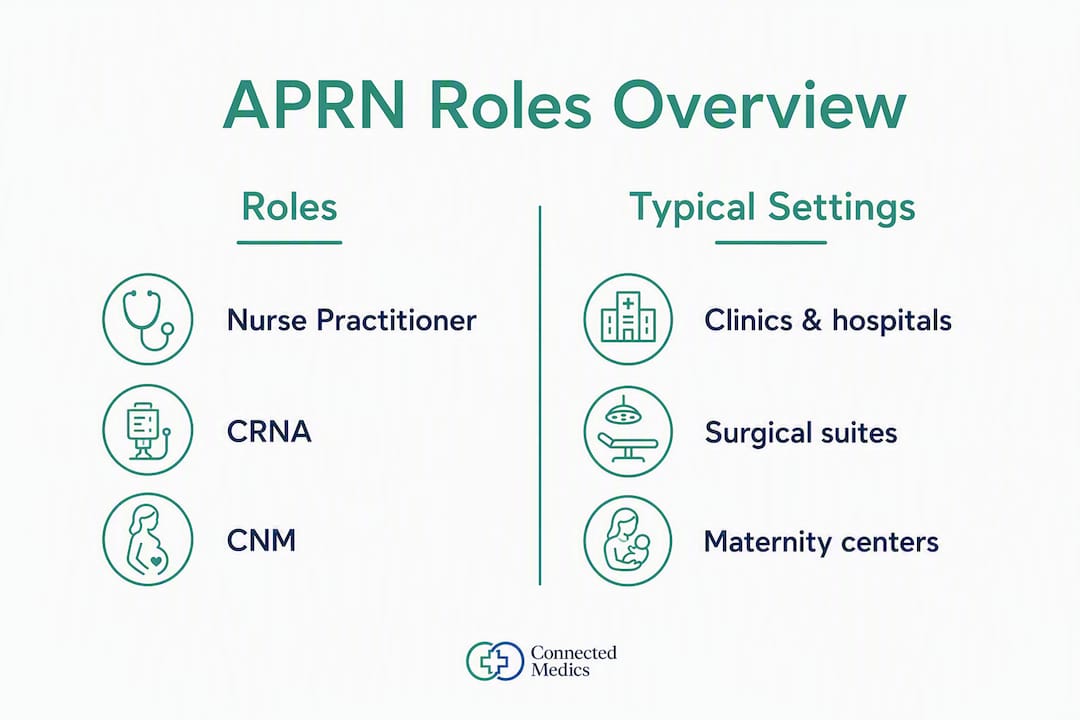
- Nurse Practitioner (NP): — NPs, including the widely pursued Family Nurse Practitioner (FNP) track, assess, diagnose, order diagnostics, and prescribe medications across the lifespan or within a defined population focus. They practice in primary care clinics, urgent care, hospitals, and telehealth settings.
| Role | Common Settings | Typical Services |
|---|---|---|
| Nurse Practitioner (NP/FNP) | Primary care, urgent care, telehealth | Diagnosis, prescribing, chronic disease management |
| Clinical Nurse Specialist (CNS) | Hospitals, health systems | Specialty consultation, staff education, protocol development |
| Certified Nurse-Midwife (CNM) | Birth centers, hospital L&D, community health | Prenatal care, delivery, gynecology, primary care |
| Certified Registered Nurse Anesthetist (CRNA) | ORs, rural hospitals, procedural suites | Anesthesia administration, pain management |
Why RNs choose APRN careers: the full range of motivations
The reasons for advanced nursing roles are rarely singular. Most RNs who make the transition cite a cluster of professional, financial, and mission-driven factors that compound over time.
Autonomy and clinical decision-making
For many RNs, the most immediate draw is the shift from executing orders to writing them. APRNs assess, diagnose, and initiate treatment plans without requiring physician co-signature in full-practice-authority states. That shift changes the texture of every patient encounter.
Specialization and intellectual challenge
Advanced practice nursing career motivation often centers on depth. RNs who feel constrained by generalist bedside roles frequently describe wanting to own a clinical domain, whether that is neonatal intensive care, psychiatric-mental health, or women's health. The neonatal nurse practitioner role, for example, places APRNs at the center of high-acuity decision-making in a way that staff RN roles structurally cannot.
Leadership and system influence

APRNs regularly move into roles that shape care protocols, mentor staff, and influence organizational policy. Research shows that nurses often underestimate the importance of systems-level training, including policy advocacy and systems thinking, yet these competencies are what separate APRNs who transform care delivery from those who simply extend it.
Salary and job security
The Bureau of Labor Statistics reports a median annual wage of $129,480 for nurse practitioners and $214,060 for CRNAs, compared with a median of $86,070 for registered nurses. That gap is a primary driver for nurses weighing the return on a graduate degree.
Flexibility and practice setting variety
APRNs practice in private offices, federally qualified health centers (FQHCs), acute care hospitals, telehealth platforms, and academic settings. Telehealth policy has expanded APRN opportunities in virtual care substantially, particularly for NPs managing chronic conditions remotely.

Mission and access to care
Studies of APN role development consistently identify workforce gaps and long wait times as primary drivers for creating APRN positions. Nurses who want to be part of that structural solution, particularly in rural or underserved communities, find APRN roles a direct path to that goal.
Pro Tip: Map your top motivation to a specific role before researching programs. If autonomy drives you, check whether your state grants full practice authority to NPs. If specialization is the draw, list three clinical areas you already find yourself reading about on your days off. Those two filters alone will narrow four role families to one or two.
How to become an APRN in the U.S.: education, certification, and timeline
The pathway from RN to APRN runs through graduate education, national certification, and state licensure. The route you choose depends on your timeline, career goals, and whether your target role or employer requires a Doctor of Nursing Practice (DNP).
Degree routes
- Master of Science in Nursing (MSN): The traditional entry point. Most NP, CNS, and CNM programs are MSN-level. Full-time programs typically run 2–3 years; part-time options extend to 3–4 years.
- Post-Master's Certificate: For RNs who already hold an MSN in a different specialty and want to add a second APRN certification. Duration is typically 1–2 years.
- Doctor of Nursing Practice (DNP): The terminal practice degree. Some CRNA programs now require a DNP by accreditation standards. DNP programs add 1–2 years beyond an MSN or run as direct BSN-to-DNP tracks of 3–4 years full-time.
International consensus on minimum educational preparation is still developing, which makes U.S. program accreditation a critical filter. Look for programs accredited by the Commission on Collegiate Nursing Education (CCNE) or the Accreditation Commission for Education in Nursing (ACEN).
Certification and licensure bodies
- American Association of Nurse Practitioners (AANP): Offers the AANP Family Nurse Practitioner (FNP-C) and other NP certification exams.
- American Nurses Credentialing Center (ANCC): Certifies NPs and CNSs across multiple specialty tracks, including the Family Nurse Practitioner-Board Certified (FNP-BC).
- National Board of Certification and Recertification for Nurse Anesthetists (NBCRNA): Administers the National Certification Examination for CRNAs.
- American Midwifery Certification Board (AMCB): Certifies CNMs.
- National Council of State Boards of Nursing (NCSBN): Oversees state licensure and publishes the APRN Consensus Model guidance that state boards use to structure their rules. StatPearls on NCBI Bookshelf provides peer-reviewed clinical summaries that many APRN students use as a study reference throughout their programs.
Timeline and cost overview
| Route | Typical Duration | Required Clinical Hours | Estimated Tuition Range |
|---|---|---|---|
| MSN (full-time) | 2–3 years | clinical hours vary by program (NP/CNS/CNM) | educational costs vary widely |
| MSN (part-time) | 3–4 years | clinical hours vary by program | educational costs vary widely |
| Post-Master's Certificate | 1–2 years | Varies by program | educational costs vary widely |
| BSN-to-DNP (full-time) | 3–4 years | clinical hours for CRNA programs vary | educational costs vary widely |
Tuition ranges are estimates. Actual costs vary by institution and program format.
Application checklist
- Confirm minimum RN experience requirements (most programs require 1–2 years of clinical experience, CRNA programs typically require ICU experience).
- Identify accredited programs in your state or fully online programs with clinical placement support.
- Secure a clinical preceptor early. Many programs require students to arrange their own preceptors, and this step is consistently the longest lead-time item.
- Explore employer tuition assistance before taking on loans. Many health systems offer tuition reimbursement for nurses pursuing advanced degrees in high-need specialties.
Pro Tip: When evaluating programs, ask the admissions team for their clinical placement rate and whether they have established employer partnerships in your region. A program with a strong preceptor network can cut months off your clinical placement search.
How scope of practice varies by state and what the Consensus Model means for you
Scope of practice is not uniform across the United States. Where you plan to work after graduation determines how much independent authority you will actually hold, regardless of your education or certification.
The three practice-authority categories
- Full practice authority: The APRN can evaluate, diagnose, order tests, and prescribe medications without a physician collaboration agreement. States including Oregon, Colorado, and Minnesota grant full practice authority to NPs.
- Reduced practice: The APRN must maintain a collaborative agreement with a physician for at least some elements of practice, such as prescribing controlled substances.
- Restricted practice: The APRN must practice under physician supervision or delegation for most clinical functions.
The Consensus Model for APRN Regulation, developed through NCSBN and a coalition of nursing organizations, provides a framework for standardizing APRN licensure, accreditation, certification, and education (LACE) across states. It recommends that APRNs be licensed at the role and population-focus level, but individual states are not required to adopt it fully. That gap between the model and state law is where scope-of-practice variation lives.
Practical steps for navigating state rules
- Visit your state board of nursing website directly. Look for the APRN practice act, prescriptive authority rules, and any collaborative agreement requirements.
- Check whether your target state has enacted full practice authority legislation recently. Several states have passed or expanded full-practice laws since 2020.
- If you plan to practice in a state with restricted authority, factor the cost and administrative burden of maintaining a collaborative agreement into your financial planning.
Pro Tip: The NCSBN website maintains a state-by-state APRN regulatory map. Cross-reference it with the AANP's practice environment tool before committing to a program. If you are considering relocating after graduation, check both your training state and your target state.
Where APRNs work and what career outcomes look like
The career growth in nursing that APRN roles offer is measurable. The Bureau of Labor Statistics projects 45% employment growth for NPs, CNMs, and CRNAs through 2033, driven by an aging population, primary care shortages, and expanded state practice authority. That growth rate is roughly ten times the average for all occupations.
Median annual wages by role (BLS)
| Role | BLS Median Annual Wage |
|---|---|
| Certified Registered Nurse Anesthetist (CRNA) | $214,060 |
| Nurse Practitioner (NP) | $129,480 |
| Certified Nurse-Midwife (CNM) | $129,480 |
| Registered Nurse (RN, for comparison) | $86,070 |
Statistic: The BLS projects 45% employment growth for NPs, CNMs, and CRNAs through 2033, adding approximately 118,600 new positions over the decade.
Common practice settings and responsibilities
- Primary care clinics and FQHCs: NPs manage chronic disease panels, preventive care, and acute visits, often as the primary provider for patients who lack access to physicians.
- Hospitals and acute care: CNSs lead specialty protocols; NPs manage inpatient panels or post-acute transitions.
- Birth centers and hospital L&D: CNMs manage the full continuum from prenatal to postpartum, including uncomplicated deliveries.
- Surgical and procedural settings: CRNAs are the sole anesthesia provider in a large share of rural U.S. hospitals.
- Telehealth platforms: NPs and CNSs manage chronic conditions, behavioral health, and follow-up care remotely.
- Academic and research roles: APRNs with DNP or PhD preparation move into faculty, researcher, and clinical education roles.
Career trajectories diverge after the first few years. Clinician-leaders often move into department director or chief APRN roles. Those drawn to education pursue faculty appointments. A DNP prepares APRNs for practice leadership and quality improvement; a PhD is the standard for research-focused academic careers.
Research on workforce alignment shows that employers who actively map a nurse's clinical interests to organizational needs improve both recruitment and long-term retention. That means the employer conversation matters as much as the program choice.
Trade-offs: real benefits and real challenges of APRN practice
The importance of advanced practice roles is well documented, but the path carries genuine trade-offs. A clear-eyed view of both sides helps you plan rather than react.
| Benefit | Challenge |
|---|---|
| Greater clinical autonomy and decision-making authority | educational costs vary widely depending on route |
| Higher median salary ($129,480–$214,060 for most roles) | Student debt burden, especially for nurses without employer tuition support |
| Expanded scope: diagnose, prescribe, manage full care episodes | Role ambiguity during transition; colleagues may resist or misunderstand the APRN role |
| Leadership and policy influence opportunities | Increased malpractice exposure and liability compared with staff RN roles |
| Flexibility across settings (telehealth, primary care, acute care) | Workload expectations can be higher than anticipated in understaffed systems |
| Ability to improve access in underserved or rural communities | Restricted practice states limit autonomy despite graduate-level preparation |
Systematic review evidence confirms that APRN care is associated with improved patient satisfaction, reduced waiting times, and better chronic disease control compared with usual care. That evidence base strengthens the case for APRN roles at the system level, but it does not eliminate the individual-level trade-offs.
Practitioner-level evidence warns that failing to clarify role boundaries early can lead to "super-assistant" stigma or resistance from physician colleagues, undermining the autonomy that motivated the transition in the first place.
Pro Tip: Before accepting an APRN position, ask these five questions: (1) What does a typical patient panel look like? (2) Is there a physician collaboration agreement, and who covers it? (3) What is the call schedule? (4) How does the organization support new APRNs in the first 90 days? (5) What is the malpractice coverage structure? The answers surface workload and supervision expectations that job postings rarely disclose.
A practical decision checklist and first-steps plan
Moving from interest to enrollment requires a structured approach. Use this checklist to assess readiness, then follow the 90-day action plan.
Decision checklist
- My primary motivation aligns with what APRN roles actually deliver (autonomy, specialization, or access impact).
- I have at least 1–2 years of RN clinical experience and understand which roles require more (CRNA programs typically require 2–3 years of ICU experience).
- I have researched scope-of-practice rules in the state where I plan to work after graduation.
- I have had a preliminary conversation with my employer about tuition assistance or scheduling flexibility.
- I understand the financial commitment and have a rough estimate of time-to-breakeven.
- I have identified at least two accredited programs that match my role and population focus.
90-day action plan
- Days 1–30: Informational interviews. Contact two to three practicing APRNs in your target role. Ask about daily responsibilities, workload, and what they wish they had known before enrolling. Reach out through specialty communities or verified professional networks.
- Days 31–60: Program research and prerequisites. Compare two to three CCNE- or ACEN-accredited programs. Confirm prerequisite courses (statistics, pathophysiology, pharmacology), clinical hour requirements, and preceptor support policies.
- Days 61–75: Finance and timeline planning. Request your employer's tuition reimbursement policy in writing. Estimate total tuition cost, living expenses during school, and expected salary after graduation. A simple breakeven calculation: divide total out-of-pocket cost by the annual salary difference between your current RN wage and the median APRN wage for your target role. For salary trend context, review current APRN compensation data before finalizing your numbers.
- Days 76–90: Preceptor and clinical placement preparation. Begin identifying potential preceptors in your clinical network. Contact your state's APRN professional association for preceptor matching resources. Confirm that your top program has placement support in your geographic area.
Estimating ROI
Divide your total out-of-pocket education cost by the annual wage difference between your current RN salary and the median salary for your target APRN role. A nurse earning $86,000 who spends $60,000 on an MSN and earns $129,000 as an NP afterward reaches breakeven in roughly 1.4 years of post-graduation practice, before accounting for any employer tuition support.
What research shows about the system-level value of APRNs
The case for APRN roles extends beyond individual career outcomes. A growing body of evidence ties advanced practice nursing directly to measurable improvements in care access, quality, and efficiency.
A systematic review published in 2024 found positive effects from advanced nurse practitioners on patient satisfaction, waiting times, chronic disease control, and cost-effectiveness across multiple randomized controlled trials and observational studies. That evidence base spans both primary and specialist care settings.
"Nurses and midwives working at an advanced level enhance capacity for service transformation, improve continuity of care, and help people navigate care pathways across specialties and settings." — Nursing and Midwifery Council
Research on APN role development identifies policy windows, specifically physician shortages and long wait times, as the primary structural drivers for creating APRN positions. For individual nurses, this structural demand translates into job security and an opportunity to be part of a systemic solution rather than merely filling a workforce gap.
Systems-level competencies including policy advocacy and systems thinking are consistently identified as critical differentiators for APRNs who lead practice transformation rather than simply extend clinical capacity. Programs that embed these competencies produce APRNs who can influence care delivery at the organizational and policy level, not just at the bedside.
The practical implication: an APRN who manages a panel of patients with diabetes in a federally qualified health center is not just filling a staffing gap. That role directly reduces emergency department utilization, improves HbA1c control, and increases the number of patients who have a consistent primary care relationship. Those outcomes are documented, not aspirational.
Key Takeaways
Nurses pursue advanced practice roles because the combination of clinical autonomy, higher earning potential, and measurable system impact creates a career trajectory that staff RN roles structurally cannot match.
| Point | Details |
|---|---|
| Top motivations | Autonomy, specialization, higher pay, and access-to-care impact drive most RN-to-APRN transitions. |
| Four recognized APRN roles | NP, CNS, CNM, and CRNA each offer distinct scope, settings, and salary ranges under the Consensus Model. |
| Education and timeline | MSN programs typically take 2–3 years full-time; DNP programs run 3–4 years; clinical hours vary by program. |
| BLS job growth | NP, CNM, and CRNA employment is projected to grow 45% through 2033, far above the national average. |
| Connectedmedics next step | Use Connectedmedics to filter APRN-specific job postings, connect with verified peers, and find preceptor leads through specialty communities. |
The shift from RN to APRN: what the transition actually feels like
The clinical autonomy that draws most nurses to advanced practice roles arrives alongside a significant identity shift. As a staff RN, the role is defined by executing and monitoring. As an APRN, the role is defined by deciding. That change is more disorienting than most pre-enrollment conversations acknowledge.
The interpersonal work is just as demanding as the academic work. Colleagues who knew you as a bedside nurse may initially treat you as a resource rather than a clinician with independent authority. Clarifying role boundaries early, with both nursing staff and physician colleagues, is not optional. Practitioner evidence consistently shows that APRNs who skip this step face resistance that erodes the autonomy they trained for.
Pro Tip: In your first 30 days in an APRN role, schedule brief one-on-one conversations with key physician colleagues and charge nurses. State your scope plainly and ask how they prefer to handle overlapping clinical questions. That single step prevents months of role confusion.
Work-life balance after the transition depends heavily on role and setting. NPs in outpatient primary care often report more schedule control than they had as hospital RNs. CRNAs in surgical settings may face long, unpredictable hours tied to OR schedules. CNMs managing laboring patients work within the rhythms of birth, which no schedule fully controls. The role you choose shapes your daily life as much as your clinical identity, so that factor deserves as much weight as salary or scope when you are deciding.
Connectedmedics supports APRN candidates at every stage
Searching for APRN-specific jobs, preceptors, and peer mentors across generic platforms wastes time. Connectedmedics is built specifically for healthcare professionals, with verified profiles, specialty-filtered job postings, and peer communities where clinical conversations happen at the right level.

For nurses moving toward advanced practice, the platform offers three practical entry points. First, create a verified professional profile that signals your credentials and specialty interests to healthcare employers actively recruiting APRNs. Second, filter the jobs board by APRN role, specialty, and location to surface relevant postings from the platform's active healthcare vacancies. Third, join specialty community threads to connect with practicing APRNs who can provide preceptor leads, program recommendations, and candid transition advice.
Nurses who want to learn more about founding membership access can review the platform's premium features, including AI-powered career matching and employer recruitment tools designed for verified clinicians. Create a profile and start filtering APRN opportunities today.
Authoritative sources and further reading
- National Council of State Boards of Nursing (NCSBN) — Consensus Model: The primary regulatory framework document for APRN licensure, accreditation, certification, and education across U.S. states.
- StatPearls / NCBI Bookshelf — Advanced Practice Nursing — Peer-reviewed clinical and systems-level competency summaries used widely in APRN education.
- American Association of Nurse Practitioners (AANP): NP certification information, state practice environment maps, and continuing education resources.
- Systematic Review — APRN Effectiveness vs. Usual Care (PubMed) — Evidence base for patient satisfaction, wait times, and chronic disease outcomes associated with APRN care.
- Thinking, Educating, Acting: Developing Advanced Practice Nursing (PMC) — International consensus on APN education competencies and the MSN vs. DNP debate.
A perspective on what the APRN decision really comes down to
Most articles on this topic frame the APRN decision as a financial calculation or a career ladder move. That framing is incomplete.
The nurses who thrive in advanced practice roles are not primarily the ones who wanted a higher salary. They are the ones who found the staff RN role structurally limiting for the kind of clinical thinking they were already doing. They were already forming differential diagnoses in their heads. They were already frustrated when a patient's care plan did not reflect what the nurse at the bedside knew. The APRN credential does not create that drive. It gives it a legitimate outlet.
What the financial and career data cannot capture is the identity work involved. Moving from a role defined by collaboration and execution to one defined by independent clinical judgment requires more than coursework. It requires a willingness to be wrong in a new way, to own decisions rather than carry out someone else's, and to build credibility in a role that some colleagues will initially resist.
The system-level evidence is compelling. APRN care demonstrably improves outcomes across multiple settings. The workforce demand is real. The salary differential is significant. But the nurses who report the highest long-term satisfaction in advanced practice roles are those who made the transition because the work itself called for it, not because the numbers did.
If you are already thinking like an APRN, the credential is worth pursuing. If you are primarily motivated by salary or title, the workload, debt, and role ambiguity of the transition may erode that motivation before you reach the payoff.