
The most effective approach to physician burnout prevention combines the six lifestyle medicine pillars with direct advocacy for structural change at the institutional level. Neither strategy alone is sufficient. Three actions to start this week:
- Set a non-negotiable sleep window of 7–8 hours on post-call days and protect it like a patient appointment.
- Add one 10-minute walk between shifts or during a lunch break, three times this week.
- Schedule one peer check-in, whether a brief hallway conversation or a group message, before the week ends.
One-week quick-start plan:
- Monday: Set a consistent wake time. Prep two nutrient-dense meals in advance.
- Tuesday: 10-minute walk. Decline one non-essential meeting.
- Wednesday: 5-minute breathing or body-scan practice before a clinic session.
- Thursday: Text or call one colleague. Log your sleep duration.
- Friday: Review your schedule for the following week. Identify one workflow friction point to flag to leadership.
- Weekend: One longer physical activity session (20–30 minutes). No work email after a set cutoff.
Pro Tip: The single highest-leverage action is protecting sleep. Circadian disruption amplifies every other burnout risk factor. Fix sleep first, then layer in the other pillars.
Table of Contents
- What does the research say about lifestyle interventions and burnout?
- How do the six lifestyle pillars apply to clinical work?
- How do you make lifestyle changes stick with an unpredictable schedule?
- What must institutions do to reduce physician burnout?
- How do you measure burnout and track progress over time?
- What barriers do clinicians face and how do you fix them?
- Why lifestyle work helps but cannot replace structural change
- What do lifestyle interventions actually cost in time and money?
- Key Takeaways
- Why combining personal practice with advocacy is the only approach that works
- Connectedmedics: peer support and knowledge resources for clinicians
- Authoritative resources and further reading
What does the research say about lifestyle interventions and burnout?
The evidence base for physician burnout prevention is real but imperfect. A systematic review and meta-analysis of 22 studies found that individual burnout prevention programs produce a small-to-moderate effect (SMD ≈ −0.32, 95% CI −0.41 to −0.22). Longer, multi-week programs consistently outperformed one-off interventions. That gap between short and sustained programs is one of the most consistent findings across the literature.
Mindfulness-based interventions (MBIs), including Mindfulness-Based Stress Reduction (MBSR), show short-term reductions in stress, anxiety, and burnout-related symptoms across healthcare workers. A meta-analysis of 27 studies with 2,506 participants found MBIs produced a burnout effect size of SMD −0.44 in the short term. Long-term outcomes, however, were inconsistent. For physicians specifically, MBI effects on burnout and depression did not reach statistical significance in subgroup analyses, which is a meaningful limitation.
Multimodal programs that combine mind-body techniques, cognitive behavioral principles, and lifestyle coaching show broader and more durable results. The SMART (Stress Management and Resiliency Training) program demonstrated medium-to-large effect sizes at 2 months, with sustained improvements across multiple well-being measures at 8 months.
| Intervention type | Short-term effect | Long-term durability | Evidence quality |
|---|---|---|---|
| MBIs (MBSR, meditation apps) | Moderate (SMD −0.44 burnout) | Inconsistent | Moderate; high heterogeneity |
| Multimodal programs (SMART) | Medium-to-large | Sustained at 8 months | Moderate; observational |
| Individual lifestyle programs | Small-to-moderate (SMD −0.32) | Better with longer programs | Moderate |
| Organizational interventions | Larger than individual-only | Sustained when embedded | Moderate-to-high |
Key limitations to know: Most studies are short in duration, use heterogeneous populations, and carry risk of bias. Effect sizes are real but modest. Individual interventions do not address root causes such as documentation burden or understaffing. The U.S. Surgeon General's advisory is explicit: structural change is the primary lever; individual support is necessary but not sufficient on its own.
How do the six lifestyle pillars apply to clinical work?
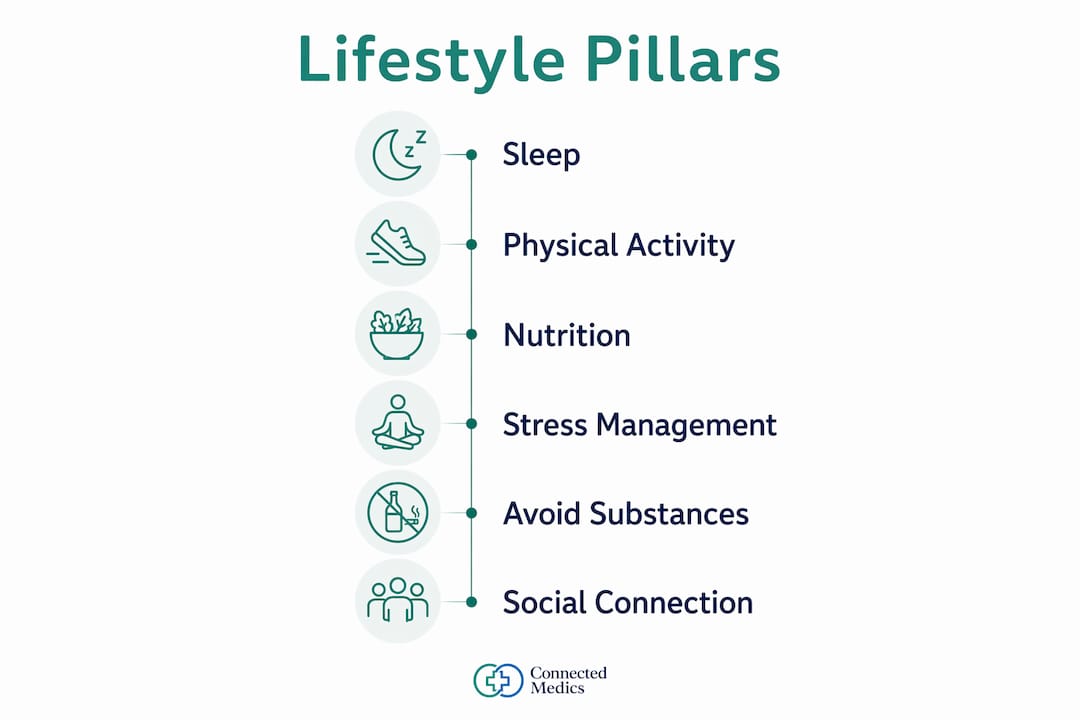
The six pillars of lifestyle medicine — sleep, physical activity, nutrition, stress management, avoiding risky substances, and social connection — provide a practical framework for clinician well-being. Each maps directly to known burnout risk factors.

Sleep and circadian health
Shift work exacerbates long-term health risks. Treating sleep as a clinical skill means using timed light exposure in the morning, limiting bright screens 60 minutes before bed, and scheduling caffeine intake to end at least 6 hours before sleep. For night-shift clinicians, blackout curtains and a consistent post-shift sleep window matter more than total hours alone.
- Use a 10-minute wind-down protocol after every shift: dim lights, no screens, brief breathing exercise.
- On rotating schedules, anchor your longest sleep block to the same time whenever possible.
Physical activity
Even brief activity reduces cortisol and improves mood. A 10-minute walk between patients or during a handoff period counts. The goal is consistency over intensity, particularly during high-call weeks. For work-life balance strategies that include movement planning, structured templates help.
- Aim for 150 minutes of moderate activity per week, broken into 10–20 minute segments.
- Use stairs, walk during phone calls, or do a 5-minute resistance routine in a break room.
Nutrition
Irregular meal times and on-the-go eating are the norm in clinical settings. Batch-cooking two to three meals on a day off, keeping high-protein snacks in a locker, and avoiding the vending machine default are practical fixes. A whole-food, plant-predominant eating pattern — the dietary standard in lifestyle medicine — reduces inflammation and supports cognitive function.
- Pre-pack meals the night before a long shift.
- Keep nuts, seeds, or a protein bar accessible during rounds.
Stress management
Mindfulness practices do not require a 45-minute MBSR session. A 2-minute body scan before entering a patient room, a brief gratitude note at end of shift, or a structured breathing technique (4-7-8 breathing) during a bathroom break are all evidence-adjacent micro-habits. Cognitive behavioral techniques — identifying cognitive distortions, reframing catastrophic thinking — add a layer that mindfulness alone does not cover.

Avoiding risky substances
Alcohol use among physicians is higher than in the general population and often increases with burnout severity. Monitoring intake honestly, using validated tools like the AUDIT-C, and having a peer or physician health program contact available are practical safeguards.
Social connection
Isolation is both a symptom and a driver of burnout. Scheduling a brief peer check-in, joining a specialty interest group, or participating in community outreach programs with colleagues builds the social infrastructure that buffers against detachment.
Pro Tip: Practicing lifestyle medicine with patients is itself protective. Research shows that clinicians who integrate lifestyle medicine into their clinical work report greater professional meaning and lower burnout — the act of teaching these habits reinforces them personally.
How do you make lifestyle changes stick with an unpredictable schedule?
The failure mode for most clinician wellness plans is all-or-nothing thinking. A structured, stepwise approach works better.
4–8 week microhabit ramp-up:
- Weeks 1–2: Add one habit per pillar. Sleep window, one walk, one meal prep session, one 2-minute breathing practice.
- Weeks 3–4: Extend duration. Walks become 15 minutes. Meal prep covers three days. Add one peer check-in per week.
- Weeks 5–6: Introduce a tracking method. A wearable (Garmin, Apple Watch, Fitbit) for sleep and activity, or a simple paper log.
- Weeks 7–8: Review what held and what dropped. Adjust for the next rotation or schedule block.
Sample weekly template:
| Day type | Morning | Midday | Evening |
|---|---|---|---|
| Clinic day | 7-min walk + protein breakfast | 10-min walk or stairs | Meal prep, evening screen cutoff |
| Night shift | Sleep 8 AM–3 PM (blackout) | Light meal, caffeine ends by 6 PM | Brief breathing before shift |
| Post-call | Sleep priority, no alarms | Light activity only | Social contact, early bedtime |
| Day off | Longer exercise (20–30 min) | Batch cook, peer contact | Wind-down routine |
Recommended tools:
- Wearables: Garmin Forerunner or Apple Watch for sleep staging and HRV monitoring.
- Mindfulness apps: Headspace (10-minute guided sessions), Calm (sleep stories for post-shift wind-down), or Insight Timer (free, flexible session lengths).
- CBT-based apps: Woebot or Sanvello for cognitive reframing exercises between shifts.
- Short audio: NAMI's wellness resources for healthcare professionals include brief guided practices sized for clinical schedules.
Residents and high-call specialists face the steepest barriers. For this group, the priority order is: sleep first, then nutrition, then any form of movement. Social connection and formal mindfulness can be added once the first three are stable. Part-time clinicians often have more schedule flexibility but face identity-related detachment; for them, peer connection and professional community matter more.
What must institutions do to reduce physician burnout?
Organizational interventions produce larger burnout reductions than physician-directed individual programs alone. The evidence points to a clear priority list.
High-impact structural changes:
- Reduce documentation burden: scribes, AI-assisted note generation, and medical assistant EHR data entry all reduce physician time on clerical tasks.
- Increase schedule control: flexible scheduling, protected administrative time, and the ability to adjust panel size.
- Optimize staffing ratios: studies in California showed that nurses meeting mandated staffing ratios reported lower burnout and job dissatisfaction, with lower patient mortality as a secondary benefit.
- Reduce face-to-face visit volume: AHRQ research found that reducing physician panel size to 1,800 patients and increasing care team staffing reduced burnout rates from 32.7% to 25.8% in one health system.
- Protect time for peer connection and debrief: monthly provider meetings focused on work-life issues, structured peer support groups.
- Align compensation with quality and team-based work rather than pure volume productivity.
Clinician advocacy checklist:
- Request a burnout baseline assessment using the Maslach Burnout Inventory or Mini Z Burnout Survey.
- Propose a 90-day pilot: one workflow change (e.g., scribes for EHR entry) with pre/post measurement.
- Identify one scheduling accommodation to request: a protected half-day, a reduced panel week, or a swap to a more predictable rotation.
- Connect with the AMA's STEPS Forward program for evidence-based workflow redesign modules.
- Bring data: cite the AHRQ burnout rate reduction figures when making the case to leadership.
Institutional wellness programs like UPMC Physician Thrive demonstrate that structured, multi-component programs — combining peer support, mental health access, and workflow redesign — can shift culture and reduce attrition when leadership commits to sustained investment rather than one-off wellness events.
How do you measure burnout and track progress over time?
Validated tools give clinicians and leaders a shared language and a baseline to measure against. Without measurement, it is impossible to know whether an intervention is working.
Validated screening tools:
- Maslach Burnout Inventory (MBI): The gold-standard measure. Assesses emotional exhaustion, depersonalization, and personal accomplishment across 22 items. Used in most major research studies. Available through Mind Garden.
- Professional Fulfillment Index (PFI): Measures both burnout and professional fulfillment. Validated for physicians. Shorter than the MBI and well-suited for repeat monitoring.
- Mini Z Burnout Survey: A single-page, 10-item tool developed with AHRQ funding. Designed for practice-level use. Quick to administer and score.
- Single-item screens: A single question ("Overall, based on your definition of burnout, how would you rate your level of burnout?") with a 5-point scale has demonstrated reasonable validity for population-level screening.
Monitoring timeline:
| Timepoint | Action | Tool |
|---|---|---|
| Baseline (Week 0) | Administer full MBI or PFI | MBI or PFI |
| 3 months | Repeat screen; review lifestyle habit log | Mini Z or PFI |
| 6 months | Full reassessment; adjust program | MBI or PFI |
| 12 months | Annual review; escalate if no improvement | MBI + leadership review |
Escalation guidance:
- If MBI scores show severe emotional exhaustion at baseline, refer to occupational health or an employee assistance program (EAP) before starting a self-directed lifestyle program.
- If scores do not improve at 3 months despite consistent habit adoption, flag to a department chief or wellness officer.
- If a clinician reports suicidal ideation or substance dependence, immediate referral to a licensed mental health professional or physician health program is required.
What barriers do clinicians face and how do you fix them?
Common barriers and practical fixes:
- No time: Replace 30-minute sessions with 5–10 minute micro-practices. A 5-minute walk and a 2-minute breathing exercise require no scheduling.
- Stigma around help-seeking: Frame wellness as a clinical skill, not a personal weakness. Physician mental health resources and peer support programs normalize the conversation.
- Cost of programs: MBSR courses range from free (hospital-sponsored) to $500–$650 for an 8-week community program. Many EAPs cover mindfulness coaching at no cost. The American College of Lifestyle Medicine (ACLM) offers member resources and continuing education at accessible price points.
- Skepticism about evidence: Point to the SMD −0.32 meta-analysis finding and the SMART program's 8-month sustained results. Small effects are still real effects, and they compound over time.
- Isolation in rural or solo practice: Online peer groups, virtual MBSR programs, and specialty-specific forums on verified professional networks fill the gap when in-person options are limited.
Normalizing help-seeking starts with leadership. When a department chief or program director openly discusses their own use of an EAP or a peer support group, utilization rates among staff increase. Nine out of 10 employees report appreciating when leaders share stories of getting support, according to CDC-cited research.
Sample email to request a wellness pilot:
Subject: Proposal for a 90-Day Burnout Reduction Pilot
Dear [Chief/Medical Director], I am writing to propose a 90-day pilot program to address burnout in our department. Based on validated data showing burnout rates above 35% in physician populations, and evidence that workflow adjustments and peer support reduce those rates meaningfully, I would like to suggest we begin with [one specific change: e.g., scribes for EHR documentation / a monthly peer debrief / a protected half-day per month]. I am happy to coordinate baseline measurement using the Mini Z Burnout Survey and report results at 90 days. Please let me know if you are open to a brief meeting.
Pro Tip: Pair the email with a one-page summary of the AHRQ burnout rate reduction data. Decision-makers respond to local, quantified outcomes — not general wellness arguments.
Why lifestyle work helps but cannot replace structural change
The Surgeon General's advisory on health worker burnout is unambiguous: the most effective long-term approach is structural change. Documentation burden, understaffing, and loss of schedule control are the primary drivers. Individual lifestyle practices address the symptoms; they do not fix the system.
Between 35% and 45% of nurses and physicians, and 40%–60% of medical students and residents, report symptoms of burnout, according to the National Academy of Medicine. Those numbers have not moved significantly despite a decade of individual-focused wellness programs. That is the clearest signal that personal habits alone are insufficient.
The practical recommendation from converging authoritative sources — the Surgeon General, AHRQ, CDC NIOSH, and recent systematic reviews — is a combined approach:
- Personal: Adopt the six lifestyle medicine pillars with shift-adapted micro-habits. Use validated tools to measure baseline and track progress. Engage with MBSR or multimodal programs at sufficient intensity (multi-week, not one-off).
- Systemic: Advocate for workflow redesign, EHR burden reduction, staffing adjustments, and schedule control. Use the ACLM's clinical framework and the AMA's STEPS Forward modules to build the case.
Relying only on mindfulness and exercise while organizational pressures remain unchanged risks what researchers describe as moral injury: the gap between what clinicians know patients need and what the system allows them to provide. Pairing personal practice with advocacy closes that gap.
What do lifestyle interventions actually cost in time and money?
Setting realistic expectations prevents early dropout. Here is what clinicians should budget:
Time costs:
- MBSR (8-week standard program): 2.5 hours per week in class plus 45 minutes of daily home practice. Total commitment: roughly 40–50 hours over 8 weeks. Abbreviated formats (4-week, app-based) exist but show smaller effects.
- Multimodal programs (SMART-style): typically 1–2 hours per week over 8–12 weeks, often delivered in group format during protected time.
- Self-directed micro-habits: 10–20 minutes per day. The lowest-barrier entry point and the most sustainable for high-call schedules.
Financial costs:
- MBSR community programs: $500–$650 for 8 weeks. Hospital-sponsored programs are often free to staff.
- ACLM membership and lifestyle medicine certification: membership starts at accessible annual rates; board certification requires additional coursework and examination fees.
- Mindfulness apps: Headspace and Calm run $70–$100 per year. Insight Timer is free. Many EAPs provide app access at no cost.
- Wearables: $150–$500 depending on device. Not required, but useful for sleep and HRV tracking.
- EAP counseling: typically free for 6–12 sessions per year under most hospital benefit plans.
The most cost-effective starting point is an EAP-covered counseling session combined with free app-based mindfulness and self-directed micro-habits. Formal programs add value when the schedule and budget allow, particularly for clinicians with moderate-to-severe burnout scores at baseline.
Key Takeaways
Combining the six lifestyle medicine pillars with institutional advocacy is the most evidence-supported strategy for physician burnout prevention — neither approach works as well in isolation.
| Point | Details |
|---|---|
| Individual programs have modest effects | Major meta-analyses found small-to-moderate effects (SMD ≈ −0.32) for individual burnout programs; longer, multi-week formats perform better. |
| MBIs help short-term, not always long-term | Mindfulness-based interventions reduce stress symptoms acutely; sustained burnout reduction requires ongoing practice and structural support. |
| Structural change is the primary lever | The U.S. Surgeon General's advisory identifies systemic reforms — staffing, documentation burden, schedule control — as the most effective long-term interventions. |
| Measure before and after | Use the Maslach Burnout Inventory or Professional Fulfillment Index at baseline, 3 months, and 6 months to track real change. |
| Connectedmedics supports implementation | The Connectedmedics knowledge hub and peer network connect clinicians to wellness resources, verified colleagues, and institutional program contacts. |
Immediate checklist:
- Set a protected sleep window this week.
- Add one 10-minute movement break per shift day.
- Identify one structural friction point and draft a pilot proposal.
- Administer a baseline burnout screen (Mini Z or PFI) to yourself or your team.
- Connect with one peer or professional community for accountability.
Why combining personal practice with advocacy is the only approach that works
The research is consistent enough to say plainly: lifestyle interventions help, but they are not a substitute for fixing the system. What gets lost in most wellness conversations is that asking clinicians to meditate their way out of a structurally broken environment is not a wellness strategy. It is a deflection.
The more useful framing is this: personal lifestyle practices build the physiological and psychological reserve that makes advocacy possible. A clinician who is sleeping adequately, moving regularly, and connected to peers has more capacity to identify systemic problems clearly and push for change without burning out in the process of doing so. The habits are not the solution. They are the foundation from which the real work gets done.
Clinicians who integrate lifestyle medicine into their clinical practice report greater professional meaning, which directly counters the detachment component of burnout. That is not incidental. It suggests that the act of modeling these habits for patients creates a feedback loop that reinforces the clinician's own sense of purpose. Propose a pilot. Measure the baseline. Connect with peers who are doing the same work. The evidence supports all of it.
Connectedmedics: peer support and knowledge resources for clinicians
Clinicians working on burnout prevention need more than information. They need verified peers, curated resources, and access to institutional contacts who have already run wellness pilots.

Connectedmedics is a professional network built exclusively for healthcare professionals. The knowledge hub aggregates clinical guides, research summaries, and wellness resources contributed by verified medical experts — including content directly relevant to physician well-being, lifestyle medicine, and burnout prevention strategies. The platform also hosts over 4,600 active healthcare vacancies, making it practical for clinicians considering a role change as part of a broader burnout recovery plan.
For clinicians who want peer accountability, specialty-specific groups on Connectedmedics connect physicians with colleagues facing the same scheduling and workload pressures. For those looking to propose an institutional pilot, the knowledge hub provides access to evidence summaries that can support a leadership conversation. Visit Connectedmedics to create a verified profile and access the full resource library.
Authoritative resources and further reading
| Resource | What it covers | Best for |
|---|---|---|
| U.S. Surgeon General advisory on health worker burnout | Systemic drivers of burnout and policy recommendations | Clinicians advocating for institutional change |
| AHRQ Physician Burnout research summary | Evidence-based organizational interventions and measurement tools | Department chiefs and practice managers |
| CDC NIOSH Impact Wellbeing Guide | Step-by-step guide for hospital leaders on improving professional wellbeing | Hospital administrators and wellness officers |
| PMC review: lifestyle medicine and physician well-being | Six-pillar framework applied to clinician burnout | Clinicians building a personal wellness plan |
| MBI meta-analysis: mindfulness in healthcare workers | Effect sizes and limitations of MBIs across healthcare professions | Clinicians evaluating MBSR or app-based programs |
| SMART program cohort study | Multimodal program outcomes at 2 and 8 months | Program coordinators designing multi-week interventions |
| American College of Lifestyle Medicine (ACLM) | Certification, clinical tools, and member resources for lifestyle medicine practice | Clinicians integrating LM into practice |
| Maslach Burnout Inventory (Mind Garden) | Gold-standard burnout measurement tool | Baseline and follow-up assessment |
| StatPearls: Healthcare Professional Burnout | Comprehensive clinical overview of burnout causes and interventions | Residents and trainees seeking a clinical reference |