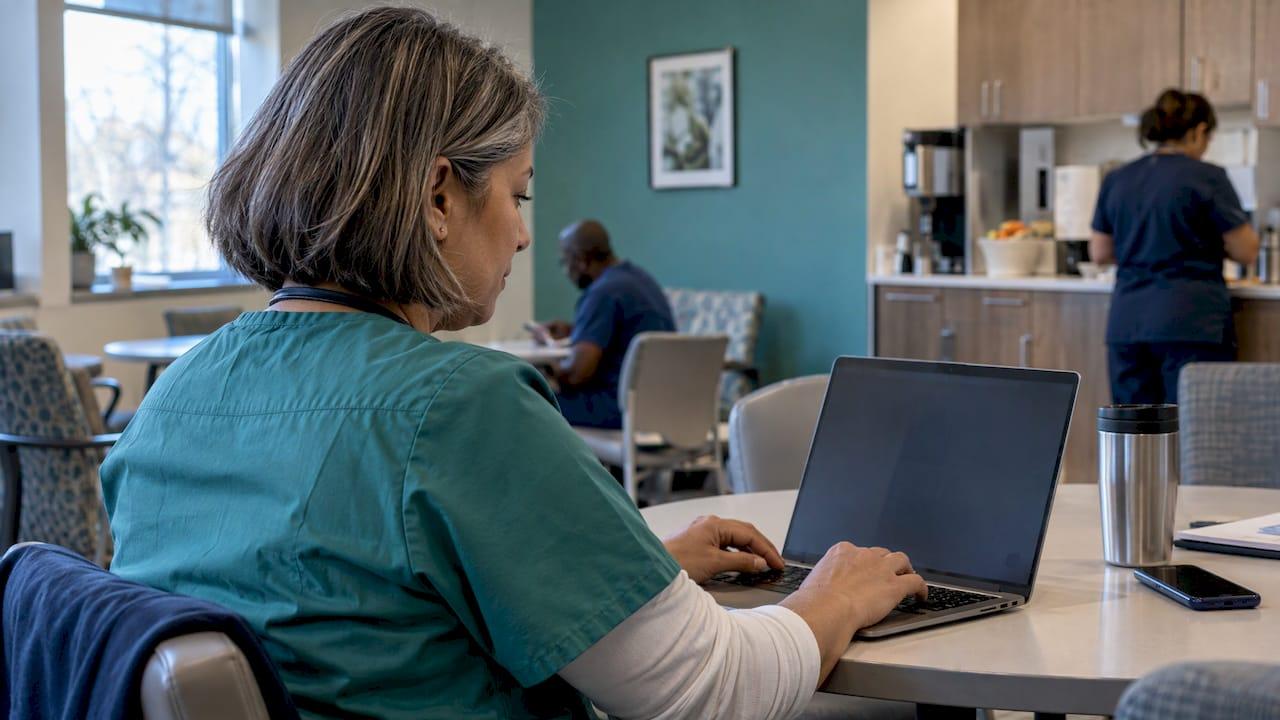
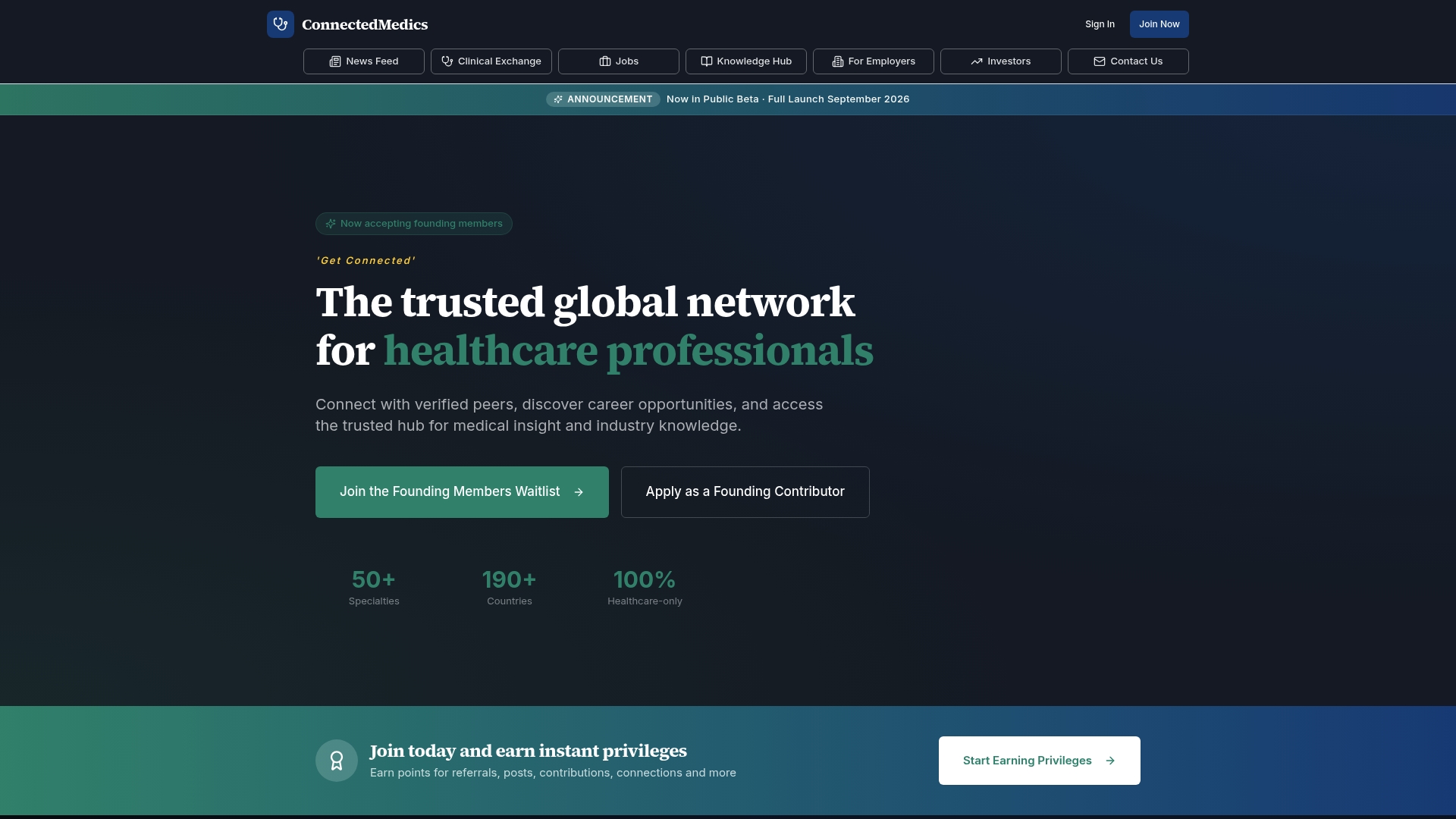
A medical social network is an online space built for people who work in healthcare. Members are clinicians, researchers, pharmacists, administrators and care staff. Purposes: peer discussion, learning, visibility and jobs. The strongest fit for a US professional is a healthcare-only network with verified profiles, specialty communities and a jobs board in one place. ConnectedMedics is built that way: verified profiles, specialty-led communities, a global jobs board with over 22,000 active healthcare vacancies and a knowledge hub.
This guide covers what these networks are, the main types, what professionals use them for, which features to compare, and the conduct rules that apply.
TL;DR
- Medical social networks are special-purpose communities for health professionals. They differ from general social media in audience, topics and privacy risk.
- Main uses: specialty knowledge sharing, mentoring, career development, job discovery and research collaboration.
- Compare six features: verification, specialty targeting, discussion quality, jobs, learning content and privacy controls.
- Patient information never belongs in a post. HIPAA applies online as it does in the clinic.
- ConnectedMedics combines verified profiles, forums, a jobs board and a knowledge hub for healthcare staff in 190+ countries.
Table of Contents
- What medical social networks are
- Types of networks clinicians use
- What professionals actually do on them
- How different roles use them
- Features to compare before joining
- Privacy and professional conduct
- Perspective
- What ConnectedMedics offers professionals
- FAQ
- Sources
What medical social networks are
General social networks serve everyone. Special-purpose online health communities serve a defined group. A 2019 academic review separates the two. In its framing, health professionals, patients and families use special-purpose communities to share illness information, seek support and connect with others in similar circumstances. The same review groups health-care social media use into peer-to-peer, peer-to-consumer, consumer-to-consumer and consumer-to-peer categories.
For a working clinician, the peer-to-peer category matters most. Ventola's review explains why. Professional networking platforms are often open only to people in the profession and cater to them. They support discussion of ethics, biostatistics, practice management and career strategy. They also give subspecialists a supportive environment that general platforms do not.
Three things set a medical social network apart:
- Audience. Members share a profession or specialty.
- Content. Cases, evidence, practice questions, career moves.
- Risk profile. Confidentiality duties shape what can be posted.
How they differ from marketing channels
Much of what ranks online for this topic is social media marketing for practices. That is a different job. A 2021 literature review lists several uses of social media in health care: health promotion, practice promotion, recruitment, professional networking, medical education, telemedicine and scientific research. Promotion aims at patients. Professional networking aims at colleagues. The two need different platforms and different habits.
A 2012 guidance paper from US authors keeps professional networking apart from social networking, media sharing and direct patient engagement. It notes that using general social channels for physician-patient clinical communication is generally not advisable, because of privacy and legal risks. Peer networks sit on the safer side of that line, provided patient data stays out.
Types of networks clinicians use
No single network covers every need. Most professionals end up with a small mix.
| Type | Who it serves | Main value |
|---|---|---|
| Healthcare-only network with jobs board | All healthcare roles | Peer connection, visibility, vacancies |
| Specialty society communities | Members of one specialty | Education, position statements, local events |
| Practice-based research networks | Ambulatory practices, researchers | Studies on community practice |
| Academic departmental alliances | Faculty in teaching hospitals | Education, research, professional home |
| General professional networks | Any industry | Broad contacts, weak clinical relevance |
| General social media | Public | Reach, with higher privacy risk |
Some examples from US professional bodies show how specialty communities work:
- The American College of Chest Physicians runs seven member-only CHEST Networks on areas such as critical care, sleep medicine and thoracic oncology.
- The Society of General Internal Medicine calls itself the professional home for more than 3,300 academic general internists.
- The American Osteopathic Association's directory lists 21 specialty colleges, 48 divisional societies and 22 stakeholder organizations.
- In research, practice-based research networks had 152 registered networks by June 2011, with over 16,900 practices and 69,000 members in all 50 states.
Society communities go deep on one specialty and usually require membership. They rarely cover jobs across roles. A healthcare-only network fills that gap by serving every role in one place: doctors, nurses, pharmacists, healthcare assistants, home care assistants, administrators and researchers. This overview of doctor networking platform types sets out the clinical value of each kind.
An ASCO educational chapter makes the same split. General professional networks tend to serve broad career networking. Others are geared specifically to networking among physicians and other health care professionals.
What professionals actually do on them
Research gives a clear picture. An integrative review of 72 studies looked at how health-care professionals build virtual communities. The most common reason was to create a forum for sharing specialty knowledge and discussing professional issues. It was the reason for 17 of 36 communities. The most common activity was requesting and supplying specialty-specific clinical information. The review also found communities used to address professional isolation, support mentoring, aid professional development and obtain clinical advice.
Peer connection and collaboration
A 2018 systematic review found that health professionals use network sites to build professional relationships. Users join groups by profession or research area, sometimes beyond their usual practice. One hand surgery group reached 4,106 members in four years. A 2023 study of health professionals' online communities reports that members reach leaders in their fields and develop collaborations they would not otherwise have access to.
Peers also act as a sounding board. Pianese and Belfiore describe clinicians sharing treatments and checking their experience against colleagues, usually inside networks organized by specialty. They link this to better decision quality and individual learning.
Career growth and visibility
An AMA article on building a network after residency advises early-career physicians to join organizations, attend events and use mentorship, coaching and peer connections. It also quotes a physician who says new attendings often underestimate how much they lose when the built-in camaraderie of residency or fellowship ends. Online networks help replace that loss for those who work in small teams or remote settings.
AACN guidance for nurses lists networking as a benefit: building professional contacts, attracting potential employers and using a wide network for career advancement.
Job discovery
Recruiters and professionals meet on these platforms. A 2021 clinician best-practices review notes that a social platform can serve as a recruitment portal for agencies, hospitals and individuals, advertising job, committee, funding and speaking opportunities. A jobs board inside a healthcare-only network keeps vacancies relevant to the role and specialty.
How different roles use them
- Doctors: peer-to-peer insight on cases and practice, specialty forums, locum and permanent roles. The guide to medical forums for doctors covers where physicians connect.
- Nurses: shared best practice, specialty forums, mentoring. See how nurses share best practice online and nursing specialty forum practices.
- Pharmacists: a visible, verified profile that shows credentials to employers and peers.
- Researchers: collaborators in the same specialty, with research summaries to follow.
- Administrators: industry insight, workforce trends, hiring contacts.
- Healthcare assistants and home care assistants: vacancies filtered by role, and contact with peers in the same line of work.
Features to compare before joining
Compare networks on what the profession needs. Six criteria cover most decisions.
- Verification. Are profiles checked against credentials? A verified base means contacts and advice come from real clinicians.
- Specialty targeting. Can feeds, forums and jobs be filtered by specialty? A general feed buries clinical content.
- Discussion quality. Are forums led by specialty? The research above ties value to specialty-based knowledge exchange.
- Jobs. Is the jobs board healthcare-specific, with role and specialty filters, and does it reach the country the professional wants to work in?
- Learning content. Does the network summarize research, news and clinical insight so that keeping up takes less time?
- Privacy controls. Who sees a profile, and who can contact a member? A guide to privacy controls in medical networking explains the settings to lock down.
A practical test: write down the single outcome wanted in the next year. A new post, a research partner, a mentor, a move abroad. Then check that the network has a feature for that outcome. The evidence on physician networking benefits is a useful companion at this stage. For nurses, why professional communities matter covers the same ground.
Worked example
A nurse practitioner in Texas wants a move into cardiology and a mentor. Her checklist: a verified profile that states her credentials, a cardiology-targeted forum, vacancy filters for nurse practitioner roles by specialty, and a privacy setting that limits who can message her. A healthcare-only network can meet all four in one account. A general network meets perhaps one.
A home care assistant looking for work has a shorter list. A jobs board with a home care filter, a profile employers can trust and a simple way to contact peers. The same six criteria apply, weighted differently.
Privacy and professional conduct
A peer network is safer than general social media for clinical talk. It is not a place for patient data.
- The ANA states that nurses must not post individually identifiable patient information. Removing a name or face may not protect identity under HIPAA, the federal law protecting patient health information. The same document says online conduct can enhance or undermine a career and the profession.
- Even anonymized images can fall short. Alasnag, Ahmed and Mamas point out that rare cases and complications can be identified without labels, and advise obtaining patient consent before posting images even when identifiers are removed.
- The AACN warns that social media posts have led to nurses being fired or losing licenses. Its examples of HIPAA violations include sharing photographs or other protected health information without written patient consent.
- Posts are public and open to scrutiny. Breaches of confidentiality can lead to litigation or privileging review, per the same 2021 best-practices review.
Safe habits: discuss cases only in general terms, change enough detail that no patient could be identified, get written consent before any image, and check employer social media policy. For questions about a specific situation, the compliance office at the employer is the right contact.
Perspective
Clinicians do not lack networks. They lack relevant ones. A feed that mixes clinical cases with unrelated content costs time, and a jobs board that lists every industry hides the roles that fit.
We built ConnectedMedics around one idea: healthcare only. Profiles are verified. Communities are led by specialty. The jobs board carries over 22,000 active healthcare vacancies. The knowledge hub holds clinical insights and research summaries, contributed by verified medical experts.
The research points the same way. Specialty knowledge exchange, mentoring and professional development are what health professionals value most online. A network designed around those uses, across 190+ countries, puts them in one place. Work permits are available online for those looking to move.
David
What ConnectedMedics offers professionals
ConnectedMedics is a networking platform for healthcare professionals. It covers:
- Verified profiles of medical professionals.
- A global jobs board with specialty-specific filters.
- Peer-to-peer clinical discussion forums and specialty-led communities.
- AI-powered career matching and workforce assessments.
- Curated medical news and research summaries in the Knowledge Hub.
Professionals can start at the ConnectedMedics home page. Employers have separate options: a Free plan, Growth at £99 per month, Enterprise and Premium Employer. Details are on the employer plans page and the Premium Employer page.
The same account also gives access to a marketplace with categories such as books and education, scrubs and clinical clothing, and medical equipment. For a wider view of how the profession connects, read how healthcare professionals network and what peer networking means for nurses.
FAQ
What is the best social network for doctors?
The best fit is a healthcare-only network with verified profiles, specialty communities and relevant jobs. Society communities add depth in one specialty. ConnectedMedics combines verified profiles, forums, a global jobs board and a knowledge hub, so one account covers peer insight and career moves.
How is a medical social network different from general social media?
Audience and risk. Members share a profession, so content centers on clinical and career topics. Academic guidance also advises against using general channels for physician-patient clinical communication because of privacy and legal risks. Patient information stays out of any network.
Can nurses and healthcare assistants use these networks, or are they for physicians?
They serve every healthcare role. Nurses use specialty forums and mentoring. Healthcare assistants and home care assistants use role-specific job filters and peer contact. Pharmacists, researchers and administrators use them for visibility, collaboration and industry insight.
Is it safe to discuss cases online?
Only in general terms. Never post identifiable patient information, and note that removing a name or face may not be enough under HIPAA. Get written consent before sharing any image, and follow employer policy.
How do I find jobs through a medical network?
Complete a verified profile, state the specialty and set role and location filters on the jobs board. Join specialty forums to meet peers who work in the target setting. AI-powered career matching on ConnectedMedics suggests relevant roles from the profile.
Sources
- Criteria to Measure Social Media Value in Health Care (PMC, 2019)
- Social Media and Health Care Professionals: Benefits, Risks, and Best Practices (PMC)
- Practical Guidance: The Use of Social Media in Oncology Practice (2012)
- Social Media and Health Care, Part I: Literature Review (PMC, 2021)
- Characteristics and lessons learned from practice-based research networks (PMC)
- CHEST Networks (American College of Chest Physicians)
- About SGIM (Society of General Internal Medicine)
- Affiliates Directory (American Osteopathic Association)
- Social Media for Networking, Professional Development, and Education (ASCO)
- How Health Care Professionals Use Social Media to Create Virtual Communities (PMC, 2016)
- Use of Social Network Sites for Communication Among Health Professionals (PMC, 2018)
- How do health professionals use online communities (Digital Health Week, 2023)
- Exploring the Social Networks' Use in the Health-Care Context (PMC, 2021)
- How to develop a professional network after physician residency (AMA)
- Do's and Don'ts of Social Media Use for Nursing Professionals (AACN)
- Best Practices of Social Media for the Clinician (PMC, 2021)
- Principles for Social Networking and the Nurse (ANA)