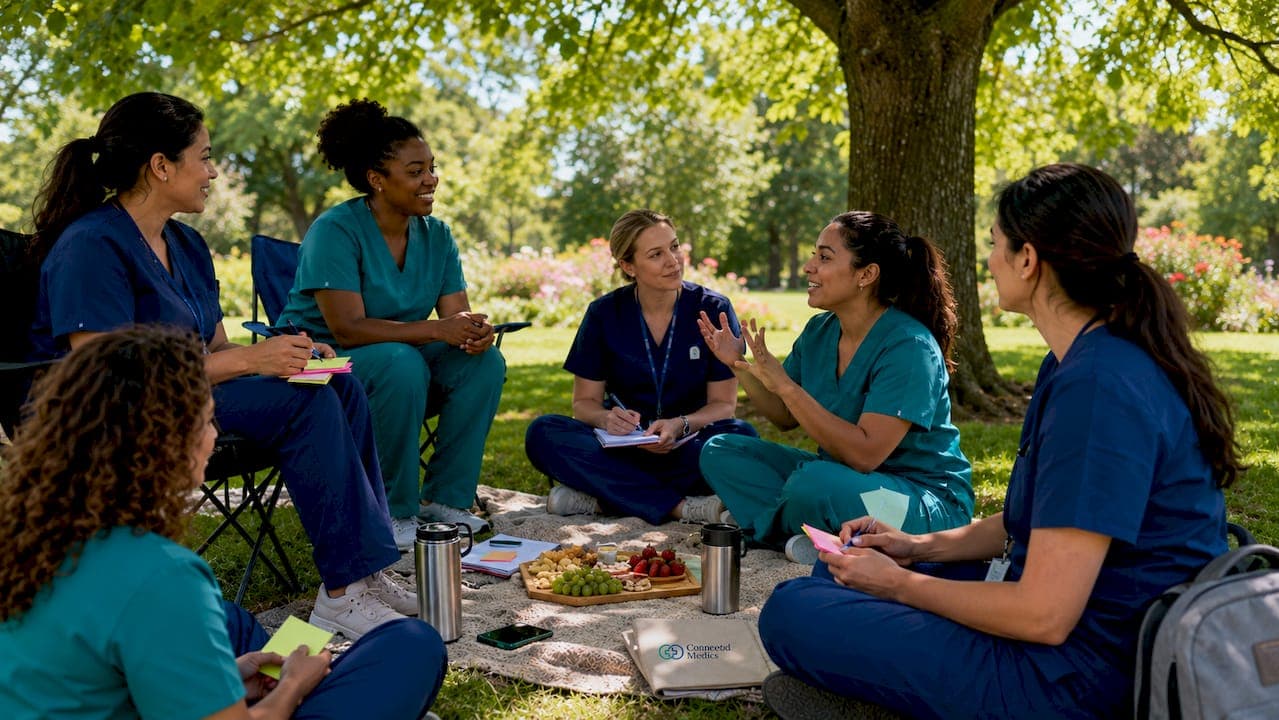
Professional nursing communities are defined as organized networks where nurses share knowledge, access career resources, and build peer relationships that extend beyond their immediate workplace. These groups represent one of the most direct answers to why nurses need professional communities: they fill the gaps that no single employer, hospital, or unit can fill alone. Platforms like The Nurses Lounge, AllNurses.com, and Connectedmedics give registered nurses access to mentorship, continuing education, and peer support across specialties and geographic boundaries. Whether you are a new graduate or a 20-year veteran, the right community changes how you practice, how long you stay in the profession, and how far your career goes.
Why nurses need professional communities: core benefits
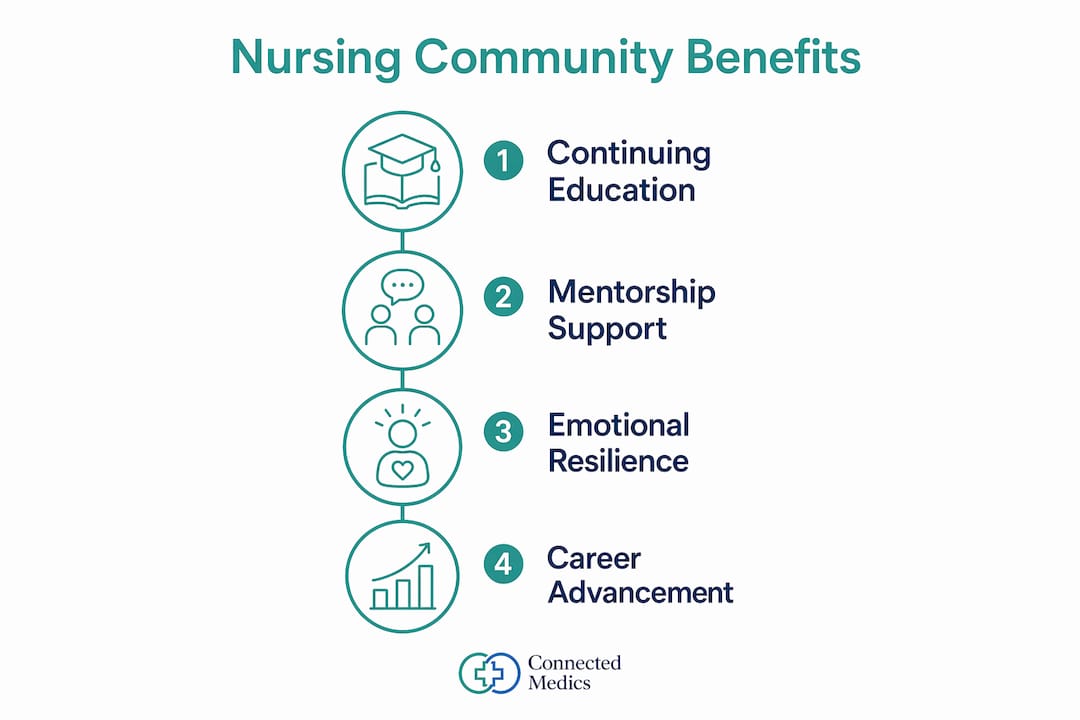
Professional nursing communities deliver four concrete advantages: continuing education, mentorship, emotional support, and career access. Each one addresses a gap that isolated practice creates.
Continuing education and clinical currency
Healthcare advances faster than any individual nurse can track alone. Professional communities aggregate clinical updates, research summaries, and practice guidelines in one place. The QNI Community Nursing Research Forum gained 439 members in less than 12 months, built specifically to address the fact that only 8% of NIHR research award holders since 2013 were nurses. That number reveals a research participation gap that community-based learning directly addresses. When nurses engage with forums and knowledge hubs, they stay current without relying solely on employer-sponsored training.
Mentorship and peer networking across specialties
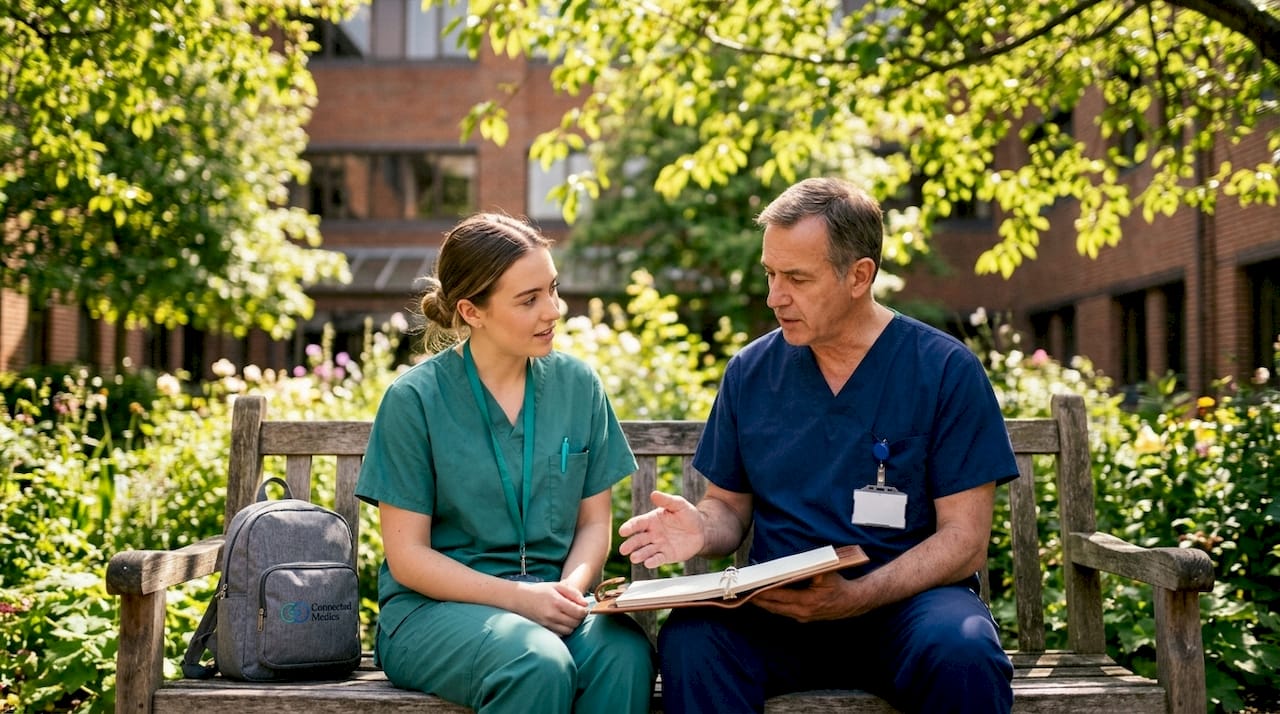
Mentorship inside a single unit is limited by the specialties and seniority levels present on that floor. Professional communities break that ceiling. Online nursing communities help nurses see their unique experiences as leadership strengths rather than gaps, particularly when navigating healthcare hierarchies. A pediatric nurse connecting with an ICU charge nurse through a shared forum gains perspective that no in-house orientation program provides. The cross-specialty exposure accelerates clinical confidence and opens doors to roles nurses might not have considered.
Emotional support and burnout prevention
Burnout is a structural problem in nursing, not a personal failure. Communities provide a space to process difficult experiences with people who understand the clinical context. The Nurses Lounge grew to over 1,200 members by early 2026, built around social support, career resources, and burnout prevention for nurses across all experience levels. That membership size reflects real demand. Nurses who have a place to decompress with peers report stronger morale and longer career longevity.
Access to career advancement resources
Job boards, leadership programs, and specialty certifications are easier to find when your network surfaces them. Communities curate these opportunities and filter them for nursing relevance, something generic platforms like LinkedIn do not do well.
Pro Tip: Join at least one specialty-specific community and one broad nursing forum. The specialty group gives you clinical depth; the broad forum gives you career breadth.
How do professional communities improve nurse job satisfaction?
Job satisfaction in nursing correlates directly with professional connection. Nurses who build connections in their first week at a new role report significantly higher job satisfaction than those who delay community engagement. That finding is not subtle. Early integration signals to the brain that the new environment is safe and supported, which reduces the anxiety that drives early attrition.
Rural nurses face the sharpest version of this problem. The Iowa Online Nurse Residency Program connects rural nurses across hospitals using online curriculum and cohort discussions, directly reducing professional isolation and building clinical confidence. Geographic distance no longer has to mean professional isolation. Technology-enabled communities replicate the belonging that urban nurses find more easily in dense hospital systems.
The retention data points in the same direction. Regular collaboration across nursing levels drives staff retention, clinical innovation, and workforce resilience. Retention is not just a staffing metric. It represents years of accumulated clinical knowledge staying inside the profession rather than walking out the door.
Key patterns in how communities improve satisfaction:
- Peer interaction builds clinical confidence faster than solo practice
- Shared experiences reduce the sense that struggles are personal failures
- Mentorship from experienced nurses shortens the learning curve for new graduates
- Community participation gives nurses a professional identity beyond their current employer
- Access to career resources reduces the feeling of being stuck in one role or setting
How can nurses build and use their professional networks?
Building a professional community connection is a skill, not a passive outcome. The most effective approach combines multiple platforms and starts earlier than most nurses think necessary.
- Start in week one. Introduce yourself to charge nurses, unit educators, and department leads during your first week. These early contacts become the foundation of your in-house network and often connect you to external communities.
- Join a broad forum. Reddit's r/nursing has over 900,000 members and covers candid career and clinical discussions that no employer-sponsored channel replicates. The scale means someone has already asked your question and received peer-reviewed answers.
- Add a specialty-specific group. City-specific Facebook groups and specialty nursing associations connect you with nurses who share your clinical context. These smaller groups produce higher-quality mentorship conversations than broad forums.
- Use a dedicated healthcare platform. Generic professional networks do not filter for nursing relevance. A healthcare professional network built for clinicians surfaces job leads, clinical updates, and verified peer connections that general platforms miss.
- Engage outside clinical settings. Nurses who join non-clinical group activities within communities, such as hiking groups or volunteer projects, report stronger professional bonds and greater career satisfaction. These activities reconnect nurses with their identity beyond the clinical role, which is a direct defense against burnout.
A multi-platform strategy balances emotional support, clinical advice, and career advancement. No single platform delivers all three equally well. Treating community building as a deliberate, multi-channel practice produces better results than relying on one forum or one workplace relationship.
Pro Tip: When joining a new online community, spend two weeks reading before posting. You will understand the culture, identify the most knowledgeable members, and make a stronger first impression when you do contribute.
Which nursing communities and platforms are worth joining?
The table below compares the most active nursing communities by focus, size, and primary benefit.
| Community | Primary Focus | Membership Scale | Best For |
|---|---|---|---|
| r/nursing (Reddit) | Candid career and clinical discussion | 900,000+ members | Broad peer support, anonymous advice |
| AllNurses.com | Clinical advice and career guidance | Large established forum | New graduates, specialty questions |
| The Nurses Lounge | Social support and burnout prevention | 1,200+ members (2026) | Morale, career resources, all experience levels |
| QNI Community Nursing Research Forum | Nursing research capacity building | 439 members (first year) | Research-active community nurses |
| Connectedmedics | Verified professional networking and jobs | 4,600+ active vacancies | Career advancement, specialty connections |
Each platform serves a different need. r/nursing delivers scale and candor. AllNurses.com provides structured clinical discussion. The Nurses Lounge focuses on morale and belonging. The QNI forum targets research-active nurses. Connectedmedics addresses the career and networking layer with verified profiles and a global jobs board built specifically for healthcare professionals. Using two or three of these in combination covers the full range of professional development needs.
Specialty-specific and location-based groups add another layer. A cardiac nurse in Chicago benefits from both a national cardiac nursing association and a Chicago-area nursing Facebook group. The national group provides clinical depth; the local group produces real-world job leads and in-person meetups.
Key takeaways
Professional nursing communities are the single most direct tool for improving job satisfaction, reducing burnout, and advancing a nursing career beyond what any one employer can provide.
| Point | Details |
|---|---|
| Start community building early | Nurses who connect in week one of a new role report significantly higher job satisfaction. |
| Use multiple platforms | Combine broad forums, specialty groups, and healthcare-specific networks for full coverage. |
| Communities reduce isolation | Rural nurses especially benefit from technology-enabled communities like the Iowa Online Nurse Residency Program. |
| Non-clinical activities matter | Joining social or volunteer groups within nursing communities strengthens professional bonds and career longevity. |
| Verified platforms add career value | Healthcare-specific networks like Connectedmedics surface relevant jobs and peer connections that generic platforms miss. |
What i have learned about nursing communities after years of watching them work
The nurses who advance fastest are rarely the most technically skilled. They are the ones who build relationships intentionally and early. That observation holds across every career stage I have seen.
Most nurses wait for community to come to them. They expect the hospital to provide it, or they assume it will develop naturally over time. It does not. The nurses who thrive treat peer networking as a deliberate practice, not a byproduct of showing up to work.
The other thing worth saying directly: diverse connections matter more than deep ones in a single setting. A nurse who knows 50 people in her unit has less career mobility than a nurse who knows 10 people across 10 different specialties and settings. Breadth of connection is what opens unexpected doors, surfaces the job posting you did not know existed, and connects you with the mentor who has already solved the problem you are facing.
The importance of nursing communities goes beyond career mechanics. Nurses who feel professionally connected report stronger clinical confidence and a clearer sense of purpose. That is not a soft benefit. It is the difference between a nurse who stays in the profession for 30 years and one who leaves at year five.
— David
Build your professional network with Connectedmedics
Connectedmedics is a global networking platform built exclusively for healthcare professionals. It addresses the fragmentation that generic networks create by providing verified profiles, a knowledge hub with clinical insights, and a jobs board with over 4,600 active healthcare vacancies.
For nurses looking to move beyond their current unit or hospital, Connectedmedics connects you with verified peers across specialties and locations. The knowledge hub delivers clinical summaries and research trends contributed by verified medical experts. The jobs board filters for healthcare-specific roles, cutting out the noise that general platforms produce. If you are ready to build the kind of professional network that actually advances your career, join Connectedmedics and start connecting with the healthcare community you need.
FAQ
What is a professional nursing community?
A professional nursing community is an organized network where nurses share clinical knowledge, career resources, and peer support beyond their immediate workplace. Examples include r/nursing, AllNurses.com, The Nurses Lounge, and platforms like Connectedmedics.
How do nursing communities reduce burnout?
Nursing communities provide a space for peer support and shared experience, which reduces the professional isolation that drives burnout. The Nurses Lounge, for example, was built specifically around burnout prevention and social support for nurses at all career stages.
When should a nurse start building a professional community?
Nurses should start building professional connections during their first week in a new role. Research shows that early community engagement correlates directly with higher job satisfaction and stronger professional integration.
Are online nursing communities effective for rural nurses?
Online communities are especially effective for rural nurses. The Iowa Online Nurse Residency Program uses online curriculum and cohort discussions to connect rural nurses across hospitals, reducing isolation and building clinical confidence.
How many nursing communities should a nurse join?
A multi-platform approach works best. Joining one broad forum like r/nursing, one specialty-specific group, and one career-focused platform like Connectedmedics covers emotional support, clinical advice, and career advancement without overlap.