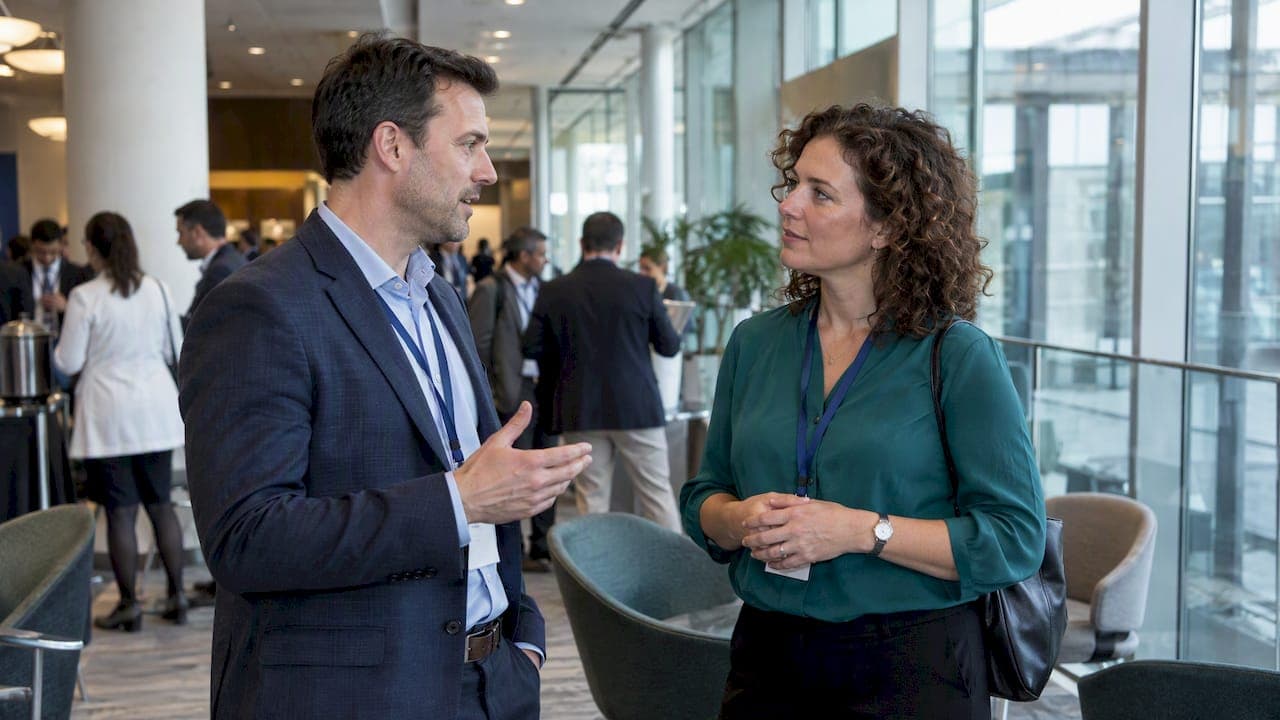
Physician networking pays off in five documented ways: career advancement, mentorship and sponsorship, access to clinical research, better information sharing between colleagues, and stronger peer support. The benefits are not automatic. They depend on who is in your network, how often you use it and whether you have a goal for each contact. This guide covers what research says, where networks fail and how to build one as a practicing physician, resident or early-career doctor.
TL;DR
- Networking supports career growth. A nationwide study of faculty development participants tied new colleague relationships to more academic achievement.
- Weak ties (distant contacts) often surface jobs and opportunities that close mentors cannot.
- Peer networks influence research participation and the adoption of new practices.
- Peer support is now part of physician retention and well-being strategies at many organizations.
- Most training programs teach little about networking, so it has to be learned deliberately.
Table of Contents
- What physician networking actually means
- Benefit 1: Career advancement
- Benefit 2: Mentorship and sponsorship
- Benefit 3: Access to clinical research
- Benefit 4: Better information flow and care coordination
- Benefit 5: Peer support, well-being and retention
- Why most physicians network badly
- How to build a physician network: a practical sequence
- Online vs. in-person networking
- Our perspective
- Using ConnectedMedics
- FAQ
- Sources
What physician networking actually means
Networking in medicine is the process of building and maintaining relationships that exchange information, resources and opportunities. A 2024 review on networking in medical education treats it as a core part of professional development, not a social extra.
It is not the same as collecting contacts. A network includes:
- Mentors and advisers who know your work well.
- Peers at your stage who share the same problems.
- Specialty colleagues in other hospitals or regions.
- Former co-residents, co-authors and program faculty.
- Recruiters, department chairs and society leaders.
The American Medical Association describes this as a personal learning network: a web of mentors, advisers, friends, colleagues and subject-matter experts that doctors rely on every day.
Benefit 1: Career advancement
This is the benefit most physicians search for, and it has the strongest direct evidence.
In a nationwide study of faculty development programs, enrollees reported starting or strengthening an average of nine career-supportive relationships, including three peers and two mentors. Those relationships correlated with greater academic achievement.
The practical effects are familiar:
- You hear about openings before they are posted.
- A colleague can vouch for your clinical skills, which a CV cannot do.
- You learn what a group, health system or region is really like before you sign.
- You find out which roles fit a change, such as moving from hospital to outpatient practice or into leadership.
Strong ties and weak ties
The AMA's guidance on building a network after residency separates two kinds of contacts. Strong ties, such as mentors and advisers, give guidance. Weak ties, such as distant acquaintances, are frequently more useful for career mobility and for discovering opportunities you did not know existed. Neglecting weak ties is a common mistake.
In practice, a former co-resident who now works in another state may tell you about a job you would never see through your own circle. Keep those contacts warm with a short note once or twice a year.
Benefit 2: Mentorship and sponsorship
Mentors give strategic career guidance and advocacy. Coaches help you find your own answers to specific challenges. AAMC leadership guidance treats the two as complementary, and both matter for a long career.
A wider network raises your odds of finding the right mentor, not just the nearest one. Few people have a single mentor who covers clinical practice, research, negotiation and work-life questions. A network lets you assemble several.
Our own pages on peer mentoring for US clinicians cover a step-by-step approach, including near-peer models where someone just ahead of you in training guides you.
Networking as an equity issue
Access to sponsors and role models is not equal. A paper in the medical education literature describes strong networks as fertile soil for talent and argues that institutions should facilitate connections instead of expecting every trainee to find them alone. If you are a first-generation physician, an international medical graduate or someone without a family tie to medicine, deliberate networking matters more, not less.
Benefit 3: Access to clinical research
Research participation spreads through relationships. A social network analysis of physician research participation found that a physician's odds of joining clinical trials rose by a factor of 1.05 for every 1% increase in the share of their network peers already participating. Physicians with ties to multiple hospital facilities were more likely to take part (odds ratio 7.28).
The same work notes that interventions to increase research engagement work better when they use existing influential hubs than when they target individuals in isolation.
For you, this means:
- Co-authors and trial investigators are your route into studies.
- Ties across more than one institution widen the pool of projects.
- A single introduction from a known colleague often does more than a cold email to a research office.
If research is your goal, see our overview of clinical study networking tools for US researchers.
Benefit 4: Better information flow and care coordination
Networks are not only about your career. A systematic review of health professional networks looked at 26 studies that mostly used social network analysis to examine how clinicians connect, collaborate and share information. It points to the role of connectors, people in management or key clinical roles who bridge separate groups and build the trust needed for coordination.

It also warns of a weakness: a network that depends on one central person is fragile if that person changes roles or leaves.
A broader scoping review of network approaches in healthcare says interest in networks rests on the belief that they can improve the quality and efficiency of care delivery, while noting that the evidence base is still developing. That is a fair summary: the logic is strong, and the outcome data are still catching up.
A familiar example is the interdisciplinary consult. When a case spans several specialties, knowing whom to call matters. One clinic explains why interdisciplinary consults matter in complex cases, in the dental context. The same principle holds in any specialty: a known colleague answers faster than a stranger.
Benefit 5: Peer support, well-being and retention
Peer connection is now part of how organizations try to keep physicians. In an AMA report on physician retention drawing on a survey of recruiters, 71% of respondents said they had peer support and well-being in their retention strategy. The same article describes one health system where reported burnout fell from 50.3% to 36.5% between 2022 and 2024 alongside such efforts. That is an association at one organization, not proof that peer support alone caused the change.
For an individual doctor, the value is simpler. A colleague who has faced the same call schedule, the same payer dispute or the same difficult outcome is often the person who helps most. If you are struggling, a network is not a substitute for care. Talk to your own physician or a licensed mental health professional, and see our pages on physician mental health and burnout prevention.

Why most physicians network badly
Most programs do not teach it. An article on resident networking in emergency medicine notes that few residencies have lessons on networking or how to do it well, even though it matters for career development. Residents are left to work it out alone.
Common problems:
- Only networking when job hunting. Contacts made under pressure feel transactional.
- Staying inside one hospital. Your whole network shares your employer's blind spots.
- Passive attendance. Going to a conference and talking to nobody does not count.
- No follow-up. A good conversation fades within weeks without a message.
- One central person. If your only route to opportunity is one mentor, you are exposed.
How to build a physician network: a practical sequence
The same article recommends a goal for each interaction, preparation beforehand and consistent follow-up. Here is one way to apply that.
- Set one aim per quarter. Examples: learn about outpatient roles, find a co-author, meet three people in your subspecialty.
- List your current ties. Sort them into strong and weak. Note the gaps.
- Prepare before events. Check the speaker or attendee list and pick two or three people to meet. Our guide on medical conference networking goes deeper.
- Ask specific questions. "How did you decide between academic and community practice?" beats "Can I pick your brain?"
- Follow up within a week. Send a two-line message that references what you discussed.
- Give something back. Share an article, make an introduction, answer a question.
- Maintain weak ties. A brief check-in twice a year is enough.
- Review yearly. Drop what does not serve you and add where you are thin.
Online vs. in-person networking
| Factor | In-person (conferences, societies, hospital groups) | Online (specialty networks, forums) |
|---|---|---|
| Trust building | Fast, through face-to-face contact | Slower, grows through repeated exchanges |
| Reach | Limited by travel and cost | National and international |
| Frequency | A few times a year | Daily or weekly, on your schedule |
| Best for | Mentors, sponsors, deep ties | Weak ties, specialty questions, job leads |
| Risk | Fades without follow-up | Irrelevant or unverified contacts |
The two work together. Meet in person, then keep the connection alive online. For a broader look at where doctors gather online, see Doctor Net: where to join.
Our perspective
General professional networks were not built for clinicians. A doctor's feed mixes sales posts, unrelated job ads and contacts whose credentials nobody has checked. The result is a large network that is not very useful.
We built ConnectedMedics as a healthcare-only network with credential-checked members, specialty targeting and a jobs board that carries healthcare roles only. We think three things matter most when you choose where to network:
- Verification. You should know the person on the other side is who they say they are.
- Specialty relevance. A nephrologist and a pediatric nurse need different conversations and different job leads.
- Visible opportunities. Connections matter more when openings, discussions and research summaries sit in the same place.
The research above points the same way. Weak ties find opportunities, hubs spread information and peer support helps retention. A network designed around those facts should beat one designed for general business contacts.
— David
Using ConnectedMedics
ConnectedMedics gives healthcare professionals verified profiles, specialty communities, peer discussion, a global healthcare jobs board and curated research summaries. Visit the ConnectedMedics home page to see how it works.
If you recruit, the employer plans include Free, Growth (£99 per month), and Enterprise tiers, and a separate Premium Employer option. For a hiring approach, read our physician recruiting strategies playbook.
FAQ
What are the main benefits of networking for physicians?
The best-documented benefits are career advancement, access to mentors and sponsors, entry into clinical research, and peer support. Networks also help information move between clinicians. The size of each benefit depends on how diverse your contacts are and how actively you maintain them.
Is networking worth it for early-career physicians?
Yes. Residents and new attendings often have the fewest contacts outside their own program, and few training programs teach networking. Starting with a clear goal, a few targeted conversations and prompt follow-up gives the best return for limited time.
What is the difference between strong and weak ties?
Strong ties are people who know you well, such as mentors and close colleagues, and they provide guidance. Weak ties are looser contacts, and they often bring news of jobs and opportunities you would not otherwise hear about. A healthy network has both.
Does networking improve patient care?
There is a plausible link, because networks help clinicians share information and coordinate. A scoping review of the field says the belief in these gains is widespread, but that the evidence is still developing. Treat it as a likely benefit, not a guaranteed one.
Sources
- A Nationwide Study of the Influence of Faculty Development Programs on Colleague Relationships
- Constructing within and between hospital physician social networks for modeling physician research participation
- How to tell when physician retention gets more than lip service, AMA
- Networking in medicine as an equity issue
- Mentoring leadership guide, AAMC
- Health professional networks as a vector for improving healthcare quality and safety
- How to develop a professional network after physician residency, AMA
- Number Needed to Meet: Ten Strategies for Improving Resident Networking Opportunities
- Network approaches and interventions in healthcare settings: a systematic scoping review
- Connecting for Success: The Role of Networking in Medical Education
- Struggling to build your learning network? A coach can help, AMA