
For U.S. clinical research professionals who need verified profiles, an active jobs board, and site-centric integration, Connectedmedics is the top clinical study networking tool to evaluate. The platform is built exclusively for healthcare professionals, not adapted from a general-purpose network.
Why Connectedmedics stands out:
- Verified clinician profiles. Every profile goes through a structured claim-and-verify process, so collaborators and recruiters see credentialed professionals, not scraped registry entries.
- Thousands of active healthcare vacancies. The jobs board covers specialty-specific clinical roles across the U.S., with filters by therapeutic area and role type.
- Site-centric integration focus. The platform connects clinicians, employers, and study sponsors within a single ecosystem, reducing the manual back-and-forth that slows trial startup.
Next step: Join Connectedmedics, complete profile verification, and search or post clinical roles.
Table of Contents
- What should you look for in a clinical-study networking tool?
- Which features make a clinical research collaboration platform effective?
- How does Connectedmedics meet these evaluation criteria?
- How do you join and get started on a clinical networking platform?
- What pricing and membership models should you expect in the U.S.?
- Why does site-centric collaboration matter for clinical trials today?
- Key Takeaways
- Why specialized clinical networks outperform generic platforms
- Connectedmedics: verified profiles and 4,600+ clinical vacancies
- Useful sources and further reading
What should you look for in a clinical-study networking tool?
The right platform does more than list profiles. It verifies them, connects them to real job opportunities, and fits into the workflows clinical teams already use.
Core evaluation criteria:
- Identity proofing: does the platform require investigators to claim their profiles and confirm institutional affiliation, or does it pull data from public registries without verification?
- Jobs board relevance: are listings filtered by specialty, trial phase, and therapeutic area, or is it a generic healthcare board?
- Specialty filters and community size: can you narrow searches to oncology, cardiology, or rare disease without scrolling through irrelevant results?
- Employer and recruiter tools: applicant tracking, direct outreach, and per-hire reporting matter for hospital recruiters and study sponsors.
Integration and interoperability needs:
- Two-way CTMS and eTMF integration for document exchange
- EHR/EMR compatibility for site-native workflows
- Single sign-on (SSO) and REST API availability
- 21 CFR Part 11 compliant eSignatures for regulated document handling
Vendor questions to ask (10–12 to start):
- How do you verify profile credentials and institutional affiliation?
- What is your HIPAA compliance posture for messaging and document exchange?
- Do you support 21 CFR Part 11 for electronic signatures?
- What CTMS and eTMF systems do you integrate with natively?
- Is there an audit log for all user actions and document exchanges?
- How many active clinical job listings are live right now?
- What specialty filters are available on the jobs board?
- What is the per-hire fee structure, and is it disclosed upfront?
- Can we export our data if we cancel the subscription?
- What SLAs cover uptime and support response times?
- Do you offer a free trial or pilot period before committing?
- How do you handle PHI in messaging threads?
Red flags to watch for: no structured verification process, profiles built from scraped public registries, no audit logs, opaque per-hire fees, and no stated HIPAA or 21 CFR Part 11 compliance.
Pro Tip: Ask any vendor to show you a sample audit log before signing. If they cannot produce one quickly, compliance is likely an afterthought, not a foundation.
Which features make a clinical research collaboration platform effective?
Not all features carry equal weight for trial startup and staffing. These categories separate functional platforms from ones that slow teams down.
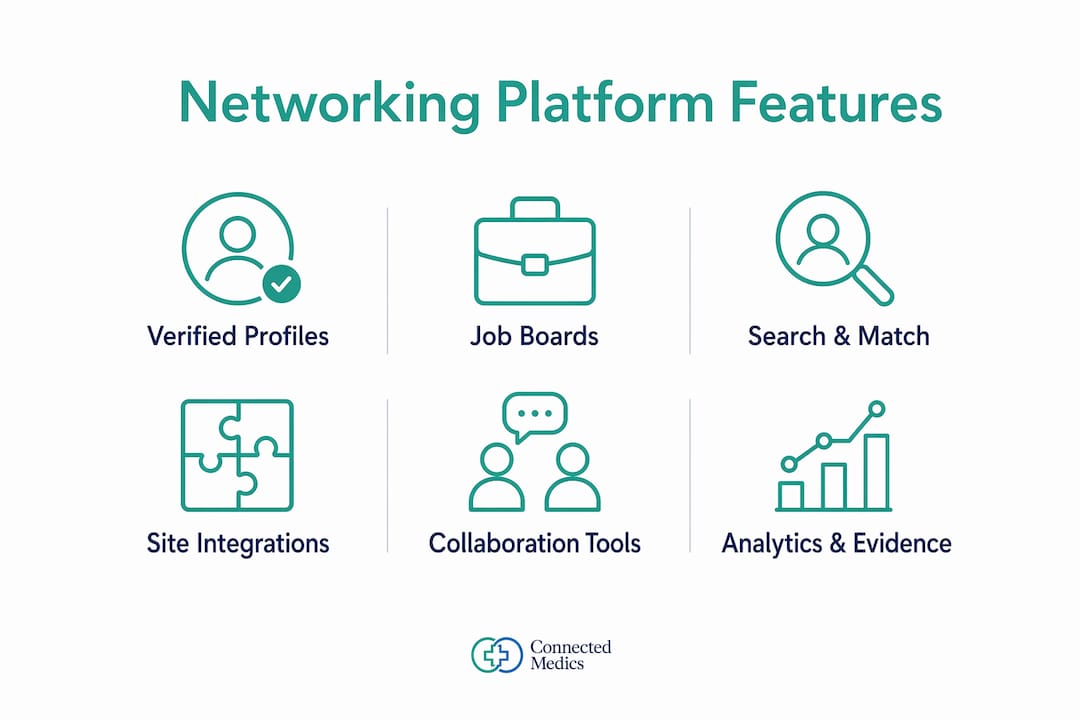
Verification and identity proofing
Platforms that require investigators to claim and verify their own profiles produce more reliable collaborator data than those built from scraped public registries. Claimed profiles with institutional confirmation are the standard to require. Platforms using only registry scraping introduce outdated contact details and unverified credentials into your workflow.
Jobs board and hiring tools
Active listings with specialty filters, applicant vetting, and per-hire metrics are the difference between a jobs board and a recruitment tool. Volume matters too: a board with 4,600+ live clinical vacancies gives recruiters real options.
Search and matchmaking
Protocol-aware search and AI-assisted matching by therapeutic area and trial phase reduce the manual work of finding qualified collaborators. Some platforms now offer AI-powered matching that scores site feasibility against protocol criteria automatically.
Integrations and site-centric workflows
Site-centric integration with CTMS, eTMF, and EHR systems is the dominant driver of faster trial startup. Platforms that plug directly into site-native tools reduce duplicate data entry and keep study progress visible to sponsors and sites simultaneously.
Collaboration features
HIPAA-compliant secure messaging, peer forums, document exchange, and role-based access are table stakes for any platform handling clinical communications. Secure discovery environments that restrict PHI exposure are a specific feature to confirm.
Analytics and evidence
Site performance history, response rates, and enrollment reliability indicators help sponsors make faster, better-informed site selection decisions.
Pro Tip: Check whether the platform supports bulk protocol import. Platforms that auto-generate feasibility questionnaires from protocol text, as LINEA's RSI and AcceleTrial do, can cut site activation time by days compared to manual outreach.
How does Connectedmedics meet these evaluation criteria?
Connectedmedics is built specifically for healthcare professionals, which means every feature maps to a clinical workflow rather than a generic professional networking use case.

| Evaluation Criterion | Connectedmedics Capability |
|---|---|
| Verified profiles | Structured claim-and-verify process for all clinician profiles |
| Jobs board scale | 4,600+ active healthcare vacancies with specialty filters |
| Knowledge hub | Expert-contributed content authored by verified medical professionals |
| Employer tools | Job posting, applicant management, and recruiter dashboards |
| Community focus | Specialty-led peer forums and clinical discussion threads |
| Privacy posture | HIPAA-aligned data handling for professional communications |
Use-case highlights:
- Finding collaborators: Search verified clinician profiles by specialty, institution, and therapeutic area to identify qualified co-investigators or site staff.
- Posting and recruiting: Employer tools let hospital recruiters post roles, manage applicants, and access a pool of verified candidates without sorting through unverified submissions.
- Accelerating site activation: Verified profiles mean less time spent confirming credentials before outreach begins.
- Maintaining professional networks: Specialty communities and a knowledge hub keep clinicians connected between studies and conferences.
The platform's 4,600+ active vacancies represent a live, filterable jobs board, not a static directory. That scale gives both job-seeking clinicians and recruiting employers a meaningful pool to work from.
How do you join and get started on a clinical networking platform?
Getting value from a clinical networking platform depends on completing verification quickly and using the search and posting tools from day one.
Step-by-step onboarding:
- Create your profile with full name, specialty, institution, and license details.
- Claim your institutional affiliation and upload supporting credentials for verification.
- Add therapeutic areas, trial phases, and role types to your profile filters.
- Search the jobs board using specialty and location filters to find relevant listings.
- Join specialty-led forums and peer communities aligned with your research focus.
- For recruiters: post a job listing with role type, specialty requirements, and location.
- Set notification preferences for new listings, connection requests, and forum activity.
For clinicians: A complete, verified profile with specific therapeutic area tags generates more relevant connection requests and job matches than a generic profile. Medical conference networking best practices apply here too: specificity in your profile description drives quality over volume.
For hospital recruiters: Use specialty filters to narrow applicant pools before outreach. Track response rates per posting to identify which role descriptions attract verified candidates fastest.
Pro Tip: Measure early ROI by tracking interview invites per application and connection acceptance rates in the first 30 days. A verified profile on a specialty platform should generate higher response rates than a generic network within the first two weeks.
What pricing and membership models should you expect in the U.S.?
Clinical networking platforms in the U.S. use several pricing structures. Knowing the model before you sign avoids surprises.
Common models:
- Free tier with premium individual membership upgrade for advanced search and messaging
- Employer subscriptions for job posting, recruiter dashboards, and applicant management
- Per-post job fees for one-off listings without a full subscription
- Per-hire success fees charged when a placement is confirmed
- Enterprise seat licensing for health systems or CROs with multiple users
Features typically behind a paywall:
- Advanced search filters and saved search alerts
- Recruiter dashboards with applicant tracking
- API and CTMS integration access
- Per-hire performance reports and analytics
Questions to ask about billing:
- Is there a free trial period, and what features are included?
- Are per-hire fees disclosed upfront and capped?
- What happens to posted jobs and profile data if the subscription lapses?
- Is data export available at any tier, or only at enterprise level?
- Are enterprise SLAs documented and enforceable?
Red-flag pricing behaviors: per-hire fees that are not disclosed until contract signing, no data portability clause, and enterprise SLAs that exist only as verbal commitments.
Why does site-centric collaboration matter for clinical trials today?
The industry is moving away from siloed sponsor portals toward unified platforms that deliver protocol and regulatory status directly into site workflows. That shift is the single biggest driver of faster trial startup.
Platforms that integrate directly into site systems, including EHR and CTMS, reduce duplicate data entry and give sponsors real-time visibility into site readiness. WCG's ClinSphere positions this unified data layer as the mechanism for removing silos across sites, sponsors, CROs, and participants. The practical result: fewer manual questionnaires, less re-keying of protocol data, and faster activation decisions.
AI-driven tools are accelerating this further. Clincove and similar platforms now offer protocol-first setup where study binders, forms, and visit schedules are auto-generated from the protocol document, with most sponsors going live within 2–4 weeks. That is a material reduction from legacy timelines.
Implications for clinicians and recruiters:
- Less time spent on manual feasibility questionnaires
- Faster site qualification when performance data feeds directly from IRB and CTMS records
- Reduced communication lag between sponsors and site staff
- More accurate enrollment forecasts when recruitment data flows in real time
Key Takeaways
Connectedmedics is the recommended starting point for U.S. clinical research professionals who need verified profiles, a specialty-filtered jobs board, and a HIPAA-aligned networking platform in one place.
| Point | Details |
|---|---|
| Verified profiles are non-negotiable | Require a structured claim-and-verify process; reject platforms built on scraped registry data. |
| Jobs board scale matters | A board with 4,600+ active vacancies gives clinicians and recruiters a real working pool, not a static list. |
| Site-centric integration speeds startup | Platforms that connect to CTMS and EHR systems reduce duplicate entry and accelerate site activation. |
| Compliance must be explicit | Confirm HIPAA posture and 21 CFR Part 11 support before signing any vendor agreement. |
| Connectedmedics as a starting point | Join at connectedmedics.com, complete profile verification, and use specialty filters to search or post clinical roles. |
Why specialized clinical networks outperform generic platforms
Generic professional networks were not built for clinical research workflows, and the gap shows up in every search. Verified credentials, specialty-specific job filters, and peer forums moderated by practicing clinicians are features that general platforms do not prioritize because they serve too many industries at once.
A specialized network like Connectedmedics delivers something a general platform cannot: a community where every profile has been verified against clinical credentials, every job listing is filtered by therapeutic area and role type, and the knowledge hub is authored by practitioners with direct research experience. That specificity matters when you are trying to identify a qualified co-investigator quickly or fill a research coordinator role with a vetted candidate.
The quality of peer-reviewed content and expert-moderated forums also affects how useful a network is for ongoing clinical collaboration. A platform where healthcare professionals network around shared clinical interests produces better long-term connections than one where clinical researchers are a small subset of a much larger, unfocused user base.
Connectedmedics: verified profiles and 4,600+ clinical vacancies
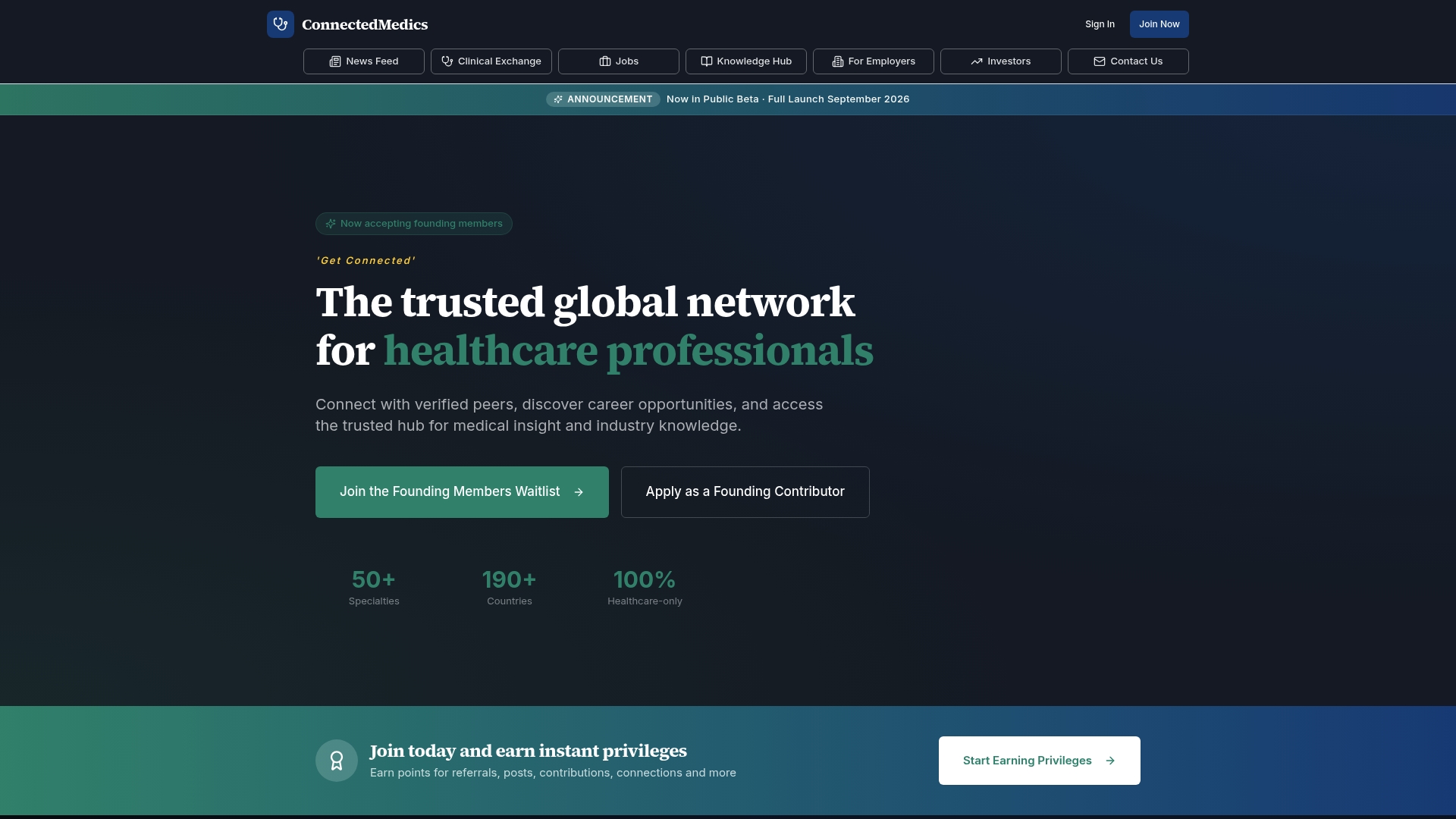
Connectedmedics gives U.S. clinical research professionals a single platform with verified clinician profiles, a jobs board carrying 4,600+ active healthcare vacancies, and specialty filters that cut search time significantly. Hospital recruiters get employer tools for posting roles and managing verified applicants. Clinicians get access to peer forums, a curated knowledge hub, and AI-powered career matching built for healthcare, not adapted from a generic network.
What you get:
- Verified profiles with institutional confirmation
- 4,600+ active vacancies filtered by specialty and therapeutic area
- Employer recruitment tools and applicant management
- Expert-contributed knowledge hub and clinical discussion forums
Start with a free profile at connectedmedics.com, or explore clinical guides and research summaries in the Knowledge Hub.
Useful sources and further reading
- Connectedmedics — The trusted global network for healthcare professionals: Primary platform page for clinician signups, employer subscriptions, and jobs board access.
- Connectedmedics Knowledge Hub: Curated clinical guides, research summaries, and expert-authored content for practicing clinicians.
- Why Medical Conference Networking Matters for Your Career: Practical guidance on professional networking strategies for clinicians, including profile optimization.
- Advarra Study Collaboration Solutions: Covers site-centric integration with CTMS and eTMF systems and sponsor-site collaboration workflows.
- WCG ClinSphere: Explains unified data layer architecture and AI-backed insights for removing silos across sites, sponsors, and CROs.
- Clincove: Industry commentary and platform detail on protocol-first setup, 21 CFR Part 11 compliance, and unified clinical trial operations.
- LINEA System: Details on automated feasibility outreach and protocol-aware scoring for accelerating site activation.
- Citeline Investigator SmartSelect: Context on HIPAA and 21 CFR Part 11 compliance requirements for clinical document exchange and vendor evaluation.
- ClinicalTrialsNetwork.org: Overview of AI-powered site-study matching and site onboarding verification for U.S. clinical research networks.