
Doctor networking platforms fall into four categories: peer-case consult communities, referral networks, recruitment boards, and research collaboration networks. Verified, specialty-matched networks with peer consult and referral tools deliver the most clinical value per hour spent. ConnectedMedics is one option built around this model, combining verified profiles with case discussion and a global jobs board.
TL;DR:
- Verified, specialty-specific platforms with EHR integration and HIPAA compliance provide the highest clinical value and retention for physicians.
- Rapid response to case posts relies on clear, specific questions and active moderation, especially in specialty-led groups with trusted content.
- Most physicians use two or three platform types simultaneously, prioritizing clinical relevance and workflow fit over sheer community size.
- Cost structures vary: free platforms often monetize employer subscriptions, while tiered models offer premium features like advanced referral tools and visibility.
- Mobile app parity and integration with medical associations enhance usability, trust, and adherence to professional standards.
Table of Contents
- Types of Doctor Networking Platforms and When to Use Each
- What Features and Security Checks Actually Matter?
- How Do Doctors Get the Most Value From These Platforms?
- How to Choose the Right Platform: Questions and Red Flags
- ConnectedMedics Spotlight: Solving the Fragmentation Problem
- What Do Doctor Networking Platforms Actually Cost?
- How Do User Base Size and Engagement Compare?
- Do These Platforms Work Well on Mobile?
- Do These Platforms Connect With Medical Associations?
- Getting Started With ConnectedMedics
- A Closing Take on Peer Networking and Clinical Impact
- Sources
Types of Doctor Networking Platforms and When to Use Each
Not every physician networking site solves the same problem. Matching the platform type to your actual goal saves time and avoids account fatigue.
Peer-case consult communities let verified clinicians post de-identified cases and crowdsource diagnostic input. Figure 1 documents real cases where shared discussion led to faster, more accurate management decisions. These communities work best for on-call questions, rare presentations, and second opinions outside your specialty.
Referral and referral-coordination networks connect practices for patient handoffs, tracking acceptance rates and appointment timing. LeadingReach links more than 125,000 providers and 60,000 care settings, and its referral tracking cuts down the phone-and-fax cycle that eats up staff time.
Recruitment and job boards serve a different purpose entirely: connecting physicians with healthcare-specific openings, often filtered by specialty, location, and practice setting.
Research and collaboration networks support multi-site studies, case series, and academic co-authorship. They matter most for physicians in academic medicine or subspecialties with thin case volume.
Common use cases break down cleanly:
- On-call diagnostic questions: peer-case consult communities
- Building a referral pipeline: referral-coordination networks
- Active job search or recruiting: recruitment platforms
- Multi-site studies or publication collaboration: research networks
- General professional connection and continuing education: medical forums and knowledge hubs
Most doctors end up using two or three of these types simultaneously, not one platform for everything.
What Features and Security Checks Actually Matter?
A platform's feature list means little without verification behind it. Here's what to check before you commit time to a profile.
Verification should require a medical license number, NPI, or institutional email, cross-checked against a licensing database. Platforms open to anyone with an email address dilute the clinical signal fast.
Security is non-negotiable for anything touching patient data, even de-identified. Look for HIPAA-aligned practices, encryption at rest and in transit, audit logging, and a stated data retention policy. LeadingReach cites HITRUST certification as part of its trust profile, and customers report reaching measurable ROI in roughly 90 days.
Workflow fit determines whether you actually keep using the platform. Deep knowledge from industry adopters consistently points to one failure mode: platforms without EHR integration get abandoned. FHIR-compliant systems that let you send structured referral packets in a couple of clicks, rather than re-entering data, retain physicians at far higher rates.
Before adopting any platform, verify:
- Licensing verification method (license lookup, NPI check, institutional email)
- Encryption standard and stated compliance framework
- EHR/FHIR integration or single sign-on support
- Mobile app parity with the desktop experience
- Moderation policy for specialty groups and case posts
- Whether job filters and employer tools are separate from clinical features
Pro Tip: Ask a vendor to show you their verification workflow live, not describe it. If they can't demonstrate it in under two minutes, the process is probably manual and slow.
How Do Doctors Get the Most Value From These Platforms?
Getting real value from networking for doctors comes down to a handful of habits, not the platform's feature count.
- Build a profile that states specialty, current role, and one or two areas of clinical focus, not a résumé dump.
- Verify your license and institutional affiliation immediately. An unverified profile gets ignored in case consult threads.
- When posting a curbside consult, include a de-identified summary, three key clinical data points (a relevant lab or vital sign), your current differential, and one specific question.
- Mute non-specialty groups and set alerts only for your subspecialty and direct mentions.
- For referrals, send complete packets (history, imaging, labs) the first time and set a calendar reminder to follow up on acceptance status.
- Keep job board activity private from your current employer using platform privacy settings, if your search is not public yet.
Pro Tip: A curbside consult post with a specific, answerable question gets replies in hours. A vague "thoughts on this case?" post often gets none.
How to Choose the Right Platform: Questions and Red Flags
Rank your criteria in this order: clinical value and workflow fit first, then security, then raw community size. A network with 500,000 members and no specialty filtering wastes more time than a focused group of 5,000 in your field.
Ask any vendor these questions directly:
- What EHR systems do you integrate with, and is it FHIR-based?
- How exactly do you verify a physician's license and identity?
- Who moderates specialty groups, and what is the escalation process for inappropriate posts?
- What is your data retention policy for shared case content?
- Can you provide a written compliance attestation, not just a marketing claim?
Watch for these red flags:
- No license verification step at signup
- Vague or absent security documentation
- Content that is pay-to-post or employer-sponsored only, with no genuine peer discussion
- No mobile app, or a mobile app with stripped-down functionality
Pro Tip: If a vendor can't answer the EHR integration question specifically, in real terms, on a first call, assume the integration is limited or nonexistent.
One line worth keeping in your notes for vendor calls: verified, workflow-integrated, specialty-relevant. If a platform fails on any of those three, keep looking.
ConnectedMedics Spotlight: Solving the Fragmentation Problem
Generic professional networks like LinkedIn were not built for clinical discussion, and physicians have felt that gap for years. TechCrunch's coverage of DailyRounds traced how clinician-specific platforms emerged precisely to fill that hole, giving doctors a space built around case sharing rather than generic career updates.
Some platforms approach the same problem with three core pieces: verified professional profiles, a global healthcare jobs board with active vacancies, and a knowledge hub summarizing clinical research and trends.
That combination maps directly onto the evaluation checklist above:
- Verification anchors every profile to a real, checkable healthcare credential
- Specialty-led communities keep case discussion relevant instead of generic
- The jobs board is filtered specifically for healthcare roles, not scraped from general listings
- The Knowledge Hub delivers curated clinical content, similar in spirit to how clinicians already rely on resources like Medscape for news and continuing education
The gap in generic networking isn't a lack of connections. It's a lack of relevance. A cardiologist scrolling through marketing job posts and unrelated career updates gains nothing that a specialty-filtered feed couldn't deliver in a fraction of the time.
David, editorial lead, has followed clinical networking trends and platform design closely, drawing on healthcare technology reporting and firsthand review of major networking sites for this analysis.
What Do Doctor Networking Platforms Actually Cost?
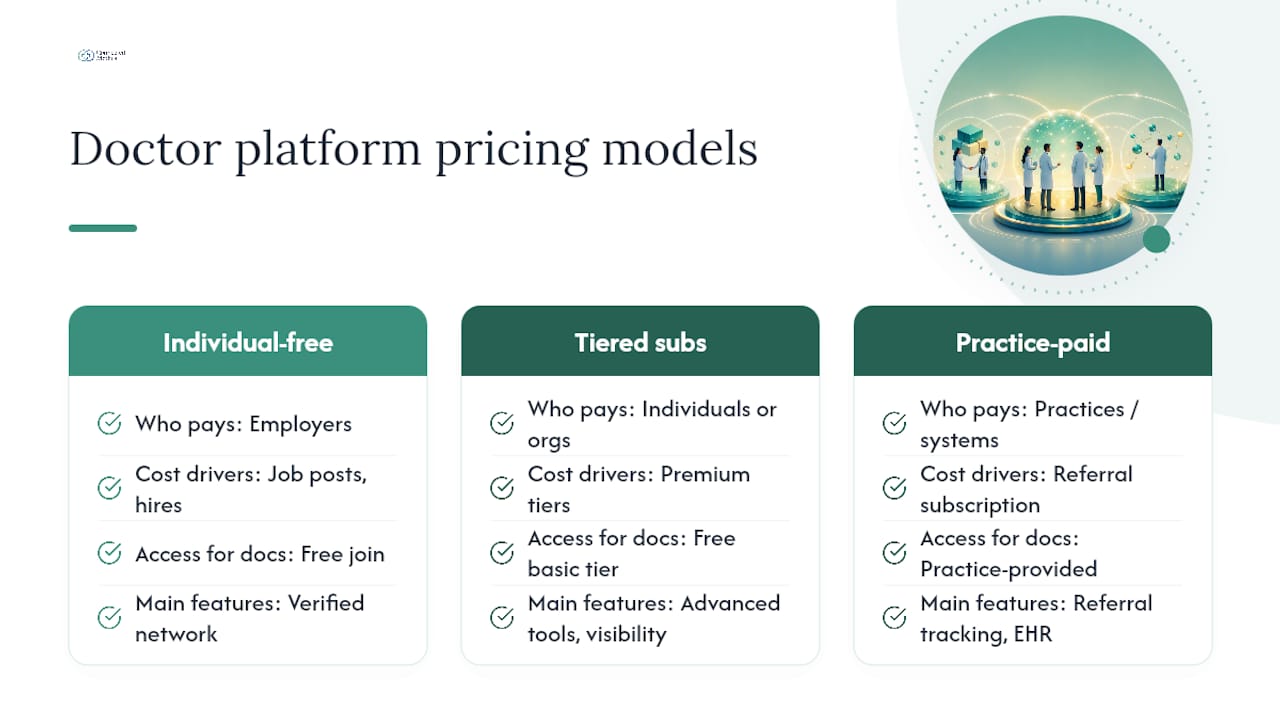
Pricing across doctor networking platforms tends to split into two structures, and knowing which one you're looking at matters before you sign up.
Some platforms are free to join for individual clinicians, monetizing instead through employer subscriptions for job postings, per-hire placement fees, and sponsored clinical content. This model keeps the barrier to entry low for practicing physicians while shifting cost onto hospital recruiters and healthcare employers who want access to a verified talent pool.
Other platforms run tiered subscription models, offering a free basic tier with limited features (basic profile, limited group access) alongside a paid premium tier unlocking advanced networking tools, priority visibility in specialty groups, or expanded job board access.
Referral-focused networks often price differently still, charging practices or health systems a subscription for referral tracking and EHR integration rather than charging individual doctors directly. ReferOS and similar referral tools follow this practice-level pricing approach rather than an individual physician subscription.
Before comparing costs, identify who actually pays on a given platform. If you're an individual physician evaluating a free-to-join network, check whether "free" means genuinely free or a stripped-down tier designed to push you toward premium. If you're a recruiter or practice administrator, the real cost conversation is about per-hire fees and job posting volume, not individual membership.
How Do User Base Size and Engagement Compare?
Raw membership numbers make for easy marketing claims, but they tell you little about whether a platform will actually answer your clinical question at 2 a.m.
Referral networks tend to report the largest connected numbers because they count institutional relationships, not just individual sign-ups. LeadingReach, for instance, cites more than 125,000 connected providers and 60,000 care settings, a figure that reflects network reach for referral coordination rather than daily active clinical discussion.
Peer-case consult communities measure engagement differently, tracking how quickly a posted case gets a specialist response rather than total registered accounts. A network with fewer total members but faster, higher-quality response times in your specialty beats a sprawling general network every time you actually need an answer.
When comparing platforms, ask about active engagement in your specific specialty group, not the platform-wide member count. A general figure of "500,000 healthcare professionals" is close to meaningless if only a few hundred are your subspecialty and actively posting. Specialty-led community structures, where groups are curated rather than open to anyone with an account, tend to produce sharper engagement even with lower total membership.
Do These Platforms Work Well on Mobile?
A networking platform that only works well on desktop fails the doctors who need it most. On-call consults happen from a hallway, a car, or a break room, not from behind a workstation.
Check for full feature parity between the mobile app and desktop site, not a stripped-down mobile version that drops case posting or referral tracking. Image sharing for case consults, in particular, needs to work smoothly on mobile since that's often where the photo or scan originates.
Notification controls matter as much as core functionality. A physician juggling multiple specialty groups needs the ability to mute non-relevant threads while keeping alerts active for direct mentions and their own posts, otherwise the app becomes noise instead of a tool. Single sign-on support also reduces friction, since a separate login and password for yet another app is exactly the kind of workflow break that industry adopters flag as a top reason clinicians abandon a platform after initial signup.
Before trusting a platform with time-sensitive consults, test the mobile app yourself. Post a sample case, upload an image, and time how the notification and reply flow actually feels on your phone.
Do These Platforms Connect With Medical Associations?
Integration with recognized medical associations and certification bodies adds a layer of credibility that a standalone login can't replicate on its own.
Some networking platforms build in continuing education tracking that aligns with board certification requirements, letting physicians log relevant activity toward maintenance of certification. Others partner directly with specialty societies to co-host case discussions or verify credentials against association membership databases rather than relying solely on license lookups.
This kind of integration also shows up in how curated content gets sourced. Knowledge hubs that summarize research and clinical trends often pull from the same continuing-education ecosystem that clinicians already trust for medical news and guidelines, rather than generating generic content in isolation. For physicians choosing a platform, checking whether it has any formal tie to your specialty's professional association is worth a direct question during vendor evaluation, since it often signals a more rigorous verification and moderation standard behind the scenes. It's also worth reviewing recent shifts in how healthcare professionals network, since association partnerships have become more common as platforms mature.
Getting Started With ConnectedMedics
Joining gets you a verified profile, access to specialty-led case discussion, and visibility into a jobs board with thousands of active healthcare vacancies without wading through unrelated postings.
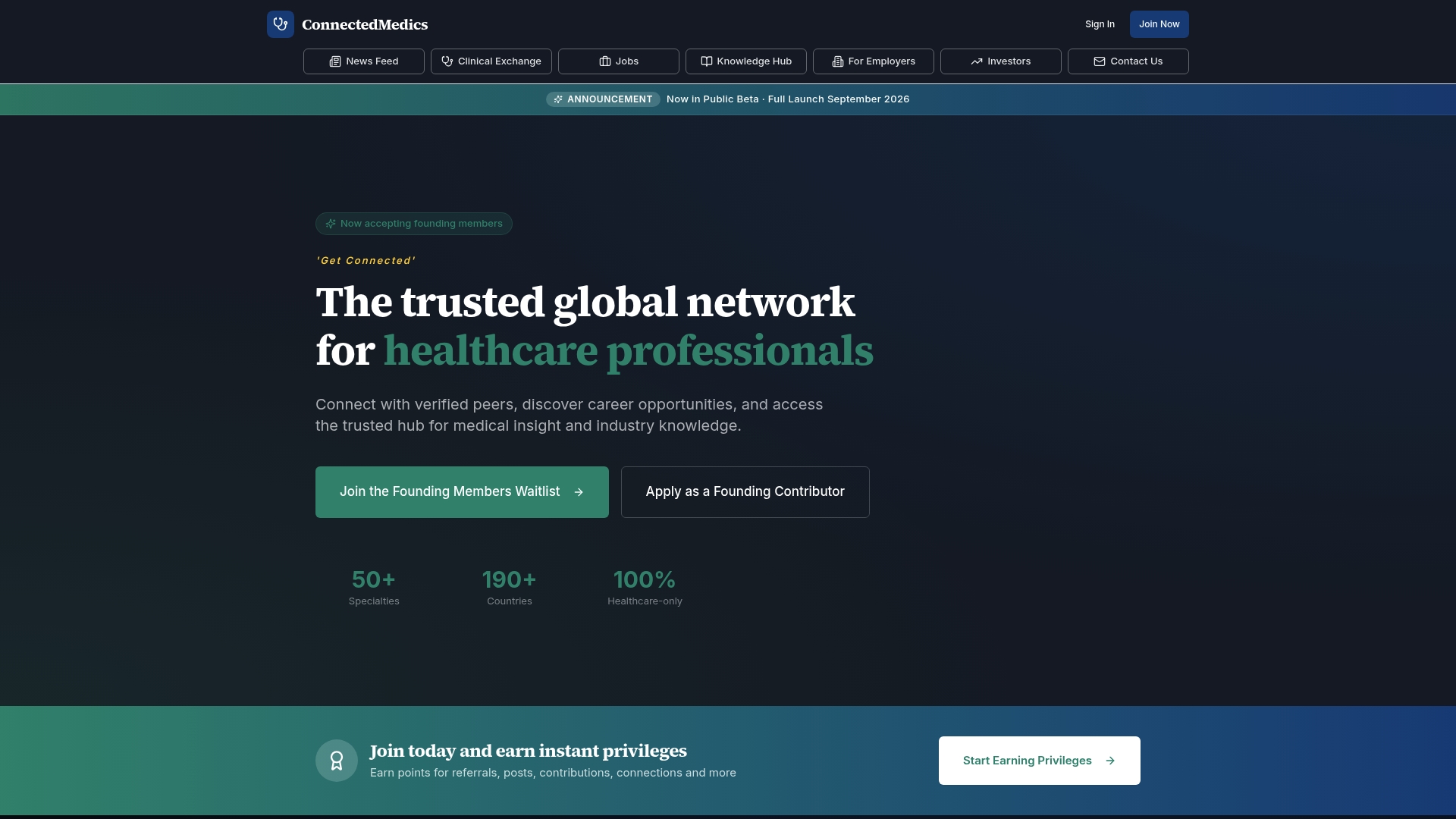
Signing up starts with basic professional details: license information, specialty, and current role. Verification checks that against your credentials, so keep your license number and institutional email on hand to speed the process. Once verified, your profile appears in specialty groups relevant to your field, and you gain access to case discussion threads and job filters built specifically for healthcare roles.
Compared to sifting through a generic professional network or piecing together separate tools for referrals, job hunting, and clinical reading, ConnectedMedics puts verified peers, curated jobs, and clinical content in one place. Visit the ConnectedMedics landing page to start your profile, and check the Knowledge Hub for research summaries relevant to your specialty before your first case post. For a broader look at where doctors are already gathering online, the doctor networking overview is a useful next read.
A Closing Take on Peer Networking and Clinical Impact
Case consults and referral networks earn their place in a physician's toolkit because they shorten the distance between a hard question and a good answer. That's the real draw, not the size of the member count.
The responsibility side gets less attention than it deserves. Every case post is a patient's data, even stripped of identifiers, and moderation quality varies wildly between platforms. Choose networks that take that seriously.
One habit worth adopting: write your consult question before you write the case summary. It forces clarity, and clarity is what gets you a fast, useful answer.
— David
Sources
- Figure 1 — Medical collaboration on real patient cases
- LeadingReach — Healthcare's connected referral network
- TechCrunch — DailyRounds coverage
- Medscape — Latest medical news, clinical trials, guidelines