
Join a verified, specialty-focused physician forum that requires credential validation. That single criterion separates platforms worth your time from ones that waste it. Online physician forums function as virtual professional communities where clinicians exchange clinical insights, practice patterns, and career intelligence across disciplines and locations. The best ones combine physician-only access, searchable archives, and active moderation.
Recommended starting point:
- Confirm the forum requires credential or license verification before posting
- Set up a complete profile with specialty tags and institutional affiliation
- Run one search on a recent clinical question before posting to gauge archive quality
Key Takeaways
Verified, specialty-focused physician forums deliver better clinical signal, faster peer input, and career intelligence than open or unverified alternatives.
| Point | Details |
|---|---|
| Verification is the baseline | Only join forums that require credential or license checks before granting post access. |
| Match forum type to purpose | Use closed networks for clinical Q&A, society forums for policy, and open communities for broad peer pulse. |
| De-identify before posting | Remove exact ages, rare-condition combinations, and geographic details from every case description. |
| Treat replies as hypotheses | Verify forum answers against primary literature or current guidelines before applying them clinically. |
| Connectedmedics covers the checklist | Verified profiles, specialty communities, a curated knowledge hub, and over 4,600 active jobs in one platform. |
Table of Contents
- What are medical forums for doctors, exactly?
- What types of physician forums should you consider?
- What do physicians actually gain from participating?
- How do you evaluate and choose the right forum?
- How do you join a forum and get useful answers quickly?
- What are the professional rules for posting cases and opinions?
- How does Connectedmedics meet the evaluation checklist?
- Why verified, specialty-led forums are worth the extra step
- Connectedmedics: a verified network built for practicing physicians
- Sources
What are medical forums for doctors, exactly?
Physician forums, also called medical discussion boards or physician discussion platforms, are structured online spaces built specifically for licensed clinicians. They differ from general social media in one key way: access and content are organized around professional identity, not personal interest.
Typical features include:
- Credential or license verification before read or post access is granted
- Specialty subforums segmented by discipline (oncology, cardiology, primary care, etc.)
- Searchable archives with thread metrics such as view counts, reply counts, and last-post timestamps
- Polls and expert panels for rapid peer input on clinical questions
- Watchlists and saved searches for tracking ongoing discussions
- CME or discussion-credit tracks tied to case-based participation
- Job boards with specialty-filtered postings
The distinction from society governance pages matters. A forum on the AMA's website may be organized around policy resolutions and committee timelines rather than clinical Q&A. Knowing which type you are looking at prevents mismatched expectations.
What types of physician forums should you consider?
Three categories cover most of what practicing physicians will encounter. Each serves a different professional need.
Closed, credentialed networks
These require license or credential verification before granting access. Content quality tends to be higher because every contributor has been vetted. Searchable archives make past threads reusable as a clinical reference. This category suits day-to-day clinical decision support, gray-area dosing questions, and peer practice-pattern benchmarking.

Society- and association-run forums
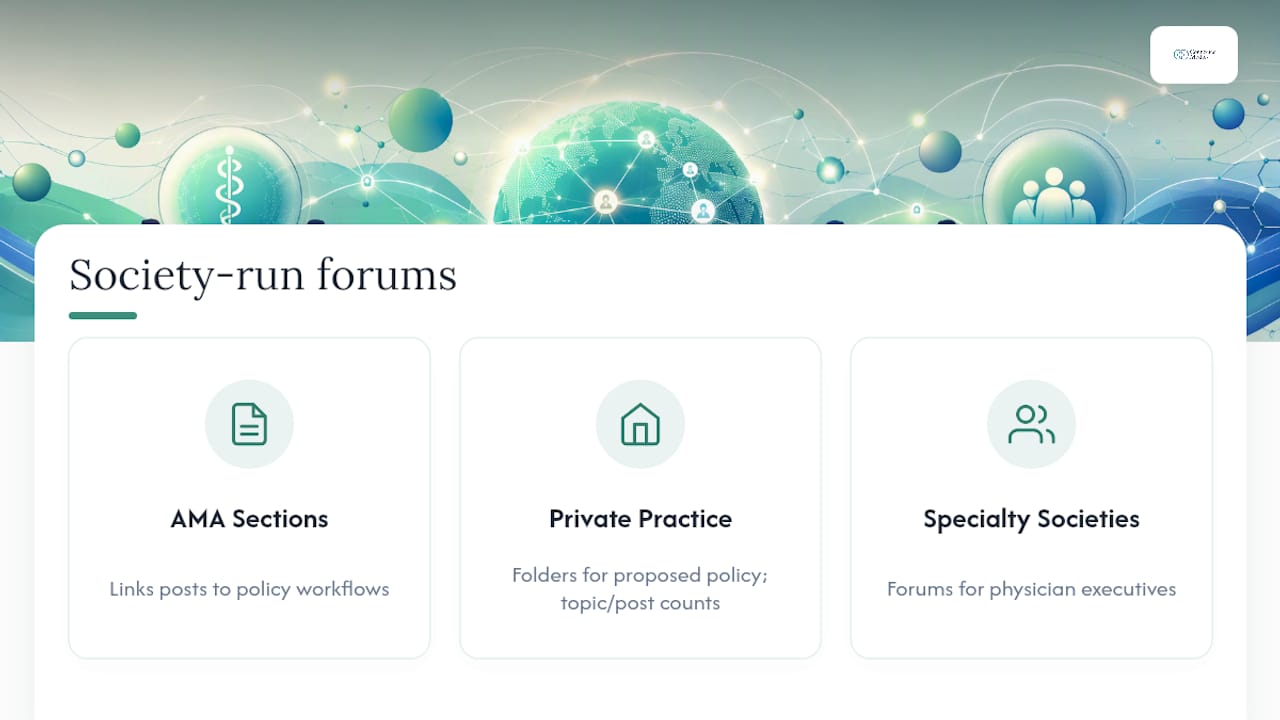
The AMA's section forums link posts directly to policy resolution workflows, submission deadlines, and House of Delegates business cycles. The Private Practice Physicians Section forum lists folders for proposed policy and resolutions with topic and post counts. Specialty societies and organizations like ACHE host similar spaces for physician executives and niche sub-audiences. These forums are built for governance and advocacy, not clinical Q&A. Expect policy language, resolution timelines, and committee-level discussion.
Open or public communities
/r/medicine is a large, active subreddit where medical professionals discuss clinical advances and practice questions. Activity is high; formal credential verification is not. Student Doctor Network covers pre-med through practicing clinician categories in a nonprofit, moderated structure. Both are useful for broad discussion and community pulse-checking, but neither should be the primary source for clinical decision support.
Pro Tip: Use more than one forum type. A closed credentialed network handles clinical Q&A. A society forum tracks policy relevant to your practice. An open community gives you a broader read on what peers across the country are thinking.
What do physicians actually gain from participating?
Active participation in physician discussion forums pays off in four concrete ways.
- Clinical decision support. Searchable past threads surface how peers have managed similar presentations, dosing sequences, or off-label scenarios. This is faster than a literature search for gray-area questions where guidelines are silent.
- Crowd-sourced practice patterns. Polls and expert-panel replies give a rapid read on what experienced clinicians actually do, not just what guidelines recommend.
- Career and hiring intelligence. Forums with integrated job boards and specialty networking connect physicians to roles and referrals that never appear on general job sites. Discussions on global healthcare communities show how peer networks accelerate placement.
- CME and structured learning. Discussion CME tracks tied to case-based forum participation let physicians earn credit while engaging with real clinical problems, not manufactured modules.
How do you evaluate and choose the right forum?
Use this checklist before committing time to any platform.
Verification and governance:
- Does the forum require license or credential verification?
- Is there a clear moderation policy and an escalation path for violations?
- Is the forum affiliated with a recognized medical organization or run by a credentialed editorial team?
Content quality signals:
- Are threads searchable, with view counts, reply counts, and timestamps?
- Do expert or specialist replies get labeled or rated?
- Are polls and watchlists available for tracking ongoing discussions?
Privacy and compliance:
- Does the platform publish a HIPAA policy or data-retention statement?
- Is there a clear content-removal workflow for posts that include identifiable patient information?
Practical fit:
- Does the forum have active specialty subforums matching your discipline?
- Is there a job board with specialty-filtered postings?
- What is the cost structure: free access, tiered membership, or employer-sponsored?
Red flags to watch for:
- No credential check or open self-registration
- Heavy promotional content from sponsors mixed into clinical threads
- No stated moderation policy or community guidelines
- Unclear data ownership or vague privacy terms
Pro Tip: Before joining, run a search on a clinical question you already know the answer to. If the archive returns useful, well-moderated threads with expert replies, the platform earns its time investment. If results are thin or dominated by promotional posts, move on.
How do you join a forum and get useful answers quickly?
A structured onboarding approach gets you to value within days.
- Submit credentials. Gather your NPI number, state license, and institutional affiliation before starting registration. Most verified forums require at least one of these.
- Complete your profile. Add your specialty, subspecialty tags, current institution, and a two-sentence bio. Profiles with complete specialty tags receive more targeted replies.
- Set specialty and topic tags. Tag the subforums relevant to your practice. This filters your feed and surfaces the threads most likely to be useful.
- Run archive searches before posting. Your question has likely been asked. Search first; post only if the existing threads are outdated or incomplete.
- Post your first clinical question using a privacy-safe template. See the format below.
First-post template for clinical questions:
- Patient descriptor: age range (not exact age), sex, relevant comorbidities only
- Clinical question: specific and bounded ("What sequencing do peers use for X in patients with Y?")
- What you have already tried or reviewed
- What type of input you are seeking (peer practice patterns, literature pointers, dosing experience)
Staying efficient after joining:
- Use watchlists to track threads relevant to recurring clinical scenarios
- Save searches for your most common clinical topics
- Set notification preferences so active threads surface without manual checking
What are the professional rules for posting cases and opinions?
HIPAA risk is real on any forum, including physician-only ones. A single post containing enough detail to identify a patient can constitute a disclosure, regardless of the platform's privacy policy.
Do:
- De-identify all cases before posting: use age ranges (not exact ages), remove rare-condition combinations that could identify a patient, omit geographic details, and change non-clinically-relevant demographics
- Declare conflicts of interest when discussing treatments, devices, or drugs you have a financial relationship with
- Maintain a professional tone, even in disagreement
- Treat forum replies as hypotheses to verify against primary literature or current guidelines
Don't:
- Post identifiable patient details, even in a "closed" physician-only forum
- Diagnose or recommend treatment for a specific named or identifiable patient
- Share screenshots or images that contain metadata or identifying information
Moderation and escalation:
Strong forums have a clear reporting mechanism for posts that violate community guidelines. When you see a violation, use the report function rather than engaging in the thread. Expect a response timeline from the moderation team; if none is posted publicly, ask before joining.
Pro Tip: De-identification is not just about removing a name. A 34-year-old woman with a rare autoimmune condition in a small rural county can be identifiable even without a name. When in doubt, generalize further or describe the clinical pattern without any patient-level detail.
How does Connectedmedics meet the evaluation checklist?
Connectedmedics is built specifically for healthcare professionals and maps directly to the criteria above.
Feature checklist:
- Verified profiles. Every clinician on the platform goes through a credential check, so peer interactions carry professional accountability.
- Specialty communities. Subforums and groups are organized by specialty, giving physicians a focused space rather than a general feed.
- Knowledge hub. Curated clinical summaries and research digests, contributed by verified medical experts, function as a searchable reference layer on top of peer discussion.
- Global jobs board. Thousands of active healthcare vacancies with specialty-specific filters. Relevant for physicians tracking career options alongside clinical engagement.
- Moderated discussions. Community guidelines and moderation keep content quality high and promotional noise low.
- AI-powered career matching. Workforce assessments and role recommendations based on specialty and experience profile.
Getting started on Connectedmedics:
- Go to Connectedmedics and create a profile
- Submit your credentials for verification (license number, specialty, institutional affiliation)
- Select specialty tags to join relevant communities and filter your knowledge hub feed
- Browse the jobs board using specialty and location filters
- Engage in peer discussions or post clinical questions within your specialty community
Membership tiers and pricing details are listed on the Connectedmedics platform page.
Why verified, specialty-led forums are worth the extra step
The verification step that most physicians skip on general networks is exactly what makes a forum clinically useful. An unverified thread from an anonymous contributor carries no professional accountability. A reply from a board-certified specialist with a confirmed institutional affiliation is a different kind of input.
The practical workflow that works: triage a forum thread using ratings and watchlists, note the consensus or the outlier replies, then verify against primary literature or current guidelines before acting. Forums are not a replacement for evidence; they are a faster path to knowing which evidence to look for. CME tracks built into verified platforms add a second layer of value by converting that engagement into documented learning.
Physicians who treat forum participation as a passive activity get little from it. Those who post specific, well-framed questions, use watchlists to track evolving threads, and cross-reference replies with guidelines consistently report faster clinical triage and better awareness of peer practice variation.
*— David
Connectedmedics: a verified network built for practicing physicians
Connectedmedics gives practicing physicians a single platform covering peer discussion, curated clinical knowledge, and specialty-filtered job search. Verified profiles mean every connection and reply comes from a credentialed clinician. The knowledge hub delivers research summaries without requiring a separate literature search workflow. Over 4,600 active vacancies make it a practical resource for physicians tracking career options alongside daily clinical work.
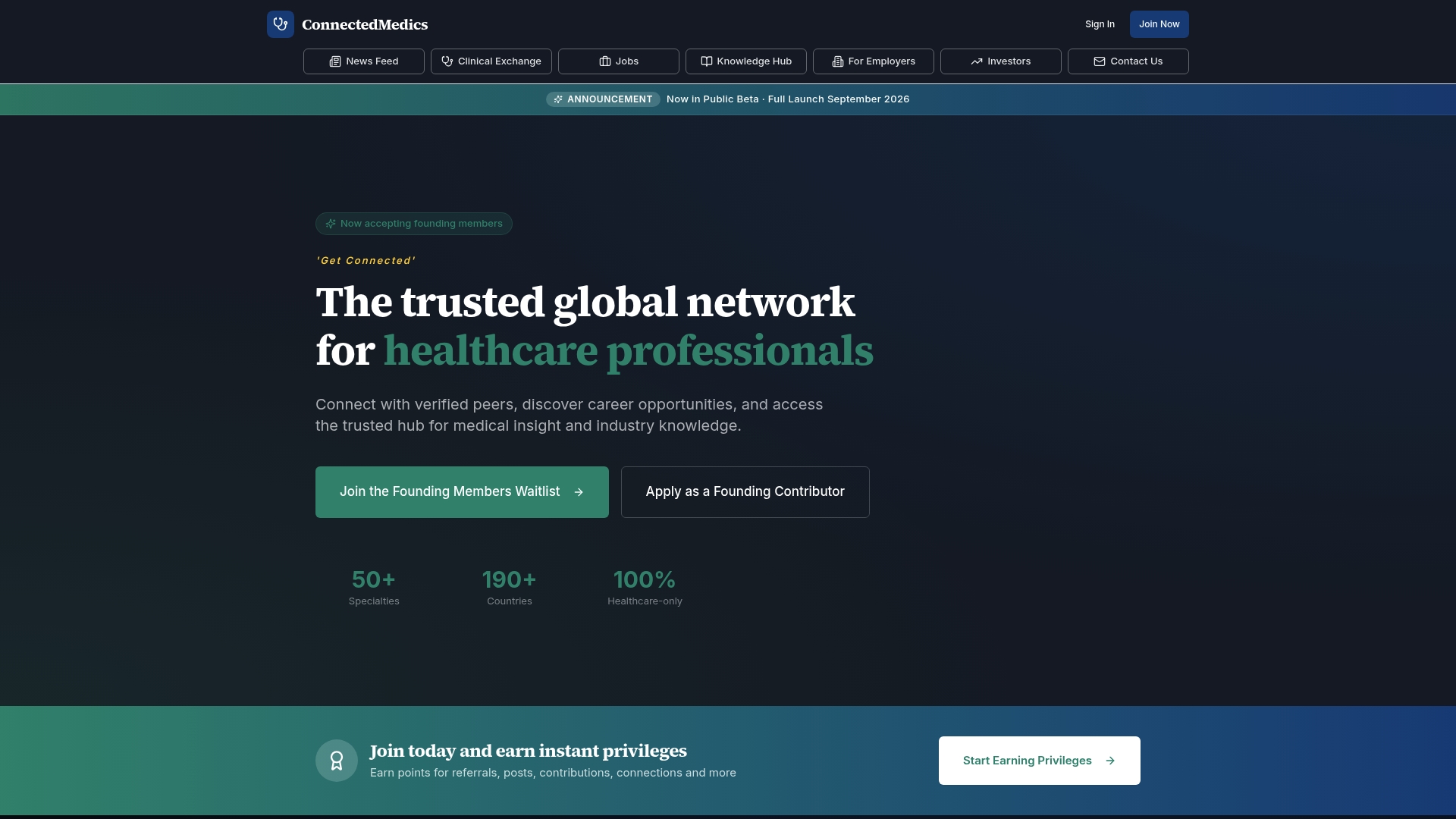
Free access covers core networking and knowledge hub browsing. Premium membership unlocks advanced career matching, full jobs board filters, and priority visibility in specialty communities. Create a verified profile at Connectedmedics to get started.
Sources
- American Medical Association | American Medical Association
- Online Physician Forums: A Virtual Professional Community
- Student Doctor Network Forums
- /r/medicine: a subreddit for medical professionals