Online best practice sharing in nursing is defined as the structured, moderated exchange of clinical knowledge through digital platforms to improve patient outcomes and professional development. Knowing how nurses share best practice online matters because fragmented information access remains one of the biggest barriers to consistent, safe care. Today, nurses use social media, virtual journal clubs, knowledge management systems, and moderated peer forums to collaborate across specialties and borders. Each method works best when it follows professional guidelines, uses skilled facilitation, and connects directly to clinical workflows.
How nurses share best practice online: primary formats
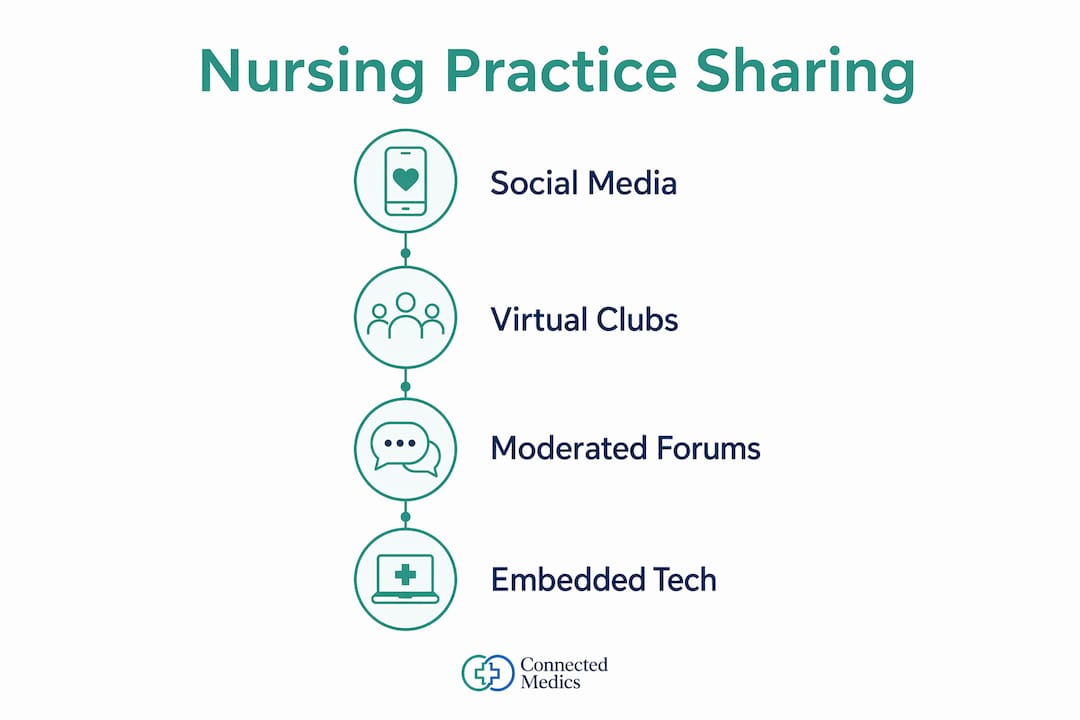
The most widely used formats for online sharing of nursing practices fall into four categories: social media communities, virtual journal and podcast clubs, moderated peer support forums, and knowledge management systems embedded in clinical tools.
Social media is the most accessible entry point. Nurses use platforms like Facebook Groups, LinkedIn, and X (formerly Twitter) to share clinical updates, ask questions, and post links to new research. The Nursing and Midwifery Council (NMC) publishes social media guidance that helps nurses balance engagement without overextending their time or crossing professional boundaries. The guidance is practical: post with purpose, protect patient confidentiality, and represent your profession accurately.

Virtual journal and podcast clubs are a more structured format. The Oncology Nursing Society (ONS) runs an asynchronous journal club with rotating moderators and monthly participant input on topic selection. That model keeps content relevant and reduces burnout for any single facilitator. Nurses can engage on their own schedule, which makes participation realistic across shift patterns.
Moderated peer support communities give nurses a space to discuss difficult cases, share protocols, and seek advice from colleagues outside their own unit. These forums work best when they have clear rules, active moderation, and a sense of psychological safety.
Knowledge management systems (KMS) represent the most clinically integrated format. A KMS embeds evidence-based resources directly into the tools nurses already use, such as electronic care plans and patient charts.
- Social media: broad reach, low barrier to entry, requires professional conduct
- Virtual journal clubs: structured, asynchronous, rotating moderation reduces burden
- Peer support forums: community-driven, requires skilled facilitation for safety
- Knowledge management systems: embedded in clinical workflows, highest point-of-care impact
Pro Tip: When joining a new online nursing community, spend two weeks reading before posting. You will understand the tone, the rules, and the gaps in discussion before you contribute.
Why moderation makes or breaks online nursing communities
Moderation is the single most important factor in whether an online nursing community produces real clinical value or collapses into noise. Safe online peer support requires clear escalation pathways, transparent policies, and rules that members help create. Co-produced moderation policies carry more legitimacy because nurses trust rules they helped write.
Effective moderation in nursing forums follows a consistent pattern:
- Set visible community rules before the first post goes live. Members need to know what is acceptable from day one.
- Co-design policies with members. JMIR Nursing research confirms that co-produced moderation rules increase trust and reduce rule violations.
- Establish escalation pathways. Every community needs a clear process for handling distressing content, misinformation, or conduct violations.
- Update policies routinely. Communities grow and change. Policies that worked at 50 members may fail at 500.
- Recognize and reward good contributions. Moderators who acknowledge quality posts encourage others to contribute at the same level.
"Moderators blending clinical authenticity with adaptive facilitation transform virtual nursing communities into dynamic, practice-relevant learning environments." — JMIR Nursing, 2026
JMIR Nursing research identifies five engagement themes driven by moderator collaboration and clinical framing. That finding matters because it shows moderation is not just about removing bad content. It is about actively shaping the quality of conversation. A moderator who frames discussions around real clinical scenarios gets more useful responses than one who simply enforces rules.
Pro Tip: If you are moderating a nursing forum, open each week with a short clinical scenario or question. It gives members a concrete starting point and drives higher-quality responses than open-ended prompts.
Peer networking in nursing communities works best when moderation adapts to the community's growth. Read more about what peer networking in nursing actually looks like in practice.
What technology integrations improve point-of-care knowledge use?
Nurses sharing knowledge online only creates value if that knowledge reaches the bedside. The biggest barrier is retrieval friction: nurses under time pressure will not search a separate database when they need an answer in 90 seconds. Embedding evidence-based resources directly into electronic nursing care plans and patient charts solves that problem by putting the answer where the question arises.
A JMIR Nursing qualitative study found that nurses want KMS formats that match their workflow. Checklists, short videos, and brief summaries outperform long-form PDFs in clinical settings. The study also found that embedded evidence reduces reliance on colleagues for routine clinical decisions, which frees up senior nurses for complex cases.
Canada's GC Forms program offers a concrete example of technology done right. GC Forms provides secure, conditional logic design for sensitive health data transmission in Indigenous communities. Nurses use it to capture and share clinical data consistently across remote locations without compromising patient privacy.
| Integration Type | Format | Primary Benefit |
|---|---|---|
| KMS in electronic care plans | Checklists, short videos | Reduces search time at point of care |
| Embedded clinical summaries | Brief text, decision trees | Supports consistent care decisions |
| Secure digital forms (e.g., GC Forms) | Conditional logic forms | Standardizes data capture across sites |
| Moderated online forums | Discussion threads | Enables peer knowledge exchange |
The table above shows that no single format covers every need. The most effective digital platforms for nurses combine at least two of these integration types. A forum without embedded evidence stays theoretical. A KMS without peer discussion misses the contextual knowledge that only experienced nurses carry.
What ethical guidelines govern nurses sharing online?
Professional conduct online is not optional for nurses. The NMC Code applies to digital spaces the same way it applies to clinical ones. Nurses who post under their professional title carry the weight of that title in every comment, share, and reply.
Key conduct principles for nurses sharing best practices online include:
- Protect patient confidentiality at all times. No case details, images, or identifiable information should appear in any public or semi-public forum.
- Separate education from commercial promotion. A June 2026 notice from Zambia's national nursing council restricts commercial use of uniforms and titles on social media. That principle applies broadly: your professional identity is not a marketing asset.
- Distinguish personal opinion from clinical guidance. Label personal views clearly so readers do not mistake them for evidence-based recommendations.
- Follow your regulator's social media code. The NMC, the American Nurses Association (ANA), and equivalent bodies in other countries all publish specific guidance for digital conduct.
- Maintain accuracy. Sharing outdated or unverified clinical information online can cause direct patient harm. Verify sources before posting.
The American Nurse Journal defines professionalism in the digital age as maintaining the same standards online that you would in a clinical setting. That framing is useful because it removes ambiguity. If you would not say it in a ward handover, do not post it in a nursing forum. Understanding what a healthcare professional network requires in terms of conduct helps nurses set the right expectations before they engage.
Key takeaways
Nurses who combine structured formats, skilled moderation, and embedded technology get the most clinical value from online best practice sharing.
| Point | Details |
|---|---|
| Use structured formats | Virtual journal clubs and moderated forums produce more clinical value than unstructured social media posts. |
| Prioritize moderation | Co-produced policies and active facilitation are the foundation of safe, effective online nursing communities. |
| Embed knowledge at the point of care | KMS tools integrated into electronic care plans reduce retrieval friction and support consistent decisions. |
| Follow professional conduct codes | NMC, ANA, and national nursing regulators all publish specific digital conduct guidance nurses must follow. |
| Combine formats for full impact | No single platform covers every need; the best approach layers social media, forums, and embedded tools. |
What i have learned about sharing best practice online as a nurse
The most common mistake I see nurses make online is treating knowledge sharing as a broadcast activity. They post an article, share a guideline, and consider the job done. Real knowledge transfer does not work that way. It requires conversation, challenge, and context.
The research on moderator behavior confirms what I have observed directly. Moderators who frame discussions around specific clinical scenarios get substantively better responses than those who post open-ended questions. The clinical framing signals to other nurses that the conversation is grounded in real practice, not theory.
The second thing I have learned is that technology integration is not a nice-to-have. Nurses will not change their behavior based on information they have to hunt for. If a best practice resource is not embedded in the tool they use at the bedside, it will not change what they do at the bedside. The JMIR Nursing findings on KMS adoption make this point clearly, and it matches what I have seen in practice.
The third insight is about ethics. Nurses sometimes underestimate how much their online presence shapes public trust in the profession. Every post under a professional title is a representation of nursing as a whole. That is not a reason to stay silent. It is a reason to engage thoughtfully, accurately, and with the same accountability you bring to clinical work.
My recommendation: start with one structured format, such as a virtual journal club or a moderated specialty forum. Get the moderation right before you scale. Then look at how to connect what you learn online to what you do at the point of care.
— David
How Connectedmedics supports nurses sharing best practices
Connectedmedics is a verified global network built specifically for healthcare professionals, including nurses who want to share and access clinical knowledge without the noise of generic platforms.
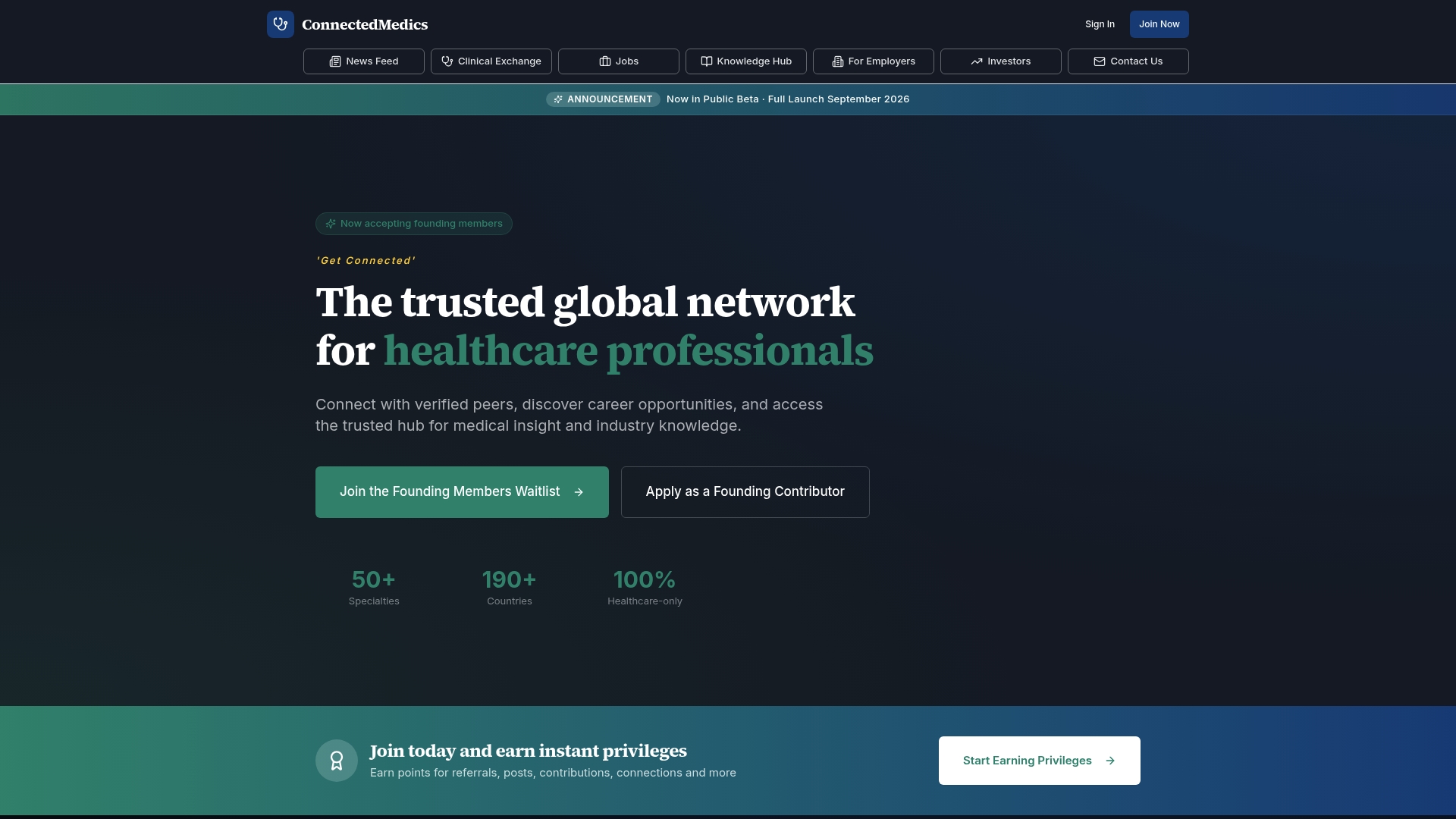
The Connectedmedics Knowledge Hub provides clinical guides, research summaries, and medical news contributed by verified healthcare experts. Resources are organized for quick access, which fits the time constraints nurses work under. The platform also connects nurses with specialty-specific peers across more than 4,600 active healthcare roles, making it a practical tool for both knowledge sharing and career development. Join Connectedmedics to access a professional network where every profile is verified and every resource is clinically relevant.
FAQ
What platforms do nurses use to share best practices online?
Nurses use social media platforms, virtual journal clubs, moderated peer forums, and knowledge management systems embedded in clinical tools. The Oncology Nursing Society's asynchronous journal club model is one well-documented example.
How do nurses stay professional when sharing knowledge online?
Nurses follow their regulator's social media code, such as the NMC Code or ANA guidelines, which require protecting patient confidentiality, separating personal opinion from clinical guidance, and avoiding commercial use of professional titles.
Why does moderation matter in online nursing communities?
Moderation builds the trust and safety that make nurses willing to share honestly. JMIR Nursing research shows that co-produced policies and clear escalation pathways are the most effective moderation practices.
How can shared best practices reach nurses at the point of care?
Embedding evidence-based resources directly into electronic nursing care plans and patient charts reduces retrieval time. Formats like checklists and short videos work better in clinical settings than long-form documents.
What is the difference between a knowledge management system and a nursing forum?
A knowledge management system delivers structured, evidence-based content within clinical workflows. A nursing forum enables peer discussion and contextual knowledge exchange. The most effective digital setups for nurses combine both.