
A home care network platform is defined as a centralized digital system that connects agencies, clinicians, and community-based organizations to coordinate care, manage workflows, and improve patient outcomes in home settings. Unlike generic project management tools, these platforms are purpose-built for home care delivery. They replace phone calls, paper records, and disconnected spreadsheets with a single operating environment. For healthcare professionals and caregivers, understanding home care networks is increasingly relevant as home-based care expands across the U.S. healthcare system.
What is a home care network platform and what does it do?
A home care network platform, also called a home care management platform or care coordination platform, centralizes information and connects agencies, clinicians, and community organizations to coordinate care and improve patient outcomes. The platform acts as the operational backbone for home care delivery. It replaces fragmented workflows with a unified digital environment where every stakeholder works from the same data.
The core purpose is coordination. A patient receiving home care may interact with a registered nurse, a personal care aide, a social worker, and a family caregiver within a single week. Without a shared platform, each of those contacts operates in isolation. With one, every interaction is logged, visible, and traceable. This is the foundational value that separates a true home care network platform from a simple scheduling app.

These platforms also serve as the infrastructure layer for provider networks. Agencies, community-based organizations (CBOs), and health plans all connect through the same system. That shared infrastructure is what makes the "network" in the name meaningful. It is not just software. It is a connected ecosystem of care providers operating under a common digital framework.
What features and functionalities are typical in home care network platforms?
Home care network software typically includes the following core modules:
- Digital care planning. Clinicians create and update individualized care plans within the platform. Changes are visible to the entire care team in real time, reducing the risk of outdated instructions reaching a caregiver.
- Electronic medication administration records (eMAR). eMAR modules replace paper medication logs. Caregivers record each administration digitally, creating an auditable trail that supports both safety and regulatory compliance.
- Scheduling and mobile caregiver apps. Scheduling tools match caregiver availability to patient needs, factoring in geography, skill set, and continuity of care. Mobile apps give field caregivers access to care plans, visit notes, and task checklists directly from a smartphone.
- Real-time monitoring and reporting. Supervisors track visit completion, flag missed tasks, and generate quality reports without waiting for paper submissions. This visibility accelerates response times when patient conditions change.
- Communication channels. Secure messaging connects care teams, family members, and clinical supervisors. Some platforms include family portals that give relatives read-only access to visit logs and care updates.
- Integration with other healthcare systems. Leading platforms connect with electronic health records (EHRs), billing systems, and health plan portals via API. Integrated platforms unify clinical and administrative data, improving consistency and reducing duplicate entry.
Pro Tip: When evaluating home care technology solutions, prioritize platforms that function as a single operating system rather than a bundle of separate tools. Agencies that patch together multiple standalone tools for scheduling, billing, and compliance face data loss and audit risk.
The distinction between a basic home care software product and a full network platform lies in that last point. A scheduling tool is a feature. A platform is the environment in which scheduling, clinical documentation, communication, and reporting all happen together.
How do home care network platforms improve collaboration and patient outcomes?
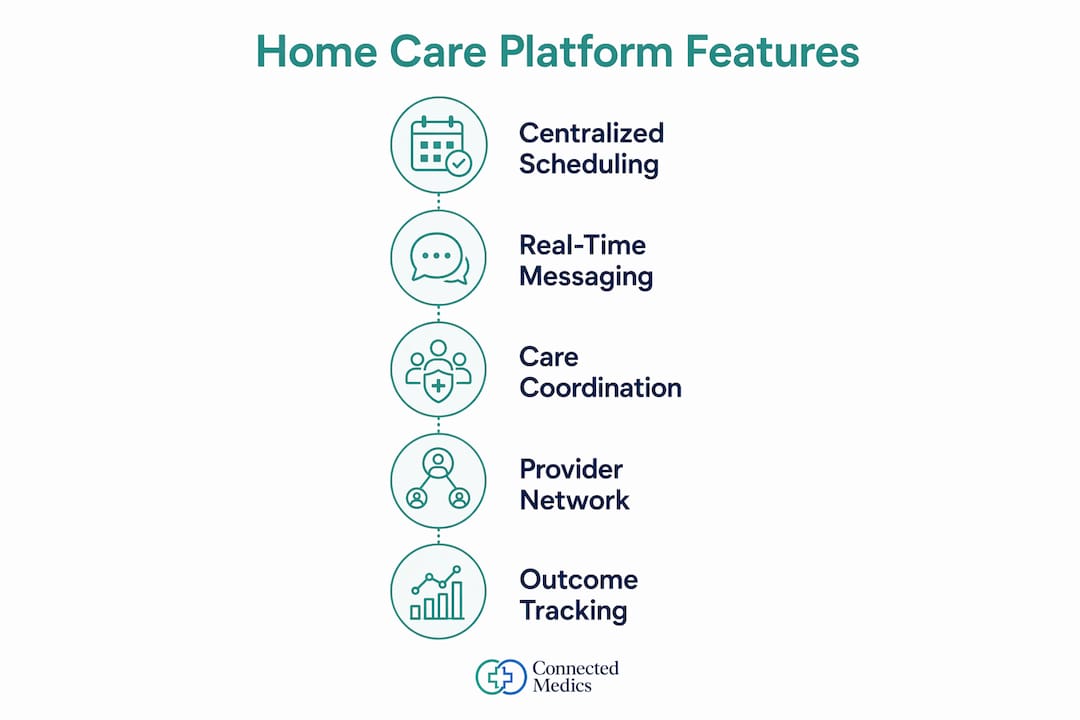
Home care delivery has historically been fragmented. A nurse completes a visit, writes a note, and that information may not reach the next caregiver for hours or days. A home care network platform closes that loop. Closed-loop communication prevents duplicated services and accelerates decision-making across the care team.
The evidence for outcome improvement is specific. Research on integrated social and health home care services shows that network-based integration reduces nursing home institutionalization risk by 19.5% and lowers social expenditures by 19.1%. Overall combined social and health expenditures dropped by 2.6% for patients receiving integrated care. These numbers reflect what happens when coordination replaces fragmentation at scale.
"The value of home care network platforms goes beyond technology to fostering a culture of collaboration, accelerating decision-making and reducing errors." — Aging and Disability Business Institute
Peer learning is another documented benefit. Network platforms support shared learning among caregivers and agencies, reducing staff errors during home visits and accelerating onboarding for new team members. This is particularly relevant for smaller agencies that cannot afford dedicated training departments. The network itself becomes the learning infrastructure.
For caregivers specifically, the collaboration benefit is practical. When a personal care aide can message a supervising nurse directly through the platform and receive a response before the next visit, clinical decisions improve. When a social worker can see that a patient missed two medication doses this week, intervention happens faster. The platform does not replace clinical judgment. It gives clinicians the information they need to exercise it.
How do network models benefit community-based organizations and smaller providers?
Community-based organizations often lack the administrative infrastructure to compete for large managed care contracts independently. A network model changes that equation. Smaller CBOs leverage shared infrastructure to engage in larger contracts, minimizing costs and filling care coordination gaps they could not address alone.
The table below compares operating independently versus joining a network platform:
| Factor | Operating independently | Within a network platform |
|---|---|---|
| Contract access | Limited to direct bilateral agreements | Access to larger managed care contracts via shared infrastructure |
| Referral management | Manual, phone-based, prone to bottlenecks | Digital, trackable, and scalable |
| Operational costs | Higher per-agency overhead | Shared across network participants |
| Care coordination | Gaps between providers | Closed-loop communication across all network members |
| Peer learning | Isolated to internal staff | Shared knowledge base across the network |
The network model also addresses a cultural barrier. Many providers treat peers as competitors and resist information sharing. Joining provider networks acts as a force multiplier, solving referral bottlenecks and staffing shortages that standalone agencies cannot address alone. The shift from competition to collaboration is not idealistic. It is operationally necessary when patient needs exceed any single agency's capacity.
Pro Tip: If you work for a smaller home care agency or CBO, look for network platforms that offer single-point entry for contracting. This means one agreement grants access to multiple payers and referral sources, reducing administrative burden significantly.
For peer networking among nurses and other home care clinicians, the network model creates professional development pathways that isolated employment cannot. Shared platforms expose caregivers to diverse patient populations, clinical protocols, and agency practices that accelerate professional growth.
What operational challenges do home care platforms address?
Home care agencies face a specific set of operational problems that general business software does not solve. A purpose-built home care platform addresses each of them directly.
-
Referral bottlenecks. Manual referral processes rely on phone calls and faxes. A single missed call can delay a patient's first visit by days. Network platforms replace this with digital referral workflows that route requests automatically and confirm acceptance in real time.
-
Lack of real-time provider data. Traditional Medicare Advantage infrastructure lacks the hyper-local, real-time data needed for in-home care. Network platforms fill this gap with digital directories that track provider capacity by zip code, enabling accurate matching between patient needs and available caregivers.
-
Fragmented tool stacks. Agencies that use separate tools for scheduling, billing, documentation, and communication create data silos. Prioritizing an integrated operating system drastically lowers manual effort and closes information gaps between clinical and administrative teams.
-
Regulatory compliance and audit readiness. Home care agencies operate under state licensure requirements, Medicare Conditions of Participation, and managed care contract standards. Platforms that centralize documentation make compliance reporting faster and reduce the risk of audit findings.
-
Scaling without strain. Relying solely on internal resources limits agency flexibility. Network platforms maintain referral stability and allow agencies to respond to increased patient volume without proportional increases in administrative staff.
The scalability point matters most for growing agencies. A platform built on shared network infrastructure means that adding ten new patients does not require ten new phone relationships with referral sources. The network handles routing. The agency handles care.
Key takeaways
A home care network platform is the operational infrastructure that makes coordinated, scalable, and outcome-focused home care delivery possible for agencies, clinicians, and community-based organizations.
| Point | Details |
|---|---|
| Core definition | A home care network platform centralizes care coordination across agencies, clinicians, and CBOs in a single digital environment. |
| Outcome evidence | Network-based integration reduces nursing home institutionalization risk by 19.5% and lowers social expenditures by 19.1%. |
| CBO advantage | Smaller providers access larger contracts and reduce overhead by operating within shared network infrastructure. |
| Operational fix | Platforms replace manual referral workflows with real-time digital directories and closed-loop communication. |
| Platform vs. tool | A true platform unifies scheduling, eMAR, documentation, and communication. Standalone tools create data silos and compliance risk. |
Why the shift to network platforms is overdue
I have spent years watching home care agencies operate with the same coordination model that existed before smartphones. A nurse finishes a visit, calls the office, the office calls the next provider. Information degrades at every handoff. Patients fall through gaps that no single person created but everyone inherits.
What strikes me most about home care network platforms is not the technology itself. It is what the technology reveals about the old model. The old model assumed that coordination was someone's job title. The new model treats coordination as infrastructure. That is a fundamental shift, and it changes what is possible.
The agencies I have seen thrive are not the ones with the most staff. They are the ones that stopped treating their peers as threats and started treating the network as a shared asset. Providers who see peers as competitors are solving the wrong problem. The real liability is a phone-based referral system that cannot scale and cannot be audited.
For caregivers hesitant about adopting these platforms, the practical case is straightforward. You spend less time chasing information and more time with patients. For agency leaders, the case is financial. Shared infrastructure costs less than building everything internally, and network referral stability protects revenue in ways that no amount of internal hiring can replicate.
The cultural shift toward digital adoption in home care is not optional at this point. It is the condition for staying operationally viable.
— David
Connectedmedics: a professional network built for home care professionals
Connectedmedics is a global healthcare professional network built exclusively for clinicians, caregivers, and home care professionals. The platform provides verified professional profiles, a jobs board with over 4,600 active healthcare vacancies, and a knowledge hub with clinical insights contributed by verified medical experts. For home care professionals seeking collaboration, career opportunities, and access to specialty-specific resources, Connectedmedics delivers what generic networks cannot. Explore the clinical knowledge hub for home care research, trends, and practical guides. Recruiters and agencies can also reach verified professionals directly to fill home care roles faster.
FAQ
What is a home care network platform?
A home care network platform is a centralized digital system that connects agencies, clinicians, and community-based organizations to coordinate patient care, manage workflows, and replace manual processes in home settings. It typically includes modules for care planning, scheduling, eMAR, and secure communication.
How does a home care platform work?
A home care platform works by giving every member of a care team, including nurses, aides, social workers, and supervisors, access to a shared digital environment where care plans, visit records, and communications are stored and updated in real time. Referrals, scheduling, and documentation all flow through the same system.
What are the main benefits of home care networks?
The main benefits include reduced institutionalization risk, lower coordination costs, faster referral processing, and improved care quality through closed-loop communication. Research shows integrated home care networks reduce nursing home placement risk by 19.5%.
How do home care platforms support smaller agencies and CBOs?
Smaller agencies and CBOs use network platforms to access larger managed care contracts through shared infrastructure, reducing the administrative overhead of managing multiple bilateral agreements. The network model also provides referral stability that standalone agencies cannot maintain independently.
What should caregivers look for in home care network software?
Caregivers should prioritize platforms that offer mobile access to care plans, secure messaging with supervisors, and real-time visit documentation. A digital platform for healthcare that integrates scheduling, documentation, and communication in one place reduces administrative burden and supports better patient care.