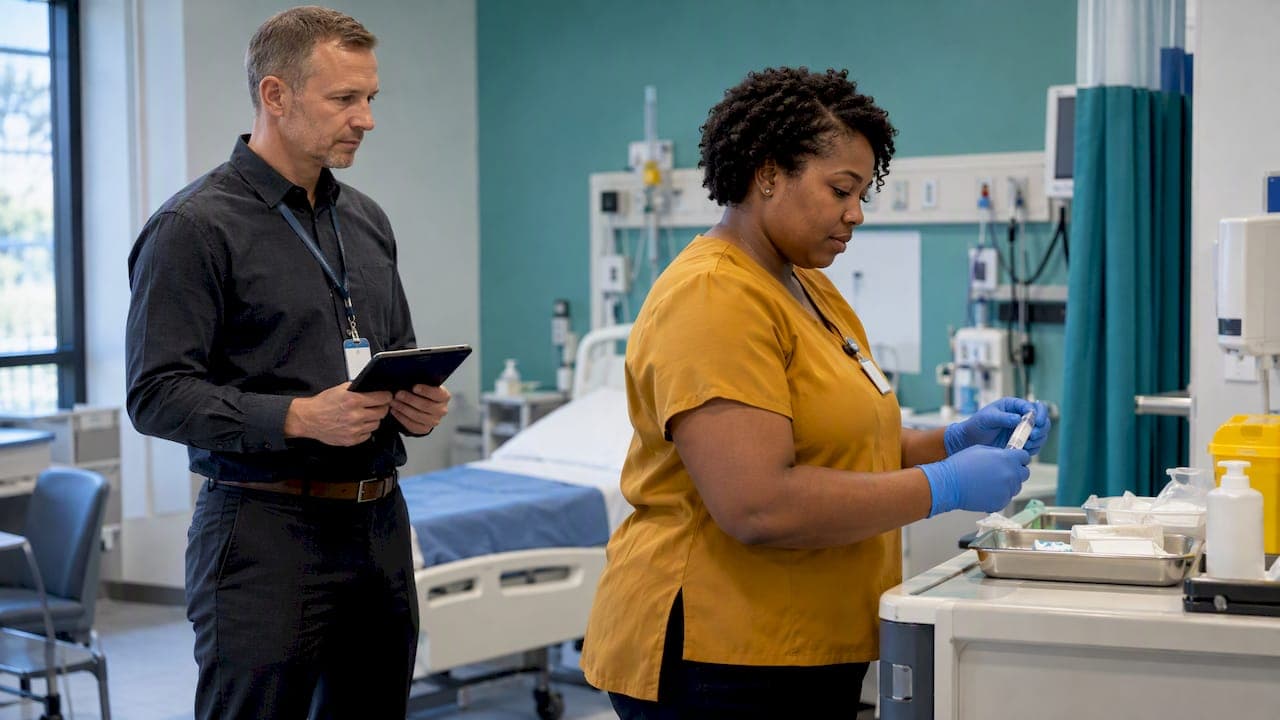
Skills-based hiring in healthcare means selecting candidates on demonstrated skills, knowledge and abilities. It does not replace licensure. Physicians, nurses and pharmacists still need the credentials the law requires. Skills-based methods apply most to non-clinical, administrative, IT and clinical support roles, and to the way every role is described, screened and assessed.
This guide covers the definition, where it fits, how to assess skills, evidence, risks and a rollout plan.
TL;DR
- Skills-first hiring selects workers on skills they can demonstrate, regardless of how they acquired them, per the U.S. Department of Labor starter kit.
- Licensed clinical roles keep their credential requirements. Skills-based methods grow fastest in non-clinical and clinical support jobs.
- Structured interviews, hands-on evaluations and simulations give more consistent results than unstructured screening.
- Automated screening tools need job-relatedness checks and independent audits.
- Start with job descriptions, then assessments, then leadership buy-in and measurement.
Table of Contents
- What skills-based hiring means in healthcare
- Where skills-based hiring fits in a hospital or practice
- Why healthcare employers are adopting it
- What the evidence shows
- How to assess skills fairly and consistently
- Meeting licensure, certification and patient-safety requirements
- Risks and barriers
- Rollout plan for a healthcare employer
- Our perspective
- Posting and finding skills-matched candidates
- FAQ
- Sources
What skills-based hiring means in healthcare
Definition:
- Hiring or promoting based on skills, knowledge and abilities a person can demonstrate.
- Where or how the skills were acquired is secondary.
- Source: DOL Skills-First Hiring Starter Kit.
In healthcare, the approach identifies the essential competencies for a role, both technical and interpersonal, and assesses candidates on those abilities rather than on where they studied, as Addison Group describes it.
Traditional hiring vs skills-based hiring
| Step | Traditional approach | Skills-based approach |
|---|---|---|
| Job description | Degree and years of experience listed first | Essential tasks and competencies listed first |
| Resume screen | Keywords, school names, job titles | Evidence of the required skills |
| Interview | Open conversation, varies by interviewer | Structured questions, same for every candidate |
| Assessment | Often none | Work sample, simulation or hands-on check |
| Credentials | Used as a proxy for ability | Required only where law or safety demands them |
A necessary clarification
Skills-based hiring is not a lowering of standards. Per Fast Company's reporting, academic qualifications remain non-negotiable for clinical roles such as physicians, nurses and pharmacists. Jacob Kupietzky frames the approach there as a strategic widening of the lens in areas where academic credentials are not functionally essential.
Where skills-based hiring fits in a hospital or practice
Sorted by how much room the approach has:
Licensed clinical roles
- Physicians, nurses, pharmacists, advanced practice providers.
- License, education and training are verified. This is not optional.
- Skills-based methods still help here: structured interviews, clinical scenarios, specialty-specific competency checks.
Clinical support roles
- Medical assistants, phlebotomy technicians, pharmacy technicians, patient care technicians, home care and healthcare assistants.
- Certifications and demonstrated competencies carry weight. A four-year degree often adds little.
Non-clinical roles
- Scheduling, revenue cycle, patient access, IT support, data analysis, administration.
- The widest room for skills-first screening.
The pattern: the more directly a role is regulated, the more the credential is a legal and patient-safety requirement. The less regulated the role, the more a degree is a proxy that can be swapped for direct evidence.
Why healthcare employers are adopting it
Reaching candidates a degree filter hides
The DOL kit states that skills-first strategies can help employers find workers who can do the job. They can also open opportunities to workers who may be overlooked by degree-focused hiring. The kit adds that hidden workers found this way tend to stay in a job longer. For employers with chronic turnover in support roles, retention is the practical argument.
Supply is tight
The Bureau of Health Workforce notes that for U.S. occupations requiring licensure or certification, the number of people trained and eligible often exceeds actual supply. One cause is active licensees being temporarily out of the workforce (BHW technical documentation). Employers that define roles by skills can consider returners, career changers and internal movers more readily. Those candidates often have the competencies but not the conventional resume.
Access and diversity
Degree requirements screen out people who built skills through work, military service, apprenticeships or certificate programs. Removing unneeded requirements widens the pool. It does not guarantee outcomes, and a pool is only the first step. Our guide to two evidence-backed diversity hiring moves covers what to do after the pool widens.

What the evidence shows
The best documented healthcare example is Cleveland Clinic. According to MIT Sloan Management Review:
- 260 job descriptions were rewritten, covering over 2,000 roles.
- Four-year degree requirements were removed from 90% of them.
- 1,019 Black employees were hired or promoted into jobs with family-sustaining wages.
Beth Berwick, in the same piece, says the approach involved reworking job descriptions, ongoing skills training and mindsets that value inclusivity. The project also had senior-leader buy-in.
Read this carefully:
- It is one health system, reported by the organization's own leaders.
- It shows what is achievable when job descriptions are rebuilt at scale.
- It does not prove every employer will see the same results.
Setting up your own measurement matters more than borrowing someone else's numbers. See the rollout section below.
How to assess skills fairly and consistently
The DOL kit points to three methods: structured interviews, hands-on skills evaluations and simulations. It says standardized interviewing provides more consistent data and reduces the impact of bias.
Structured interviews
- Define the five to seven competencies the role needs.
- Write the same behavioral or situational questions for every candidate.
- Score each answer against a written rubric.
- Have interviewers score independently before discussing.
Hands-on evaluations and simulations
Examples by role type:
- Medical assistant: vital signs and room turnover on a timed scenario.
- Patient access: a scripted registration call with an insurance discrepancy.
- Scheduler: a multi-provider calendar conflict to resolve.
- Clinician: a case discussion tied to the specialty. Our specialty matching guide explains why matching on specialty detail beats generic screening.
Write the posting for the skills
BCG's research on skills-based hiring says employers need a deep understanding of the skills a role requires and should advertise for those skills. A posting that lists vague traits attracts vague applications. Our overview of top skills healthcare employers seek in 2026 is a useful starting vocabulary.
Meeting licensure, certification and patient-safety requirements
Skills-based hiring sits on top of compliance, not instead of it. HRSA's health center site visit protocol gives examples of credentialing evidence. They include primary-source verification of a licensed independent practitioner's identity, current licensure, education and training. Basic life support training documentation is also listed (HRSA credentialing and privileging protocol).
Practical rules:
- Separate required credentials (license, board status, mandated certifications) from preferred background (degree level, prior employer type).
- Verify required credentials at the source before an offer, whatever the assessment results.
- Keep verification and credentialing as distinct steps. See credentialing vs verification and how doctor licenses are verified.
- Document why each requirement exists. A requirement with no safety or legal reason is a candidate for removal.
Risks and barriers
It takes real work
The DOL kit warns that skills-first strategies need careful, thorough work, leadership buy-in and a review of hiring practices. Employers may also struggle to hire on skills after dropping degree requirements, because recruiters and managers lose their familiar shortcut.
Automated tools can undermine the goal
In testimony to the EEOC, Matthew Scherer recommended that selection procedures measure essential job functions. He also called for independent audits of automated tools before deployment and on an ongoing basis. His point: many current systems do not measure essential task-based performance and can perpetuate bias against already disadvantaged workers.
For teams using AI screening:
- Configure it against the skills list, not against past hires.
- Audit outcomes by group on a schedule.
- Keep a human decision-maker on every rejection path.
Our AI resume screening playbook goes deeper.
Manager resistance
Hiring managers trained on degree filters may see skills-based hiring as risk. Show them the competency rubric, the verification steps and the assessment results. Credentials stay where safety requires them.
Rollout plan for a healthcare employer
- Audit job descriptions. For each requirement, record why it exists: law, accreditation, payer rule, safety, or habit.
- Rewrite around tasks. List essential duties and the skills each one needs.
- Pick pilot roles. Choose high-volume, non-clinical or support roles first.
- Build assessments. One structured interview and one work sample per role.
- Train interviewers. Rubrics, independent scoring, bias awareness.
- Get leadership sponsorship. The Cleveland Clinic example had it.
- Measure. Track applicant pool makeup, time to fill, 90-day and 12-month retention, and hiring manager satisfaction against the pre-change baseline.
- Expand. Move to more roles when the pilot data supports it.
Timing also matters. Our hiring seasonality tests help schedule a pilot before peak demand.
Our perspective
We run a network and jobs board built only for healthcare, so we see both sides of this: employers writing postings and professionals reading them.
What we think:
- Verification and skills are complementary. A verified license answers "is this person permitted to practice?" Skills evidence answers "can this person do this job on this unit?" Employers need both.
- Postings are where skills-based hiring succeeds or fails. A posting built on specialty, setting and tasks gets better-fit applicants than one built on a degree line.
- Candidates can help. A profile that shows procedures, settings, certifications and specialty focus gives recruiters skills evidence. Our application tips cover how to present it.
- Do not drop requirements for the sake of it. Remove the ones with no safety or legal purpose, and keep the rest firmly.
— David
Posting and finding skills-matched candidates
ConnectedMedics offers employers tools to post roles and reach verified healthcare professionals. Plans are Free, Growth (99 GBP per month), Enterprise and Premium Employer, with details on the employer plans page and the Premium Employer page. Recruiters can also see the recruiters page. Specialty filters let a posting target the skills a role needs.
For more on how recruitment platforms fit into a hiring process, see the healthcare recruitment platform guide.
FAQ
Does skills-based hiring mean degrees no longer matter in healthcare?
No. Licensed clinical roles such as physician, nurse and pharmacist still require specific education and licensure. Skills-based hiring applies most to non-clinical, administrative, IT and clinical support roles. In clinical roles it improves how candidates are assessed, not what the law requires.
What is the fastest way to start?
Audit the requirements in your highest-volume job descriptions. Remove those with no legal, safety or operational reason. Then add a structured interview with a scoring rubric. This needs no new software and gives a baseline for comparison.
How do employers assess skills without bias?
Use the same questions, the same scoring rubric and independent scoring by each interviewer. The DOL kit recommends structured interviews, hands-on evaluations and simulations. It notes that standardized interviewing gives more consistent data and reduces the impact of bias.
Can AI screening support skills-based hiring?
It can, if it is configured to measure essential job functions and audited. Experts testifying to the EEOC recommend independent audits before deployment and on an ongoing basis. Keep a human review step on rejections.
Sources
- Skills-First Hiring Starter Kit, U.S. Department of Labor
- How skills-based hiring is reshaping the health care workforce, Fast Company
- Skills-Based Hiring in Healthcare: What to Prioritize, Addison Group
- Introduction, Bureau of Health Workforce, HRSA
- The Why, What, and How of Skills-Based Talent Practices, MIT Sloan Management Review
- Competence Over Credentials: Skills-Based Hiring, BCG
- Health Center Program Site Visit Protocol: Credentialing and Privileging, HRSA
- Testimony of Matthew Scherer, U.S. EEOC