
Yes, AI resume screening works for healthcare hiring, but only when you require verified credentials, build mandatory binary filters for licensure and certification, and run adverse-impact audits before going live. Skip those three conditions and you inherit legal risk and bad hires. Do them first, then automate.
- Speed: Screening time drops sharply when AI hiring flows integrate credential verification with structured clinical data.
- Credential accuracy: Matters more than keyword matching. A resume with "ICU experience" listed twice means nothing if the RN license lapsed last year.
- Risk: Bias claims (EEOC), PHI exposure, and unauditable "black box" scores are the three ways this goes wrong.
Pro Tip: In the next 7 to 14 days, define your mandatory filters (active license, required certifications, exclusion list checks), inventory your credential data sources, and pick one role to pilot before touching your full requisition load.
Before anything else: document a manual-override policy. Every automated ranking needs a human path to challenge it.
Key Takeaways
AI resume screening succeeds in healthcare hiring only when mandatory credential filters, adverse-impact testing, and a documented manual-override process are all in place before launch.
| Point | Details |
|---|---|
| Filter first, score second | Treat licensure and certification as binary pass/fail gates, not weighted factors, to reduce bias risk. |
| Test before you trust | Run retrospective validation on historical hiring data and segment results by protected class. |
| Stage your rollout | Move from parallel scoring to recruiter-in-the-loop to monitored production, never straight to full automation. |
| Budget realistically | Expect a few months from kickoff to production, with verification and integration as primary cost drivers. |
| ConnectedMedics as the example | Combines verified credentials, specialty filters, and ATS sync into an audit-ready shortlist process. |
Table of Contents
- Why Healthcare Hiring Requires a Specialized AI Screening Approach
- What You Need Before Deploying AI Resume Screening in Healthcare
- Step-by-Step: How to Implement AI Resume Screening for Healthcare Roles
- How to Validate Accuracy and Meet Compliance Requirements
- Timeline, Team, and Cost Considerations for Rollout
- How ConnectedMedics Approaches AI Resume Screening
- What AI Should (and Shouldn't) Decide in Healthcare Hiring
- See ConnectedMedics in Action
- Frequently Asked Questions
- Sources
Why Healthcare Hiring Requires a Specialized AI Screening Approach
Generic resume screening tools look for keyword overlap. That approach fails in clinical hiring because a license expiration date matters more than how many times "patient care" appears on a resume. Healthcare recruiting carries constraints most industries never touch.
- Mandatory credentials aren't optional extras. A candidate missing an active state license or a required certification like BLS or ACLS should never surface as a strong match, regardless of how well their resume reads.
- Specialty and shift fit outrank job titles. An ICU nurse and a med-surg nurse share a title but not a skill set; ambulatory and long-term care settings demand different competencies entirely.
- Compliance stakes are higher. EEOC adverse-impact rules, state licensure boards, and PHI handling all apply the moment you touch candidate data.
- Volume swings wildly by role. CNA and EVS postings can draw hundreds of applicants overnight, while a specialized physician assistant search might yield a dozen qualified candidates over months.
What You Need Before Deploying AI Resume Screening in Healthcare
Readiness comes down to four categories of groundwork, and skipping any one of them turns a promising pilot into a compliance headache.
- Authoritative credential sources, including state licensure feeds, certification registries (ACLS, BLS, specialty boards), and federal exclusion lists like the OIG database.
- ATS/HRIS integration mapped end to end: how resumes flow in, how scores flow out, and where audit logs live. Platforms like skyHire build this verification-to-ATS sync directly into their workflow.
- Structured job descriptions with mandatory versus optional criteria clearly separated, including shift and location requirements. Vague postings produce vague matches.
- Governance groundwork: updated privacy notices, data retention rules, a documented manual-override workflow, and a scheduled cadence for adverse-impact testing.
Pro Tip: Assign one owner to the credential-source inventory before kickoff. Recruiters usually know which state boards and registries they check manually; that list becomes your integration spec.
Step-by-Step: How to Implement AI Resume Screening for Healthcare Roles
Treat this as a sequence, not a menu. Skipping ahead to production without steps 5 and 6 is the single most common mistake healthcare HR teams make.
- Define mandatory criteria as binary filters. Active licensure, state authorization, required certifications, and exclusion-list clearance should function as pass/fail gates, not weighted scoring factors. This is also your primary bias-mitigation control.
- Clean and structure your job descriptions so every requirement maps to a model attribute: specialty, years of setting-specific experience, shift availability, required credentials.
- Map your credential verification sources and decide whether checks run in real time or in daily batches. State board lookups and exclusion-list checks are the two you cannot skip.
- Configure the ATS integration: score fields, audit log fields, and candidate status transitions, all inside a sandboxed test environment before anything touches live requisitions.
- Run retrospective validation against historical hiring data. Measure precision and recall, and check pass rates across protected groups before you trust the model with real candidates.
- Roll out in stages: parallel scoring first (AI scores alongside human review, no automated decisions), then recruiter-in-the-loop, then monitored production with weekly dashboards.
- Document your manual-override and appeal process. Define exactly when a human must review a rejection, and make that path visible to candidates.
A few operational notes worth flagging along the way:
- Build scheduling-aware filters so candidates match shift patterns and care settings, not just job titles. A day-shift ICU opening and a night-shift med-surg role need different matching logic entirely.
- Loop in compliance/legal by step 1, not step 5. Retrofitting legal review after configuration wastes weeks.
- Involve hiring managers in reviewing the first 50 to 100 scored candidates during parallel scoring. Their gut checks catch model blind spots statistics miss.
Pro Tip: Run your pilot on a high-volume role first (CNA, medical assistant) rather than a low-volume specialty search. You'll accumulate enough data to validate the model in weeks instead of months.
How to Validate Accuracy and Meet Compliance Requirements
Four metrics matter here: precision, recall, false-positive and false-negative rates, and pass rates segmented by protected class. Without segmentation, you have no way to catch adverse impact until an EEOC complaint forces the question.
- Run adverse-impact testing on a set schedule, not once at launch. Quarterly reviews catch drift as your applicant pool and role mix change.
- Use retrospective simulations with meaningful sample sizes. Testing on several hundred historical applications per role where possible gives you statistically defensible results; smaller samples should trigger a staged rollout rather than full production.
- Keep audit logs with plain-English rationale for every ranking decision. "Score: 82" means nothing to a regulator or a rejected candidate; "Missing active RN license in requested state" does.
- Minimize candidate data collection and address PHI handling directly. Review your platform's privacy policy and terms of service during vendor selection, since consent language and retention rules vary by provider.
Modern ATS platforms increasingly rely on NLP and predictive analytics rather than keyword counts, which raises the bar for what "explainable" actually means in a compliance audit.
Timeline, Team, and Cost Considerations for Rollout
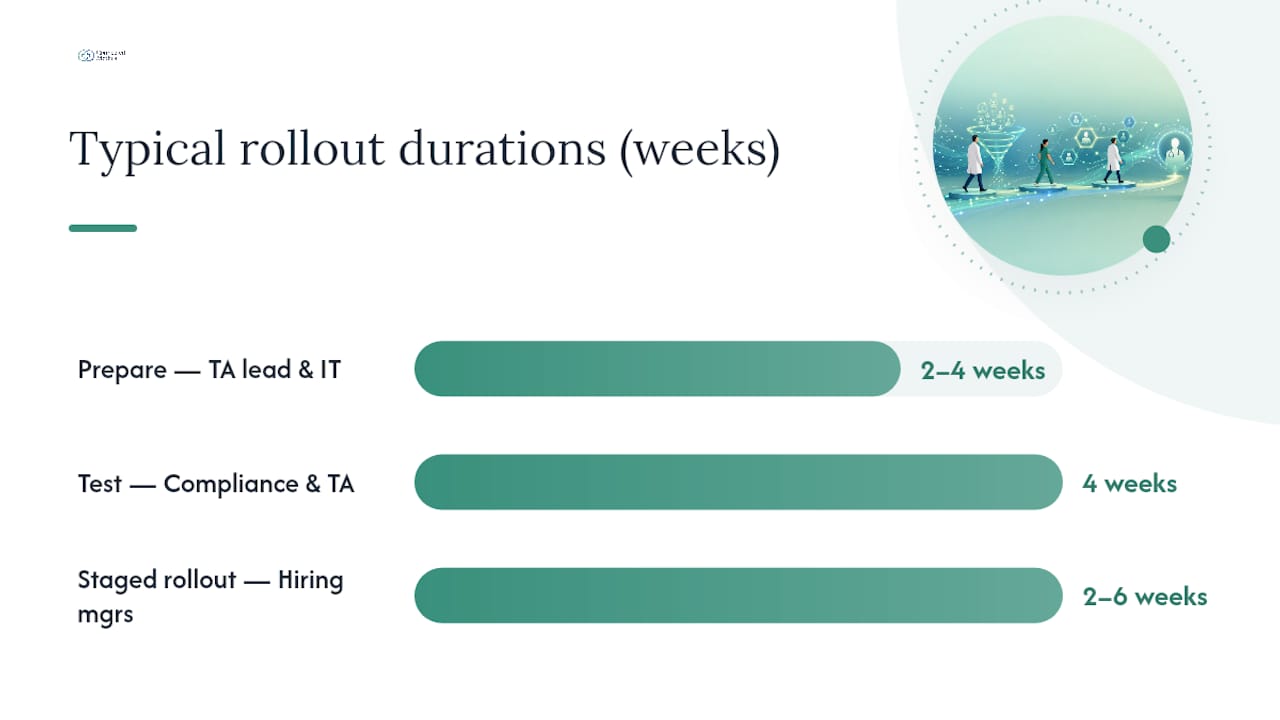
Most healthcare AI screening projects typically run a few months from kickoff to full production, assuming credential data sources are already identified.
| Stage | Duration | Primary Owner |
|---|---|---|
| Prepare (criteria, data mapping) | 2 to 4 weeks | TA lead + IT/data engineer |
| Test (sandbox, validation) | 4 weeks | Compliance/legal + TA lead |
| Staged rollout | 2 to 6 weeks | Hiring managers + implementation owner |
| Full production | Ongoing | Implementation owner |
- Cost drivers include verification API calls, ATS integration labor, vendor licensing (per-seat or per-hire), and any model customization for specialty roles.
- Build internally only if you have sustained engineering capacity and very high applicant volume; most healthcare employers get to production faster through vendor integration, since AI applied to clinical workflows pays off fastest when screening aligns with existing staffing and scheduling systems.
How ConnectedMedics Approaches AI Resume Screening
ConnectedMedics applies credential verification, specialty filters, and ATS sync together, producing a shortlist that's ready for audit from the moment it's generated, not patched together after the fact.
- Verified profiles mean licensure and certification status are confirmed before a candidate ever reaches a recruiter's queue.
- Specialty and job-board integration matches candidates to setting-specific requirements (ICU, ambulatory, long-term care) instead of relying on title matching alone.
- Audit-ready by design, with screening logic that preserves a record of why each candidate was ranked, cutting time-to-interview without cutting corners on compliance.
Pro Tip: If you're evaluating vendors, ask each one to show you their audit log format before you sign anything. If they can't produce a plain-English rationale for a sample ranking, that's a compliance gap you'll inherit.
Request an integration demo to see how verified-profile screening maps onto your existing requisitions.
What AI Should (and Shouldn't) Decide in Healthcare Hiring
AI earns its keep on logistics: verification, scheduling, credential checks, the repetitive work that used to eat a recruiter's week. That's where the time savings are real.
What it shouldn't do is replace human judgment on safety-critical hires. A ranking score is a starting point, never a final verdict, especially for roles touching direct patient care.
If you're rolling this out, invest in training hiring managers on what the score means and doesn't mean before launch day, not after the first override request lands on your desk.
See ConnectedMedics in Action
ConnectedMedics gives healthcare employers verified clinician profiles, a specialty-filtered jobs board, and AI-powered matching built specifically for clinical hiring, not adapted from generic recruiting software.
A demo walks through exactly what this looks like in practice: how credential verification runs before a candidate reaches your queue, how ATS sync eliminates duplicate data entry, and how audit logs give you a defensible record for every ranking decision. If you're evaluating whether your current screening process can withstand an EEOC inquiry, that's the question to bring to the call. Request a demo and see how verified-profile screening fits your requisition load.
Frequently Asked Questions
Is AI resume screening legal for healthcare hiring in the United States?
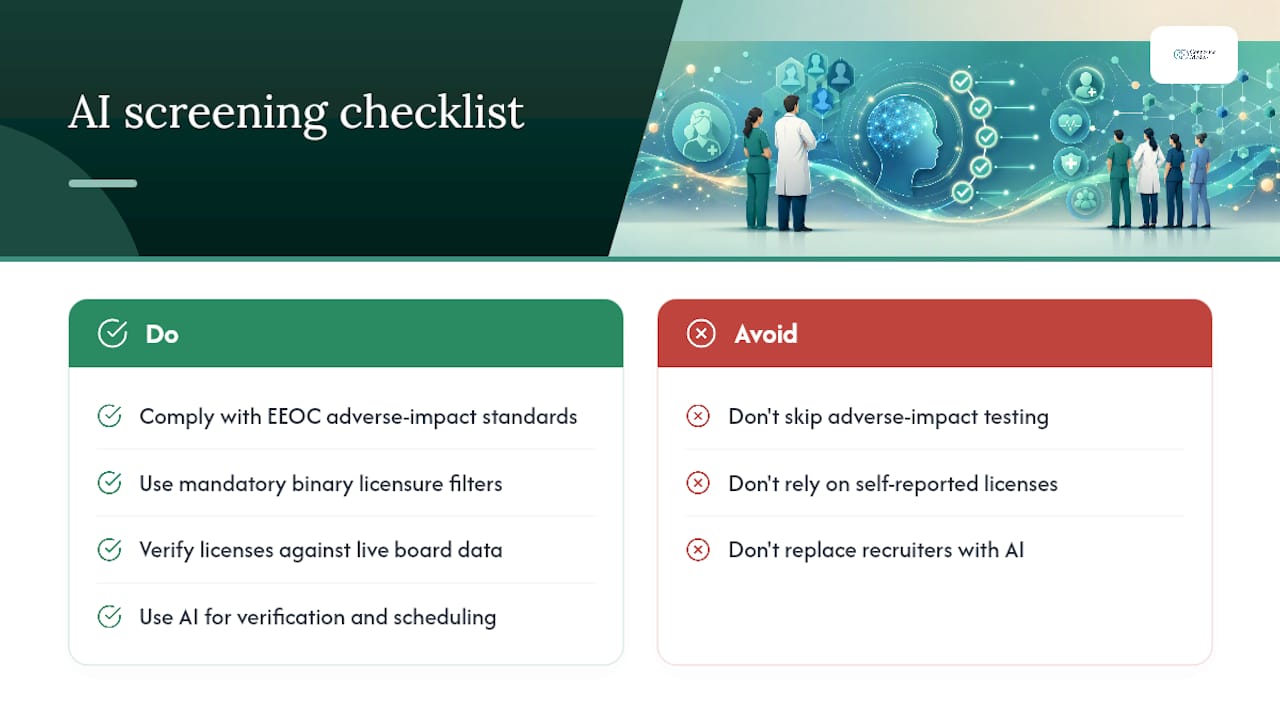
Yes, but it must comply with EEOC adverse-impact standards. Using mandatory binary filters for licensure and certification, rather than weighted scoring that could disproportionately exclude protected groups, is the standard defensible approach.
How does AI applicant screening handle expired or state-specific licenses?
Effective systems check candidate licensure against live state board data or certification registries rather than relying on self-reported resume text, catching expired or non-transferable licenses before a candidate reaches a recruiter.
Does automated healthcare hiring replace recruiters?
No. AI recruiting tools handle verification, scheduling, and initial filtering, freeing recruiters to focus on interviews, culture fit, and final hiring decisions, particularly for safety-critical clinical roles.
What's the biggest mistake healthcare employers make when adopting AI applicant screening?
Skipping adverse-impact testing before full production. Employers who move straight from vendor selection to live scoring, without segmenting pass rates by protected class, expose themselves to compliance risk that's difficult to unwind after the fact.
This article is general information, not a substitute for advice from a qualified lawyer. Consult a qualified legal professional about your own circumstances before acting on anything here.
Sources
- How applicant tracking system (ATS) platforms are using AI to screen healthcare job applicants
- Google Privacy Policy
- Google Terms of Service