
To apply for HCA jobs step by step, create a candidate profile at careers.hcahealthcare.com, search by role or location, upload your resume (PDF or Word), complete any required assessments, and submit. Here is the exact sequence:
- Create a candidate profile at careers.hcahealthcare.com and verify your email address.
- Search roles using filters for specialty, location, shift, and category on the HCA Careers landing page.
- Upload your resume (PDF or Word) or sync your LinkedIn or Indeed profile, then complete pre-screening questions.
- Join the HCA Talent Network for targeted job alerts and interview tips.
- Prepare 3–5 STAR method stories (Situation, Task, Action, Result) before your interview.
- Expect background checks and drug screens before your start date, which can take 1–3 weeks.
- Connectedmedics offers a verified healthcare jobs board with specialty filters to help you track HCA-aligned roles alongside your application.
Table of Contents
- How do you apply for HCA jobs step by step?
- How to tailor your resume to pass HCA's ATS screening
- Submission checks that prevent avoidable rejections
- How long does the HCA hiring process take?
- How to prepare for HCA behavioral interviews using STAR
- What happens after an offer: pre-employment checks and onboarding
- How to fix common HCA application problems
- Key Takeaways
- What most applicants get wrong about the HCA process
- Connectedmedics: verified healthcare roles alongside your HCA search
- Useful sources
How do you apply for HCA jobs step by step?
The HCA application process follows a clear sequence. Work through each step in order to avoid delays.
- Go to careers.hcahealthcare.com — and click "Create Account." Enter your name, email, and a password.
Pro Tip: Apply to no more than three to five roles at once. Spreading applications too thin makes it harder to tailor each one, and HCA recruiters notice generic answers.
If a file fails to upload, try a different browser (Chrome or Firefox work reliably), clear your cache, or compress the PDF below 5 MB. For persistent issues, contact HCA Talent Acquisition through the portal's help link.
How to tailor your resume to pass HCA's ATS screening
Generic resumes fail at large health systems. HCA's applicant tracking system scans for exact keywords from the job posting before a human ever reads your file.
- Use a single-column layout with a standard font such as Calibri or Arial, size 10–12. No graphics, text boxes, or columns.
- Embed keywords verbatim from the job description. If the posting says "electronic health records documentation," use that phrase, not "EHR charting."
- For clinical roles, place your license or certification number and expiration date in the header — hiring managers scan for these details first.
- Quantify achievements where possible: "Reduced patient wait time by 15 minutes per shift" outperforms "Improved patient flow."
- Weave soft skills into accomplishments rather than listing them separately. "Coordinated care across a 32-bed unit during staff shortages" shows teamwork without stating it.
Dos and don'ts for HCA job descriptions:
| Do | Don't |
|---|---|
| Mirror the posting's exact terminology | Use synonyms the ATS may not recognize |
| Lead with credentials for clinical roles | Bury license numbers at the bottom |
| Quantify outcomes | List duties without results |
| Keep to one or two pages | Submit a three-page resume for entry-level roles |
Pro Tip: Read the full job description twice before writing a single word. The second read reveals the three or four skills HCA weights most heavily — those belong in your first bullet point.
For more medical job application tips on ATS-safe formatting, the Connectedmedics blog covers resume structure in detail.
Submission checks that prevent avoidable rejections
Before clicking submit, run through this checklist:
- Confirmation email: — after submission, watch for a message from HCAJobApplication@HCACareers.com. No email within 30 minutes may mean the application did not go through.
If the portal times out, use "Continue Later" before closing the tab. The system emails a direct link to resume your application exactly where you left off.
How long does the HCA hiring process take?
| Stage | Typical Duration |
|---|---|
| Application review | 1–2 weeks |
| Recruiter phone screen | 1–2 weeks after review |
| Assessments (if required) | Completed within 48–72 hours of invitation |
| Interview (phone or in-person) | 1–2 weeks after screen |
| Background check and drug screen | 1–3 weeks |
| Offer and onboarding paperwork | 1–2 weeks after clearance |
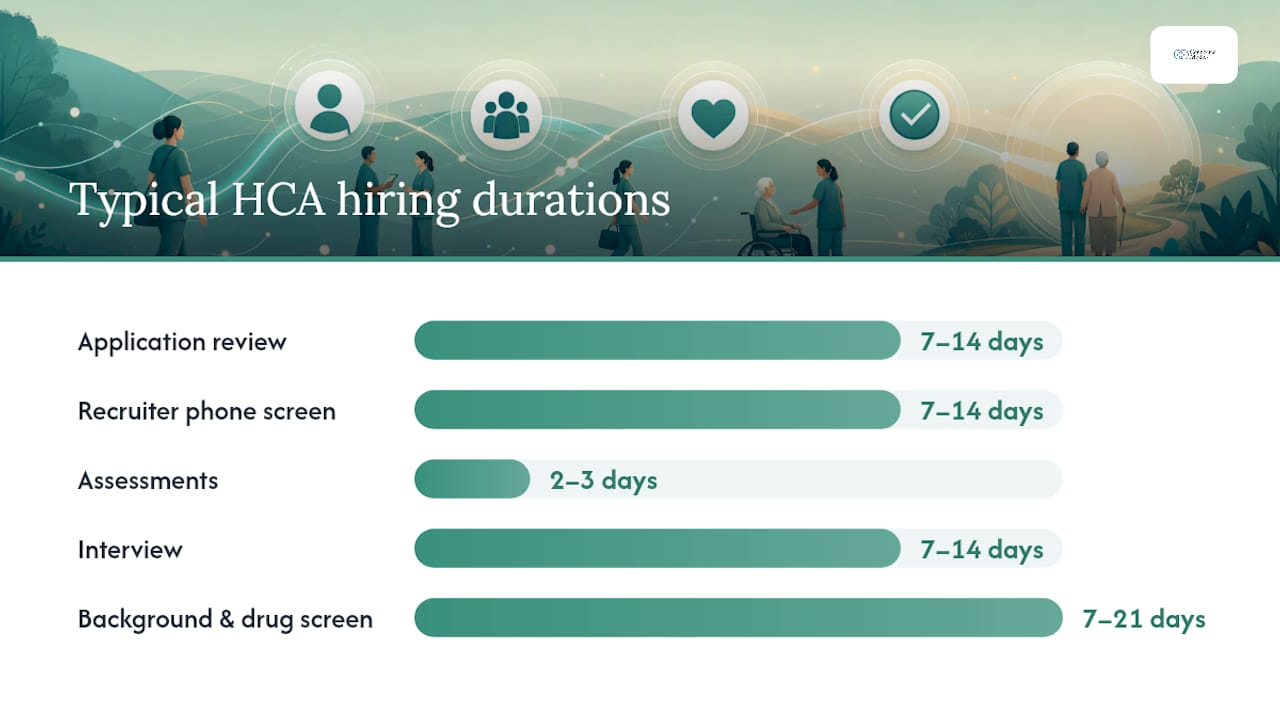
Status updates appear in your candidate account and arrive by email from HCAJobApplication@HCACareers.com. Check both regularly.
If two weeks pass with no update after submitting, send a brief follow-up. Include your full name, the job title, the requisition number, and the date you applied. Keep the message under five sentences. Applying early and tracking each application by facility, date, and status raises your response rate at high-demand facilities.
How to prepare for HCA behavioral interviews using STAR
HCA uses behavioral interviews, and the STAR method is the framework recruiters expect. STAR stands for Situation, Task, Action, Result.
Common HCA interview prompts:
- Describe a time you handled a difficult patient or family member.
- Tell me about a conflict with a coworker and how you resolved it.
- How do you prioritize tasks when multiple patients need attention simultaneously?
- Give an example of when you followed infection control protocols under pressure.
- Describe a documentation error you caught and corrected.
Sample STAR template:
Situation: During a night shift, two patients required urgent attention at the same time. Task: I needed to triage and communicate clearly with the charge nurse. Action: I assessed both patients in under two minutes, flagged the higher-acuity case, and delegated the second to a colleague. Result: Both patients received timely care, and the charge nurse cited the response in my quarterly review.
Prepare 3–5 stories that cover teamwork, patient safety, prioritization, and communication. Adapt each story to the specific facility by referencing its patient population or service line.
Pro Tip: For clinical scenario questions, briefly name the protocol you followed (e.g., "per our facility's sepsis bundle"). It signals compliance awareness without requiring you to memorize every policy.
For more clinical interview question frameworks, the Connectedmedics blog provides specialty-specific examples.
What happens after an offer: pre-employment checks and onboarding
An offer from HCA is conditional until all pre-employment screens clear. Background checks typically take 1–3 weeks and may delay your start date if documents are missing.
Prepare these in advance:
- Government-issued photo ID (driver's license or passport).
- Social Security card (some facilities request the physical card).
- Certification transcripts and license verification printouts.
- Reference contacts: names, titles, and current phone numbers for at least two professional references.
- Drug screen: HCA requires a urine drug screen at a designated collection site. Complete it within the window specified in your offer letter.
If you have a prior background issue, disclose it proactively to your recruiter before the check runs. Conditional offers can expire if clearances take too long, so respond to every document request within 24 hours.
How to fix common HCA application problems
Account access:
- Password reset links arrive from HCAJobApplication@HCACareers.com. Check spam if it does not appear within five minutes.
- If your verification email never arrives, try a different email provider and re-register.
Automatic disqualifications:
- The most common cause is a lapsed or unverifiable license. Check your state registry before applying and correct any errors directly with the licensing board.
- If disqualified, wait the period specified in the rejection notice before reapplying to the same role.
No response after applying:
- Follow up once after two weeks, then again after four weeks if still no reply.
- Address the message to the specific recruiter listed on the posting when possible.
Pro Tip: Track every application in a simple spreadsheet: facility name, job title, requisition number, date applied, date followed up, and current status. This takes two minutes per application and prevents duplicate submissions or missed follow-up windows.
Tracking applications efficiently across multiple healthcare systems is covered in detail on the Connectedmedics blog.
Key Takeaways
Applying for HCA jobs requires a complete candidate profile, an ATS-safe resume tailored to each posting, and consistent follow-through from submission to pre-employment clearance.
| Point | Details |
|---|---|
| Start at the official portal | Create and verify your account at careers.hcahealthcare.com before searching any roles. |
| Tailor every resume | Embed exact keywords from each job posting to pass ATS screening. |
| Join the Talent Network | Sign up via apply.talemetry.com to receive targeted alerts and interview tips. |
| Prepare STAR stories | Build 3–5 behavioral examples covering teamwork, safety, and prioritization before your interview. |
| Allow 1–3 weeks for checks | Background checks and credential verification commonly take 1–3 weeks; have all documents ready at offer. |
| Use Connectedmedics | The Connectedmedics verified jobs board offers specialty filters and job alerts to complement your HCA search. |
What most applicants get wrong about the HCA process
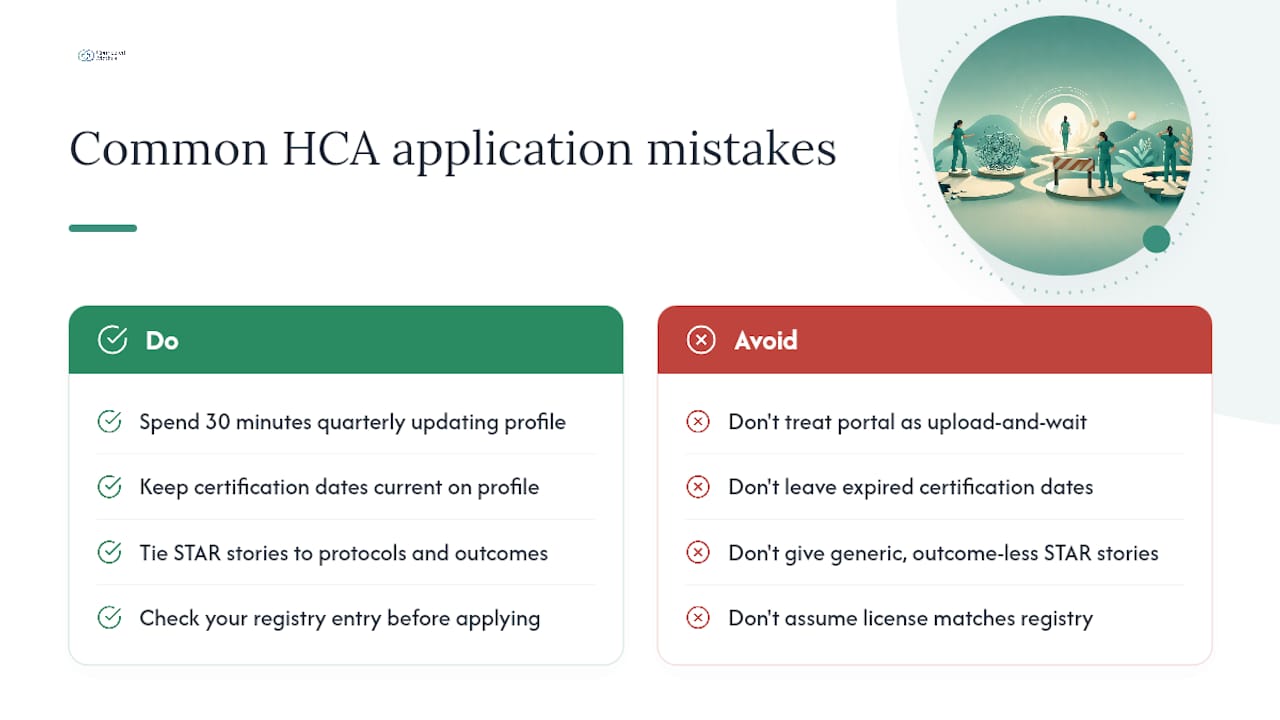
Most candidates treat the HCA portal as a simple upload-and-wait system. It is not. The portal is an active screening layer, and the decisions that determine whether a recruiter ever reads your file happen before any human is involved.
The single most overlooked tactic is profile maintenance. HCA retains candidate data, and recruiters do search the database for past applicants when new roles open. A profile last updated a year ago, with an expired certification date, reads as disengaged. Thirty minutes of quarterly maintenance can generate recruiter outreach with no new application required.
The second gap is STAR preparation. Candidates who prepare stories generically ("I once helped a patient who was upset") consistently lose ground to those who tie the story to a measurable outcome and a specific protocol. HCA's behavioral interview structure rewards specificity, not length.
Finally, most applicants underestimate the credential verification step. A license that appears active on your resume but shows a discrepancy in the state registry will stall or end a conditional offer. Check your registry entry before you apply, not after you receive an offer.
For deeper CV and interview preparation guidance tailored to clinical roles, Connectedmedics publishes specialty-specific resources worth reviewing before your first HCA interview.
Connectedmedics: verified healthcare roles alongside your HCA search
Applying to HCA is a structured process with specific portal requirements. Connectedmedics gives healthcare professionals a parallel advantage: a verified jobs board with over 4,600 active healthcare vacancies, specialty-specific filters, and job alerts that surface roles matching your credentials without manual searching.
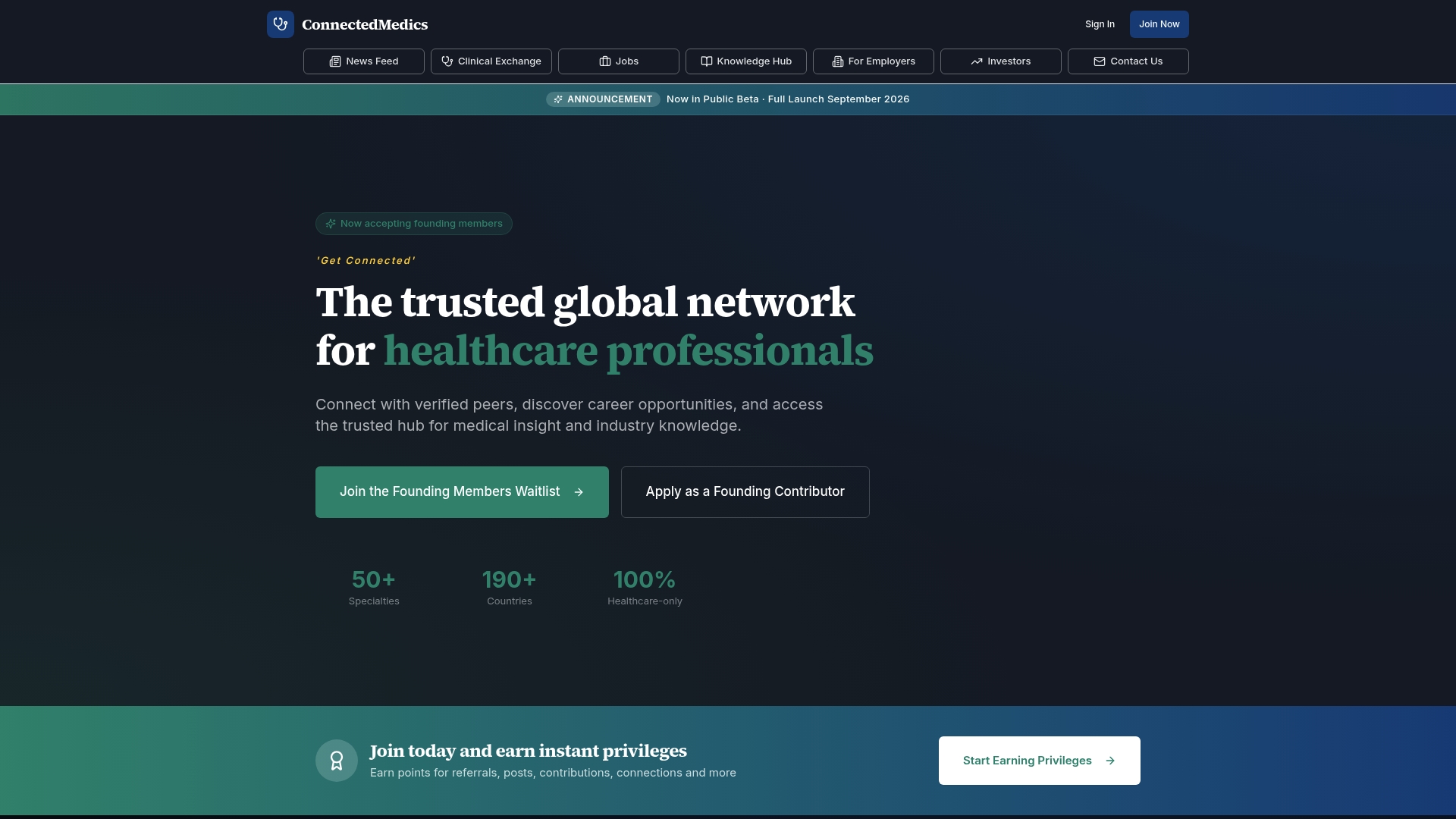
Where generic job boards mix unverified postings across industries, Connectedmedics is built exclusively for healthcare professionals. Profiles are verified, listings are specialty-tagged, and the platform's AI-powered matching surfaces roles aligned to your license type and preferred location. For candidates actively working the HCA hiring process, Connectedmedics functions as a real-time backup pipeline: if an HCA role fills before your application clears, you have qualified alternatives already tracked.
Visit Connectedmedics to set up your verified profile and activate job alerts for HCA-aligned roles today.
Useful sources
- Frequently Asked Questions
- Careers Landing | HCA Healthcare
- Working at HCA Healthcare
- Apply for HCA Jobs: Complete Career Guide 🎯 2026 August
- HCA Careers: Rewarding Opportunities or Tough Road Ahead in 2026?