
A role-tailored, reverse-chronological CV with a concise professional summary, combined with a multi-week mock-interview rehearsal plan ending in panel simulations, is the fastest evidence-backed route to winning consultant- and fellowship-level clinical interviews in the U.S.
Quick CV checklist:
- Contact header (name, phone, email, LinkedIn or professional profile URL)
- 3–4 line professional summary aligned to the target role
- Education and licensure/certifications
- Work history with quantified achievement bullets
- Role-specific skills and CME; remove routine task lists
Quick rehearsal checklist:
- Build a storybank of 6–8 clinical examples using STAR+HR
- Schedule 2–4 mock sessions with role-appropriate panelists
- Record each session and score with a rubric (clarity, evidence, judgment, leadership, presence)
- Create a one-page walk-in plan for morning-of review
Table of Contents
- How should you structure a U.S. clinical CV?
- How do you tailor your CV quickly for a specific posting?
- What interview formats do clinical panels use?
- How do you turn duties into measurable stories for panel interviews?
- What does a 4–6 week mock-interview rehearsal plan look like?
- What should you do in the 72 hours before the interview?
- What is the right way to follow up after a clinical interview?
- How do medical interview panels score candidates?
- How do you address gaps or weaknesses in a clinical CV or interview?
- Key Takeaways
- The gap between clinical excellence and being easy to hire
- Connectedmedics supports your next clinical career move
- Useful sources
How should you structure a U.S. clinical CV?
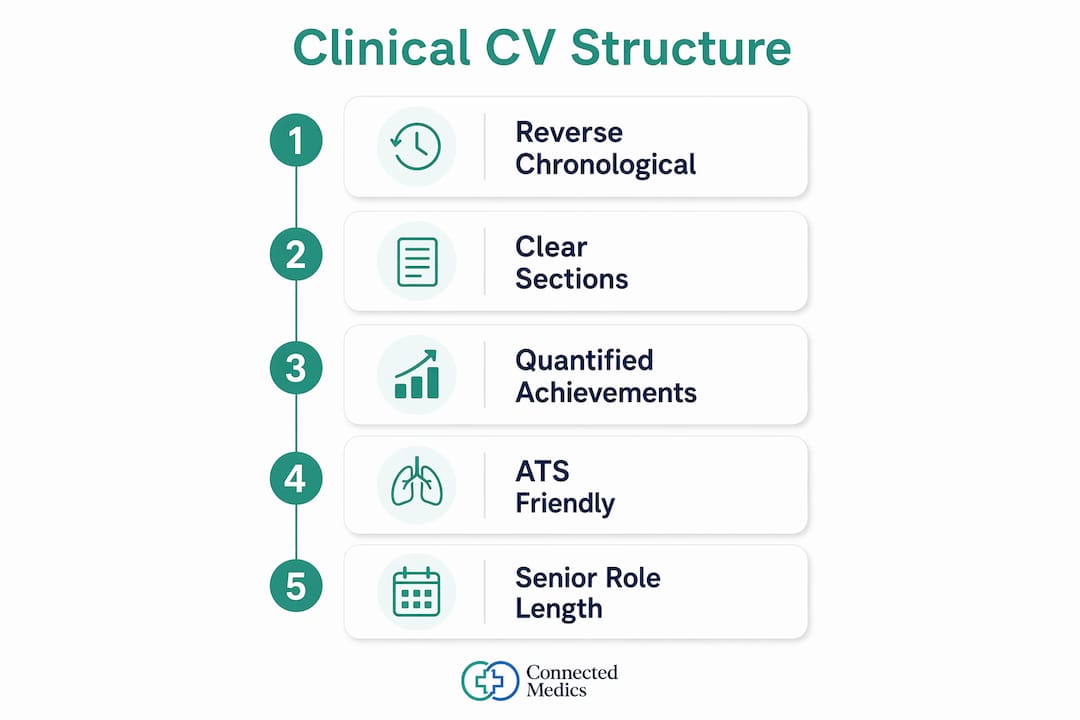
U.S. clinical hiring panels expect a reverse-chronological CV with clear, skimmable sections. The standard order: contact header, professional summary, education, licensure and certifications, clinical work history, research and publications, skills, and CME.
Keep achievement bullets concise, outcome-focused, and ATS-friendly. For senior roles, longer CVs are acceptable; for fellowship applications, shorter CVs are typical.
| Section | What to include | What to remove |
|---|---|---|
| Professional summary | 3–4 lines; role-specific, outcome-focused | Generic objectives ("seeking a challenging role") |
| Work history | Quantified bullets: metrics, team size, protocols | Lengthy daily task lists |
| Research/publications | Peer-reviewed work, grants secured, presentations | Unpublished drafts unless highly relevant |
| Skills | Clinical competencies, EMR systems, leadership | Unrelated software or hobbies |
| CME | Relevant continuing education, board certifications | Outdated or unrelated coursework |
Sample achievement bullets (adapt these):
- Reduced ICU average length of stay by 18% over 12 months by implementing a standardized early-mobility protocol across a 24-bed unit.
- Led a 14-member multidisciplinary team in a quality-improvement initiative that cut 30-day readmission rates by 11% for heart failure patients.
- Secured $320,000 in grant funding to support a two-year clinical trial on post-surgical pain management protocols.
Metrics familiar to U.S. clinical panels include percent change in readmission, length-of-stay reduction, procedure volumes, grant dollars, and educational reach (learners trained). Recruiters also cross-check CVs with LinkedIn, so align both profiles to tell a consistent career story.
How do you tailor your CV quickly for a specific posting?
Treat the CV as a living document adjusted for each application, not a static master file. A focused 15–30 minute edit is enough to meaningfully improve ATS match rates.
Quick-edit checklist:
- Rewrite the professional summary to mirror the posting's language and priorities.
- Reorder the top 3 work-history bullets to lead with the most relevant outcomes.
- Insert 3–5 role-specific keywords from the job description naturally into bullet text.
- Highlight the most relevant research, leadership, or quality-improvement work.
- Confirm your LinkedIn profile matches the updated narrative.
Keyword mapping example: If a posting lists "quality improvement leadership" and "patient safety," scan your existing bullets for those themes and surface them earlier. Do not invent experience; reframe what exists in the posting's language.
AI tools are useful for identifying keywords and spotting structural gaps. Use them for that purpose only. Write the final language in your own voice. Over-reliance on AI to generate interview answers produces responses that experienced hiring panels detect quickly. See also: medical job application tips for a broader tailoring workflow.
What interview formats do clinical panels use?
Consultant, fellowship, and senior clinical interviews differ significantly from standard corporate recruitment. Panels assess specialty-specific competency, clinical judgment, and systems-level thinking, not just general leadership.
| Format | Primary competencies assessed | Typical evidence expected |
|---|---|---|
| Multi-member panel | Leadership, collaboration, cultural fit | Structured narratives, behavioral examples |
| Clinical case presentation | Clinical judgment, safety, decision-making | Case walk-through, outcome data |
| OSCE-style simulation | Procedural skill, communication, safety | Direct observation, structured scoring |
| Leadership/operational interview | Management, strategy, quality improvement | Metrics, team impact, change management |
| Research/academic panel | Research impact, teaching, grant history | Publications, grant amounts, learner reach |
Corporate interviews rarely probe clinical decision-making or patient-outcome data. Medical panels do. Prepare specialty-specific competency examples for each format you are likely to face.
How do you turn duties into measurable stories for panel interviews?
Senior clinicians often fail to convert duties into demonstrated value. Interviewers assess leadership, collaboration, and how candidates handle adversity — not job descriptions. The fix is a structured narrative framework.

STAR+HR framework: Situation, Task, Action, Result, plus Healthcare relevance. The healthcare relevance step connects the outcome to patient safety, system improvement, or team development, which is what clinical panels want to hear.
Sample STAR+HR answer — quality improvement: "Our unit's 30-day readmission rate for COPD patients was above the national benchmark. My task was to lead a root-cause analysis and design an intervention. I convened a multidisciplinary team, mapped discharge gaps, and implemented a structured follow-up call protocol within 72 hours of discharge. Over time, readmissions declined notably. The healthcare relevance: fewer preventable hospitalizations and measurable cost savings for the system."
Sample STAR+HR answer — complex clinical decision: "A post-op patient presented with atypical chest pain on day two. Standard workup was inconclusive. I escalated to a rapid cardiology consult, ordered a CT-PA, and confirmed a pulmonary embolism. Immediate anticoagulation prevented deterioration. The case became a teaching scenario for our residents on atypical PE presentation."
Pro Tip: Keep a 60–90 second version of each story for initial answers and a 2–3 minute expanded version ready for panel follow-ups. This accordion technique lets you compress or expand on demand without losing structure.
Evidence types to cite: readmission rates, average length of stay, procedure volumes, grant amounts, publications, and learner counts. These are the metrics U.S. clinical panels recognize.
What does a 4–6 week mock-interview rehearsal plan look like?
High-fidelity mock interviews — real-time, recorded, role-appropriate — are the single most effective tool for reducing anxiety and tightening delivery before a high-stakes clinical interview. Many candidates show measurable improvement after 3–5 sessions.
| Week | Focus | Time allocation |
|---|---|---|
| Week 1 | Build a set of clinical example stories covering leadership, quality, clinical judgment, research | Several hours |
| Week 2 | Practice clinical and behavioral questions; record and review | A few hours |
| Week 3 | Conduct mock interviews with peers; score and revise weak answers | A few hours |
| Week 4 | Panel simulation with multiple participants | A few hours |
| Final weeks | Final rehearsals; refine walk-in plan; review progress | Limited hours |
Scoring rubric (score each 1–5):
- Clarity: Is the answer structured and easy to follow?
- Evidence of impact: Are outcomes specific and measurable?
- Clinical judgment: Does the answer reflect sound decision-making?
- Leadership: Is team and system-level thinking visible?
- Presence: Is delivery confident and natural, not scripted?
Record every session. Transcribe answers and compare scores across sessions. Aim for measurable progress, not perfect scripting.
What should you do in the 72 hours before the interview?
72-hour and morning-of checklist:
- Print 3–4 copies of your updated CV and a one-page walk-in brief (3–5 strongest STAR+HR stories, key talking points).
- Gather printed copies of key publications, protocols, or quality-improvement data you may reference.
- Confirm references are validated and briefed on the role.
- For virtual interviews: test camera, microphone, lighting, and platform login 24 hours ahead.
- Attire: business professional is standard for U.S. clinical settings; confirm with the recruiter if unsure.
- Morning of: review the walk-in plan only. Do not rehearse full answers.
Panel etiquette: Address senior clinicians by title and last name unless invited otherwise. Ask clarifying questions before answering complex case questions. If panelists interrupt or cross-question, pause, acknowledge the question, and redirect calmly.
Negotiation preparation:
| Step | Action |
|---|---|
| Collect market data | Use MGMA, Medscape, or specialty society salary surveys for your role and region |
| Phrase expectations | "Based on market data for this specialty and region, I'm targeting a range of $X–$Y" |
| Start date flexibility | State your earliest available date; note any contractual notice period |
| Benefits discussion | Defer detailed benefits negotiation to HR after a verbal offer is extended |
What is the right way to follow up after a clinical interview?
Send a brief thank-you email within 24 hours of the interview. Address each panelist individually if you have their contact details; otherwise send one note to the primary recruiter or hiring coordinator and ask them to pass along your thanks.
Keep the note short: two to three sentences confirming your interest, one specific reference to a topic discussed in the interview, and a clear statement that you are available for any follow-up questions. Avoid restating your entire qualifications. A well-placed, specific reference ("I appreciated the discussion about your unit's sepsis protocol work") signals genuine engagement and attention.
If you have not heard back within the stated timeline, one follow-up email to the recruiter is appropriate. Do not contact panelists directly unless invited to.
How do medical interview panels score candidates?
Most U.S. clinical hiring panels use a structured scoring rubric aligned to the competencies the role requires. Common dimensions include clinical knowledge and judgment, communication and interpersonal skills, leadership and management capability, commitment to quality and patient safety, and cultural fit with the department or institution.
Panels often score each dimension on a numeric scale and reach a consensus rating after individual scoring. Knowing this structure helps candidates prepare targeted evidence for each dimension rather than giving generic answers. For fellowship panels, research productivity and teaching contributions typically carry additional weight.
How do you address gaps or weaknesses in a clinical CV or interview?
Gaps in clinical employment, a career pivot, or a period of reduced activity are common in healthcare careers. Address them directly rather than hoping panels will not notice.
On the CV, use a brief parenthetical or a short line in the relevant date range: "Career break: parental leave" or "Sabbatical: research fellowship preparation." Do not leave unexplained white space. In the interview, prepare a one- to two-sentence factual explanation and pivot immediately to what you did during that period and what you gained.
For skill gaps relative to the role, acknowledge the gap, name the steps already taken to address it (CME, additional training, supervised practice), and frame it as a development area with a clear plan. Panels respond better to self-aware candidates with a plan than to candidates who deflect.
Key Takeaways
A role-tailored clinical CV combined with a 4–6 week mock-interview plan that ends in recorded panel simulations is the most direct path to a consultant- or fellowship-level offer.
| Point | Details |
|---|---|
| CV structure | Use reverse-chronological format with quantified achievement bullets and a 3–4 line professional summary. |
| Tailoring | Adjust the summary and top 3 bullets for each posting; insert 3–5 role-specific keywords naturally. |
| STAR+HR stories | Build 6–8 clinical examples with measurable outcomes; keep a 60–90 second and a 2–3 minute version of each. |
| Mock interviews | Complete 3–5 recorded sessions with a scoring rubric; measurable progress across sessions matters more than scripted perfection. |
| Connectedmedics | Use the platform's specialty-filtered jobs board and verified peer network to find target roles and recruit mock-interview partners. |
The gap between clinical excellence and being easy to hire
Being an excellent clinician and being easy to hire in a panel interview are not the same skill. Most clinicians who struggle in high-stakes interviews are not struggling because of clinical knowledge gaps. They struggle because they have never been trained to convert years of complex work into a two-minute structured answer that a non-specialist panelist can evaluate.
The walk-in plan is underused and undervalued. A single page of your 3–5 strongest stories, reviewed the morning of the interview, keeps your best material accessible under pressure rather than buried under nerves. Pair that with at least two recorded mock sessions under realistic panel conditions, and the difference in delivery is significant.
The other overlooked variable: authentic delivery. AI tools can help identify keywords and flag structural gaps in a CV. They cannot replace the natural cadence of a clinician who has rehearsed their own stories in their own voice. Over-polished answers are detectable, and experienced panels notice them quickly.
Connectedmedics supports your next clinical career move
Connectedmedics gives healthcare professionals direct access to over 4,600 verified clinical vacancies, filtered by specialty, role type, and location, so the job search starts with relevant targets rather than generic listings.
The platform's verified peer network is a practical resource for mock-interview preparation. Connect with clinicians in your specialty who have recently navigated similar panels and can provide role-appropriate feedback. The knowledge hub offers curated clinical research summaries and career resources that support both interview preparation and ongoing professional development.
Browse healthcare jobs by specialty on Connectedmedics, use the specialty filters to identify target roles, and tap the peer community for realistic mock-interview partners before your next panel.
Useful sources
| Source | What it covers | How to use it |
|---|---|---|
| How to write a CV | CV structure, achievement-focused bullets, and professional summary guidance | Use as a formatting reference and bullet-writing template |
| CV writing tips — UW–Madison | Academic and clinical CV structure, section order, and skimmability principles | Use for academic/research-focused CV sections and formatting standards |
| STAR interview coaching | Mock-interview methods, STAR frameworks, and session frequency recommendations | Use to design your rehearsal plan and scoring rubric |
| Interview coaching — TopResume | One-on-one coaching structure, mock interview delivery, and salary negotiation prep | Use for coaching service benchmarks and session structure guidance |
| Professional CV in 2026 | Tailoring workflow, AI tool use, and LinkedIn alignment | Use for the tailoring checklist and responsible AI guidance |
| Walk-in plan coaching | One-page walk-in brief, scoring rubrics, and session cadence | Use to build your walk-in plan and track rubric progress across sessions |