
A medical CV template is a structured format that organizes your clinical qualifications, licenses, and experience in a way that satisfies both Applicant Tracking Systems (ATS) and human recruiters. Unlike a generic resume, a healthcare CV follows specific conventions that signal professional credibility before a recruiter reads a single line. The standard structure includes a header with credentials, a professional summary, licenses and certifications, clinical experience, education, and skills. Getting this structure right is the first requirement of any competitive medical job application in 2026.
What are the essential sections of a medical CV template?
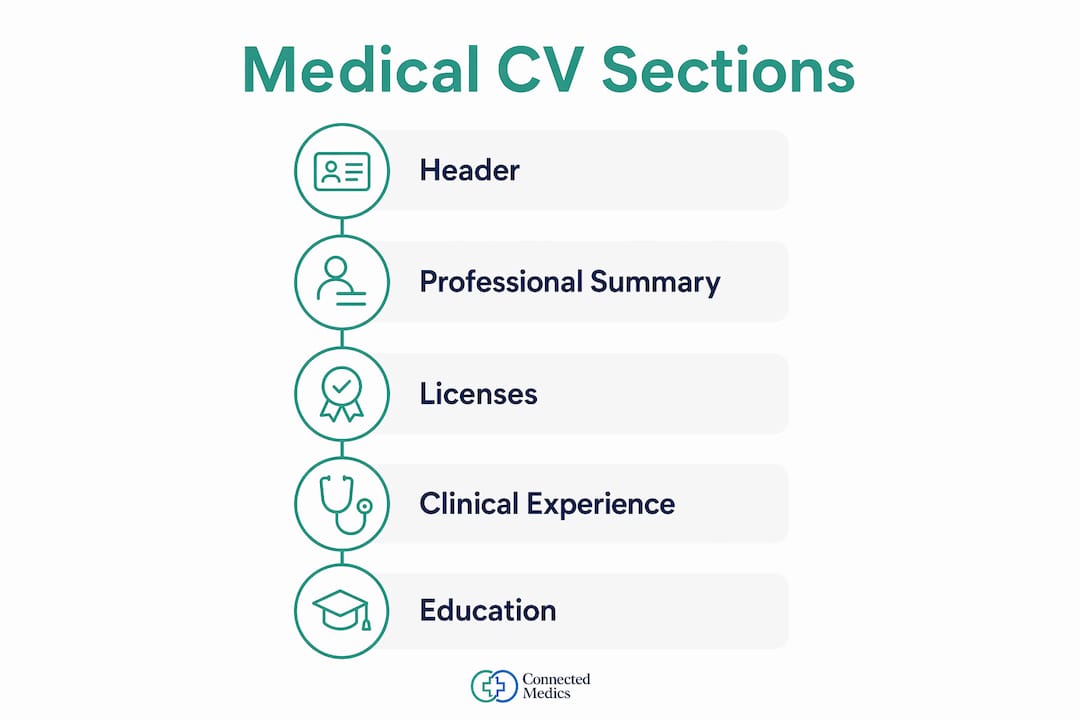
A well-built healthcare CV follows a defined sequence. Each section serves a specific purpose, and omitting any one of them weakens your application.
Header with credentials

Your name must appear at the top, immediately followed by your professional credentials. Credentials after your name such as MD, RN, or MBBS signal your specialty and licensing before a recruiter reads anything else. This small detail prevents recruiters from scanning the entire document to confirm your qualifications.
Professional summary
The professional summary sits directly below your header. A strong summary runs 3–4 sentences and covers your years of experience, primary specialty, and at least one quantified achievement. Avoid generic mission statements. A line like "Board-certified emergency physician with 8 years of experience, reducing average patient wait times by 22% across two Level I trauma centers" outperforms vague claims every time.
Licenses and certifications
This section belongs high on the page, right after your professional summary. Each entry must include the issuing body, license or certification number, and expiration date. Expired certifications should be noted as "Renewal in progress" rather than omitted. Omitting them creates gaps that raise questions.
Clinical experience
List roles in reverse chronological order. Each entry should name the institution, your title, the dates of service, and bullet points that describe patient outcomes and specific responsibilities. Quantify wherever possible: patient volume, procedure counts, complication rates.
Specialized sections
Senior roles require additional sections that core trainees may not need yet. These include:
- Audit and Quality Improvement projects
- Research and Publications
- Teaching Experience
- Presentations and Conferences
- Leadership and Committee Roles
CV length varies by seniority: 2–4 pages for core trainees, 4–6 pages for senior roles, and 6–10+ pages for consultants. A longer CV at consultant level is not padding. It signals the depth of clinical, research, and leadership experience that selection committees expect.
Pro Tip: List your most recent role first in every section. Recruiters and clinical leads read top to bottom, so your strongest, most recent experience should appear before older entries.
How to format a medical CV for ATS compatibility
Formatting is not cosmetic. The wrong layout causes ATS software to misread or discard your CV before a human ever sees it.
Single-column layouts are the standard in medical hiring. NHS recruitment and clinical committee processes favor them for consistency and parseability. Two-column designs, common in creative fields, break ATS parsing logic and reduce recruiter readability in clinical settings.
Typography matters too. Use a clean, standard font at 10–11pt. Avoid decorative typefaces, graphics, icons, and color blocks. These elements confuse ATS and add no clinical value.
Section headings must be standardized. Use labels like "Clinical Experience," "Licenses and Certifications," and "Education." Custom headings like "My Journey" or "Where I've Worked" are not recognized by ATS software.
Keywords drive ATS ranking. Specific clinical competencies and familiarity with EHR systems like Epic and Cerner improve your CV's ATS score. Generic soft skills such as "team player" or "good communicator" add no value. Replace them with specific skills: "Advanced Cardiac Life Support (ACLS) certified," "proficient in Epic EHR," or "experienced in laparoscopic procedures."
Pro Tip: Copy the exact terminology from the job posting into your CV where it accurately reflects your experience. ATS software matches keywords literally, so "Electronic Health Records" and "EHR" are not always treated as the same term.
Key formatting rules to follow:
- Single-column layout only
- Standard fonts (Arial, Calibri, or Times New Roman) at 10–11pt
- No tables, graphics, or text boxes in the body
- Consistent date formatting throughout (e.g., January 2022 to March 2024)
- File saved as a .docx or PDF, depending on the employer's stated preference
How to build your medical CV step by step
A structured process produces a stronger result than filling in a template at random. Follow these steps in order.
-
Gather your source documents. Collect your medical license certificates, employment contracts or letters, audit project summaries, research publications, and teaching records. Having these in front of you prevents guesswork and errors.
-
Write your professional summary last. Draft the rest of the CV first, then write the summary. By that point, you know exactly which achievements are strongest and can select the most relevant one to quantify.
-
Complete the licenses and certifications section with full details. Include the issuing body, the license number, and the expiration date for every entry. For a nursing resume template or a doctor CV template, this section carries significant weight with both ATS and clinical leads.
-
Document clinical experience with outcome-focused bullets. Each bullet should answer: what did you do, for how many patients, and what was the result? "Managed a caseload of 30+ inpatients daily in a 600-bed teaching hospital" is stronger than "responsible for patient care."
-
Add specialized sections relevant to your seniority. If you have completed audits, include the audit title, the standard you measured against, and the outcome. For research, list publications in a recognized citation format such as Vancouver or APA.
-
Tailor keywords to the specific role. Read the job description and identify the clinical terms, EHR systems, and competencies listed. Confirm those terms appear in your CV where they accurately reflect your experience.
The table below shows which sections are required at each career stage:
| Section | Core Trainee | Senior Clinician | Consultant |
|---|---|---|---|
| Header with credentials | Required | Required | Required |
| Professional summary | Required | Required | Required |
| Licenses and certifications | Required | Required | Required |
| Clinical experience | Required | Required | Required |
| Audit and quality improvement | Optional | Required | Required |
| Research and publications | Optional | Required | Required |
| Teaching experience | Optional | Required | Required |
| Leadership roles | Not applicable | Optional | Required |
Common mistakes that weaken a medical CV
Most CV errors fall into a small number of repeatable patterns. Recognizing them is the fastest way to fix them.
- Generic soft skills. "Excellent communicator" and "works well under pressure" tell a recruiter nothing specific. Replace these with clinically relevant skills and named software proficiencies.
- Missing or incomplete credentials. A license listed without an expiration date or issuing body looks incomplete and raises compliance concerns.
- Two-column or graphic-heavy layouts. These formats fail ATS parsing and slow down clinical leads who need to assess competence quickly.
- Dishonest status on certifications. Never list an expired certification as current. Note it as "Renewal in progress" if that is accurate.
- Applying the same CV to every role. A CV for a general practice position and one for a surgical registrar post should not be identical. Tailor the keywords, the summary, and the order of specialized sections to match each role.
Pro Tip: Before submitting, run your CV through a free ATS checker tool to see which keywords are missing or flagged. This takes five minutes and can significantly improve your shortlisting rate.
Physician CV tips for specific roles go deeper on tailoring strategies for different specialties. The core principle holds across all of them: specificity beats generality every time.
Key Takeaways
A structured, ATS-compatible medical CV with complete credentials, quantified clinical experience, and role-specific keywords is the single most effective tool for advancing a healthcare career in 2026.
| Point | Details |
|---|---|
| Lead with credentials | Place MD, RN, or equivalent directly after your name in the header. |
| Use a single-column layout | Two-column designs fail ATS parsing in medical recruitment settings. |
| Quantify clinical experience | Include patient volumes, procedure counts, and measurable outcomes in each role. |
| Match CV length to seniority | Consultants need 6–10+ pages; core trainees need 2–4 pages. |
| Tailor keywords per role | Copy exact clinical terms from the job description where they reflect your experience. |
What I've learned about medical CVs after years of watching them succeed and fail
The biggest mistake I see healthcare professionals make is treating their CV as a static document. They build it once, save it, and send the same file to every employer for years. That approach fails in medical recruitment, where selection panels assess candidates against a specific person specification for each post.
The second pattern I notice is undervaluing specialized sections. Audit and quality improvement work, in particular, gets buried at the bottom of CVs or left out entirely. Clinical leads look for evidence that you engage with service improvement, not just patient care delivery. A completed audit cycle with a measurable outcome tells a selection panel more about your clinical thinking than a list of procedures ever will.
The formatting debate is settled. Plain, structured layouts win. I have seen beautifully designed two-column CVs from talented clinicians get rejected at the ATS stage before a human read a word. The design added nothing and cost them the shortlist.
One thing that does not get enough attention is the professional summary. Most healthcare professionals write it as an afterthought. A tightly written summary with a specific achievement is often the only section a recruiter reads before deciding whether to continue. Treat it as your strongest 4 sentences, not a formality.
The CV requirements for medical roles will keep evolving, particularly around EHR proficiencies and digital health competencies. Building a habit of updating your CV after every significant role, audit, or publication keeps you ready without the last-minute scramble.
— David
Connectedmedics: career resources for healthcare professionals
Healthcare professionals who want verified job leads alongside practical career resources have one place built specifically for them.
Connectedmedics is a global healthcare network with over 4,600 active vacancies across specialties, verified professional profiles, and a knowledge hub curated by medical experts. The platform provides access to healthcare-specific job alerts, clinical insights, and career guidance that generic professional networks cannot match. Whether you are a core trainee refining your first CV or a consultant exploring senior roles, Connectedmedics connects you to opportunities and resources relevant to your specialty. Explore healthcare salary trends and role-specific career data directly on the platform.
FAQ
What is a medical CV template?
A medical CV template is a pre-structured format designed for healthcare professionals that organizes credentials, clinical experience, licenses, and specialized achievements in a layout compatible with ATS and clinical recruitment panels.
How long should a medical CV be?
CV length depends on seniority: 2–4 pages for core trainees, 4–6 pages for senior clinicians, and 6–10+ pages for consultants. Length at senior levels reflects the depth of clinical, research, and leadership experience expected by selection committees.
What is the difference between a medical CV and a resume?
A medical CV is a comprehensive document covering all clinical roles, publications, audits, and teaching experience, with no page limit. A resume is a shorter, role-specific summary typically used outside healthcare and academic settings.
Should I use a two-column layout for my healthcare CV?
No. Single-column layouts are standard in medical hiring because two-column designs interfere with ATS parsing and reduce readability for clinical leads and recruitment committees.
What keywords should I include in a medical CV?
Include specific clinical competencies, named EHR systems such as Epic and Cerner, and certification names like ACLS or BLS. EHR system proficiencies are frequently scanned by hospital recruitment software and improve your ATS ranking directly.