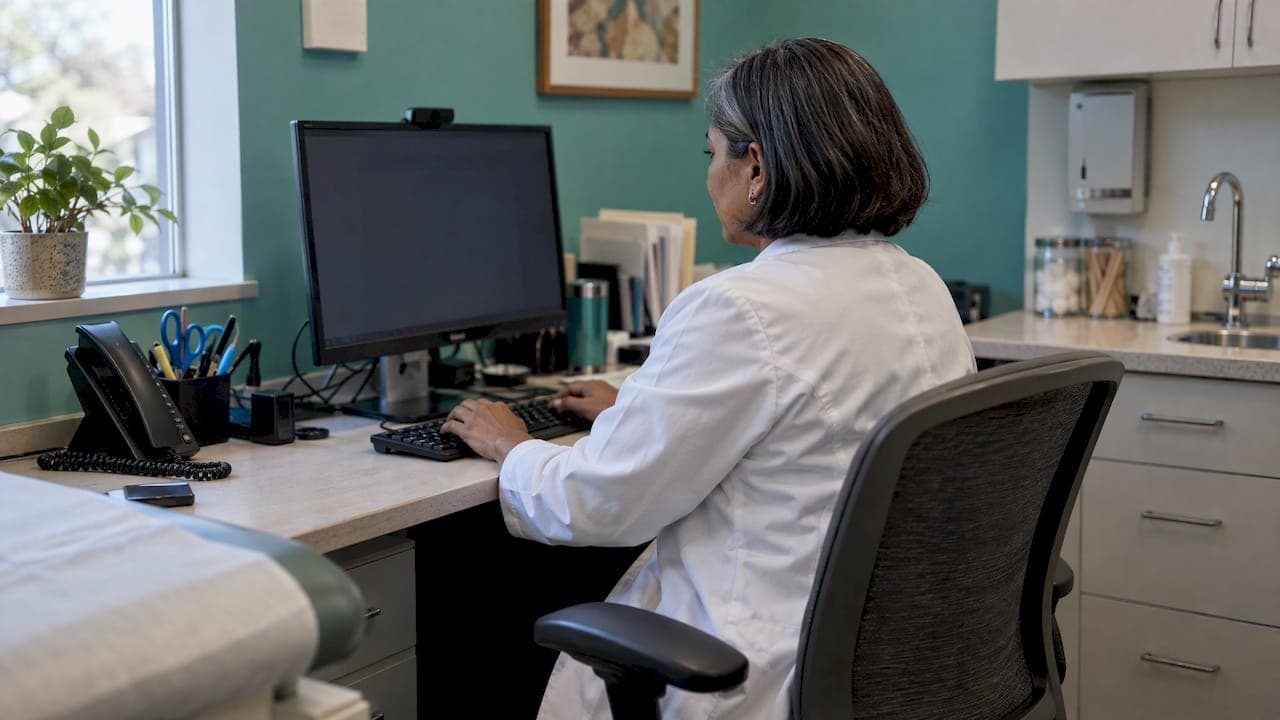
Dermatology forums fall into four types: society-run communities, trainee discussion boards, specialty-neutral verified networks and open social groups. Each suits a different clinician. Society communities are best for case discussion. Verified networks are best for careers. Open groups are the least predictable on privacy. This guide covers each type, who can join, how to check credibility and privacy, and where dermatology job boards fit.
TL;DR
- Dermatology forums include society-run communities, trainee boards, verified networks and open social groups.
- Access differs. Some forums are for members of one society only. Others accept any verified clinician.
- Check moderation, verification and patient privacy rules before posting a case.
- Job boards come in two kinds: specialty boards and general boards that also list medical roles.
- Verify every employer before sharing personal or financial data.
Table of Contents
- What dermatology forums are used for
- Types of dermatology forums
- Comparison at a glance
- How to judge a forum before you post
- Privacy rules for posting cases
- Research and ingredient discussions
- Dermatology job boards
- Spotting fake job postings
- Access and cost across forums and boards
- Our perspective
- Build a dermatology network that works
- Find peers and roles on ConnectedMedics
- FAQ
- Sources
What dermatology forums are used for
A dermatology forum is an online space where clinicians discuss cases, therapies, research and careers. Uses:
- Second opinions on unusual presentations
- Treatment questions from daily practice
- Trial and research news
- Residency and career questions
- Referral and job leads
The research backs this up. A JAMA Dermatology article on social networking sites describes online professional communities as places where providers communicate, share knowledge and discuss care. Journals and professional organizations can also use them to distribute research, clinical-trial news, education and commentary. The authors see value in the timely, less formal conversation these spaces allow next to conventional publishing.
A review of dermatology education resources lists discussion boards, online communities and journal clubs among the self-directed, remotely accessible tools for students and clinicians.
A forum is not a clinic. Online talk does not replace an encounter between patient and physician. That point comes back in the privacy section.
Types of dermatology forums
Society-run clinical communities
Professional societies run the most credible peer spaces, because membership is checked before anyone posts.
The American Academy of Dermatology launched its AAD Clinical Community in 2022. It is a secure, moderated forum by dermatologists for dermatologists, free to AAD members. By the 2023 report it had onboarded 21,019 members and passed 10 million views. About 80% of discussions received a response from a dermatology expert.

The Society of Dermatology Physician Associates runs SDPA Connect, a community hub exclusive to dermatology physician associates. It supports clinical case collaboration, networking and career development. It offers personalized feeds, case collaboration and member recognition badges.
Pattern: a narrow audience, a verified membership and high-quality replies. The trade-off is access. A nurse practitioner or a researcher outside the society cannot join.
Trainee and student boards
Residents, fellows and students use public discussion boards to compare residency programs, research paths and career options. These boards are open and anonymous, so advice varies in quality. They suit orientation and peer comparison. They do not suit identifiable patient cases.
Subspecialty and topic forums
Some forums cover a single area, such as acne, pediatric dermatology or innovation in dermatologic science. Media brands in the field run topic-based forum series with news and insight. A pediatric dermatology society runs an online case forum where members discuss cases in search of a diagnosis or management options. Topic forums give depth. They offer less breadth for careers.
Open social groups
Large groups on general social platforms discuss complex cases and real-world practice. Reach is wide and replies are fast. Verification, moderation and data handling are set by the platform and the group admins, not by a clinical body. Treat these as public spaces.
Verified, cross-specialty networks

A fifth route sits between societies and open groups: a healthcare-only network with credential-checked profiles and specialty communities. ConnectedMedics is one. Its pitch is a healthcare-only, verified network with specialty targeting across 190+ countries, plus a global jobs board and a knowledge hub. See the guide to medical forums for doctors and the overview of doctor networking platform types for how these compare.
Comparison at a glance
| Type | Who can join | Best for | Main watch-out |
|---|---|---|---|
| Society community (AAD, SDPA) | Members of that society | Case discussion with peers | Closed to non-members |
| Trainee board | Open, often anonymous | Residency and career questions | Uneven advice quality |
| Topic or subspecialty forum | Varies by host | Deep topical news | Narrow scope |
| Open social group | Anyone approved by admins | Fast replies, wide reach | Privacy depends on the platform |
| Verified cross-specialty network | Verified healthcare professionals | Networking, jobs, knowledge | Less niche than a society hub |
How to judge a forum before you post
Use five checks. They take a few minutes.
- Who is verified? Look for credential checks at sign-up. Open forums cannot tell a dermatologist from a layperson.
- Who moderates? A named society or editorial team is better than anonymous admins. The AAD community describes itself as moderated and secure.
- What do the rules say about advice? Some communities state they are not a source of medical advice for the public. That is a good sign for a professional space.
- How are posts stored and shared? Read the privacy policy. Check who can see your profile and whether posts are indexed by search engines.
- Does it separate personal and professional? The AMA guidance advises physicians to consider separating personal and professional content online and to routinely monitor their presence for accuracy and appropriateness.
The vetting checks for cardiology forums and the privacy-first radiology forums guide apply to dermatology too. The same applies to privacy controls in medical networking.
Privacy rules for posting cases
Dermatology is visual. Photos can identify a patient through a tattoo, a face, a distinctive scar or metadata. Rules to follow:
- Deidentify everything. An AMA Journal of Ethics article says clinicians using social media must comply with HIPAA, protect patient confidentiality and deidentify posted information. It was written about plastic surgeons, and the principle carries over.
- Keep boundaries. The same article says online communication does not substitute for a patient-physician encounter.
- Do not give individual advice to people who are not your patients.
- Flag problems. The AMA guidance says physicians should bring unprofessional content to a colleague's attention. If it significantly violates professional norms and is not addressed, they should report it to the appropriate authorities.
- Mind blurred identities. A case-based analysis in the AMA Journal of Ethics says blurred personal and professional identities raise ethical and legal challenges and can complicate patient-physician relationships.
If your employer or institution has a social media policy, read it before posting images. For questions about a specific case, ask your compliance or privacy officer.
Research and ingredient discussions
Many threads move from clinical cases to the science behind topical products, peptides and cosmetic actives. When a thread cites bench work, read the primary source and check whether it is lab research or clinical evidence. Background reading such as dipeptide 2 research applications can help you follow ingredient-level talk in skin-science threads. Clinical claims still need peer-reviewed human data.
For trial news, the top clinical study networking tools for US researchers page lists ways to find collaborators.
Dermatology job boards
Forums lead to jobs through referrals. Job boards are the direct route. Two kinds matter.
Specialty boards
The AAD's career development page points to AAD CareerCompass, a board where dermatology job seekers can search open positions. The same page covers career launch resources, guidance on hiring staff, and information on joining or selling a practice. Society boards fit dermatologists and trainees well. Check the society's page for access terms.
General boards with medical categories
General job sites also post medical roles, including dermatology. A guide to finding dermatology jobs notes that these sites are not physician-specific. Results may include physician assistant and administrative positions. Filter hard by title, setting and credential.
Healthcare-only boards
Healthcare-only boards sit between the two. They list roles for doctors, nurses, pharmacists, researchers, healthcare assistants and home care assistants in one place. ConnectedMedics reports over 22,000 active healthcare vacancies, with specialty filters and work permits available online. Use specialty and location filters to narrow results to dermatology roles.
What to compare
- Specialty depth: how many dermatology roles appear.
- Role mix: physician, PA, NP, nurse, research or administrative.
- Location filters: state, city, remote or telehealth.
- Profile visibility: who can see your profile, and whether you can hide it from your current employer.
- Cost to job seekers: many boards are free for candidates. Check before you upload a CV.
- Work authorization: look for visa and permit information on the listing.
Spotting fake job postings
Fake listings target clinicians too. The FBI's Internet Crime Complaint Center warned that fake postings may appear on job boards but not on the company's website. They may use non-company email domains and ask for credit card, bank or personal information. Its advice: verify the employer before sharing sensitive data.
A quick routine:
- Find the same listing on the employer's own site.
- Check that recruiter emails use the employer's domain.
- Never pay to apply or to "secure" a position.
- Share license and Social Security details only after a verified offer process.
- Confirm the practice or hospital exists through a state license lookup or a phone call to its main line.
Access and cost across forums and boards
Costs and entry rules differ by type:
- Society communities: tied to membership. The AAD Clinical Community is free to AAD members, so the cost is the dues. SDPA Connect is exclusive to dermatology PAs.
- Trainee boards and open groups: typically free to read and join.
- Verified networks: profile creation is generally free for clinicians. Employers pay for posting and recruiting tools.
On ConnectedMedics the employer side has a Free plan, a Growth plan at £99 per month, and Enterprise and Premium Employer plans without a published price. Details are on the employer plans page and the Premium Employer page.
Our perspective
Dermatology talk is scattered. Clinicians use one society hub, one open group and one job site. Each holds a piece.
We built ConnectedMedics as a healthcare-only network. Profiles are credential-checked. Communities are led by specialty. The jobs board and the knowledge hub sit in the same account.
Our view: relevance matters more than reach. A dermatologist does not need a general feed. A dermatologist needs peers, current research and roles that fit. Verification keeps the room professional. Specialty targeting keeps it useful.
Societies will keep running excellent member spaces. We add a place that crosses titles and borders: doctors, nurses, pharmacists, researchers and healthcare assistants in one verified network.
David
Build a dermatology network that works
Start with the basics: a complete profile, a clear specialty, and a location. Then:
- Join the society community you qualify for.
- Add a verified network for cross-specialty contacts and job alerts. The medics connect guide explains how professionals network in 2026.
- Read before posting. Learn the tone and the rules.
- Contribute deidentified cases and cited research summaries.
- Follow up one-to-one with people who answer well.
Medical students and trainees can start with the doctor net guide. Nurses in dermatology settings may find the guide to nursing specialty forums and the piece on how nurses share best practice online useful.
Find peers and roles on ConnectedMedics
ConnectedMedics gives healthcare professionals verified profiles, specialty-based communities, a global jobs board and a knowledge hub with clinical news and research summaries. Employers can post jobs and reach verified clinicians.
Create a profile or browse roles at ConnectedMedics. Employers can compare plans on the employer page. The Knowledge Hub carries research summaries and clinical guides.
FAQ
Are dermatology forums safe for discussing patient cases?
They can be, if the forum is moderated and verified and you deidentify everything. Follow HIPAA and your institution's policy. Avoid posting images that show faces, tattoos or other identifying features on open platforms.
Can nurses, PAs and researchers join dermatology forums?
It depends on the forum. Some are limited to one profession, such as SDPA Connect for dermatology physician associates, and the AAD Clinical Community is built for dermatologists. Cross-specialty verified networks accept several healthcare roles.
Which dermatology job boards are worth using?
Use a mix. A society board such as AAD CareerCompass covers dermatology roles. General boards add volume but also bring in unrelated medical and administrative jobs. A healthcare-only board adds specialty filters across professions.
How do I avoid job posting scams?
Match the listing to the employer's own site, check the email domain, and never share bank or card details early. The FBI's IC3 advises verifying employers before sharing sensitive data.
Sources
- Social Networking Sites: Emerging and Essential Tools (JAMA Dermatology)
- Dermatology education and the Internet
- AAD Clinical Community surpasses 10 million views
- SDPA Connect, Society of Dermatology Physician Associates
- AMA House of Delegates Handbook, Reference Committee G
- AMA Journal of Ethics, social media and confidentiality
- Why Can't We Be Friends? (AMA Journal of Ethics)
- AAD career development
- How To Find the Best Dermatology Jobs
- FBI IC3 public service announcement on fake job postings
- Dipeptide 2: Research Applications and Mechanisms