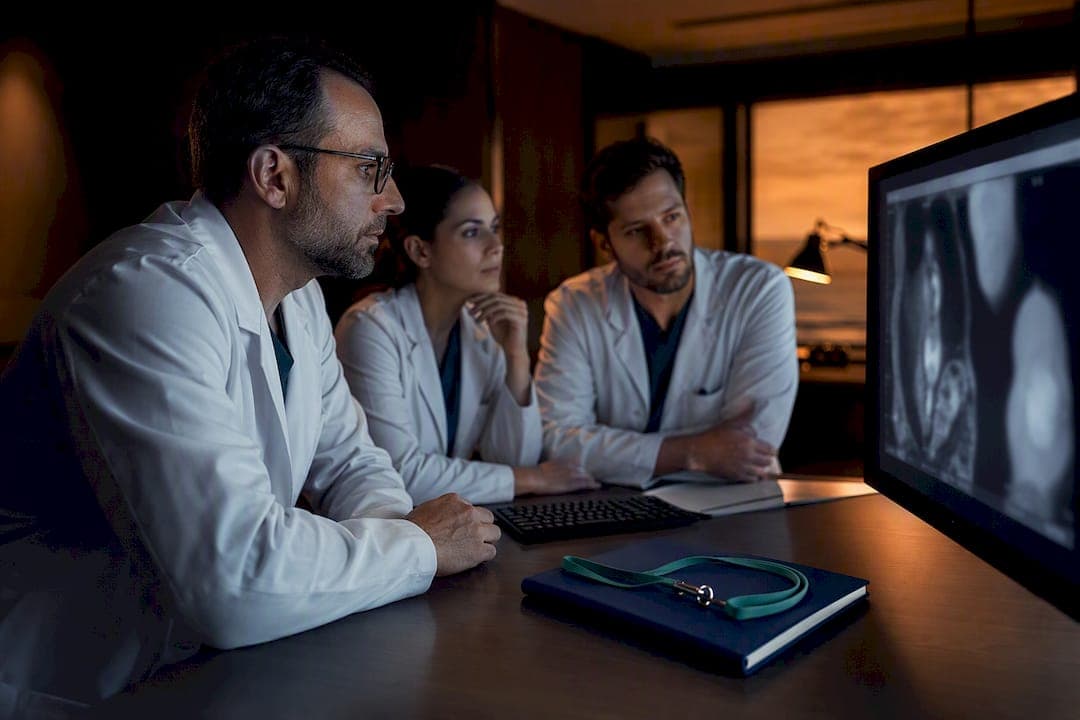
Radiologists and trainees rely on a handful of forum types: threaded message boards, society-hosted communities, subreddits, and real-time chat groups on platforms like Telegram or Discord. The right pick comes down to three filters: audience fit, verification standards, and active moderation. Society communities such as RSNA and ACR Engage offer credentialed, moderated spaces, while a specialty network like Connectedmedics adds verified profiles and job matching on top of clinical discussion.
TL;DR:
- Verified society-backed communities like RSNA and ACR Engage provide credentialed, moderated spaces with active oversight and clear rules.
- Open platforms like Reddit and unverified chat groups have wide participation but often lack consistent moderation, increasing the risk of misinformation.
- Running a quick background check on verification methods, moderation activity, and recent engagement helps ensure a forum’s reliability before joining or posting.
- When conflicting opinions arise, focus on the reasoning and context behind each reply rather than volume, and always cross-check with institutional resources for patient care.
- Connecting with a verified network like Connectedmedics offers both credible case discussions and access to thousands of healthcare job listings, bridging clinical and career needs.
Table of Contents
- What Types of Radiology Forums Exist?
- Where Do You Find Reputable Radiology Networking Sites?
- How Do You Choose the Right Radiology Forum for You?
- How Do You Post a Radiology Case Safely and Professionally?
- Why a Verified Network Changes the Signal-to-Noise Ratio
- What Are the Most Common Reasons Radiologists Use Forums?
- How Do You Know a Radiology Forum Is Credible?
- What Should You Do When Forum Advice Conflicts?
- An Editorial Take on Picking Your First Radiology Community
- Get Verified Connections and Radiology Jobs in One Place
- Where Else to Look for Reliable Radiology Resources
- Sources
- FAQ
What Types of Radiology Forums Exist?
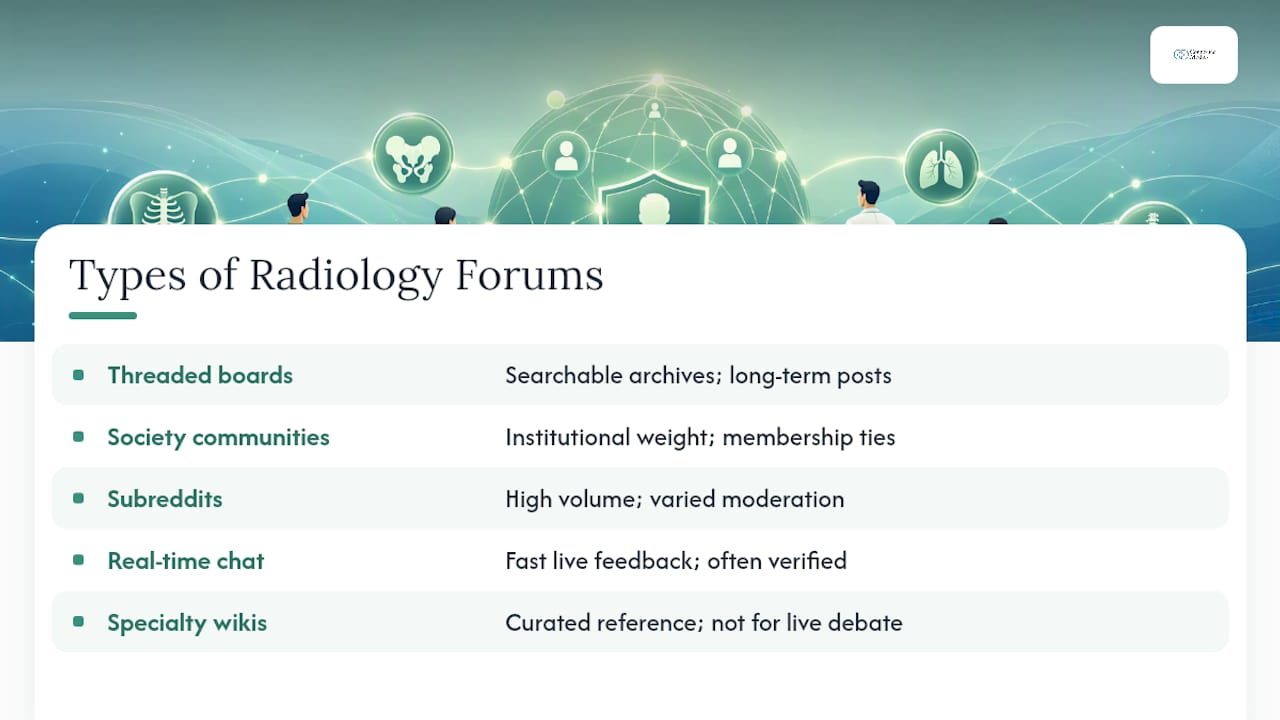
Every radiology discussion group solves a slightly different problem, and picking the wrong format wastes time you could spend on actual cases.
Threaded message boards hold up well over time. Posts stay searchable for years, which makes them useful for tracking down a rare case someone discussed three years ago or reading old fellowship-match threads. Student Doctor Network's radiology forum is a good example: residents and applicants use it to compare programs and swap interview notes, and the archive itself becomes a resource.
Society-hosted communities carry the most institutional weight. RSNA's member communities and ACR Engage both organize discussion around special-interest groups, so a breast imager or a neurobiologist finds a focused thread rather than a general feed. Membership ties to your society credential, which cuts down on noise.
Subreddits win on volume and openness. Anyone can post, anyone can reply, and that openness is both the appeal and the risk. Moderation varies by subreddit, and posters range from attendings to medical students to curious laypeople, so treat clinical advice there as a starting point, not a verdict.
Real-time chat groups on Telegram or Discord move fast. During the COVID-19 surge, platforms like Raddiscord ran live polling and "hot seat" case sessions that gave residents immediate feedback loops impossible to replicate on a static board. Entry to these groups often requires verification, which keeps the professional tone intact.
Specialty wikis like Radiopaedia's community function more as curated reference libraries than live discussion. They're built for looking up a finding, not debating one in real time.
Where Do You Find Reputable Radiology Networking Sites?
Start with the sources that already vet their members, then widen out from there.
- Check society portals first. RSNA and ACR both run member-only discussion areas tied to your existing credential, so verification is already built into your login.
- Follow specialty blogs and trainee networks. Fellowship program pages, radiology residency blogs, and newsletters frequently link to the specific forums their alumni use.
- Look at what verification the group requires. Institutional email addresses, moderator review of new members, credential uploads, or active society membership are all standard gatekeeping methods.
- Match access level to the conversation. Closed, verified groups suit sensitive case discussion or job leads; open communities work better for general awareness or outreach content.
- Watch for red flags. Anonymous accounts with no verification, groups with zero posted rules, or requests to download copyrighted teaching images outside the platform's terms are signs to leave.
Telegram groups aimed at radiologists, like RadioGyan, often enforce identity checks and ban anonymous profiles specifically to keep the membership professional. That single policy tells you more about a group's quality than its follower count ever will.
How Do You Choose the Right Radiology Forum for You?
Run through this before you join anything, not after you've already posted a case.
- Audience fit: Is this built for trainees, attendings, or a specific subspecialty, and does that match where you are right now?
- Moderation and safety: Are there published rules, and do moderators actually enforce them?
- Verification and trust: Does the group check credentials or lean on society backing, or is anyone with an email address welcome?
- Activity and content quality: Are recent threads getting substantive replies, or is the feed mostly stale?
- Feature needs: Does it offer a jobs board, CME credit, a searchable archive, or mobile notifications you'll actually use?
Pro Tip: Lurk for a week before posting anything. Read the pinned rules, skim the last twenty threads, and note who replies and how. A forum with sharp, respectful case discussion in its archive will treat your first post the same way.
Turn those five criteria into a quick yes/no checklist: Does the group match my training level? Is membership verified? Are rules posted and enforced? Has someone posted in the last week? Does it offer job leads or CME? Can I search old threads? Is there a mobile app or notification system? If you answer "no" to more than two, keep looking.
How Do You Post a Radiology Case Safely and Professionally?
Sharing a case for feedback is one of the most valuable things a radiology online community offers, but it only works if the post protects the patient and gives readers enough to actually help.
- Strip every identifier. Remove name, medical record number, date of birth, accession number, and any burned-in text on the image. Check DICOM metadata too, since patient details often hide in the header even after the visible overlay is cropped.
- Crop out facial features on any study where the face is visible, such as a head CT reconstructed in 3D.
- Get consent when required. Many institutions require written or recorded patient consent before an image leaves the electronic record for educational sharing, even de-identified. Check your institution's policy before you post, not after.
- Structure the post for a fast, useful reply. The most effective format runs: a focused clinical question, brief relevant history, anonymized representative images, a concise summary of findings and differential, and an explicit ask such as "What would you report here?" That structure speeds up moderator review and produces more useful replies than a vague "thoughts?" caption.
- Expect moderator scrutiny, and respond to it. A well-run group will flag anything that looks like residual PHI before it flags a wrong diagnosis.
In groups where PHI risk runs higher, visible moderation logs and searchable, archived threads are a meaningful trust signal. If a community can't show you how it handles a privacy complaint, that's worth noting before you contribute your first case.
Why a Verified Network Changes the Signal-to-Noise Ratio
Generic social platforms let anyone weigh in on a radiology case, which is exactly the problem. Verified, specialty-focused networks raise the signal-to-noise ratio by restricting membership and curating content, and that shows up directly in the checklist above.
Connectedmedics builds its radiology community around three pieces that map to those selection criteria:
- Verified profiles confirm the person replying to your case is a credentialed radiologist, not an anonymous account.
- A curated knowledge hub summarizes research and imaging trends, so members get vetted context alongside raw discussion.
- A jobs board listing over 4,600 healthcare vacancies connects the same professional network to career opportunities, closing the gap between clinical discussion and job leads.
Before you trust any platform's verification claims, look for concrete evidence: active, recent job postings rather than stale listings, visible credentials on the people replying to cases, and sample knowledge-hub summaries you can actually read before joining. A network that can't show its work on any of those points is asking you to take its word for it.
What Are the Most Common Reasons Radiologists Use Forums?
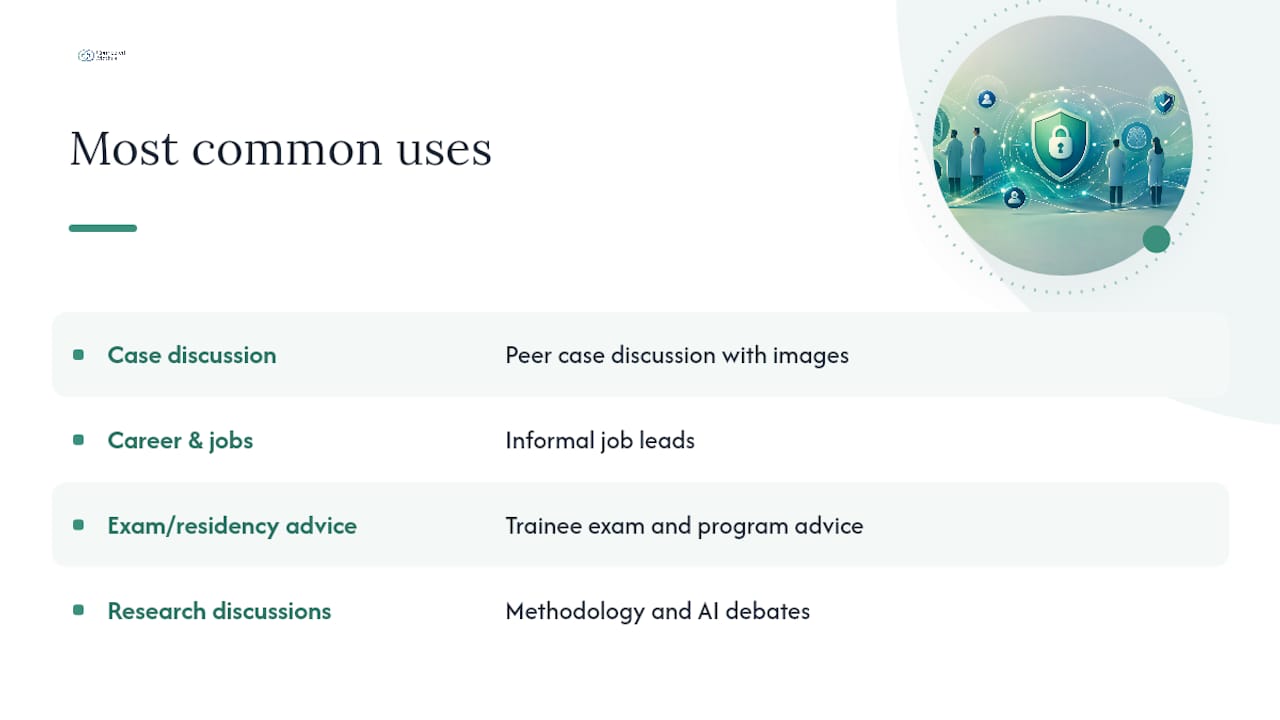
Four use cases account for most of the traffic on any radiology discussion platform, and each one rewards a slightly different approach.
Case discussion is the anchor activity. A radiologist posts an ambiguous finding, attaches anonymized images, and asks for differential input from peers who may have seen something similar. This is where threaded boards and verified communities earn their keep, since a searchable archive turns today's tricky case into next year's reference.
Career and job posts run a close second, especially in trainee-heavy spaces. Fellowship openings, locum coverage, and full-time attending roles get shared informally long before they hit a formal job board, and a specialty-filtered jobs search can turn that informal lead into an actual application.
Exam and residency advice dominates trainee-focused corners of the internet. Applicants compare program cultures, board-exam study strategies, and interview experiences, often cross-referencing official guidance like the AAMC's ERAS application timeline against what current residents say on forums.
Research discussions cover everything from statistical methodology questions to debates over emerging tools, including how AI is reshaping diagnostic radiology. These threads tend to run longer and attract more senior voices, since the questions are less about "what is this" and more about "how do we know."
How Do You Know a Radiology Forum Is Credible?
Credibility signals are consistent across formats, even when the platforms look completely different.
Start with who runs it. A forum backed by a recognized society or institution has already done some vetting for you, since membership usually ties back to a verifiable credential. An anonymous Facebook group with no listed administrator has done none of that work, and you're trusting strangers by default.
Check the moderation trail next. Scroll through a few threads and see whether moderators actually intervene when something goes wrong, whether that's a privacy violation, a hostile reply, or a post that strays into giving direct patient-care advice outside an educational context. Published, enforced rules are a far better signal than a long member count.
Look at how disagreements get resolved. A credible group lets people push back on a diagnosis with evidence and keeps the tone collegial. A forum where the loudest voice wins, regardless of accuracy, tends to produce worse case discussion over time, not better.
Finally, weigh activity against size. A group with ten thousand members but three posts a month tells you the size number is decorative. A tighter group with steady, substantive weekly threads is doing more for your actual practice than a large, dormant one.
What Should You Do When Forum Advice Conflicts?
Disagreement on a radiology case discussion thread isn't a failure, it's often the most useful part of the post.
Treat conflicting replies as a differential, not a tiebreaker. If three radiologists suggest three different read-outs on an ambiguous finding, that spread of opinion usually reflects genuine diagnostic uncertainty rather than someone being wrong. Note the reasoning behind each answer, not just the conclusion.
Weight replies by context, not volume. A single detailed response from a fellowship-trained subspecialist carrying specific reasoning is worth more than five quick agreements with no explanation. Look for who cites imaging findings, prior studies, or clinical correlation, and who's simply pattern-matching from a thumbnail.
Cross-check against your own institution's resources when the stakes are real. Forum input works well for building a differential or sanity-checking an unusual pattern, but it should never replace your own read, your attending's sign-off, or a formal second opinion when patient care is on the line.
When you genuinely can't resolve the disagreement, say so in the thread. Asking a clarifying follow-up, such as what specific feature is driving someone's read, usually surfaces the reasoning gap faster than re-posting the same images and hoping for consensus.
An Editorial Take on Picking Your First Radiology Community
Skip the debate about which platform is "best" and just join one verified, moderated community that matches your subspecialty, then spend a week reading before you post anything. Your first contribution should be one well-prepared case, not a stream of quick questions. That single habit filters out more noise than any feature list ever will.
— David
Get Verified Connections and Radiology Jobs in One Place
Connectedmedics gives radiologists a specialty network built around verified profiles, so the cases and career leads you see come from credentialed peers rather than anonymous accounts. That's the practical difference from an open subreddit or an unmoderated chat group: you skip the guesswork over who's actually qualified to weigh in.
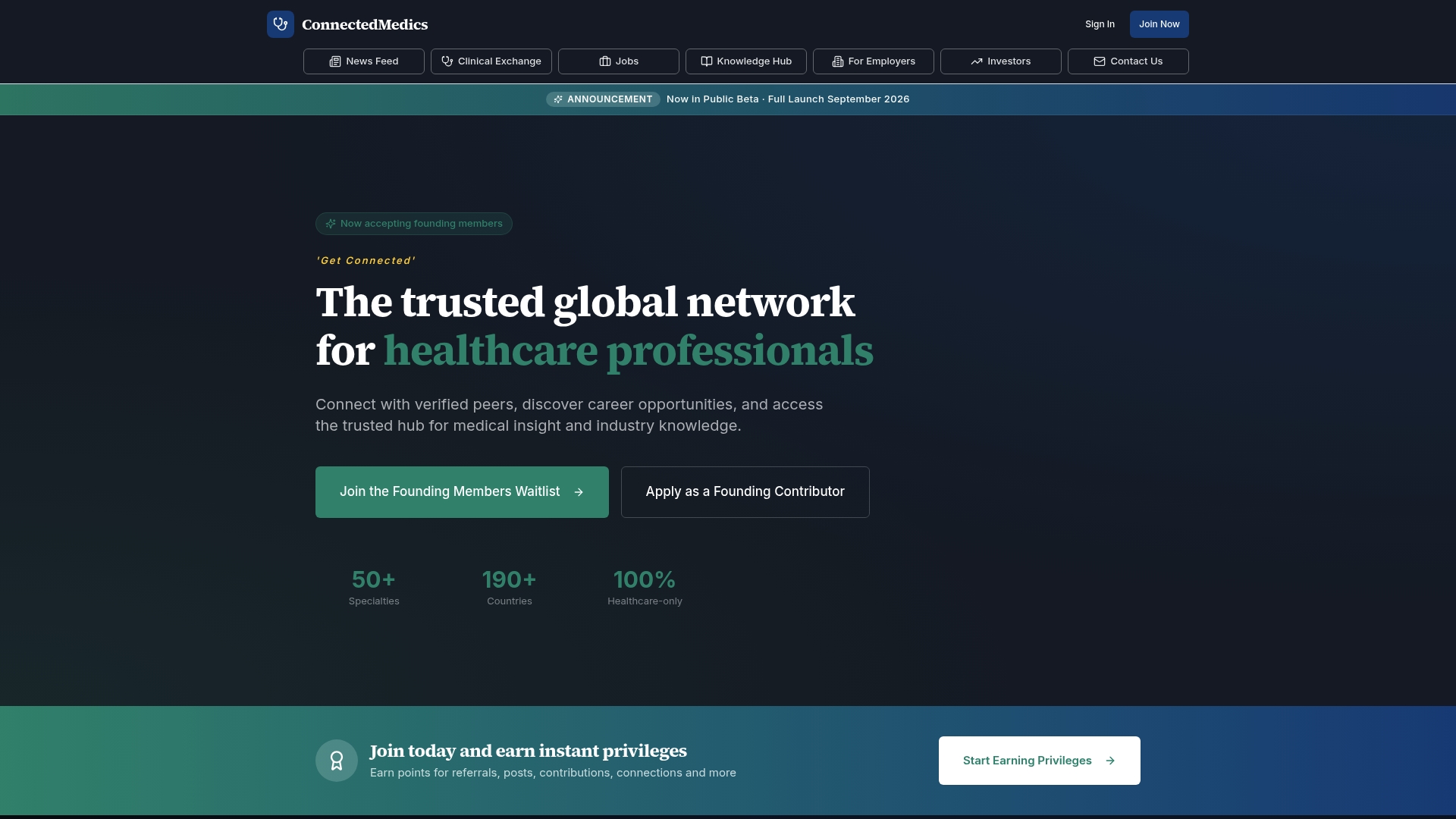
The platform pairs specialty radiology communities with a jobs board covering thousands of healthcare vacancies filtered by subspecialty, so a conversation about a fellowship opening or a locum shift can turn into an application without leaving the platform. Employers get access through Free, Growth, and Enterprise plans, with Growth priced at $99 per month, while individual radiologists browse case discussions, curated research summaries, and job listings as members. Set up a free profile and check the current radiology communities to see whether the fit works for your subspecialty.
Where Else to Look for Reliable Radiology Resources
A handful of established resources are worth bookmarking alongside any forum you join.
- RSNA Communities: society-hosted discussion groups and special-interest groups backed by a recognized professional body.
- ACR Engage: member discussion boards and interest groups with document-sharing built in.
- AAMC's ERAS guidance: authoritative timelines for residency applicants navigating the match alongside forum advice.
- For a broader look at how professional communities support outreach and clinical communication, the diagnostics marketing playbook from 121 Group offers useful context.
Sources
- Home - Radiological Society of North America
- Home - American College of Radiology
- What you need to know about 2027 ERAS application season
- Raddiscord: Covid-19 antidote, resident education and more
FAQ
How Do You Verify a Radiology Forum Is Legitimate?
Check whether the group ties membership to a professional credential, an institutional email, or society backing like RSNA or ACR. A published set of rules and visible moderator activity are additional signs the community takes verification seriously.
Is Reddit Appropriate for Radiology Case Discussion?
Reddit works for general awareness and informal discussion, but moderation and member credentials vary widely by subreddit. For sensitive case discussion or anything touching patient information, a verified, credential-checked community is the safer choice.
How Do You Anonymize Radiology Images Before Posting?
Remove all visible identifiers, including name, medical record number, and accession number, then check the DICOM metadata for hidden patient details. Crop facial features on any 3D reconstruction, and confirm whether your institution requires patient consent before the image leaves the record, even de-identified.
Where Should Residents Go for Residency and Exam Advice?
Trainee-focused threaded boards like Student Doctor Network's radiology forum cover program comparisons and interview experiences, and applicants should cross-reference that with official AAMC ERAS timelines. Society-hosted groups and specialty networks add a verified layer on top of that informal advice.
What Makes Connectedmedics Different From a General Radiology Forum?
Connectedmedics combines verified professional profiles, specialty-focused radiology communities, and a jobs board with thousands of listings in one platform, rather than splitting discussion and career search across separate sites. Current membership pricing and employer plans are listed on the Connectedmedics employers page.