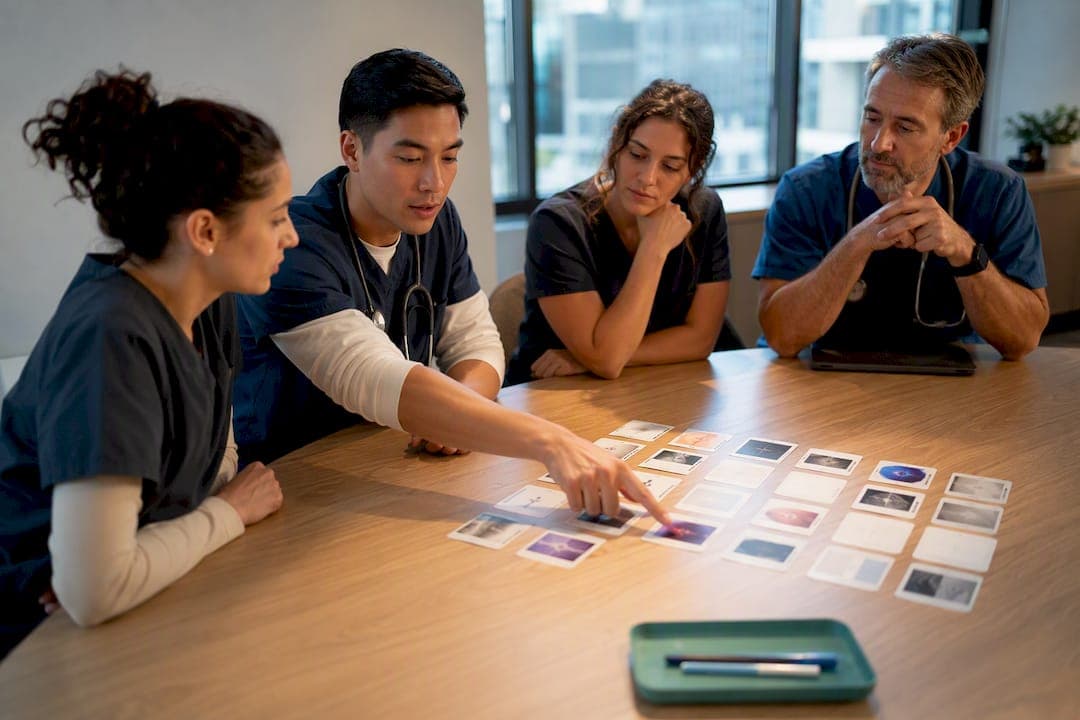
A clinical case discussion (CCD) is a structured, peer-led, clinician-supervised case session that trains diagnostic reasoning through serial disclosure and interactive problem solving. Trainees see a case unfold step by step, forming and revising hypotheses as new data arrives instead of reading a fully resolved chart. Randomized evidence shows live, interactive CCDs improve clinical reasoning performance more than video or paper-based case formats.
TL;DR:
- Live-case discussions produce greater improvements in clinical reasoning than recorded or static paper cases, especially if some discussion occurs in real time.
- Shorter, structured sessions of one to two hours, with moderate-sized groups, optimize participant engagement and reasoning participation.
- Randomized evidence shows that even recorded CCDs outperform non-interactive cases, but live sessions have the strongest benefit.
- Proper facilitation involves limiting dominant speakers, redirecting quieter participants, and pacing information release to maintain serial cueing.
- Building a sustainable CCD program depends on recruiting committed clinicians and presenters through specialty networks and creating cases with diagnostic ambiguity.
Table of Contents
- What Is a Clinical Case Discussion, and How Does It Differ From Other Formats?
- What the Evidence Says About CCD Effectiveness
- How a CCD Session Actually Runs
- A Step-by-Step Guide to Running Your First CCD
- Facilitation Tips and Pitfalls That Sink a Good Case
- How to Measure Whether Your CCDs Are Working
- Choosing Cases That Actually Teach Reasoning
- Why Structured Case Discussion Deserves More Attention
- Organize and Share Clinical Case Discussions With ConnectedMedics
- Sources
- FAQ
What Is a Clinical Case Discussion, and How Does It Differ From Other Formats?
A CCD is not a lecture with a case attached. It is closer to a rehearsal for real diagnostic work, run by peers and checked by a supervising clinician.
Clinicopathological conferences (CPCs) usually present a resolved case to a passive audience, often ending with a pathology answer nobody in the room had to fight for. Problem-based learning (PBL) spreads case work across multiple sessions and a written trigger. A CCD compresses the reasoning work into a single sitting and drip-feeds the clinical story piece by piece, a technique often called serial cueing. Participants commit to a differential diagnosis before the next data point arrives, then defend or abandon that guess out loud.
The pedagogic logic borrows from cognitive apprenticeship: a novice presenter walks the room through their thinking while a more experienced clinician models expert reasoning in real time, and peers challenge each other's logic along the way.
A typical CCD session runs on three moving parts:
- Information release. The presenter discloses history, exam findings, and test results in stages, not all at once.
- Group hypothesis generation. Participants propose and rank differentials after each new piece of information.
- Clinician-guided synthesis. The supervising clinician steers the discussion toward the reasoning gaps, not just the final diagnosis.
Three roles anchor the format: a moderator who paces the disclosure and keeps time, a presenter who owns the case narrative, and a supervising clinician who corrects reasoning errors without hijacking the discussion. Everyone else in the room is expected to argue, not just listen.
What the Evidence Says About CCD Effectiveness
The strongest evidence for CCDs comes from a randomized controlled trial that pitted three formats against each other: live discussion, video recordings of the same discussion, and static paper cases. Live-CCD participants gained more clinical reasoning performance than either comparison group, and the advantage held up on delayed testing weeks later, according to the BMJ Open trial.
The interactivity gap: Video-CCD participants still outperformed the paper-cases group on delayed post-tests, meaning even a recorded, non-interactive version of a CCD beat a static written case. Live interaction produced the largest gains overall.
That finding matters for anyone weighing cost against outcome. A five-year program evaluation of a peer-led CCD model at a European medical school found participant acceptance above 85 percent, meaning more than 8 in 10 students said they would join another session, alongside measurable gains in self-assessed clinical reasoning competence. The program also produced reusable facilitator materials, evidence that a well-run CCD format survives beyond its pilot year.
Two practical conclusions follow from this evidence:
- Live sessions beat recorded ones, but recorded CCDs still beat handing someone a written case and asking them to read it alone.
- A program built for scale can lean on video or hybrid formats without losing all of the interactive benefit, as long as some live discussion survives somewhere in the curriculum.
If you can only run one interactive teaching format this term, the data says put your effort into live, peer-driven case discussion before investing in polished video content or static case libraries.
How a CCD Session Actually Runs
Group size and timing are not incidental details. They determine whether every participant gets to reason out loud or just watches three confident classmates dominate the floor.
The reference model, run at LMU Munich, uses groups of moderate size meeting for approximately one to two hours at regular intervals during the academic term. That size is large enough to generate competing hypotheses but small enough that a moderator can call on quieter participants without the session dragging.
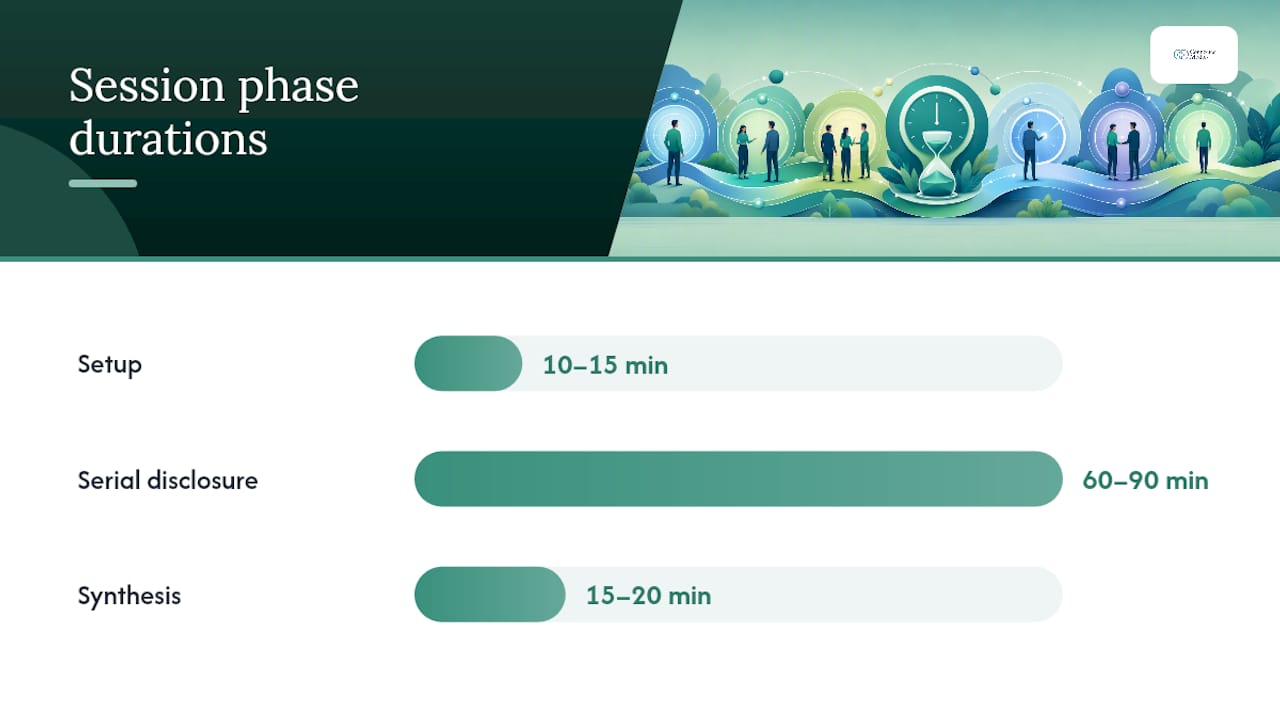
- Setup (10 to 15 minutes). The moderator introduces the format for new participants, states ground rules, and the presenter delivers only the chief complaint and basic demographics.
- Serial disclosure and reasoning (60 to 90 minutes). History, exam findings, labs, and imaging are released in planned stages. After each release, the group generates a ranked differential before the next piece of data appears.
- Synthesis and debrief (15 to 20 minutes). The supervising clinician reveals the final outcome, walks through the reasoning gaps the group missed, and the moderator collects quick feedback.
Role clarity keeps the format from collapsing into a free-for-all. The moderator owns the clock and the disclosure sequence, deciding when to release the next test result even if the room wants it sooner. The presenter has usually prepared the case in advance with a faculty sponsor and needs to know the full clinical course cold, since group questions rarely stay on script. The supervising clinician stays mostly silent during the reasoning phase, intervening only to redirect a stalled discussion or correct a dangerous assumption, then takes over fully for the synthesis.
Rotating these roles across a term, rather than letting the same two or three students run every session, spreads the presentation skill development around and prevents burnout on the moderator role specifically.
A Step-by-Step Guide to Running Your First CCD
Running a CCD for the first time works better as a checklist than an improvisation. Here is a sequence that covers prework, live facilitation, and the follow-up most first-time organizers skip.
Before the session:
- Select a case with genuine diagnostic ambiguity. A case where the first three tests all point the same direction teaches nothing; a case with a red herring or an atypical presentation teaches everyone something.
- Anonymize patient identifiers per your institution's privacy standards and confirm the case is cleared for teaching use.
- Brief the presenter using a structured template covering patient information, clinical course, assessment and plan, and outcome, along the lines of the ASHP case-presentation framework.
- Confirm room setup or, for virtual sessions, test screen-sharing and breakout functionality a day ahead.
During the session:
- Open with chief complaint and demographics only. Resist the urge to front-load history that would let participants skip straight to the answer.
- Use standardized prompts at each disclosure point: "What are your top three differentials now?" and "What one test would you order next, and why?" Practitioner guidance on serial-cueing scripts recommends pre-deciding exactly when each lab or imaging result gets revealed, rather than improvising the reveal order mid-session.
- Reveal results only after the group has committed to a differential out loud. Committing before seeing the answer is the entire point of the exercise.
- Redirect dominant speakers by directly inviting quieter participants: "What's a differential nobody's mentioned yet?"
After the session:
- Run a five-minute debrief asking what reasoning step the group got wrong and why, not just what the final diagnosis was.
- Collect a short evaluation form covering perceived value and self-assessed reasoning improvement.
- Log what worked for next time. A case that fell flat once might need a different disclosure pace, not a different case.
Pro Tip: Start every case at the point of admission and reveal test results serially instead of chronologically explaining the whole workup. Groups reason far better from an unresolved starting point than from a summary that already hints at the answer.
Facilitation Tips and Pitfalls That Sink a Good Case
Getting the format right matters more than picking a dramatic case. Even a strong case falls apart under weak facilitation.
- Prevent one voice from taking over. Direct questions at specific participants by name rather than opening the floor generally, which tends to reward whoever talks fastest.
- Keep it no-blame. When a case involves a missed diagnosis or delayed workup, frame it around systems factors, not individual error, an approach UCSF's quality and safety case-review guidance recommends for candid participation.
- Treat wrong answers as data. A dead-end differential reveals a reasoning gap worth discussing openly, not a mistake to move past quickly.
- Watch the clock on disclosure pacing. The most common logistical failure is releasing too much information at once, which collapses the serial-cueing effect into a standard case report.
How to Measure Whether Your CCDs Are Working
A CCD program is worth running only if you can show it changes how people reason, not just how they feel about the session.
The BMJ Open randomized trial used objective knowledge-application testing before and after sessions, comparing live, video, and paper formats on actual reasoning performance rather than satisfaction alone. That is the gold-standard measure if you have the infrastructure to run pre- and post-tests.
Most programs won't run a full RCT, and that's fine. Two lighter-weight tools cover most of the ground:
- Self-assessment surveys asking participants to rate their own diagnostic confidence before and after a term of CCDs.
- Session evaluation forms capturing case quality, pacing, and moderator effectiveness immediately after each session.
The five-year program evaluation mentioned earlier reported acceptance above 85 percent alongside self-assessed reasoning gains, a combination that suggests learners not only enjoyed the format but felt it changed how they thought. Feed presenter feedback back into your case bank. If a case consistently gets solved too quickly, it needs more ambiguity or an earlier red herring; if nobody reaches the diagnosis, it may be miscalibrated for the group's training level.
Choosing Cases That Actually Teach Reasoning
The best CCD cases share one trait: the early findings point somewhere plausible but wrong. A case with a normal-looking initial workup and a serious underlying diagnosis, like a proximal coronary occlusion missed on first-pass evaluation, forces the group to keep reasoning past a falsely reassuring result instead of anchoring on it.
Adapted NEJM and MGH case records remain a reliable source library, since they are already written with a diagnostic arc in mind. For write-ups, the ASHP presentation template covers the fields you need: patient information, clinical course, assessment and plan, treatment and outcome. Anonymize identifiers, confirm teaching-use clearance, and balance complexity to the group's training level. A case built for residents will lose first-year students in the first ten minutes.
Why Structured Case Discussion Deserves More Attention
Most medical curricula treat case discussion as filler between lectures and rotations, something to run when there's spare time on the schedule. That gets the priority backwards. The randomized evidence on CCDs points to something the lecture format cannot replicate: reasoning trained under uncertainty, in front of peers, with a clinician correcting the process in real time rather than just grading the outcome.
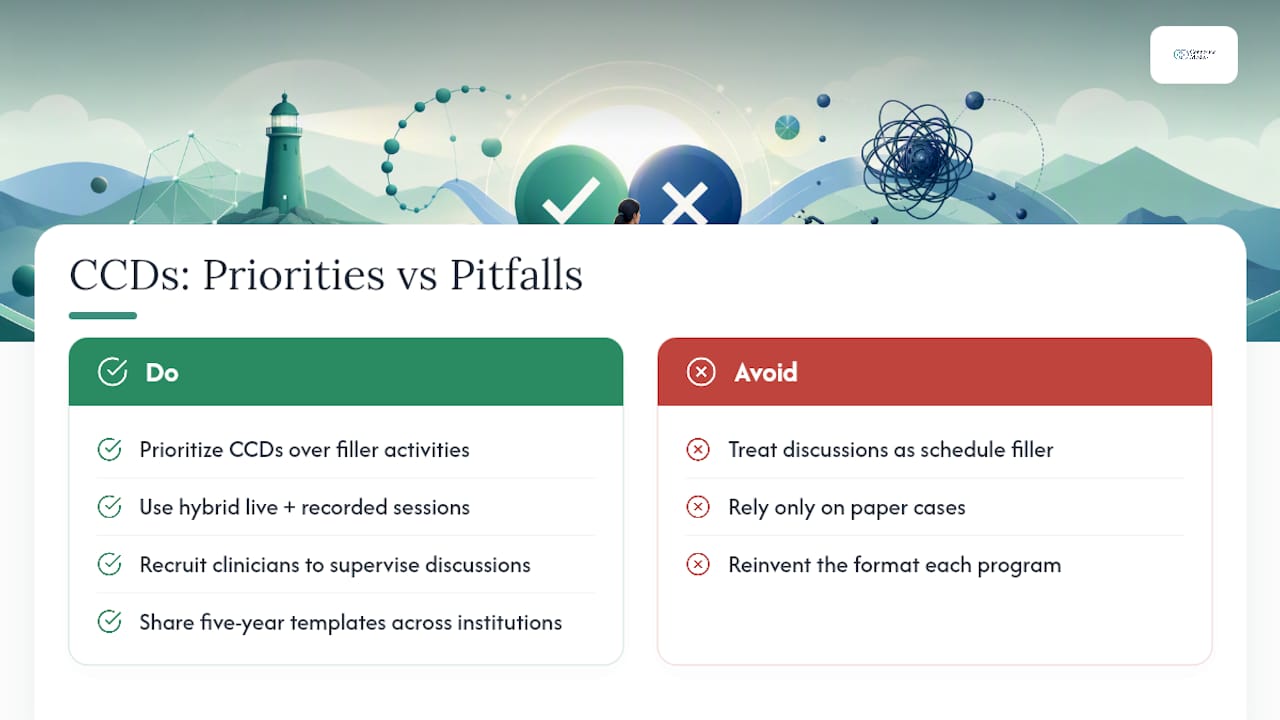
The overlooked nuance is that video-recorded CCDs still beat paper cases, which means programs with limited faculty time don't have to choose between "do it live and well" or "skip it entirely." A hybrid approach, live sessions where feasible and recorded ones to fill gaps, keeps most of the benefit without needing a supervising clinician in the room every single week.
What CCDs need most isn't better cases. It's better distribution, more presenters willing to prepare a case properly, more clinicians willing to supervise instead of lecture, and more institutions treating a program's five-year track record as a template rather than reinventing the format from scratch. That is exactly the kind of peer contribution a specialty-based professional network can support at scale, connecting people willing to run these sessions with people who want to join one.
— David
Organize and Share Clinical Case Discussions With ConnectedMedics
Running a good CCD program takes more than a willing moderator and a strong case. It takes a way to find clinicians willing to supervise, presenters willing to prepare cases, and colleagues in your specialty who actually want to show up.
ConnectedMedics gives you verified specialty peer networks instead of a generic contact list, so you can recruit a supervising clinician or co-presenter who already works in the field your case touches. The knowledge hub carries curated clinical summaries you can adapt into disclosure-stage case content, and features like the clinical decision support coverage on hematological malignancies show the kind of source material that translates well into a serial-cueing script. If you're building a case bank from scratch, the top applications for clinical case studies is a practical starting point for structuring your first few sessions. Create a verified profile, connect with clinicians in your specialty, and start lining up your next CCD facilitator today.
Sources
For readers building a program from the ground up, four sources cover the evidence base and the operational template: the five-year CCD program evaluation includes downloadable working materials for implementation; the BMJ Open randomized trial provides the strongest outcome data comparing live, video, and paper formats; the ASHP case-presentation guide offers a ready-to-use structure for presenter write-ups; and the LMU Munich CCD program page describes a working model at real scale, including group size and session cadence.
This article is general information, not a substitute for advice from a qualified doctor. Consult a qualified healthcare professional about your own circumstances before acting on anything here.
- Clinical Case Discussions – a novel, supervised peer-teaching format to promote clinical reasoning in medical students
- Can clinical case discussions foster clinical reasoning skills in undergraduate medical education? A randomised controlled trial | BMJ Open
- How to Present a Patient Case
FAQ
What is a clinical case discussion?
A clinical case discussion is a structured, peer-led session where a presenter discloses a real patient case in stages while participants generate and revise differential diagnoses, supervised by a clinician who guides the reasoning process.
How long should a CCD session last?
Most CCD programs run sessions of one to two hours with groups of about 15 participants, meeting roughly biweekly during an academic term, based on the LMU Munich model.
Are live case discussions actually more effective than recorded ones?
Yes. A randomized controlled trial found live-CCD participants gained more clinical reasoning performance than video-CCD or paper-case groups, though video still outperformed static paper cases.
What roles do you need to run a CCD?
A CCD needs a moderator to pace the disclosure and manage time, a presenter who owns the case narrative, and a supervising clinician who corrects reasoning gaps during the synthesis phase.
Where can I find a clinician to supervise a CCD in my specialty?
Specialty-based professional networks like ConnectedMedics connect verified clinicians across specialties, making it easier to recruit a qualified supervisor or co-presenter for your session.