
What are clinical practice guidelines and why do they matter?
Clinical practice guidelines (CPGs) are statements that include recommendations intended to optimize patient care, informed by a systematic review of evidence and an assessment of the benefits and harms of alternative care options. That definition comes from the National Academy of Medicine (formerly the Institute of Medicine), which updated the original IOM framing to better reflect current standards for trustworthy guideline development.
CPGs are not written by individual clinicians. They are developed and endorsed by professional bodies following multi-year, evidence-grounded processes.
Key facts about clinical practice guidelines:
- Purpose: Assist clinician and patient decisions about appropriate care for specific clinical circumstances.
- Evidence base: Combine systematic evidence review with value judgments about benefits and harms.
- Scope: Address patient cohorts, reduce practice variation, and support consistent care quality.
- Key US bodies: National Academy of Medicine (NAM), American Academy of Family Physicians (AAFP), United States Preventive Services Task Force (USPSTF), and the VA/Department of Defense (VA/DoD).
- Grading: The GRADE system rates both the strength of recommendations and the quality of underlying evidence.
- Distinction: CPGs differ from clinical research protocols, which govern study conduct rather than routine care decisions.
Understanding this distinction matters for both clinical and administrative contexts, where the two are frequently confused.
How clinical guidelines are developed and assessed for quality
Guidelines are built through a structured, multi-step process. No single expert authors them. Instead, professional organizations convene multidisciplinary panels, commission systematic reviews, and apply explicit grading criteria before issuing recommendations.
The core development stages include:
- Topic selection: Prioritized by clinical need, evidence gaps, or public health burden.
- Systematic evidence review: Comprehensive literature search, study appraisal, and synthesis.
- Expert panel consensus: Multidisciplinary group deliberates on evidence and formulates recommendations.
- Conflict-of-interest management: Transparent disclosure and exclusion policies protect recommendation integrity.
- External stakeholder review: Public and professional comment periods before finalization.
- Grading with GRADE: The GRADE system rates recommendation strength as strong or weak and evidence quality from high to very low.
- Publication and dissemination: Final guideline released with full methodology documentation.
Quality problems are well documented. Variable evidence quality, lack of transparency, and failure to include multidisciplinary stakeholders all undermine trustworthiness. Guidelines produced within a structured environment, using a defined "Guidelines for Guidelines" framework, consistently show higher quality than those developed ad hoc.
The National Academy of Medicine's eight standards for trustworthy CPGs address these gaps directly, covering everything from conflict-of-interest exclusions to ongoing literature surveillance after publication.

Pro Tip: Always check the "last updated" date on any guideline before applying it. Organizations like the American College of Physicians actively manage active and inactive guideline statements to prevent reliance on outdated recommendations.
A structured content review workflow at the institutional level can help clinical teams track which guidelines are current and flag those due for reassessment.
Which US organizations shape clinical guideline development?
Several bodies drive the creation and endorsement of clinical practice recommendations in the United States. Each plays a distinct role.
- National Academy of Medicine (NAM/IOM): Sets the authoritative definition of CPGs and publishes standards for trustworthy guideline development. Its 2011 report remains the foundational reference for quality criteria.
- American Academy of Family Physicians (AAFP): Develops and endorses guidelines across primary care, with particular focus on preventive care and chronic disease management. AAFP also partners with the USPSTF to disseminate preventive service recommendations to family physicians.
- United States Preventive Services Task Force (USPSTF): An independent panel of 16 national experts in prevention and evidence-based medicine, created in 1984. The USPSTF issues evidence-based recommendations on clinical preventive services including screenings, counseling, and preventive medications.
- VA/Department of Defense (VA/DoD): A collaborative guideline program active since the early 1990s. In 2010, the Institute of Medicine recognized VA/DoD as a leader in CPG development. Current VA/DoD guidelines cover tobacco use treatment (2026), lipid management (2025), asthma (2025), obesity (2025), and chronic kidney disease management, among others.
- Agency for Healthcare Research and Quality (AHRQ): Historically hosted the National Guideline Clearinghouse, which accepted 722 guidelines in 2008 alone before federal funding ended in 2018. AHRQ continues to support evidence-based research underlying guideline development.
These organizations do not operate in isolation. Overlapping partnerships, shared systematic review resources, and cross-endorsement agreements mean that a recommendation from one body often carries weight across multiple clinical communities.
How to apply clinical guidelines effectively in practice
Guidelines provide a framework, not a script. The VA/DoD program states this directly: guidelines are recommendations within the context of a provider's clinical judgment, not mandates that override individual patient circumstances.
Applying guidelines well requires several practical habits:
- Treat strong recommendations grounded in moderate to high-quality evidence as the default starting point for care decisions and quality improvement initiatives.
- Adjust for patient-specific factors. Patients with multiple comorbidities or rare conditions are often underrepresented in the original trials that generated guideline recommendations.
- Integrate patient values and preferences. Shared decision-making is not optional; it is built into the CPG framework.
- Use the GRADE rating to calibrate flexibility. A strong recommendation based on high-quality evidence warrants close adherence. A weak recommendation based on low-quality evidence signals that clinical context should carry more weight.
- Consult the "last updated" date before applying any guideline to a patient encounter.
Pro Tip: Ambiguous guideline language is a real clinical hazard. When a recommendation uses terms like "consider" or "may be appropriate," that phrasing reflects genuine uncertainty in the evidence, not editorial hedging. Treat it as a signal to weigh individual patient factors more heavily.
Clinical performance measures derived from guidelines are also used in quality improvement programs, so understanding which recommendations carry strong evidence grades directly affects how your practice is evaluated.
Expert perspectives on guidelines as a floor, not a ceiling
Guidelines represent the minimum standard of quality care, not the upper limit of clinical discretion. That framing, consistent with VA/DoD guidance, reframes how clinicians should relate to CPGs: they establish a defensible baseline, while the art of medicine operates above it.
The GRADE system is central to this. By transparently labeling recommendation strength and evidence quality, GRADE allows clinicians to understand precisely when strict adherence is warranted and when clinical context justifies a different approach. A strong recommendation backed by high-quality evidence leaves little room for deviation. A weak recommendation backed by very low-quality evidence is essentially an informed starting point.
Evidence surveillance is an ongoing challenge. The number of randomized controlled trials published in MEDLINE grew from roughly 5,000 per year in the late 1970s to approximately 25,000 per year by the early 2000s, and that pace has continued. No individual clinician can track this volume. CPGs exist precisely to translate that expanding body of research into usable recommendations, but only when the guidelines themselves are current.
Gaps in evidence for special populations remain a persistent problem. Patients with comorbidities, socioeconomically disadvantaged groups, and those with rare conditions are consistently underrepresented in the trials that underpin most guidelines. Clinicians working with these populations should treat guideline recommendations as a starting point and apply additional clinical judgment, not assume the evidence base covers their patient's situation.
Staying current with medical research updates is one practical way to bridge the gap between published guidelines and the latest evidence.
How clinical guidelines affect patient outcomes and healthcare quality
Well-developed guidelines, when applied consistently, reduce inappropriate variation in care. The VA/DoD program describes this as one of its primary goals: systematizing best practices to deliver consistent quality across a large, geographically dispersed health system.
Guidelines also serve as cornerstones for accountability. They facilitate learning, support research design, and provide the evidence base for quality measures used in performance evaluation. When a clinical team consistently follows strong, evidence-grounded recommendations, the downstream effect on patient outcomes is measurable, even if the mechanism is indirect.
Current examples illustrate the range. Guidelines now address cardiovascular-kidney-metabolic risk staging, colorectal cancer screening protocols, and cannabis use for chronic noncancer pain. Each represents a clinical area where synthesized evidence reduces uncertainty and supports more consistent decision-making. New infectious disease guidance, such as updated tuberculosis testing guidelines from the WHO, shows how rapidly the guideline landscape shifts as new evidence emerges.
The gap between guideline quality and its potential remains real. As the National Academy of Medicine has noted, CPG development has not yet fully met its promise of translating research complexity into reliably better outcomes. Closing that gap depends on both better development processes and more consistent clinical application.
Ethical considerations in guideline development and application
Conflict of interest is the most documented ethical risk in guideline development. When panel members have financial ties to manufacturers of treatments under review, recommendation integrity is compromised. The NAM standards address this directly, requiring transparent disclosure, defined exclusion criteria, and documented management of any remaining conflicts.
Equity is a second ethical dimension. Guidelines built on evidence from narrow trial populations may not apply fairly to all patients. Applying a recommendation developed primarily in one demographic group to a patient from an underrepresented population raises both clinical and ethical questions. Guideline developers are increasingly required to address evidence gaps for subpopulations explicitly, rather than leaving clinicians to infer applicability.
Informed consent intersects with guidelines in shared decision-making contexts. When a guideline recommends a screening or intervention, patients retain the right to decline, and clinicians have an obligation to present the evidence, including its limitations, honestly. The evidence-based medicine framework that underlies CPGs is built on this transparency. Clinicians who apply guidelines without explaining the underlying evidence to patients are using the tool correctly in one sense and incorrectly in another.
Guideline adherence in quality measurement also raises ethical questions. When performance metrics are tied to guideline compliance, clinicians face pressure to follow recommendations even when individual patient circumstances argue for a different approach. Recognizing that guidelines are recommendations, not mandates, is both a clinical and an ethical position. Reviewing SOP compliance frameworks alongside CPGs helps teams distinguish between mandatory protocols and flexible clinical recommendations.
Connectedmedics: clinical knowledge for healthcare professionals
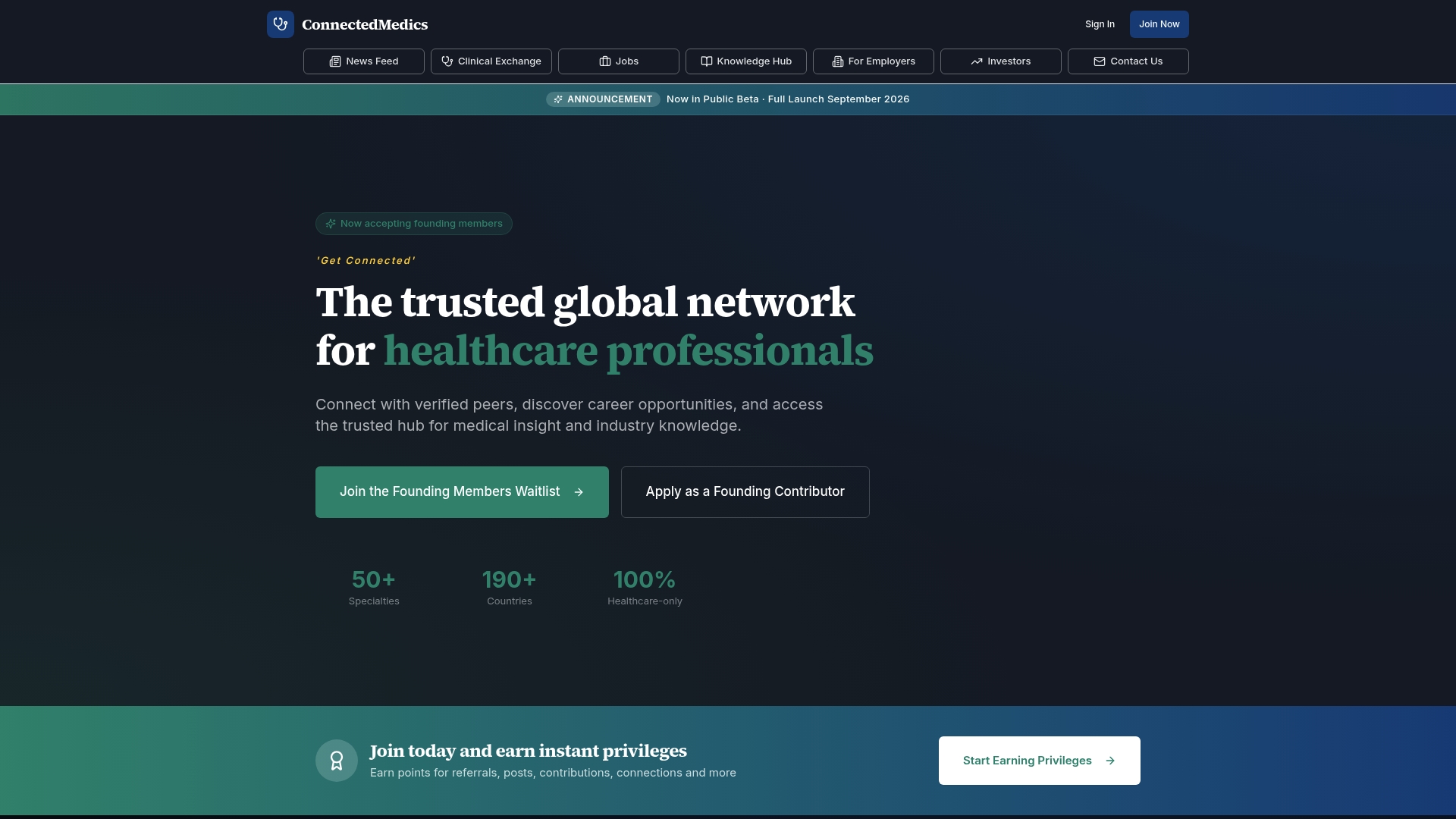
Connectedmedics is a professional network built exclusively for healthcare professionals, with a knowledge hub that aggregates clinical insights, guideline summaries, and research updates contributed by verified medical experts. For clinicians who need a reliable, specialty-relevant source of evidence-based guidance, the platform offers direct access to current clinical content without the noise of generic professional networks.
The platform hosts over 4,600 active healthcare vacancies alongside its clinical knowledge resources, making it a practical tool for professionals managing both career development and ongoing education. Whether you are tracking new guideline releases, reviewing specialty-specific recommendations, or connecting with peers in your field, Connectedmedics provides a verified, focused environment for that work.
Visit Connectedmedics to access the knowledge hub and connect with the healthcare professional community.
Key Takeaways
Clinical practice guidelines are systematically developed, evidence-based recommendations that reduce care variation and support better patient outcomes when applied with clinical judgment.
| Point | Details |
|---|---|
| NAM definition is the standard | CPGs are statements informed by systematic evidence review and assessment of benefits and harms of care options. |
| GRADE guides application | The GRADE system rates recommendation strength and evidence quality, signaling when to follow strictly or apply flexibility. |
| Evidence volume is growing | MEDLINE randomized controlled trial publications have grown substantially since the late 1970s, increasing the volume of available evidence clinicians must consider. |
| Guidelines are a floor, not a ceiling | VA/DoD guidance frames CPGs as recommendations within clinical judgment, not mandates overriding individual patient circumstances. |
| Connectedmedics supports guideline access | The platform provides verified clinical knowledge resources and guideline summaries for healthcare professionals. |